Plant science · 12 min read
Your plant's Digital Shadow — how continuous simulation beats a watering timer
Watering reminder apps set a calendar. Your plant doesn't live by one. Here's how a per-specimen Digital Shadow tracks virtual soil moisture in real time — and why that changes everything about how you care for houseplants.
Botanical Legacy · Field notes ·
Most houseplants are killed not by neglect, but by too much water, often given on a calendar's say-so.
The calendar trap most watering apps can't escape
Every plant care app starts the same way. You add your Monstera. The app asks how big the pot is, what kind of soil, roughly how much light. Then it builds a watering schedule: water every nine days.
Nine days passes. You get a notification. You water.
This works — until it doesn't. The week your Monstera sits in a south-facing window during a July heat wave, nine-day intervals are a drought. The week it gets indirect light in December, nine-day intervals are drowning. The app doesn't know the difference. The notification fires regardless.
If you're new to all this, it's worth knowing up front that watering by a fixed schedule is one of the most common mistakes that catch every beginner — and the rest of this guide is about the model built to replace it.
How reminder-based apps work
Most of the popular plant care apps use a simple recipe: at setup, they pick a base watering frequency from a lookup table for your plant and pot. Some refine it with the season or a rough weather signal. The most thoughtful ones nudge the interval by a few days based on your climate.
What they all share: the schedule is the product. The notification fires because the calendar says so, not because anyone checked what's happening in the soil. (This is the ceiling we walk through in more depth in our Greg app alternative comparison — Greg is the most polished reminder-class app on the market, and it still can't escape this constraint.)
Why fixed intervals fail
Soil moisture doesn't behave like a calendar. It responds to the conditions in your room:
- Temperature. Warmer air pulls water out of the soil faster. A warm week and a cool one can leave the same pot drying at noticeably different rates.
- Humidity. Dry winter air, especially with the heating running, makes a plant lose water through its leaves faster, so the pot can dry sooner than the season suggests.
- Light. A plant in bright light is photosynthesising harder and drinking more. Move that same plant two metres further from the window and it's effectively a different plant.
- Root health. A plant recovering from root rot can't take up water as well as a healthy one. Watering on the same schedule means more of that water sits in the soil unused, which can make the rot worse.
A fixed-interval app can't see any of this. It doesn't know about the heat wave. It doesn't know the pot moved. It doesn't know the roots are struggling.
What a Digital Shadow is (and why it's not just a fancier reminder)
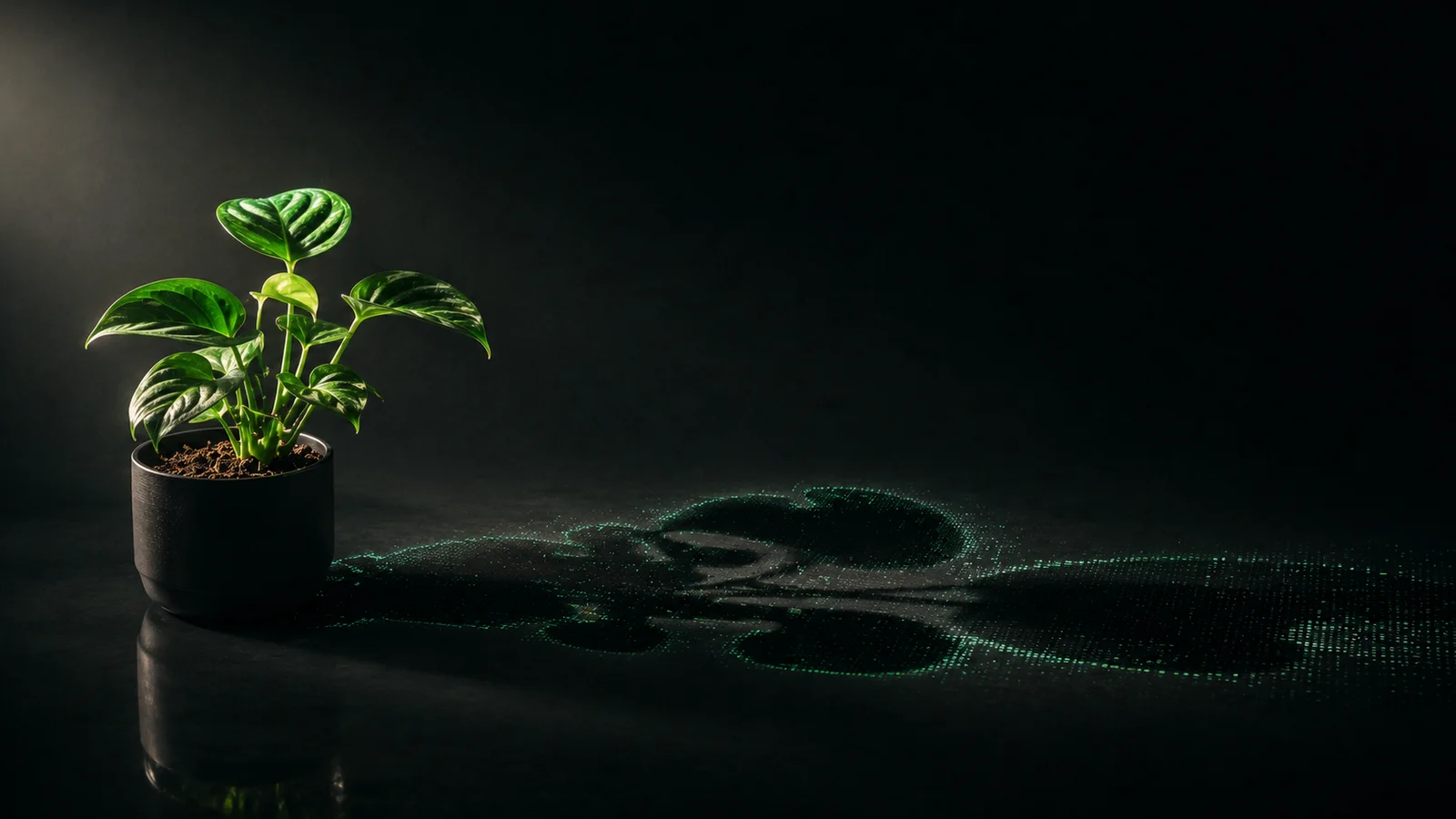
A Digital Shadow is a continuously running model of your plant — one for each plant in your collection. Instead of asking when did you last water?, it keeps a live estimate of what's happening inside the pot right now: roughly how much moisture is left, how fast it's drying, and when it's likely to need a drink.
Every night, automatically, the model updates for every plant on your account. It looks at how much time has passed, what the conditions have been like, and what we've learned about that specific plant from your past photos and care actions.
This is the difference: a watering reminder asks when is the next Tuesday? A Digital Shadow asks how much moisture is left in the soil right now?
A running estimate, refined over time
Behind the scenes, we keep a running estimate of how much moisture is left in your pot, and how fast it's drying. When you water, the estimate resets. From there, it draws down day by day based on the conditions the model knows about.
When the estimate crosses the threshold for your specific plant — not an arbitrary calendar date — we let you know it's time to water.
The practical result: in January, your Monstera might go nearly two weeks between waterings without anyone flagging a problem, because the model sees low light and cool temperatures and knows the soil isn't drying quickly. In July, it might flag at day six, because the same plant in the same pot is using water more than twice as fast.
No setting change required. No manual interval adjustment. The model does this on its own.
What industrial horticulture already knows
Greenhouse horticulture has been moving towards simulation-based plant monitoring for years. Researchers at Wageningen University in the Netherlands couple greenhouse sensor data with detailed plant models to forecast how the crop will develop and to inform climate-control decisions before growers make them.
The principle is consistent across all of these: you can't manage a living system well from a schedule alone. You need a model that reflects what's happening.
That principle doesn't stop at the greenhouse door.
The research connection. The same kind of soil-moisture logic that underpins precision irrigation in commercial growing is what powers the Digital Shadow. The physics don't change because the pot is sitting in your living room.
See tomorrow before it happens — the live what-if simulator
A nightly model tells you what your plant needs. The live simulator lets you ask what would happen. Open any Specimen and toggle a care action — water, mist, feed, or move it to a brighter spot — and the Digital Shadow re-projects every panel in real time: moisture, vitality, and the next-care date, recalculated on the spot from that plant's own telemetry.
It runs on the device, with no network round-trip, because it's the same vitality model that runs the nightly Shadow — not a separate demo. Skip a watering in the simulator and watch the projected moisture curve fall; add a feed and watch the vitality track change. It's the difference between a forecast you read and a forecast you can interrogate.
A live simulation trained on this specimen's own telemetry. Toggle what you'd do — the shadow re-projects every panel below.
How it learns from your plant
A fixed schedule gets more wrong over time as the plant changes. A Digital Shadow gets more accurate.
Every time you take a check-in photo through the app, Botanical Vision v5 looks at it for health signs and basic growth measurements: how tall the plant is, roughly how many leaves it has, and any visible signs of being over- or under-watered. That feeds back into the model. If a photo shows stress, the plant's health score drops, and the growth measurements build the plant's growth record. Stress does not bring watering forward: a stressed plant is often overwatered rather than dry, so the schedule keeps its pace.
This learning loop is what separates a model that adapts from one that just runs.
What the photo tells us
Botanical Vision v5 reads two simple growth signals from each check-in photo:
- Height — a useful proxy for how much root and canopy the plant has, and therefore how much water it can use.
- Leaf count — for rosette-style plants like succulents, individual leaves are counted; for grasses, mosses, and trailing vines where counting doesn't make sense, we fall back to overall canopy density.
When these numbers change, when your plant puts on two new leaves between March and May, the shadow records it: they build the Specimen's growth curves, which you can export from your account. They do not change the watering model, which takes its pace from the species, the pot, the soil and the conditions.
Local weather, not a generic climate zone
If you're on a paid plan with the local weather feature turned on, the model pulls real temperature and humidity data for your location and folds it into the nightly update: directly for a plant that lives outdoors, and as an estimate of indoor conditions for one inside, until a room sensor replaces the estimate with a measurement.
This is why two identical plants in different cities, or even different rooms of the same house, can end up on different watering rhythms. Not because anyone configured them differently, but because the model reflects different environments.
Growth Bias - what you're cultivating for
A reading is one half of the picture. What you want for the plant is the other.
Botanical Legacy records a cultivation intent for your Sanctuary, its Growth Bias: Vigor (new growth), Bloom (flowers), or Equilibrium (steady maintenance, the default). Today it shapes one thing: the care notes and feeding advice written when a new plant is identified lean towards growth or flowering when the bias asks for it, and fall back to steady care for a plant that is stressed or dormant. It does not change the watering model, and there is not yet a setting in the app to change the bias or to set it per Specimen.
Bringing in real sensor readings
A modelled estimate is good. A real reading is better.
Today, if you already use Home Assistant to manage smart-home devices, you can connect any soil moisture, temperature, or humidity sensors it sees on the paid plan, and we'll fold those real readings into your plant's shadow instead of relying purely on the estimate. That includes most consumer soil probes, room sensors, and DIY builds that already work with Home Assistant.
If you don't use Home Assistant, the Digital Shadow still runs — it just leans more on the modelled estimate. Direct integrations for popular standalone sensors are on the roadmap.
The estimate keeps running in the background either way (sensors run out of battery, go offline, or aren't in every pot), but a real reading anchors the model whenever one is available.
What this looks like in practice
These are illustrative — every plant and home is different — but they show how the model behaves.
Scenario 1: A hot week vs a cold week — the same Monstera
Your Monstera sits in an east-facing window. In the first week of July, your apartment hits 28°C and you run the fan. With a room sensor, or local weather on the paid plan, feeding it the heat, the model flags the plant for watering on roughly day seven.
The following week brings cloudy skies and 19°C. Same plant, same pot. The model flags around day fourteen.
A fixed nine-day interval would have watered too late in the hot week and too early in the cool one. The Digital Shadow is closer to the right answer both times. (This per-specimen way of thinking — this plant, this pot, this week — is exactly what our Monstera care guide applies section by section to a single species.)
Scenario 2: Recovering from root rot
Your Ficus was overwatered for six weeks before you caught it. The check-in photo shows browning leaves, fewer of them than last month, and a "declining" trend. The model assumes the roots can't take up as much water as before, so the soil should be allowed to dry more thoroughly between waterings.
The interval extends automatically. We also flag a note in your daily summary that this plant is in recovery, not maintenance — because how you think about it should change too. The inverse case — a fragile new specimen with roots still forming — sits in the same regime: see propagating a cutting for why a freshly rooted cutting follows the recovering-plant watering curve rather than its species' usual one.
Scenario 3: Winter slowdown
December arrives. Your heating kicks in, but your plants are in low light and have slowed down for the season. The model — which sees the temperature, the shorter daylight, and the slower growth signs from your November photo — eases off the watering rhythm for every plant it touches.
You don't change a setting. You don't manually extend intervals. The shadow accounts for winter on its own.
Your Sanctuary Brief, every morning
Once the shadows are running, you stop reading them one pot at a time. Every morning the Sanctuary Brief drafts a two-to-four-sentence narrative — what shifted overnight, what's worth your attention today, what's quietly thriving. The tone tracks the state of your collection: calm when everything is steady, alert when a Specimen has crossed a threshold, opportunity when a Specimen is on the cusp of something good. It's the running record turned into a sentence you can read in five seconds with coffee.
Frequently asked questions about digital twin plant monitoring
Is a Digital Shadow the same as a digital twin?
"Digital twin" is the established term for a continuously updated virtual model of a real-world thing, used in greenhouse horticulture, manufacturing, and energy. A Digital Shadow is our take on that idea for individual houseplants: a per-plant simulation that tracks moisture, health, and growth in real time. Same underlying principle; the scale is your living room.
What sensors are compatible?
Today, anything you've already connected to Home Assistant — soil moisture probes, temperature sensors, humidity sensors — flows into your plant's Digital Shadow once you link your Home Assistant account. That covers a wide range of consumer and DIY hardware. Native integrations for popular standalone sensors (no Home Assistant required) are on the roadmap.
How accurate is the moisture estimate without a sensor?
Accuracy depends on how much the model has learned about your plant. The image-analysis pipeline behind every check-in photo — what we call Botanical Vision v5 — extracts growth measurements, visible health signs, and lighting context for each Specimen. A brand-new plant uses a sensible baseline for its species, adjusted for its pot, soil and light. Waterings you keep postponing tell the model the plant dries more slowly than predicted, but without a sensor the estimate stays a model of your plant rather than a measurement of it. Adding a real sensor takes the guesswork out entirely.
Can I use this for outdoor plants?
Yes, though outdoor plants bring more variability — rain, full sun, sudden weather changes — that the model has to estimate rather than measure directly. Turning on the local weather feature on the paid plan helps, since it factors in real temperature and humidity for your location, and can count a heavy rain as a watering if you opt in. A real soil sensor is especially useful for outdoor plants, where conditions shift faster than indoors.
Try it yourself — free for five plants
Botanical Legacy's free Observer plan covers up to five plants. Every new account also includes a 14-day trial of Cultivator, our paid plan, which adds the Shadow's forward projection and what-if simulator, the local weather feature, and sensor integrations via Home Assistant.
If you want to see what a plant's shadow looks like before signing up, the platform preview walks you through the experience without an account.
Your calendar is a fine tool for meetings. Your plant deserves something better.
Start your collection — free, no payment required →
Botanical Legacy, July 2026. The Digital Shadow refreshes nightly for every plant on the platform, and on the paid plan it re-projects live the moment you ask a what-if. Try the platform preview to see it in action.
Sources
The plant-care facts on this page were checked against these references.
- Clemson HGIC: hgic.clemson.edu/factsheet/indoor-plants-watering
- Illinois Extension: extension.illinois.edu/houseplants/watering
- USGS: usgs.gov/special-topics/water-science-school/science/evapotrans…
- NC State Extension: content.ces.ncsu.edu/extension-gardener-handbook/18-plants-grow…
- Univ. Nebraska PASSEL: passel2.unl.edu/view/lesson/c242ac4fbaaf/6
- Clemson HGIC: hgic.clemson.edu/factsheet/houseplant-diseases-disorders
- WUR: research.wur.nl/en/projects/fs03-digital-twin-greenhouse-crop-k…
- WUR review: research.wur.nl/en/publications/digital-twins-in-greenhouse-hor…
- CSU Extension: extension.colostate.edu/resource/irrigation-scheduling-the-wate…
- UMD Extension: extension.umd.edu/resource/leaf-yellowing-problems-flowers
- UMD Extension: extension.umd.edu/resource/lighting-indoor-plants
- USU Extension: extension.usu.edu/planthealth/ipm/ornamental-pest-guide/abiotic…
- MBG: plantfinder.mobot.org/PlantFinderDetails.aspx