Plant science · 13 min read
How to propagate plants — cuttings, division, and leaf prop without the guesswork
Propagation isn't a calendar trick — it's a care protocol for a fragile new specimen. Here's how to choose the right method, prepare the substrate, and track a cutting's health like any other plant in your sanctuary.
Botanical Legacy · Field notes ·
Most propagation failures aren't bad cuttings — they're cuttings on the wrong schedule.
Why propagation is harder than the YouTube tutorials suggest
Cut a Pothos vine below a node. Drop it in a jar of water. Wait. Three weeks later you have roots, plant it in soil, send a photo to your group chat. The whole exercise looks like a five-minute trick.
The five-minute trick is real. The ten weeks around it are where most cuttings die.
The reason is almost never the cut itself. It's everything that happens after — the substrate stays too wet, or dries out invisibly, or the cutting sits in light that scorches a stressed leaf, or the parent's watering rhythm gets applied to a rootless stem that needs far more attention. The mechanics of propagation are simple. The care protocol for a fragile new specimen is the part nobody teaches.
This guide walks through the three propagation methods that cover almost every houseplant you're likely to own, what each one needs, and — honestly — how to keep a propagation alive once the photogenic part is over.
Choose the method before you cut
Three methods cover the vast majority of houseplants. The right one depends on the plant's anatomy, not on personal preference. Choose the method first; then make the cut.
Stem cuttings
Best for: most aroids (Pothos, Philodendron, Monstera, Syngonium), Hoyas, Tradescantia, Coleus, many succulents, herbs like basil and mint.
A stem cutting is a length of stem with at least one node — the small joint on the stem from which leaves and roots emerge. Two nodes is more reliable: bury or submerge the lower node, leave the upper one above the substrate with a leaf or two attached. A stem with no node cannot grow a new shoot, no matter how long you wait. That is exactly why a Monstera leaf alone never becomes a plant; only a stem segment carrying a node does (the Monstera care guide covers that node rule in full).
Use a sterilised blade and make a clean cut just below a node. Strip leaves from the lower half so nothing rots underwater or under soil.
Then choose between water and substrate:
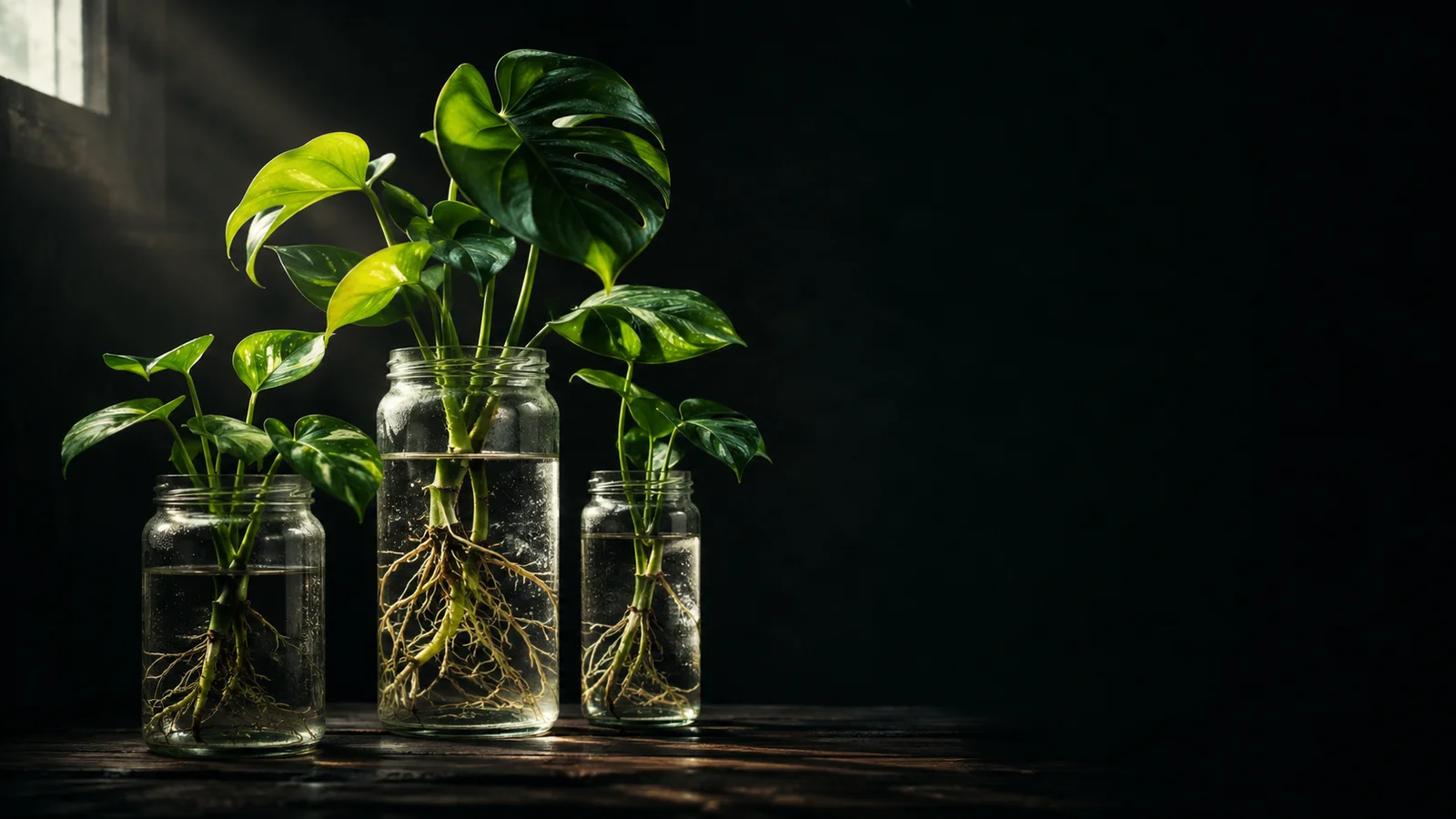
- Water propagation is forgiving and visible. You can see roots forming, change the water if it clouds, and time the soil transition precisely. The trade-off: the cutting has a second move to make, from water into compost, once its roots have grown.
- Substrate propagation in a perlite-and-peat mix or pure perlite roots the cutting in the medium it will grow on in, with no second move. The trade-off: you can't see what's happening. A cutting can rot quietly before a yellowing leaf gives it away.
There's no winner. The right answer depends on whether you'd rather have visibility or skip the second move.
Root division
Best for: Ferns, Calatheas, Marantas, ZZ plants, Snake plants, Peace lilies, Spider plants, most clumping or rhizomatous species.
Division is for plants that grow as a colony of related shoots sharing a root mass, often joined by rhizomes (creeping underground stems). You unpot the parent, gently tease the root ball apart, and end up with two or more independent plants.
The rule: each division needs at least one healthy growth point (a shoot, frond, or "pup"), ideally several, and a fair share of the root mass. A division with two leaves and a thread of root is a cutting with extra steps; it has no buffer for the recovery period.
Time it for spring, when the parent is entering its active growth phase. A division done in late autumn has little light to recover in and may make no new growth until spring.
After the cut, treat each division as a recovering specimen, not a fully grown one. Keep it out of direct sun, keep it warm, humid and evenly moist until growth resumes, and resist the urge to fertilise for about four weeks.
Leaf propagation
Best for: Echeveria and most Crassulaceae succulents, Sedum, Begonia rex, African violets, some Sansevieria.
A single leaf, gently twisted from the parent, can generate a new plant. The leaf functions as a battery — it has no roots and no growth point, so it sits on or just above the substrate while the cells at its base differentiate into both. The first sign of success is a tiny rootlet at the leaf base, followed later by a miniature rosette.
Honest scope: leaf propagation does not work for Monstera, Pothos or most aroids. A leaf cutting carries no axillary bud, so it only works for plants whose leaf tissue can form new buds of its own, and these plants can't. A Monstera leaf in water can live for months and never produce a new shoot. This is one of the most common mistakes for new propagators; it's not a technique problem, it's an anatomy problem.
For the species that do propagate from leaves: lay succulent leaves on top of barely-moist, gritty substrate; set African violet leaves in by their stalk, and snake plant leaf sections upright, cut end down. Give them bright indirect light, keep humidity up for the non-succulents with a clear cover, and expect it to take longer than a stem cutting.
The substrate-and-environment protocol
Once the cut is made, four numbers govern survival.
- Substrate. A sterile, well-draining propagation mix — typically equal parts perlite and peat, or pure perlite for very rot-prone species. Never use garden soil or used potting mix; both carry pathogens that overwhelm a stem with no immune buffer. For water propagation, use rainwater or tap water left to stand for a day so the chlorine can dissipate.
- Light. Bright, indirect. The kind of light that's bright enough to read by but doesn't cast a hard shadow. Direct sun will scorch a leaf that has no roots to replace lost moisture, and a cutting in low light will stall — there's not enough energy to push new tissue.
- Temperature. Steady warmth suits most tropical cuttings, which is why propagators are built to run slightly warmer than the room. A cold windowsill slows rooting, and in heat the leaf loses water faster than a rootless stem can replace it.
- Humidity. High, around 70–80%, during the rooting phase, reduced gradually to room humidity once roots are established. A clear plastic bag loosely tented over the cutting, or a covered propagation tray, keeps humidity high without active equipment. Keep the plastic off the leaves and let fresh air in regularly, since still, humid air favours grey mould.
These aren't recommendations from a marketing page. They're the conditions commercial propagators use because they produce predictable rooting; the same physics applies to a yogurt pot on your kitchen counter.
A propagation leans into water and light
A rooting cutting has no canopy to protect and no flowering to coax. Its job is to grow roots, and that takes compost kept moist until it has rooted and good light out of direct, scorching sun. Botanical Legacy records a new propagation's growth goal as Vigor, but today that label does not change the model's watering rhythm: a cutting starts from its parent's species schedule. Treat the app's reminder as a floor, and check a cutting in a small jar or a shallow tray by hand until it has rooted.
The first ten weeks — what changes about care
This is the part most plant care apps get wrong, and the reason the failure rate stays high even when people follow the cutting instructions perfectly.
A cutting is not a smaller version of the parent plant. It's a different plant in three important ways:
- No root buffer. A mature Monstera in a 25cm pot has litres of moist substrate to draw from. A cutting in a small pot of perlite has a small fraction of that. A skipped check can be terminal in a way that's never true for the parent.
- Faster dry-out, smaller margin. A small propagation pot dries far faster than the parent's. By the time the top looks dry, the bottom may already be bone dry. The parent's watering interval is meaningless here; check the cutting every couple of days rather than on the parent's schedule.
- No early warning system. A mature plant droops, yellows a leaf, or browns a tip days before the situation is critical — the kind of early health signals you learn to read on an established plant. A cutting is so close to its physiological limit that the first visible sign of trouble is often the last. By the time the leaf wilts visibly, the cutting may already be failing.
The implication is uncomfortable. A standard watering app — the kind that fires a notification every nine days regardless of conditions — is actively wrong for a propagation. The parent's interval is simply the wrong clock for the cutting.
The alternative isn't a stricter calendar. It's a different model entirely: track each propagation's hydration and visible health continuously, treat it like any other specimen in your sanctuary, and let the rhythm emerge from what the cutting needs.
Three scenarios
Summer water-prop on a south window
A Pothos cutting sits in a glass jar on a south-facing sill in late July. Room temperature 27°C, the jar gets four hours of indirect afternoon light. The water level drops a centimetre per day from evaporation alone, and the cutting itself starts drinking once the first roots appear at week two.
A "change the water weekly" rule fails here. By day five the water is already murky from algae and warm enough to slow rooting. Twice-weekly water changes, with the jar moved a metre back from the glass during heat-wave afternoons, cuts the failure rate sharply. The cutting doesn't need different care — it needs care that responds to the conditions in front of it.
Winter division of a Calathea
A Calathea orbifolia divided in late February takes longer to recover than the same division would in May. Soil temperatures are lower, day length is shorter, and the parent's rhythm is already in slow gear. Recovery takes noticeably longer, and the division is vulnerable to overwatering for the entire period.
The mistake almost every first-time divider makes is treating the division on the parent's normal watering schedule. The division has half the leaves and a fraction of the root mass; it uses water far slower, and the soil should be allowed to dry further between waterings than it would for the parent. The division survives the cut and dies of root rot at week three.
Scaling from one cutting to twelve
Propagating a single Pothos in a kitchen jar is something you can manage by glancing at it every morning. Propagating twelve specimens at once — three Hoyas in perlite, two Calathea divisions, a Begonia leaf tray, four Monstera nodes in water, and two succulent leaves on a windowsill — is a different problem.
Around six concurrent propagations, manual tracking quietly collapses. You start losing track of which one was watered yesterday, which one needs the bag vented, which one is on day fourteen and overdue for a check. The losses come from inattention, not technique. This is the use case the propagation tools in our app were built for.
When you add a propagation, the Grow Wizard names it after its parent, Pothos cutting, and lets you change the name before you save it. Give each cutting a name you can tell apart at a glance, so a tray of twelve does not end up as twelve identical labels identified only by their position on the windowsill.
Where Cultivation Intelligence picks up
If you're already using Botanical Legacy, the Grow Wizard's propagation branch works on every plan: choose the parent Specimen, pick the method (stem cutting, division, offset or pup, or leaf cutting), name it, and the new propagation enters your Sanctuary as a Specimen of its own, inheriting the parent's species profile. Cultivation intelligence, a Cultivator feature included in the 14-day trial, adds the Propagation page: it lists the Specimens the Doctor has judged ready to propagate, each with a method-specific plan drafted from its most recent check-in photo.
From that moment on, the propagation is treated the same way as any mature plant in the system. Its hydration is modelled through its own Digital Shadow, the same engine described in our pillar piece on continuous plant monitoring. The wizard does not ask for the cutting's pot, so the model starts from an ordinary pot size; set the real pot on the Specimen afterwards and the Shadow recalculates with the smaller volume, which dries out faster.
When you take a check-in photo, the Doctor reads that cutting's visible health signs, from the same monthly allowance of photo reads as any other Specimen. When its modelled moisture falls to the watering threshold, the reminder names that cutting, not the parent.
Each cutting gets its own card in the Sanctuary, with the same status and watering cues as any other Specimen, so you can scan a tray of twelve cuttings and see which one is calling for attention. Nothing about the underlying care logic changes; what changes is that you no longer need to remember which cutting was last attended on Tuesday.
What this approach can't do (yet)
Honest scope, because the alternative is worse:
- The model does not predict rooting timeline. A Pothos cutting in your living room may root in seven days or twenty-one, and the model will not tell you which. Rooting time depends on cellular factors no amount of room-condition modelling can see.
- The model can't see roots. It tracks above-ground health from check-in photos and modelled hydration in the substrate. Quiet root rot below the surface still requires you to lift the cutting and look.
- For deep-soil divisions and larger propagation pots, a real soil moisture sensor, connected through Home Assistant on the paid plan, produces a more accurate signal than any model. The Digital Shadow folds the sensor reading in when one is present.
The product makes propagation easier to manage at scale. It doesn't replace looking at the plant.
Frequently asked questions about propagating houseplants
When is the best time of year to propagate?
For most temperate-grown houseplants — aroids, Hoyas, succulents, Calatheas — early spring through early summer is the productive window. The parent is in active growth, photoperiod is increasing, and indoor temperatures are rising. Tropical species kept indoors at consistent warmth and supplemental light can be propagated year-round, though winter rooting is typically slower.
Water propagation versus soil propagation — which is better?
Neither, consistently. Water gives you visibility and a forgiving environment for the first few weeks; substrate roots the cutting where it will grow, with no second move when you transplant. Use water when you want to see what's happening. Use substrate when you're propagating something you'll move into long-term soil anyway, like a Pothos destined for a hanging pot. Both work. The trade-off is honest, not marketing.
How long until I should expect roots?
Soft, fleshy stems such as Pothos and Tradescantia often root within one to two weeks; tougher stems take longer, and most houseplant stem cuttings root within about three to four weeks. Leaf cuttings, which have to grow both roots and a new shoot, take longer than stem cuttings. Your specific cutting will vary based on temperature, light, and the parent's health at the time of cutting; treat these as a sanity check, not a deadline.
Do I need rooting hormone?
Helpful for woody and semi-woody cuttings, and for species that are slow or difficult to root. Largely unnecessary for fresh aroid stem cuttings and other soft, easy-rooting species. The honest answer is that rooting hormone raises the share of cuttings that root, and speeds rooting, for the cuttings that need it, and adds little for the cuttings that don't. Read the species, not the bottle.
Can I propagate from a sick parent plant?
Not if you can avoid it. Cuttings carry the parent's pests and diseases with them: a parent with scale, spider mites or a viral or fungal infection can pass it to every cutting taken from it. A parent that is struggling or short of water makes cuttings that root poorly, and some will not root at all. If you want to save a declining specimen, take the healthiest, pest-free stem you can find, and treat the parent as well.
Start your sanctuary
Botanical Legacy's free Observer plan covers up to five Specimens, each with its own nightly Digital Shadow, and the Grow Wizard's propagation branch for adding cuttings. Every new account also includes a 14-day trial of Cultivator, the paid plan, which adds Cultivation intelligence and its Propagation page, local weather data, and sensor support via Home Assistant for propagators running multiple trays at once.
If you'd rather see what a propagating specimen looks like before signing up, the platform preview walks through the experience without an account.
Start your sanctuary - five free Specimens, no payment required →
Your cuttings don't need luck. They need the same attention you give every other plant — just sooner, and more often.
Sources
The plant-care facts on this page were checked against these references.
- Illinois Extension: cuttings: extension.illinois.edu/houseplants/cuttings
- RHS: cuttings from houseplants: rhs.org.uk/plants/types/houseplants/how-to-take-cuttings-from-h…
- UF/IFAS EP150: ask.ifas.ufl.edu/publication/EP150
- NC State Extension Gardener Handbook, ch. 13: content.ces.ncsu.edu/extension-gardener-handbook/13-propagation
- RHS calathea: rhs.org.uk/plants/calathea/growing-guide
- UF/IFAS peace lily: gardeningsolutions.ifas.ufl.edu/plants/houseplants/peace-lily
- RHS spider plant: rhs.org.uk/plants/spider-plants/growing-guide
- UF/IFAS ZZ plant: gardeningsolutions.ifas.ufl.edu/plants/houseplants/zz-plant
- MBG snake plant: plantfinder.mobot.org/PlantFinderDetails.aspx
- Illinois Extension: division: extension.illinois.edu/houseplants/division
- RHS: dividing perennials: rhs.org.uk/plants/types/perennials/dividing
- RHS houseplants: rhs.org.uk/plants/types/houseplants/growing-guide
- Illinois Extension: watering: extension.illinois.edu/houseplants/watering
- RHS: poorly houseplant: rhs.org.uk/plants/types/houseplants/how-to-help-a-poorly-housep…
- RHS: how plants lose water: rhs.org.uk/advice/understanding-plants/how-plants-lose-water
- Nebraska Extension: lancaster.unl.edu/houseplants-humidity
- RHS holiday care: rhs.org.uk/plants/types/houseplants/holiday-care
- RHS grey mould: rhs.org.uk/disease/grey-mould
- RHS overpotting: rhs.org.uk/prevention-protection/overpotting
- RHS: softwood cuttings: rhs.org.uk/propagation/softwood-cuttings