Plant care · 13 min read
How to read plant health signs — what your houseplant is telling you before it dies
Yellow leaves, droop, leaf curl, brown tips — most plant deaths are signalled days in advance. Here's how to read what your houseplant is telling you, and why a single symptom rarely tells you what to do next.
Botanical Legacy · Field notes ·
Most dead houseplants were showing signs of trouble before their owners noticed.
The plant has been talking to you
Most houseplants do not die suddenly. They decline, in language the leaves are speaking the entire time: slight changes in colour, the angle of a stem, the texture of a tip. The owner only looks closely on the morning the plant has clearly tipped over, by which point the underlying problem has been running long enough to do real harm.
Learning to read plant health signs is mostly about noticing earlier. The leaves are continuous diagnostic instruments. They respond to soil moisture, light, temperature, humidity, root health, and the chemistry of what you've been pouring into the pot. Each one of those inputs leaves a different signature in the leaf — and once you know the signatures, a glance across the shelf tells you what is fine, what is shifting, and what needs intervention today.
This is a guide to reading those signs, and to the one harder thing nobody tells beginners: a single symptom almost never tells you what to do.
Five signs and what they mean
The same symptom can have opposite causes. Treating it on instinct — droop means thirsty, water it — is how owners drown plants that were already dying. Read the symptom, then read the surrounding evidence.
Yellow leaves
The most googled houseplant symptom, and the most ambiguous. Four common causes:
- Overwatering. The classic profile: lower leaves yellow first, the soil feels heavy, you watered three or four days ago. The roots are suffocating in saturated soil and shedding the leaves they can no longer support. Counter-intuitive but correct: stop watering and let the pot dry out further than usual. For the full symptom progression and how to recover, see the overwatering vs. underwatering guide.
- Nutrient deficiency. Slower onset. A pale, general yellowing that starts on the older leaves usually means too little nitrogen; yellowing between green veins (chlorosis) points at a shortage of magnesium on older leaves or iron on the youngest. Common in plants that have been in the same pot for over a year without a feed. A diluted, balanced fertiliser during the growing season is the usual fix.
- Age. A single old leaf at the base going yellow is not pathology. As a leaf ages, the plant draws nutrients such as nitrogen back out of it for newer growth. If only the very oldest leaf is yellow and the rest of the plant looks vigorous, this is normal and you can trim the leaf at the base.
- Light. A light shortage shows as long, stretched stems between leaves and older leaves that yellow and drop. The plant cannot support all its foliage on the light it gets.
The discriminator: where on the plant did it start, and what does the soil feel like? Lower leaves + wet soil = overwater. Lower leaves + stretched growth in a dim spot = relocate. Slow, general fade with no change in watering or position = feed.
Droop
Drooping is the most dangerous symptom because it has two opposite causes:
- Thirst. Cells lose their water pressure, the stems lose their stiffness, the leaves hang. Water and the plant firms up again.
- Root rot. Cells lose their water pressure because the roots can no longer take water up — even though the soil is sodden. Watering makes it worse.
If you cannot tell which one you are looking at, do not water on instinct. Touch the soil two centimetres below the surface. If it is dry, the plant is thirsty. If it is wet or even cool to the touch, the plant is not drinking, and the answer is to let the soil dry, possibly to repot into fresh, drier substrate, and to inspect the roots.
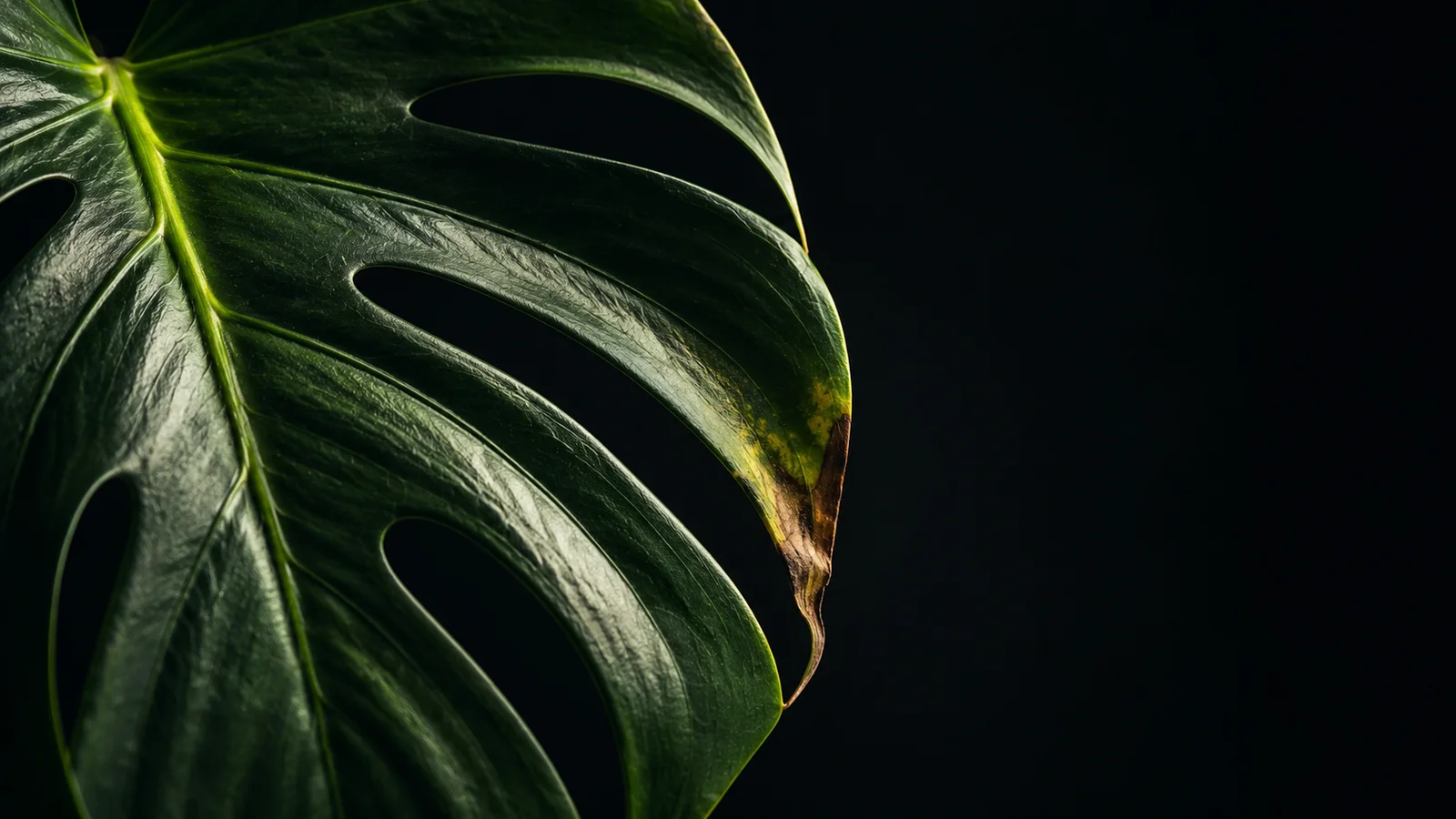
Brown crispy tips
Tips are the most marginal tissue on the leaf. They go first, and they tell you about three things:
- Humidity. Common in winter when forced-air heating is running. Many houseplants come from humid tropical habitats, and browning at the leaf tips and edges is a common sign that the air is too dry for them. A pebble tray, a humidifier, or moving the plant out of a draft helps.
- Mineral build-up. Fertiliser and tap water leave dissolved salts in the soil, and some plants are sensitive to the fluoride in tap water; either can scorch leaf tips and edges over months. The fix is to flush the pot every four to six months, pouring a large volume of plain water through and letting it drain completely.
- Underwatering, but only at the edges. A pot that consistently dries to the point of stress, then gets a top-up that wets only the top third of the soil, leaves the deeper roots short. The plant prioritises survival of the bulk of the leaf and lets the perimeter die.
Leaf curl
Curling leaves are the plant trying to reduce its own surface area — it has decided it is losing too much water, too much heat, or too much light, and is closing the shutters. Three common causes:
- Heat stress. Curl can appear on a hot afternoon, especially with bright window light. Move the plant back from the glass or close the blinds during the worst of the day.
- Light burn. A tropical that was happy in dappled light and got moved into direct south-facing sun curls inward and may also scorch. Move it back gradually.
- Pest pressure. Aphids and thrips both cause curling or twisting of new growth as they feed on developing tissue. Look on the underside of the leaves and at the growth tips.
Pale or faded green
A whole-plant fade, where the leaves are still healthy in shape, just pale, usually points at light or feeding. A plant that has slowly faded over six weeks since you moved it is asking to go back. If the position has not changed, a feed at half strength is the next thing to try.
The point of this catalogue is not that you should memorise it. The point is that every one of these symptoms has more than one cause, and the decision about what to do next depends on context the leaf alone cannot give you.
Why a single symptom never tells you what to do
The drooping example is the cleanest case. Two opposite conditions — bone-dry soil, sodden soil — produce the same outward symptom, because the underlying mechanism is the same: the leaf cannot pressurise itself. From the outside, the plant looks identical. The treatment is exactly opposite.
The discriminator is not the symptom. It is the trajectory — the soil moisture curve over the last five days, the photo from a week ago compared to today, the temperature of the room over the heat wave that just ended. A symptom is a snapshot. A trajectory is a sentence.
This is the case for keeping a continuous record of what is happening in the soil rather than a calendar of when you last watered. We've written about this at length in how a Digital Shadow tracks your plant in real time — the short version is that a per-Specimen running estimate of soil moisture, refined by your photos and the conditions in your room, is the missing context that turns droop from a guess into a diagnosis.
When you can see that the plant has been at 12% moisture for three days, droop means thirst. When you can see the plant has been at 70% moisture for a week despite no fresh watering — pointing at roots that are no longer drinking — droop means rot. The symptom is the same. The story is different. The action is opposite.
Your own observations belong in that record too. When you jot a Care Chronicle note like "yellowing on the two lower leaves, soil felt heavy", the system parses it into a structured observation and folds it into the next calibration pulse — symptom vocabulary, concern level, whether a follow-up looks warranted. The note doesn't get filed and forgotten. Your eyes augment the camera's.
Three scenarios
Three illustrative cases of how reading a symptom against its trajectory changes what you do.
Scenario 1: A hot week, droop appears Tuesday
Your Calathea has been steady for a fortnight. The forecast hits 29°C on Monday, the apartment runs warm Tuesday morning, and by lunch the leaves are angled down. The Digital Shadow on the Specimen's card shows soil moisture ran down to 8% overnight — well below the threshold the model has learned for this plant. The action is straightforward: hydrate, and the leaves recover by evening. The shadow resets to 100%, and the next watering target re-anchors based on the temperature it now expects.
Scenario 2: You watered Sunday, droop appears Wednesday
Same Calathea, three weeks later. You watered thoroughly on Sunday morning. By Wednesday the lower leaves are drooping and the stems are limp. Instinct says water. The shadow says the soil is at 68% — entirely normal for day three. Watering again would push the soil into anaerobic conditions and accelerate the rot already in progress. The action is the opposite of instinct: stop watering, lift the pot to feel for unusual weight, and if rot is suspected, repot into drier substrate.
Scenario 3: Yellow lower leaves on a Monstera that hasn't moved
Your Monstera has been in the same spot for four months. Two of the lower leaves have gone yellow in the last week. Soil and watering rhythm look unchanged. The Specimen's photo timeline shows the plant has not put on a new leaf in eleven weeks, and the light estimate for the position has been steadily under the species threshold for two months. The yellowing is a light shortage expressed slowly through the oldest leaves first. The action is to relocate, not to feed and not to water differently.
A Specimen in recovery is also a Specimen that should stay on Equilibrium rather than Vigor — the default Growth Bias is correct here. Pushing for new growth on a plant whose root mass is still rebuilding is the wrong instruction; let the model carry the recovery on its own terms, then change the bias once the trajectory turns. The same caution applies if you had been planning to take cuttings off this Monstera — cuttings are best taken from healthy stems, so a parent in slow decline is a poor source, and the trajectory the Shadow is showing you here is the signal to wait.
In none of these cases did the symptom by itself decide the action. The Digital Shadow's running record decided it.
Your Sanctuary Brief, every morning
Once you have more than two or three Specimens, the morning question stops being which one needs me today? and starts being what changed overnight? The Sanctuary Brief is the two-to-four sentence answer: Specimens entering recovery, Specimens stalling between check-ins, Specimens with worsening trajectories. Tone tracks the state — calm when the collection is steady, alert when something needs you. The Brief is what turns the Digital Shadow's running record into something you can act on in five seconds, not five minutes.
The path today
Inside Botanical Legacy, every Specimen carries its own Digital Shadow — a per-plant running estimate of soil moisture, light exposure over time, and the trajectory of its health based on your photos. When you notice a symptom, you open the Specimen, look at the shadow's recent moisture curve, see whether the next watering is overdue or wildly premature, and act with confidence rather than panic. Photos from your last few check-ins sit beside the curve, so a droop today gets compared against a droop a week ago when you were sure the plant was thirsty. The whole point is to give a Cultivator the context a single leaf cannot.
For Observers, on the free plan, the Digital Shadow runs the same nightly model on up to five Specimens: each keeps its moisture estimate and watering schedule, and the Doctor reads up to three photos a month. The Shadow tab's forward projection and what-if simulator, the local weather feed, and sensor support via Home Assistant sit on the Cultivator plan, with a 14-day trial included on every new account.
An honest limitation
Reading symptoms automatically from photos is harder than it looks. The Doctor, powered by Botanical Vision v5, reads each check-in photo for clearly visible disease and discolouration, obvious pest infestations, and growth changes such as height and leaf count, and it does that well. What it does not yet do reliably is read subtle stress: early spider mite stippling, the first week of edge crisping that points at humidity rather than thirst, or the difference between paler than last month and paler than a healthy specimen of this species. Those signals still depend on the trajectory the Digital Shadow tracks and on your own eyes.
We are working on closing that gap. When the model can read those subtler signs from a phone-quality photo without false alarms, it ships, and we'll write about it on this blog.
Frequently asked questions
Why are the lower leaves on my Monstera yellow?
In most cases the answer is one of two things: overwatering, or a slow light shortage. Lower leaves yellow first because the plant prioritises its newest growth and sheds the oldest leaves when resources are short. If the soil is wet and heavy, treat the watering rhythm. If the soil rhythm has been steady but the plant has not put on new growth in over a month, treat the position.
My plant is drooping but the soil feels wet. What is happening?
The most common explanation is root rot. The roots are sitting in saturated soil, suffocating, and have lost the ability to take water up — so the leaves droop even though the pot is full. Do not water. Lift the plant out of the pot and inspect the roots. Healthy roots are firm and pale; rotted roots are soft and brown to black. Trim the dead tissue, repot into fresh, drier substrate, and let the plant recover before the next watering.
Are brown leaf tips humidity or watering?
Both, often together. Crispy tips on a tropical plant in dry winter air almost always start with humidity. Crispy tips that began after a season of tap water with no flushing are usually mineral build-up. Crispy tips on a plant that often goes too long between thorough waterings are the deeper roots reporting underhydration. The discriminator is which one matches the recent history of the plant — and that recent history is exactly what the Digital Shadow records.
Can I just take a photo and have the app tell me what is wrong?
Honestly, not yet, and not for everything. Photo diagnostics inside Botanical Legacy reliably catch obvious disease, visible pest infestations, and growth changes between check-ins. Subtle stress signals — early mite stippling, the first signs of nutrient drift, the difference between a tired plant and a sick one — still need the Digital Shadow's running record and a careful eye. We are honest about this because the alternative is a plant care app that confidently misdiagnoses, and that is worse than no diagnosis at all.
Should I cut off yellow leaves?
If a leaf is fully yellow with no green tissue left, it is not coming back, and removing it lets the plant redirect resources. Trim at the base of the petiole with clean scissors. If a leaf is partly yellow but still has functional green area, leave it — the plant will continue to draw nutrients out of it before shedding it on its own.
How fast can a healthy plant decline once symptoms start?
Once a clear symptom is visible (droop, sudden yellowing, dramatic curl), the underlying problem has usually been running for a while. Root rot that has reached most of the root system can kill a plant. Spider mites can breed a new generation in under a week in warm, dry conditions, and a severe infestation can strip a plant of its leaves. The narrow window for intervention is exactly why noticing earlier matters, and why a continuous record of the plant's state matters more than any one symptom.
Try it yourself — free for five plants
Botanical Legacy's free Observer plan covers up to five Specimens. Every new account also includes a 14-day trial of Cultivator, our paid plan, which adds the Digital Shadow's forward projection and what-if simulator, the local weather feed, sensor support via Home Assistant, and 120 Botanical Vision v5 photo reads a month in place of three.
If you want to see what reading a Specimen looks like before signing up, the platform preview walks you through the experience without an account.
A leaf is a slow sentence. Read it.
Botanical Legacy, May 2026. Every Specimen on the platform carries its own Digital Shadow, updated nightly. Try the platform preview to see one in motion.
Sources
The plant-care facts on this page were checked against these references.
- UC IPM Houseplant Problems: ipm.ucanr.edu/PMG/PESTNOTES/pn74172.html
- Wisconsin Horticulture, houseplant care: hort.extension.wisc.edu/articles/houseplant-care
- RHS nutrient deficiencies: rhs.org.uk/prevention-protection/nutrient-deficiencies
- Illinois Extension, houseplant care: extension.illinois.edu/houseplants/care
- Havé et al. 2017, J Exp Bot (PubMed): pubmed.ncbi.nlm.nih.gov/27707774
- Nebraska Extension, humidity: lancaster.unl.edu/success-houseplants-humidity
- RHS houseplants growing guide: rhs.org.uk/plants/types/houseplants/growing-guide
- Kadioglu et al. 2012, Plant Science (PubMed): pubmed.ncbi.nlm.nih.gov/22118614
- UC IPM Aphids: ipm.ucanr.edu/PMG/PESTNOTES/pn7404.html
- UC IPM Thrips: ipm.ucanr.edu/PMG/PESTNOTES/pn7429.html
- UC IPM Spider Mites: ipm.ucanr.edu/PMG/PESTNOTES/pn7405.html
- RHS, taking houseplant cuttings: rhs.org.uk/plants/types/houseplants/how-to-take-cuttings-from-h…
- RHS glasshouse red spider mite: rhs.org.uk/biodiversity/glasshouse-red-spider-mite