Species care guide
String of pearls
Curio rowleyanus
String of pearls care honestly: why it is less forgiving than its reputation suggests, what the pearl shape is actually doing, and the watering window that keeps it full without rotting the crown.
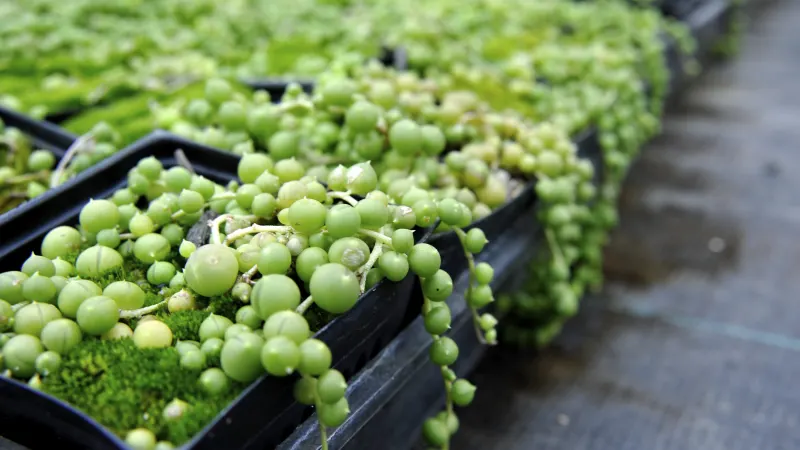

- Light
- Bright indirect light with some direct morning sun — a south- or east-facing window; insufficient light causes gaps between pearls and sparse, leggy strands
- Water
- When the soil is dry halfway down — roughly every 1–2 weeks in summer, far less in winter; a long drought causes shrivelling but overwatering causes irreversible crown rot
- Humidity
- Low; 30–50% is ideal; it is a true succulent and does not want a humid bathroom
- Temperature
- 18–24°C; avoid cold drafts and frost; a light cool rest in winter at 12–15°C can encourage the cinnamon-scented summer bloom
- Pets & toxicity
- Mildly toxic to cats, dogs, and humans
- Difficulty
- Moderate to challenging; the watering window is narrow and the crown is vulnerable — less forgiving than other trailing succulents
A string of pearls reads like a curtain of green beads, but it lives like a desert plant — generous when it rains, and unforgiving of a single drink too many.
The plant that is harder than it looks
String of pearls is one of the most photographed houseplants in the world: a curtain of round green beads spilling over the edge of a pot, improbable and architectural and faintly surreal. It is sold beside the easy trailing plants, on the implied promise that anything this striking and this succulent must also be tough. It is not, quite. String of pearls is a genuine challenge — not because it needs constant fussing, but because the margin for error in watering is narrow and the failure mode is fast and final.
The plant is a succulent from the dry grasslands of southern Africa, where it grows along the ground in the shade of taller plants and rocks, rooting where the strands touch soil. Its whole design solves one problem: surviving fierce light and long drought in a place where water arrives hard and then disappears. Read that and the care follows — it wants strong light, a soil that dries fast, brief heavy drinks, and long dry waits between them. The trouble is that the same crown that lets it root and spread is also exquisitely vulnerable to rot, so the plant gives you very little room between too dry and too wet. Where a tougher succulent like the aloe or the jade plant shrugs off a watering mistake, a string of pearls can collapse from one.
What the pearls are doing
The beads are not decoration; they are the plant's entire survival strategy made visible, and learning to read them is most of string-of-pearls care. Each pearl is a modified leaf, swollen into a sphere to hold the most water in the least surface area — a shape that minimises evaporation under hard sun. If the plant simply made flat leaves, it would lose water far faster than its dry habitat allows.
There is a clever detail on top of that. A flattened leaf shape catches light across its whole face, but a sphere exposes very little of itself to the sun at any moment — so each pearl carries a thin translucent stripe along its upper surface, an epidermal window that lets light pass into the centre of the bead, where the photosynthetic tissue lines the inside. The plant essentially built itself a row of tiny greenhouses: water stored in the round body, light let in through the window, photosynthesis happening within.
For you, the practical reading is this: the pearls are a fuel gauge. Plump, firm, rounded beads mean a hydrated plant with full reserves. Flat, softened, or wrinkled beads mean the plant is drawing those reserves down — it is using stored water because none is coming from the roots. That single observation, made before you ever pick up the watering can, prevents most of the mistakes that kill this plant.
Light: read the spacing between the pearls
String of pearls needs more light than most people give it, and the plant tells you exactly how much it is getting through the spacing of its own beads. In strong light, the strands grow tight and dense — pearls packed closely along the stem, full and round, the whole plant compact and heavy. Starve it of light and it stretches: the internodes lengthen, the gaps between pearls widen, the new pearls come in smaller, and the plant thins into a sparse, reaching tangle hunting for a window.
Give it the brightest spot you have. A south-facing window with a few hours of direct morning or filtered afternoon sun is ideal; an east-facing sill works well. This is one of the few trailing plants that genuinely wants some direct sun, and it will not stay dense without it. The caution is the same as for any succulent moved suddenly into strong light — acclimatise it over a week or two if you are shifting it from a shop's gloom to a hot summer window, or the most exposed pearls can scorch into brown, sunken patches.
If your brightest window still is not bright enough — a common problem in winter, or in a north-facing room — the plant will survive, but it will stretch and gap, and no amount of water will fix that. The answer to a leggy string of pearls is always light, never more watering. A grow light a hand's span above the strands holds them dense through a dark winter if your windows cannot.
How to water string of pearls without losing the crown
This is the section that decides whether your plant lives. String of pearls is built for the desert rhythm — a heavy soak, then a long dry wait — and watered any other way it fails in one of two directions. The plump pearls mean the plant carries its own reserve, so it does not need frequent topping up; in summer a thorough drink every week or two is plenty, and in winter it may want water only once a month or less.
The rule is to wait until the soil is dry about halfway down the pot, then water thoroughly and let it dry again. But how you water matters as much as when. The crown — the dense mat of stems where the pearls emerge and the plant meets the soil — rots with terrifying speed if water sits on it. The rot spreads down every strand from there, and by the time you see it the plant is often already lost. So water at soil level, tucking the spout under the strands, or stand the pot in a tray and let it drink from below, then drain it completely. Never water over the top of the plant, and never mist it — this is a true succulent, not a humidity-lover, and a wet crown is the one thing it cannot survive.
This narrow window is exactly where a per-specimen model proves its worth. A generic schedule cannot know whether your particular pot is dry halfway down today, but a Digital Shadow — the running model Botanical Legacy keeps for each Specimen in your sanctuary — draws the moisture estimate down on the real light, warmth, and season your plant is living through, and holds its peace until the soil has genuinely dried to the point this plant wants. For a succulent where the difference between overwatering and underwatering is the difference between a flat afternoon and a dead plant, a model that errs toward not yet is doing the one thing that keeps a string of pearls alive.
The shrivelling diagnosis
Shrivelled, flattened pearls are the single most common reason people search for help with this plant, and the trap is that the symptom points two completely opposite ways. Most of the time, wrinkled pearls mean exactly what they look like — the plant is thirsty, drawing down its stored water because the soil has been dry too long. A thorough soak, and the pearls plump back up within a day or two. That is the easy version.
The cruel version looks identical and means the opposite. When a plant has been overwatered, the roots rot and die, and dead roots cannot move water into the strands — so the pearls shrivel from drought even though the soil is wet. Reach for the watering can on instinct and you finish the plant off. The only way to tell the two apart is to check the soil before you react: dry soil plus shrivelled pearls is thirst, so water; wet soil plus shrivelled pearls is root rot, so stop watering immediately, and consider unpotting to cut away any blackened roots and start over from the firmest strands.
This is why the soil check is non-negotiable with string of pearls. The plant's most visible symptom is genuinely ambiguous, and the soil is the only thing that resolves it. Feel before you water, every time.
Common problems
A mushy, blackened crown. The emergency: rot from overwatering or from water sitting on the stems. It spreads fast. Cut away every soft, discoloured strand back to firm green tissue, let the plant dry out, and propagate the healthiest pieces by laying them on dry, gritty mix — string of pearls roots readily from the strands, so a collapsed plant can usually be rescued in part.
Pearls dropping off. A sudden cold draught, a move, overwatering, or very dry stale air can all make pearls detach and fall. Check for the obvious causes — a chilly windowsill, a recent repot, a soggy pot — and stabilise the conditions rather than chasing the symptom.
Leggy strands with wide gaps. Not enough light. The plant is stretching toward a window it cannot reach. Move it to your brightest spot or add a grow light; the existing gaps will not close, but new growth will come in tight and dense.
Brown, sunken spots on the pearls. Usually sunburn from a sudden jump in light intensity. Acclimatise the plant gradually when moving it into stronger sun, and ease it back from the most direct glass during a fierce summer.
Frequently asked questions
How often should you water string of pearls?
When the soil is dry about halfway down the pot — in practice every one to two weeks in summer, and as little as once a month in winter, though the real interval depends on your light, pot, and season. Water at soil level, never over the crown, soak thoroughly, and drain completely. The plump pearls are a water store, so the plant tolerates a long wait and rots from a frequent drink.
Why is my string of pearls shrivelling?
Shrivelled pearls mean the plant cannot get water into its strands — but for two opposite reasons. Dry soil means simple thirst, and a soak fixes it within a day or two. Wet soil means the roots have rotted from overwatering and can no longer move water, so adding more makes it worse. Always feel the soil before you react: it is the only thing that tells the two apart.
Why is my string of pearls dying?
The most common killer is overwatering, which rots the roots and the crown faster than you can see it. Check whether the soil is staying wet and whether the crown is soft or discoloured. If so, stop watering, cut back to firm green strands, and propagate the survivors. Less dramatic decline — stretching, gapping, dropping pearls — usually means too little light rather than a watering fault.
How much light does a string of pearls need?
A lot — more than most trailing plants. It wants bright indirect light with some direct morning or filtered sun, ideally a south- or east-facing window. The spacing of the pearls is your gauge: tight, dense strands mean enough light, while wide gaps and smaller pearls mean it is stretching and needs to move closer to a window.
Why is my string of pearls turning brown?
Brown, sunken spots on individual pearls are usually sunburn from a sudden increase in light — acclimatise the plant gradually and ease it off the hottest glass. Browning that spreads from the crown or along whole strands, with softness or mushiness, is rot from overwatering and needs immediate action: cut back to healthy tissue and let the plant dry.
Start your sanctuary
Botanical Legacy's free Observer plan covers up to five Specimens, each with its own continuously running Digital Shadow — and a string of pearls, whose narrow watering window is its whole difficulty, is precisely the plant a model serves best. Every new account also includes a 14-day trial of Cultivator, the paid plan, which adds the local weather feed and soil sensor support.
START YOUR SANCTUARY — FIVE FREE SPECIMENS, NO PAYMENT REQUIRED →
Read the pearls, keep the crown dry, and give it the brightest window you have — a string of pearls asks for little, but it asks for exactly the right thing.