Species care guide
Aloe vera
Aloe vera
Aloe vera care without the folklore: how often to water it, why it needs real sun, and why overwatering — not neglect — is what kills it.

- Light
- Bright direct or strong indirect sun — a south- or east-facing window; it will survive lower light but grows weak, leggy and floppy
- Water
- Only when the soil is completely dry throughout, and far less often in winter; overwatering, which rots the roots, is the real danger
- Humidity
- Unfussy; copes with dry indoor air and dislikes humid air, so no misting
- Temperature
- About 13-29°C indoors; no frost tolerance, so keep it above about 4°C in winter
- Pets & toxicity
- Mildly toxic to cats and dogs (saponins and anthraquinones); keep out of reach of pets
- Difficulty
- Forgiving of neglect, unforgiving of over-attention — specifically overwatering
An aloe asks for almost nothing — a bright sill, a pot that drains, and the discipline to leave the watering can alone.
The medicine-cabinet plant that wants to be a desert plant
Aloe vera is the plant on a million kitchen windowsills, kept for the cool gel inside its leaves and the half-remembered idea that you snap one open for a burn. It is sold as effortless, and it almost is — but the place most people keep it and the place it wants to be are not the same, and the gap between them is where aloes quietly fail.
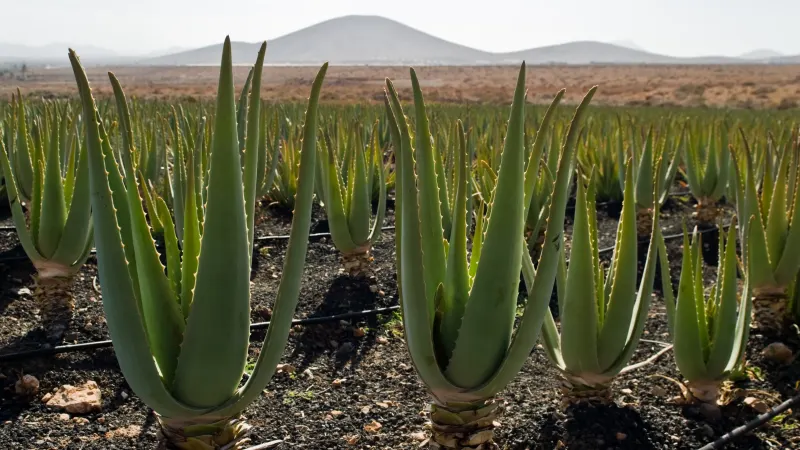
This is a succulent from the dry, sun-blasted edges of the Arabian Peninsula, naturalised across the Mediterranean and other warm regions. Everything about it is built for one problem: storing water through long rainless stretches and surviving fierce light while it waits. The thick, tapering leaves are reservoirs — the famous gel is simply stored water held in a translucent inner tissue — and the plant fills and empties them on a desert rhythm of drought and downpour, never on a steady trickle.
Read that biology and the whole care routine falls out of it. An aloe needs strong light to fill its leaves and a soil that dries fast between drinks, and it treats the things we instinctively offer houseplants — frequent watering, rich compost, a humid bathroom, a misting — as low-grade poison. Like its fellow tough succulents the snake plant and the ZZ plant, it carries a reputation for being unkillable, and like them it has exactly one reliable way to die: a wet pot. Get the light and the drainage right and an aloe will outlive most of the plants you bought after it.
Light: the need most often misread
The single most useful thing to understand about an aloe is that a floppy, splayed plant is usually short of light, not water. Starved of light, an aloe grows leggy and weak and its leaves droop; a thirsty one shows yellow, shrivelled, puckered leaves instead, and recovers once it is watered. Owners get this exactly backwards: they see drooping leaves, assume drought, water more, and rot the roots of a plant that only ever needed a brighter window.
Give an aloe the strongest light in the house. A south-facing sill is ideal; an east-facing one with a few hours of direct morning sun is comfortable. It takes full sun, though a plant moved abruptly from a dim shop into fierce summer glass can scorch: reddish-brown patches are sunburn, and the cure is to step it back from the pane and bring it into the strongest light gradually.
The opposite — a leggy, stretched aloe — is the commonest light failure, and it is worth recognising early. Starved of light, the plant reaches: the leaves elongate, grow pale and thin, lose their upright posture, and the rosette flattens and splays open until the whole plant lies almost horizontal, hunting for a window that is too far away. New growth that comes in already weak is the tell. Move the plant to your brightest spot and new leaves will grow tighter and firmer.
How often to water an aloe vera — by the soil, never the calendar
Many guides give a fixed interval, such as every two weeks. It is calendar logic, and calendar logic is precisely what kills the plants sold as hard to kill. The leaves are full of stored water; a plant carrying its own reservoir does not need topping up on a fixed day, and an aloe watered on a schedule rather than on evidence is an aloe being slowly drowned.
The only rule that holds: water when the soil is bone dry all the way through the pot, and not before. What that means in time is entirely a property of the conditions, not the species. In bright summer light a small terracotta pot dries through far faster than the same plant does in a cool, dim winter, when it needs very little water at all. A finger pushed in to the second knuckle tells you about the top only — and the top dries first — so for a plant this unforgiving of wet roots, lift the pot to learn its light dry weight. When in genuine doubt, wait another week. This plant comes through a long drought far better than a wet spell.
When you do water, water like the desert rain it is built for: a thorough soak until it runs from the drainage hole, a complete drain, and an empty saucer. The danger of an aloe is specifically that rot starts below the soil line, out of sight. By the time the base softens and the plant wilts, it can be too late, and there is no treatment for the root rot itself. The defence is not vigilance after the fact; it is never overwatering in the first place. If you take only one thing from this guide, take that the difference between overwatering and underwatering is not symmetric here — an underwatered aloe recovers once it is watered, an overwatered one is often already lost.
This is where a per-specimen model earns its place. "Water every two weeks" describes the average aloe, and nobody owns the average — your plant lives on a particular sill, in a particular pot, through a particular season, drying at its own rate. A Digital Shadow — the running model Botanical Legacy keeps for each Specimen in your sanctuary — holds a live estimate of the moisture left in your actual pot and draws it down on the real light, warmth, and season that pot is living through. An aloe on a bright windowsill in July and the same aloe in a cool back bedroom in January have completely different drying curves; the Shadow tracks the curve in front of you and stays quiet through the long dry weeks a fortnightly reminder would have interrupted twice. For a plant whose only enemy is the unnecessary watering, a model that mostly tells you not yet is worth more than any reminder that fires on time.
Soil and potting
Everything above assumes the soil can dry, and that is a decision you make once, at potting time, and then live with for years.
The mix must drain fast and hold little: a bagged cactus or succulent mix works straight from the bag, or cut ordinary potting soil by roughly a third to two-thirds with perlite, coarse grit, or pumice. What you are escaping is the dense, peat-heavy compost most nursery aloes arrive in, which behaves like a sponge and keeps the roots damp long after the surface looks dry. Rot here is rarely a watering mistake so much as a soil that refuses to let go of water the watering can left behind.
Terracotta is the right pot, and for practical rather than aesthetic reasons. Unglazed clay breathes through its walls and wicks moisture out of the soil from the sides, shortening the drying curve exactly where this plant wants it short — a plastic pot keeps the core wet far longer. A drainage hole is not optional in any material; a decorative pot with no hole is a reservoir, and a reservoir is the one thing an aloe must never sit in. Size down rather than up: aloes are content slightly crowded, a snug pot dries sooner, and an oversized pot surrounds the roots with wet soil nothing is drinking from. Repot only when the plant is genuinely root-bound or top-heavy, moving up a single size, in spring, into dry mix.
Humidity and temperature
Humidity is the variable you get to ignore entirely. Ordinary dry indoor air, drier than many tropical houseplants want, suits an aloe, and the parched air of a centrally heated winter does not trouble it. There is no reason to mist it: aloes dislike humid air, and damp conditions invite the rot you are otherwise working to prevent. A damp aloe is an unhappy aloe.
Temperature is where it asks for a little care. The comfortable band is about 13-29°C, which covers most heated homes year-round. It tolerates a cool winter rest well, down to a minimum of about 4°C, but it has no frost hardiness whatsoever. Water-filled succulent tissue is among the most easily damaged by freezing, the damage is permanent, and it often only shows a few days after the cold. The practical risks are specific and avoidable — a leaf pressed to single-glazed winter glass, a pot left on an unheated porch in a cold snap, a windowsill behind closed curtains on a freezing night. Keep it back from the coldest glass in winter and, as always, on the dry side, because cold and wet together is a dangerous combination.
Common problems
A mushy, soft base. This is the emergency, and it is root or stem rot from overwatering. Press the lowest leaves where they meet the soil: firm is healthy; soft, brown or black tissue means rot is already underway below the line. Act the same day. There is no cure for the rot itself, so the aim is to save the healthy tissue: unpot the plant, cut back to clean firm tissue with a sterile blade, let the cut surfaces dry and callus (anything from a day to a week), then pot into gritty, fast-draining mix kept only slightly moist while it roots. A firm upper rosette can often be rooted as a cutting even when the base is gone.
Brown, dry, or crispy leaf tips. Usually the gentler end of the scale: a long underwatering, where the plant has drawn down its own reserves, or sun and dry air taking the very tips. A thorough soak and a return to the normal rhythm fixes the thirst version, and the tips themselves do not heal but stop spreading. Brown patches in the middle of a leaf after a sudden move into strong sun are sunburn — ease the light. Cold damage, by contrast, turns tissue brown or black, often a few days after the cold night, so think back to where the plant stood.
Pale, thin, leaning growth. Light starvation, covered above — a much-misread aloe symptom, because it looks like thirst and is the opposite. More water makes it worse. The answer is a brighter window.
Pups crowding the pot. Not a problem at all, but a signal: a healthy aloe throws offsets — small clone plants — from the base, and in time they fill the surface and compete with the parent for water and light. That is your cue to divide, which is the next section and the nicest job an aloe gives you.
Propagation — dividing the pups
Aloes multiply by offsets, usually called pups: miniature plants that emerge from the base of the parent, often with their own small roots already formed. The pups are complete plants in waiting, and division is the recommended way to propagate an aloe.
Wait until a pup has roots of its own before you separate it. Slide the whole plant out of its pot so you can see where the pup joins the parent, and either twist it free or cut it away with a clean blade, keeping whatever roots come with it. Then do the one thing that feels wrong and matters most: leave the separated pup out of soil, in a dry, shaded spot, until the cut surface dries and calluses over (anything from a day to a week) — planting a fresh wound straight into damp soil is an open invitation to rot. Once calloused, pot each pup into gritty cactus mix kept only slightly moist while it roots, then move to the usual rule of watering only when the soil is dry. A windowsill aloe will keep you in new plants for years; the harder question is who to give them to.
A note on the gel, since it is why most people keep the plant: cut away the green outer part of the leaf and use only the clear inner gel, and keep the bitter yellow sap that seeps from just under the skin out of it: that latex irritates skin and is a strong laxative. Test the gel on a small patch of skin first.
Frequently asked questions
How often should you water an aloe vera?
When the soil is bone dry all the way through the pot, and not before — in practice far more often in bright summer light than through a cool, dim winter, when it needs very little. There is no fixed number, because the interval depends on your light, pot, and season, not on the species. When you are unsure, wait another week: an aloe shrugs off a long drought and rots from a wet one.
Why is my aloe vera turning brown or mushy?
Two very different causes with opposite fixes. Brown, dry, crispy tips are usually underwatering or strong sun, and a good soak plus the normal rhythm settles it. A soft, mushy base, or leaves collapsing, is rot from overwatering, or cold damage, and that is urgent: unpot, cut back to firm tissue, let it dry, and repot into dry mix. Feel the texture before you reach for the watering can.
Why is my aloe vera flat, pale, and leaning over?
That is light starvation, not thirst, and it is a very common aloe mistake. Firm, upright leaves need strong light; a plant in a dim spot stretches, pales, and splays as it reaches for a window too far away. Move it to your brightest sill. New growth will come in tighter and more upright — and resist the urge to water more, which only rots a plant that needs sun.
Can you grow aloe vera indoors?
Yes — it is one of the better succulents for a bright windowsill, provided you can give it real light. The binding constraint indoors is sun, not warmth or humidity: a south- or east-facing window keeps an aloe compact and firm, while a dim room keeps it alive but flat and stretched. If your brightest spot still is not very bright, an aloe will survive there, but it will not thrive.
Can Botanical Legacy stop me from overwatering my aloe?
That is exactly the part a model can carry. Botanical Legacy does not test your soil from a photo, but it tracks how your specific pot dries in your specific light and season and stays quiet until the soil is genuinely dry — which removes the scheduled, just-in-case waterings that cause nearly all aloe rot. For a plant whose only real danger is the watering can, a Digital Shadow that mostly answers not yet is doing the one thing that keeps an aloe alive.
Start your sanctuary
Botanical Legacy's free Observer plan covers up to five Specimens, each with its own continuously running Digital Shadow — and an aloe, whose entire care question is "is the soil dry yet," is the plant the model serves best. Every new account also includes a 14-day trial of Cultivator, the paid plan, which adds the local weather feed and soil sensor support.
START YOUR SANCTUARY — FIVE FREE SPECIMENS, NO PAYMENT REQUIRED →
An aloe does not want your attention. It wants your window, and the patience to leave its roots dry.
Sources
The plant-care facts on this page were checked against these references.
- NC State Extension: plants.ces.ncsu.edu/plants/aloe-vera
- Missouri Botanical Garden: plantfinder.mobot.org/PlantFinderDetails.aspx
- Hamman 2008, Molecules: pmc.ncbi.nlm.nih.gov/articles/PMC6245421
- Penn State Extension: extension.psu.edu/aloe-a-hardy-houseplant
- NC State Extension (snake plant): plants.ces.ncsu.edu/plants/dracaena-trifasciata
- NC State Extension (ZZ plant): plants.ces.ncsu.edu/plants/zamioculcas-zamiifolia
- RHS: rhs.org.uk/plants/aloe
- SDSU Extension: extension.sdstate.edu/aloe-vera-houseplant-how
- RHS: rhs.org.uk/plants/types/cacti-succulents/houseplants/growing-gu…
- UMD Extension: extension.umd.edu/resource/lighting-indoor-plants
- UMD Extension: extension.umd.edu/resource/watering-indoor-plants
- Clemson HGIC (houseplant disorders): hgic.clemson.edu/factsheet/houseplant-diseases-disorders
- Clemson HGIC (indoor plants): hgic.clemson.edu/factsheet/indoor-plants-cleaning-fertilizing-c…
- Wisconsin Horticulture: hort.extension.wisc.edu/articles/small-aloes-interesting-colorf…
- RHS overpotting: rhs.org.uk/prevention-protection/overpotting
- UC IPM: ipm.ucanr.edu/PMG/GARDEN/ENVIRON/frostdamage.html
- NIH NCCIH: nccih.nih.gov/health/aloe-vera
- ASPCA: aspca.org/pet-care/animal-poison-control/toxic-and-non-toxic-pl…