Species care guide
Snake plant
Dracaena trifasciata
Snake plant care without folklore: how often to water Dracaena trifasciata, what light it really wants, and why overwatering is the only common killer.
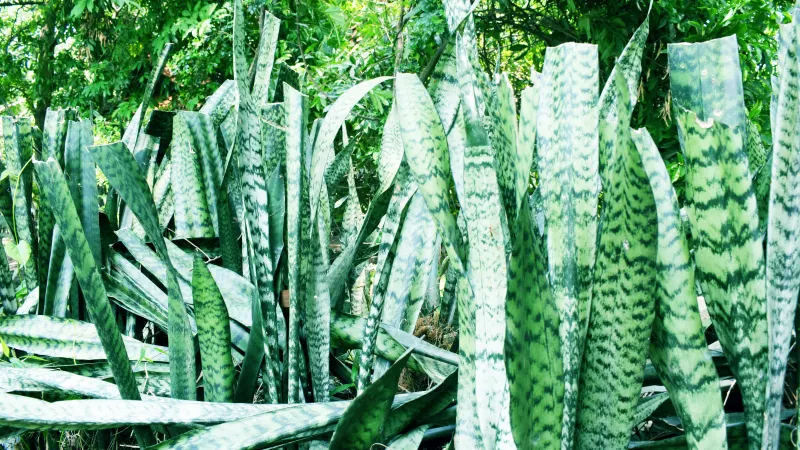
.jpg)
- Light
- Bright indirect light for visible growth; tolerates deep shade by pausing, not thriving
- Water
- Only when the soil is fully dry throughout — typically every 2–6 weeks, longer in winter
- Humidity
- Unfussy; anything from 30–60% is fine, no misting needed
- Temperature
- Happiest at 18–27°C; keep above 10°C — sustained cold causes lasting damage
- Pets & toxicity
- Mildly toxic to cats and dogs (saponins); usually drooling or an upset stomach, rarely worse
- Difficulty
- Among the most forgiving houseplants there is — if you can resist the watering can
A snake plant has almost never been killed by neglect — nearly every one that dies is watered into the grave.
Light: surviving the dark corner is not the same as liking it
The snake plant — Dracaena trifasciata, though most of the world still knows it as Sansevieria trifasciata — has been sold for a century on a single promise: it tolerates the spot no other plant will. The dim hallway. The north-facing bathroom. The desk two rooms from a window. The promise is true. It is also the most misread sentence in houseplant care, because tolerating a dark corner and thriving in one are different claims, and only the first one is on the label.
In the wild this is a plant of rocky, dry ground in tropical West Africa — from Nigeria east toward the Congo — where it grows in strong light and survives long stretches without rain. Nothing in its biology prefers gloom. Give a snake plant bright, indirect light, near a window but out of the harshest midday glare, and it behaves like a plant: new leaves rising from the soil each season, taller and thicker than the last, the cross-banding and edge colour at full contrast. It will even take a few hours of direct sun without complaint, which most plants marketed for shade will not. Like pothos, it built its reputation in dim rooms; unlike pothos — which stretches, pales, and visibly sulks when starved — a snake plant registers no complaint at all.
Park the same plant in deep shade and it does something quieter: it stops. It does not yellow, it does not wilt, it does not protest in any way you can photograph. It holds — the same leaves, the same height, sometimes for a year or more — while its water use drops to almost nothing. On variegated cultivars like 'Laurentii', the yellow margins dull and flatten. The plant is not dying. It is waiting.
The waiting has a mechanism worth knowing in plain English. Most plants open the small pores on their leaves during the day to take in carbon dioxide, and they lose water through those open pores the entire time. A snake plant runs the desert schedule instead (crassulacean acid metabolism, if you want the term): it keeps its pores sealed through the daylight hours and opens them at night, when cooler air steals far less moisture. The trick makes it remarkably thrifty with water — and it is also why everything about this plant happens slowly. Slow growth, slow drinking, slow decline. The slowness is the whole personality, and it is exactly what makes the watering question dangerous.
How often to water a snake plant — in weeks, not days
Every guide converges on the same folklore: water it once a month. As folklore goes, this is better than most — a month is a defensible average — but it is still calendar logic, and calendar logic is how forgiving plants die. Of the houseplants sold as indestructible — the snake plant, the ZZ plant, pothos — every one shares the same single point of failure, and it is a wet pot.
The only rule that holds is this: water when the soil is fully dry, all the way through the pot, and not a day before. What "fully dry" means in time depends entirely on the plant in front of you. In bright light through a warm summer, the soil in a small terracotta pot can be dry in two weeks. The same specimen in a dim corner in January — pores opening only at night, growth paused, the room cool — may not need water for six or even eight weeks. Both rhythms are correct. Both belong to the same plant in the same year, which is precisely why no single number survives contact with your living room.
Checking takes ten seconds. A finger two knuckles deep is a start, but the surface can be bone dry while the bottom is still damp — so lift the pot and learn its dry weight, or push a wooden skewer to the base and see whether it comes up clean. If you are not sure, wait a week: this plant forgives a month of extra drought without a mark, and it will not forgive a fortnight of standing wet.
When you do water, water properly — a thorough soak until it runs from the drainage hole, a full drain, and an empty saucer. Watering on a schedule rather than on evidence is the first of the mistakes every beginner makes, and the snake plant is the plant that schedule kills most reliably.
This is also where a per-specimen model earns its keep. "Water monthly" describes the average snake plant, and nobody owns the average. A Digital Shadow — the running model Botanical Legacy keeps for each Specimen in your sanctuary — holds a live estimate of the moisture left in your actual pot, drawn down day by day on the light, temperature, and season that pot is living through, and it stays silent for the six dry-soil weeks a calendar reminder would have interrupted twice. For a plant whose only real enemy is the unnecessary watering, a model that mostly tells you not yet is worth more than any reminder that fires on time.
Soil and potting
Everything above assumes the soil can dry, and that is a choice you make once, at potting time.
The mix should drain freely: a bagged cactus or succulent mix works as it comes, or cut a standard potting soil by roughly a third with perlite or coarse grit. What you are avoiding is the dense, peat-heavy compost most nursery plants arrive in — it holds water like a sponge for weeks, and a snake plant's thick roots and underground rhizome will sit in that dampness long after the surface looks dry. Rot does not begin with bad watering so much as with soil that refuses to let go.
Terracotta is the right pot for this species, and for once the reasons are practical rather than aesthetic. Unglazed clay breathes through its walls and wicks moisture out of the soil from the sides, shortening the drying curve precisely where this plant wants it short. The weight matters too: a mature snake plant is tall, rigid, and top-heavy, and a light plastic pot will eventually go over. A drainage hole is non-negotiable in any material.
Repotting is rare work. Snake plants grow from a thick rhizome that stores water and creeps outward, and they are content slightly crowded — a snug pot dries sooner, which suits them. The signal to act is unmistakable — the rhizome bulging or cracking a plastic pot, typically every two to three years. Move up a single size, two or three centimetres wider, in spring: an oversized pot surrounds the roots with soil nothing is drinking from, which is the rot risk again by another route.
Humidity and temperature
Humidity is the one variable you can ignore. Anywhere from 30% to 60% — which covers nearly every home in every season — is fine, and the dry winter air that crisps a calathea's edges does not register on a snake plant at all. Do not mist it; water pooling in the tight rosette where the leaves meet has nowhere to go, and a damp leaf base is an invitation this plant otherwise never extends.
Temperature deserves more respect. The comfortable band is 18–27°C, and that is where all growth happens. The plant survives down to about 10°C, but below that it takes real injury: cold-damaged tissue turns soft and scarred, often showing days after the cold night that caused it. The practical risks are specific — a leaf pressed against single-glazed winter glass, a pot beside a door that opens onto frost, an unheated conservatory in a cold snap. Cold and wet together is the one combination that kills quickly: chilled roots stop drawing water, the soil stays saturated, and rot moves in. In winter, keep the plant back from the coldest glass and the soil on the dry side.
Feeding
A snake plant is a light feeder, for the same reason it is a light drinker: a metabolism that breathes at night and grows slowly has modest appetites. A balanced houseplant fertiliser at half the strength on the label, once or twice across spring and summer, is the entire programme. Nothing in autumn. Nothing in winter.
If you never feed it at all, it will live for years regardless — feeding buys growth, not survival. Overfeeding, on the other hand, costs: the excess salts accumulate in a pot that gets watered this rarely, and they show up as browned tips and scorched margins. If you suspect a heavy hand, flush the pot through with plain water, let it drain hard, and return to restraint.
Common problems
A mushy base. This is the one true emergency, and it announces itself at the soil line, not at the leaf tips. Press the base of each leaf where it leaves the soil: firm is healthy; soft, wet, or smelling of decay means rot is already underway below. Act the same day — unpot the plant, expose the rhizome and roots, and cut back to clean, firm tissue with a sterile blade. Let the cut surfaces dry in open air for a day, then repot into fresh, barely damp, free-draining mix and withhold water for at least a week. Leaves that are still firm can be restarted as cuttings, with one caveat worth knowing in advance: a leaf cutting from a variegated cultivar regrows plain green, because the yellow margin lives in a tissue layer the cutting does not carry forward. Only division keeps the variegation.
Drooping or folding leaves. A healthy snake plant leaf stands rigid; one that leans, flops outward, or folds inward along its length is reporting something, and the work is in reading which thing. Check the soil and the base first. Drooping with wet soil or any softness at the base is rot, and the watering can is the last thing it needs. Drooping with dry soil and a firm base usually means months of too little light have left the leaves without the energy to hold themselves — or, less often, a drought long enough to draw down the leaf's own reserves, in which case wrinkling appears alongside the droop. The two cases call for opposite responses, which is why diagnosing before acting matters; the symptom-by-symptom breakdown in overwatering vs underwatering is the longer version. In winter, assume rot until the soil proves otherwise.
Wrinkled leaves. Vertical wrinkles or channels running down the leaf are the honest thirst signal — the plant has been drawing on the water stored in its own tissue, which means the soil has been fully dry for a good while. This is the one symptom where the answer really is the watering can: a thorough soak and drain, and the leaves smooth out over the following days. No lasting harm done. A snake plant wears a long drought far more gracefully than a short flood.
No growth in winter. Not a problem at all. Short days, cooler rooms, and a night-breathing metabolism add up to a full seasonal pause: no new leaves from November to February is normal, not a deficiency. The mistake is treating the stillness — feeding it into growth it cannot use, or watering on faith because surely it must need something by now. It does not. Let it stand dry and quiet, and it will move again in spring.
Frequently asked questions
How often should you water a snake plant?
There is no fixed number — the honest answer is "when the soil is fully dry all the way through the pot," which lands somewhere between every two and six weeks depending on light, season, and pot. A plant in bright light in summer may be ready in a fortnight; the same plant in a dim corner in winter can go six to eight weeks. When you are unsure, wait another week: a snake plant forgives extra drought without a mark and does not forgive standing wet.
Can a snake plant live in low light?
It can survive there for years, which is not the same as thriving. In deep shade a snake plant essentially pauses — no new growth, duller colour on variegated forms, and water use that drops to almost nothing. If you want it to grow, give it bright, indirect light near a window. If you want it to furnish a dark hallway, it will do that too, as long as your watering slows to match the pause.
Why is my snake plant drooping?
Check the base before anything else. Leaves drooping or folding while the soil is wet, or with any softness where the leaves meet the soil, mean root or rhizome rot — the most common cause, and the one that needs action the same day. Drooping with dry soil and a firm base points instead to months of insufficient light, or to a very long drought, in which case the leaves will also look wrinkled. The two causes call for opposite fixes, so feel the soil before you decide.
Are snake plants toxic to cats and dogs?
Mildly, yes. The leaves contain saponins, which typically cause drooling, vomiting, or diarrhoea if chewed — unpleasant rather than dangerous in most cases, and the bitter taste means animals rarely eat much. Serious reactions are uncommon, but if a pet has eaten a meaningful amount, call your vet. With a determined chewer in the house, keep the plant out of reach.
Do snake plants purify the air?
Far less than the internet says. The plant does exchange gases at night — its desert metabolism opens the leaf pores after dark — but the purifying claims trace back to a 1989 NASA study that measured plants in small sealed chambers. At room scale, ordinary ventilation outpaces a houseplant's air-cleaning effect by orders of magnitude; you would need a room packed wall to wall to measure a difference. Keep a snake plant because it is a handsome, patient plant — not for the air.
Can Botanical Legacy detect root rot before it is visible?
No. Rot starts below the soil line, and no photo of leaves can see roots. What the model does instead is work on prevention: it tracks how your specific pot dries in your specific conditions and stays quiet until the soil is dry, which removes the unnecessary waterings that cause most rot in the first place. By the time rot shows in a check-in photo, it is already advanced — the defence is the watering pattern, and that is the part a model can carry.
Start your sanctuary
Botanical Legacy's free Observer plan covers up to five Specimens, each with its own continuously running Digital Shadow — and a snake plant, whose entire care question is "is the soil dry yet," is the plant the model serves best. Every new account also includes a 14-day trial of Cultivator, the paid plan, which adds the local weather feed and soil sensor support.
START YOUR SANCTUARY — FIVE FREE SPECIMENS, NO PAYMENT REQUIRED →
With most plants, love looks like attention. With a snake plant, it looks like restraint.