Species care guide
Pothos
Epipremnum aureum
A pothos care guide built on triggers, not timers — how often to water, the light that keeps variegation alive, and what yellow leaves are really saying.
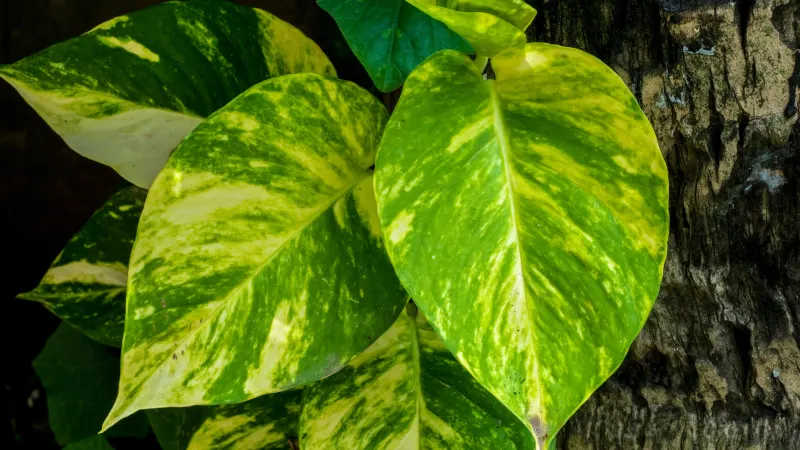

- Light
- Bright, indirect light; tolerates low light at the cost of its variegation
- Water
- When the top 2–3 cm of soil are dry to a finger — roughly weekly in summer, every 10–14 days in winter
- Humidity
- Content at 40–60%; ordinary household air is fine, no humidifier required
- Temperature
- 18–29°C; keep it above 10°C and out of cold draughts
- Pets & toxicity
- Toxic to cats and dogs — insoluble calcium oxalates irritate the mouth and throat
- Difficulty
- Among the most forgiving houseplants; the one real risk is overwatering
Nobody kills a pothos by neglecting it — the plant is so forgiving that drowning it feels like care.
The unkillable reputation is exactly the trap
The pothos earned its other name — devil's ivy — by refusing to die: it stays green in rooms too dark for almost anything else, shrugs off missed waterings, and roots from a stem fragment dropped in a glass of water. All of that is true, and all of it is beside the point. Tolerance is not health. A pothos can survive years of wrong treatment while looking quietly worse every month — paler, leggier, slower — and because it never quite collapses, nobody asks why.
The two ways a pothos suffers are both gifts of its reputation. It gets watered on a schedule, because a plant this tough surely cannot be drowned — and it can. Or it gets parked in the darkest corner of the flat, because "tolerates low light" was on the label, and the colour drains out of it one leaf at a time. This guide is about reading the vine in front of you instead of the label. If houseplants in general are still new to you, start with the ten mistakes every beginner makes — the pothos forgives most of them, which is precisely why they go unnoticed.
Light, and what the variegation is telling you
In the wild, Epipremnum aureum is a climbing aroid from Mo'orea in French Polynesia, long since naturalised across the tropics of Southeast Asia and beyond. It germinates in forest shade and climbs tree trunks on aerial roots, trading gloom for the bright, filtered light of the canopy as it rises. Every light preference it has indoors is a memory of that climb: it wants dappled brightness, it accepts shade, and it registers the difference precisely.
You can read that register, because a pothos carries its own light meter on every leaf. The golden splashes of a classic golden pothos, the cream marbling of a marble queen, the white sectors of an N'Joy — variegation is tissue without chlorophyll, leaf area that photosynthesises little or nothing. In strong light the plant can afford the decoration. In a dim corner it cannot, so new leaves come in flooded with green, and the pattern fades generation by generation until a marble queen is a plain green vine. And the more white or gold a cultivar carries, the more light it needs simply to feed itself.
"Bright, indirect" means a spot where you could read a paperback all afternoon without a lamp — within a metre or so of a window, out of harsh midday sun, which bleaches a pothos leaf into pale, papery patches. A few hours of gentle morning sun from an east window is a gift. Be suspicious of your own eyes: human vision adapts to dimness far better than a leaf does — a corner that looks bright enough to you is often a fraction of what the plant needs. A snake plant will sit in that corner indefinitely without changing its face; a pothos tells you what it thinks of the light in its newest leaves, every time.
How often to water a pothos
There is no number, and every guide that offers one — every seven days is the usual answer — is describing an average plant in an average week. Your pothos drinks at one rate on a bright July sill and at perhaps half that rate through a grey November fortnight. It dries sooner in porous terracotta than in glazed ceramic, sooner root-bound than freshly repotted. A schedule is right for a few weeks a year and wrong in both directions for the rest.
What replaces the schedule is a trigger: water when the top 2–3 cm of soil are dry to a finger, and not before. Push a finger in to the second knuckle. Dry — water. Cool and damp — wait, and check again in a few days. When you do water, do it thoroughly, until water runs from the drainage holes, then let the pot drain and empty the saucer. A full drink and a real dry-down, never a constant dampness. In practice this lands most indoor pothos near weekly in summer and every 10–14 days in winter, but the trigger decides, not the date. The longer version of the method lives in when to water your houseplants.
The trigger matters so much because the pothos's tolerance runs in one direction only. Those thick, glossy leaves store water; like the ZZ plant, it would rather be left dry than kept wet, every time. A bone-dry pothos wilts theatrically and recovers within hours of a drink. A constantly damp pothos does not wilt at all — its roots quietly rot, and by the time the leaves say so, much of the root system is already gone.
This is also the gap a per-specimen model exists to close. Botanical Legacy keeps a Digital Shadow of each Specimen in your Sanctuary — a running estimate of how much moisture is left in that particular pot, drawn down day by day on the temperature and light the plant is living in. It does not tell you what a pothos needs in general. It tells you when this one is approaching dry — which is the only version of "how often" that was ever real.
Soil and potting
A pothos is an aroid, and aroids want air at the roots. The right mix is chunky and free-draining: an ordinary houseplant potting mix opened up with a generous handful of perlite or orchid bark. A dense, peat-heavy compost holds water for days and is how careful waterers still lose plants — the finger test reads dry on top while the bottom of the pot stays sodden.
The pot does quiet work most guides skip. Porous terracotta breathes through its walls and forgives a heavy hand; glazed ceramic and plastic seal moisture in and can nearly double the time between waterings, with nothing else changed. Either is fine — what is not fine is a pot without a drainage hole. No watering discipline survives a sealed container; if you love a holeless cachepot, keep the plant in a plastic nursery pot inside it and lift that out to water.
Repot every year or two, when the plant tells you: roots circling the base and escaping the drainage holes, water racing straight through without soaking in, soil drying much faster than it used to. Go up one size only — 2–3 cm wider. An oversized pot wraps a modest root ball in wet soil nothing is drinking from, recreating the rot risk you were avoiding. A pothos is happier slightly snug.
Humidity and temperature
The pothos comes from forests where humidity rarely drops below 60%, yet it is one of the few rainforest plants untroubled by the gap between there and your living room. Anything from 40–60% suits it, and it tolerates the drier end of ordinary household air without complaint. You do not need a humidifier for a pothos. If a dry winter — heating running, air down near 30% — starts crisping the leaf edges, grouping plants together or standing the pot on a pebble tray helps in a way misting does not — a spritz is gone in minutes, and water left in leaf joints invites fungal spotting. Misting is a ritual, not a strategy.
Temperature asks slightly more. The comfortable band is 18–29°C, and the plant minds cold far more than heat: sustained exposure below about 10°C does real tissue damage, and a single hard chill can blacken leaves overnight. The dangers are local rather than average — a vine pressed against a single-glazed window takes a nightly draught the thermostat never registers, and one trailing past a radiator gets a stream of hot, dry air that spikes its water use and scorches its margins.
Feeding
A pothos is a light feeder, and the mistake that hurts it is generosity. Fertiliser is salt: pour in more than the plant can use and it accumulates in the soil, pulls moisture back out of the roots, and burns the leaf tips and margins brown from the edge inward — damage that looks almost identical to dry air, so the cause keeps getting misread and the feeding continues.
The cadence that works is modest. Through spring and summer, while the vine is visibly producing new leaves, feed every 4–6 weeks with a balanced houseplant fertiliser at half the strength on the label. From autumn, taper to almost nothing; a plant that has slowed for the season cannot use what you give it.
Common problems
Most pothos problems are one visible symptom with several possible causes, and the skill is in separating them before acting — the wrong fix usually deepens the real problem.
Yellow leaves. The most searched symptom and the most misdiagnosed. The leading cause by a wide margin is overwatering: soil still wet days after you watered, a heavy pot, yellowing scattered across the plant rather than down one vine. But a pothos also yellows from the opposite extreme — left bone-dry too long, with a feather-light pot as the tell — and from deep shade, which shows as a slow, even paling. One case to ignore entirely: the oldest leaf on a vine yellowing and dropping while the growing tip looks vigorous is the plant retiring old tissue. Feel the soil before you decide — it, not the leaf, separates the causes.
Leggy vines. Long, bare stretches of stem with small leaves spaced far apart, reaching toward the window — the plant is hunting for light it cannot find, and the reach is the message. Move it brighter, then cut the bare stems back to just above a node, the small bump where leaf meets stem; the plant branches from the cut and grows back fuller. The trimmings are free new plants.
Brown, crispy tips. Three usual suspects: dry air, irregular watering — long droughts followed by floods — and salt buildup from over-feeding. If you fertilise often, suspect salt first and flush the pot. If the heating has run all winter, suspect the air. Pothos is also mildly sensitive to chlorine; letting tap water stand overnight before using it costs nothing.
Root rot. The one that kills. The signature is a drooping pothos in wet soil — drooping in dry soil is thirst and fixes itself within hours of a drink, but a wilted plant whose pot is heavy and whose soil smells sour is losing its roots, and another drink finishes the job. Unpot it, cut every brown, soft root back to clean white tissue, repot into fresh, airy mix in a clean pot, and water far less than before. If the base is too far gone, take cuttings from healthy stem and start again.
Pale variegation. New leaves coming in plain green where the old ones were marbled or golden is a light verdict, not a disease. The plant is maximising chlorophyll to survive a dim spot. No feed or treatment restores it; brighter light does, and only on the leaves grown after the move.
Frequently asked questions
How often should you water a pothos?
There is no fixed interval — the same plant drinks twice as fast in a warm, bright week as in a cool, dim one, and porous terracotta dries days ahead of glazed ceramic. Water when the top 2–3 cm of soil are dry to a finger, then water thoroughly until it drains and empty the saucer. In practice most indoor pothos land near weekly in summer and every 10–14 days in winter. When unsure, wait — a pothos recovers from a missed watering within hours, and from a surplus sometimes never.
Why are my pothos leaves turning yellow?
Overwatering is the most common cause: the tell is soil still wet days after watering, a heavy pot, and yellowing scattered across the plant. Yellowing also follows long droughts — the pot feels feather-light — and deep shade, which pales the plant slowly and evenly. A single old leaf yellowing and dropping near the base of a vine while the rest looks vigorous is normal retirement, not a symptom. Check the soil before changing anything, because the fixes for the wet and dry causes are opposites.
Why is my pothos losing its variegation?
Too little light, almost without exception. Variegated tissue holds little chlorophyll, so in a dim spot the plant floods new leaves with green to keep feeding itself, and the pattern fades. Move it within a metre of a bright window and new leaves will carry the pattern again — but the leaves that already reverted stay green permanently, so the recovery shows only in fresh growth.
Is pothos toxic to cats and dogs?
Yes. Leaves and stems contain insoluble calcium oxalate crystals, which cause immediate mouth and throat irritation, drooling, pawing at the face, and vomiting if chewed. It is rarely life-threatening, but it is genuinely painful, and a vet call is sensible if a pet has chewed more than a mouthful. Keep the vines on a high shelf or in a hanging pot, out of reach.
Can a pothos live in water permanently?
Yes, with honest expectations. A node cutting roots in a glass of water within one to two weeks and can stay there for years if you change the water every week or two and add a few drops of dilute fertiliser monthly. It will live; it will not flourish — water holds far fewer nutrients than soil, so a permanent water-grown pothos stays smaller and slower. For a full vine, pot the cutting up once its roots reach a few centimetres.
Will Botanical Legacy catch pests on my pothos from a photo?
Not reliably, and it would be wrong to claim otherwise. The check-in photo analysis reads what a photo can show — yellowing, leaf damage, overall vigour — and folds it into the plant's running model, which is genuinely useful for catching slow declines you would miss week to week. But spider mites and scale start on the undersides of leaves and in stem joints, exactly where a photo rarely looks. Turning the leaves over yourself remains part of the job.
Start your sanctuary
Botanical Legacy's free Observer plan covers up to five Specimens, each with its own continuously running Digital Shadow — and a pothos, forgiving but legible, is an ideal first one. Every new account also includes a 14-day trial of Cultivator, the paid plan, which adds the local weather feed and soil sensor support.
The label says you cannot kill it; the plant says more than that, in colour and reach and the weight of its pot.
START YOUR SANCTUARY — FIVE FREE SPECIMENS, NO PAYMENT REQUIRED →
The pothos will forgive you almost anything — aim to give it nothing to forgive.