Species care guide
Chinese money plant
Pilea peperomioides
Pilea peperomioides care: why the weekly rotation matters, how the coin-shaped leaves change size with light, and how to share the pups it never stops making.
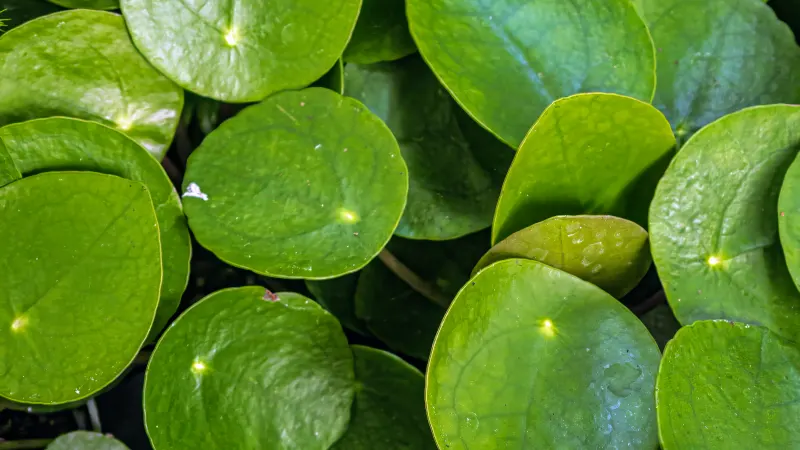
_Pilea_peperomioides_Foliage.jpg)
- Light
- Bright indirect light, turning the pot weekly to prevent the lean; tolerates lower light but grows slowly and coins shrink
- Water
- When the top 2–3 cm of soil are dry — roughly weekly in summer, less in winter; drooping leaves are the plant's own low-water signal
- Humidity
- Happy in typical indoor humidity of 40–60%; no misting needed
- Temperature
- 15–25°C; avoid hot dry air from radiators and sudden cold
- Pets & toxicity
- Non-toxic to cats, dogs, and humans
- Difficulty
- Easy to moderate; the main pitfall is overwatering or uneven light causing a lopsided plant
A pilea keeps no secrets — it leans toward the light, droops when it is thirsty, and hands you a new plant every few weeks.
The plant that travelled by friendship
The Chinese money plant is the houseplant that built its fame on generosity. For decades it was almost unknown to the commercial nursery trade in the West, and it spread instead hand to hand — a Norwegian missionary is said to have carried it back from China's Yunnan province in the 1940s, and from there it travelled across Scandinavia and beyond as cuttings passed between friends, long before a shop ever sold one. That history is not just charming trivia; it is the single best thing to know about the plant, because Pilea peperomioides propagates so freely and so reliably that a healthy specimen turns you into a node in the same network. You will end up giving them away.
The plant itself is unmistakable: slender upright petioles, each topped with a round, flat, coin-shaped leaf — the "money" and "UFO" and "pancake" of its many common names — arranged into a loose, disc-like rosette. It comes from the shaded, rocky slopes of the Himalayan foothills in southwestern China, growing in bright but filtered mountain light, and it carries those preferences indoors: good light, a cool room, and a soil that drains. It is genuinely one of the easier houseplants, sitting comfortably alongside a pothos or a spider plant in forgiveness, and like those plants its few failure modes are simple to read once you know the two signals it gives you most clearly — the lean and the droop.
Light: read the lean
A pilea wants bright, indirect light: plenty of it, but out of the path of harsh direct sun, which bleaches and scorches the thin coins. A spot a step back from a south-facing window, or directly in an east-facing one with gentle morning light, is the comfortable middle. In good light the plant grows compact and full, the leaves stay large and a healthy deep green, and pups appear readily. In a dimmer spot it survives and slows — the growth stretches, the new coins come in smaller, and the plant reaches — but it does not sulk dramatically the way some plants do.
The defining quirk of pilea light care is the lean, and it is the reason for the weekly rotation that every pilea owner learns. Each leaf sits on its own long petiole, and every one of those petioles angles itself toward the brightest light it can find. Leave the pot facing the same way for weeks and the whole plant tilts toward the window, the petioles crowding to one side, until you have a lopsided plant pointing out of the room. The fix is trivial and the habit worth building: give the pot a quarter-turn every week or so, and the plant grows evenly all the way around, filling out into the flat, symmetrical disc it is meant to be. Skip the rotation and you get the asymmetric, one-sided pilea that fills houseplant forums with "why is my plant leaning?" — the answer is always the same, and always the rotation.
How often to water a pilea — and trust the droop
A pilea wants its soil to dry out a little between drinks but not to bake. The rule is to water thoroughly when the top 2–3 cm of soil have dried, then let the pot drain completely. In a bright, warm summer that is roughly weekly; in a cool, dim winter it is less. The interval, as always, belongs to the conditions rather than the calendar — the same plant in July and January drinks at different rates, and watering both on the same weekly slot is how you end up either drowning it in winter or stressing it in summer.
What makes pilea unusually easy to water is that it tells you, unmistakably, when it has had enough drying. Pushed too far between waterings, the whole plant droops — the petioles soften and the coins sag downward in a dramatic, slightly alarming wilt. It looks like a crisis and it is not: water a thirsty, drooping pilea and it perks back up within a few hours, no harm done. That visible low-water signal is a genuine convenience, because it means the plant catches your mistakes before they become serious, and you can learn its rhythm by watching for the very first hint of softening rather than guessing. The one caveat is that a similar droop can come from the opposite problem — soggy, overwatered roots that can no longer take up water — so check the soil before you respond: dry soil plus droop means water; wet soil plus droop means you have overwatered and need to ease off, not add more.
That ambiguity — the same symptom from opposite causes — is exactly the kind of thing a per-specimen model resolves. Each Specimen in your sanctuary carries a Digital Shadow, a running estimate of the moisture left in that pot, drawn down on the real light and warmth of your room — so when a pilea droops you are not left guessing whether it is thirsty or waterlogged, because the model already knows how much water that soil should be holding. For a plant whose one dramatic signal can mean two opposite things, having the moisture state tracked underneath takes the gamble out of the response.
The coins: what makes them big or small
The size of a pilea's leaves is one of its most direct reports on how it is being kept, and it is worth learning to read. In bright, ample light a well-grown pilea produces large coins — up to ten or twelve centimetres across on a mature, happy plant — held on sturdy petioles. In low light the same plant produces small, pale coins on stretched, weak stems, because there simply is not enough energy to build full-sized leaves. If your pilea's new growth is coming in noticeably smaller than its older leaves, the plant is telling you it wants more light.
Leaf size also responds to the plant's overall vigour, so a pilea recovering from a stress, a recent repot, or a cramped root system may put out smaller coins for a while before it hits its stride. But light is the dominant lever. Give a pilea the brightest indirect spot you have, keep it fed lightly through the growing season, and the coins grow to their full, satisfying size; starve it of light and they shrink. The plant draws you a picture of its conditions, leaf by leaf.
Soil, potting, and temperature
A pilea asks for a standard, free-draining houseplant mix — ordinary potting soil lightened with a handful or two of perlite is plenty — in a pot with a drainage hole. It is not fussy about soil, but it is unforgiving of waterlogging, so the drainage matters more than the recipe. Repot in spring when the plant fills its container or the pups crowd the surface, moving up a single size; a pilea is happy in a snug pot and an oversized one only surrounds the roots with wet soil they cannot use.
On temperature, this is a cooler-room plant than most tropical houseplants. It is comfortable between roughly 15–25°C and actively dislikes both extremes of the indoor winter: the hot, dry updraught from a radiator, which crisps and curls the leaves, and sudden cold from a draughty window or an open door, which can curl and discolour them too. Keep it in a stable, moderate spot away from heat sources and cold draughts, and it holds its even, flat form happily. Humidity is a non-issue — ordinary indoor air of 40–60% suits it, and there is no need to mist.
Common problems
Yellowing leaves. Most often overwatering — a pilea in soggy soil yellows from the lower, older leaves first. Check the soil below the surface; if it is wet, let it dry further between waterings and confirm the pot is draining freely. An occasional old leaf yellowing and dropping as the plant grows taller is normal, and the lower stem naturally goes bare over time. Widespread or fast yellowing is the watering signal.
Small, pale coins on stretched stems. Too little light. The plant is reaching and cannot build full leaves on the energy available. Move it to a brighter indirect spot, and new growth comes in larger and the stems shorter and sturdier.
Curling leaves. Usually a temperature complaint — either hot, dry air from a nearby radiator or a cold draft. Pilea coins should sit flat; cupping or curling is the plant reacting to an uncomfortable spot rather than to watering. Move it away from the heat source or the draughty glass. Persistent curling with no obvious temperature cause can occasionally signal pests, so check the undersides.
A lopsided, leaning plant. The rotation problem — the petioles have all crowded toward the light. Begin the weekly quarter-turn habit and the plant evens out over the following weeks as new growth fills the bare side.
A bare, leggy main stem. Partly natural — pilea lose their lowest leaves as they grow and develop a visible trunk over time — and partly a light signal if it is excessive. You can behead and re-root the top to make a fresh compact plant, and the bare stump will usually sprout new pups, so a leggy pilea is really just two propagation opportunities.
Propagation — the pups that never stop
This is the joy of the plant and the reason it spread by friendship in the first place. A healthy pilea constantly throws pups — baby plants — in two places: from the soil around the base, where they emerge from the roots, and along the main stem, where small plantlets sprout directly from the trunk. Both are complete plants in the making, and propagating them is about as easy as houseplant propagation gets.
For the soil pups, wait until one is a few centimetres tall, then dig down gently with a clean knife and cut it away from the parent's root system, taking as much root as comes with it. A rooted pup can go straight into its own small pot of moist mix and carry on growing. For the stem pups, slice the small plantlet off the main stem and root it first — stand it in a glass of water until it grows a tuft of roots a couple of centimetres long, or nestle the cut end into moist soil and keep it humid until it takes. Either way, no houseplant is more rewarding to multiply; a single pilea on a bright windowsill will keep you supplied with gifts for years, which is exactly how it became one of the most-shared plants in the world. The general method, and how to keep any cutting alive past the first fragile fortnight, is in how to propagate plants.
Frequently asked questions
How often should you water a Pilea peperomioides?
When the top 2–3 cm of soil have dried out — roughly weekly in a bright, warm summer, and less often through a cool, dim winter. The exact interval depends on your light, pot, and season rather than a fixed schedule. The convenient thing about pilea is that it shows you when it is too dry: the whole plant droops, and a good watering revives it within hours. Just check the soil first, because a droop in wet soil means overwatering, not thirst.
Why is my pilea leaning to one side?
Because every leaf stalk angles toward the light, and the pot has been facing the same way too long. It is the most common pilea quirk and the easiest to fix: give the pot a quarter-turn every week or so, and the plant grows evenly all the way around, filling out into the flat, round disc it is meant to be. The existing lean corrects itself over a few weeks as new growth balances the plant out.
Why is my pilea drooping?
Usually thirst — pushed too long between waterings, a pilea wilts dramatically and recovers within hours once watered. But the same droop can come from the opposite cause, soggy overwatered roots that can no longer take up water, so always check the soil before responding. Dry soil plus droop means water it; wet soil plus droop means ease off and let it dry out. The symptom is the same; the soil tells you which problem you have.
Are pilea plants safe for cats and dogs?
Yes — Pilea peperomioides is non-toxic to cats, dogs, and humans, which makes it one of the safer choices for a household with curious pets or small children. If a pet nibbles a leaf it comes to no harm, though it is kinder to the plant's looks to keep it out of reach. Botanical Legacy surfaces pet-safety directly on each Specimen's card, so the safe and unsafe plants in your sanctuary are distinguishable at a glance.
Can Botanical Legacy tell me why my pilea is drooping?
It can take the guesswork out of it. Because a pilea droops for two opposite reasons — too dry or too wet — the useful thing is knowing the soil's actual moisture state, and that is exactly what the Digital Shadow tracks: a running estimate of how much water your specific pot is holding, based on how it has dried in your light and season. Instead of pressing the soil and hoping, you can see whether the droop means "water me" or "you already did," and respond the right way.
Start your sanctuary
Botanical Legacy's free Observer plan covers up to five Specimens, each with its own continuously running Digital Shadow — and a pilea, whose one dramatic droop can mean two opposite things, is a plant that benefits from having its moisture tracked underneath. Every new account also includes a 14-day trial of Cultivator, the paid plan, which adds the local weather feed and soil sensor support.
START YOUR SANCTUARY — FIVE FREE SPECIMENS, NO PAYMENT REQUIRED →
Turn it weekly, water it when it sags, and pass the pups along — a pilea asks little and gives plants away.