Species care guide
Spider plant
Chlorophytum comosum
Spider plant care that fixes brown tips at the cause — water quality, humidity, feeding — and turns the babies on the runners into new plants.
.jpg)
- Light
- Bright indirect light; tolerates medium light gracefully; prolonged direct sun scorches leaves and bleaches the striping
- Water
- Evenly moist in spring and summer; water when the surface of the soil has dried; sensitive to fluoride and chlorine in tap water
- Humidity
- Average household humidity suits it; in very dry air, typical of heated rooms in winter, brown tips sharpen and multiply
- Temperature
- 13–24 °C ideal; keep above 10 °C and away from cold draughts and heating vents
- Pets & toxicity
- Non-toxic to cats and dogs per the ASPCA — one of the safest houseplants for a home with pets, though chewing it can cause mild stomach upset
- Difficulty
- Forgiving — tuberous roots store water and buy you grace on missed waterings; constant wetness is the one thing it cannot take
Brown tips on a spider plant are not a death sentence — they are a water-quality report, filed one leaf at a time.
The most trimmed, least understood plant in the house
The spider plant has a reputation as the plant nobody can kill, and the reputation is mostly earned. It survives dim offices, erratic watering, and years of mild neglect. And yet walk into almost any room that keeps one and you will find the same picture: a fountain of striped leaves, each ending in a crisp brown point, and an owner who has been snipping those points off for years without asking why they return.
They return because trimming is cosmetic and the cause is chemical. Chlorophytum comosum is native to southern Africa, where it grows in the undergrowth of forested river valleys and thickets, and it carries two traits from home that explain nearly everything about its life in yours. The first is a set of thick, tuberous roots that store water — the reason it shrugs off a forgotten fortnight, and the reason it eventually strains against its own pot. The second is an unusual sensitivity to fluoride and chlorine, which many municipal supplies add to tap water. Those compounds ride the water stream up the leaf, run out of leaf at the tip, and accumulate there until the tissue burns. The brown tip is not damage from something you failed to do. It is a record of what you have been pouring in.
This guide fixes the cause rather than the symptom — and covers the part of spider plant ownership that is pure reward: the plantlets.
Light
A spider plant wants bright, indirect light — near a window, out of the path of harsh midday sun. It tolerates a medium-light spot with the same good grace as a pothos, growing more slowly and holding less contrast in its striping, but it does not sulk. What it cannot take is prolonged direct sun: the leaves bleach, the striping washes out to a tired pale ribbon, and scorched patches appear where the light lands hardest.
The variegated cultivars you most likely own — 'Vittatum', with a cream centre stripe, and 'Variegatum', with white leaf margins — hold their pattern best in good light. In gloom the contrast dulls and new growth comes in greener; in direct sun it fades. An east window with a few hours of gentle morning sun is the comfortable middle. If your brightest spot already belongs to a fiddle-leaf fig — a plant that genuinely needs it — the spider plant will be content one step back from the glass.
Watering — how often to water a spider plant
There is no fixed interval, and the plant's anatomy explains why the question is the wrong one. Those tuberous roots are water tanks. A spider plant left dry for a week draws down its reserves and barely registers the lapse; a spider plant kept constantly wet has its tanks sitting in airless, saturated soil, and that is the one condition it cannot tolerate. This plant is built for drought and rain in alternation, not for steady dampness.
So water on evidence. Push a finger into the soil, and when the surface has dried, water thoroughly — until it runs from the drainage holes — then let the pot drain completely. In spring and summer, a growing plant in a bright window reaches that point far sooner than the same plant does in a cool, dim winter. The interval is not a property of the species. It is a property of the week. That is the gap Botanical Legacy closes: each Specimen in your sanctuary carries a Digital Shadow, a running estimate of the moisture left in that pot, drawn down on the real temperature and light of your room — which is how it knows your spider plant is drying out faster in July than it did in March, without you keeping notes.
Then there is the water itself, which matters more for this species than for most houseplants. Fluoride and chlorine accumulate in the leaf tips, and a spider plant on straight tap water in a heavily treated area writes that history on every leaf. Rainwater is the gold standard; distilled water serves as well, but a typical charcoal jug filter does not remove fluoride. The old trick of letting tap water rest overnight is only a partial fix — it off-gasses chlorine, but chloramine and fluoride stay put. If the tips keep burning on rested water, the water is still the problem.
Soil and potting
A standard houseplant potting mix lightened with a few handfuls of perlite is all a spider plant asks for — moisture-retentive enough to feed the tubers, airy enough to drain in minutes rather than days. A pot with a drainage hole is non-negotiable for a plant this committed to storing its own water.
What is unusual is how the roots behave over time. The tubers thicken and multiply until the root mass fills the container entirely, and a spider plant left long enough will bulge the sides of a plastic pot or split the pot outright — it can physically break its way out. Mild congestion is not an emergency; a slightly rootbound spider plant is more inclined to flower and produce plantlets. But when water races straight through without soaking in, when the pot deforms, or when roots push out of the drainage holes, repot in spring into a container just 2.5–5 cm wider. An oversized pot surrounds the tubers with soil they cannot drink down, and idle wet soil is the slow road to rot.
Humidity and temperature
A spider plant is comfortable in the same air you are: average household humidity, roughly 13–24 °C. It handles ordinary household dryness well, but in very dry air (a heated room in winter can fall below 30%), brown tips sharpen and multiply, and dry air joins tap water as a co-author. If winter tips arrive even on filtered water, group your plants so they share transpired moisture, or run a small humidifier nearby.
Cold is the harder limit. Keep it above 10 °C, away from the draught line of a winter window and out of the blast path of a radiator or heating vent — a hot, dry airstream spikes water loss and crisps leaf edges in exactly the way you are trying to prevent.
Feeding
Restraint, always. Fertiliser is salt, and salt is already this plant's enemy: excess feed accumulates in the soil, draws moisture back out of the roots, and burns leaf tips brown in a pattern indistinguishable from fluoride damage. An enthusiastically fed spider plant on perfect rainwater can still have ruined tips — and an owner blaming the tap.
A balanced houseplant fertiliser at half the label strength, once a month through spring and summer, is plenty. Stop entirely through autumn and winter. Every few months, water heavily with plain water until it streams from the drainage holes, to flush accumulated salts out of the pot. Heavy feeding carries one more cost specific to this species: a heavily fed plant tends to form fewer plantlets.
Plantlets and propagation
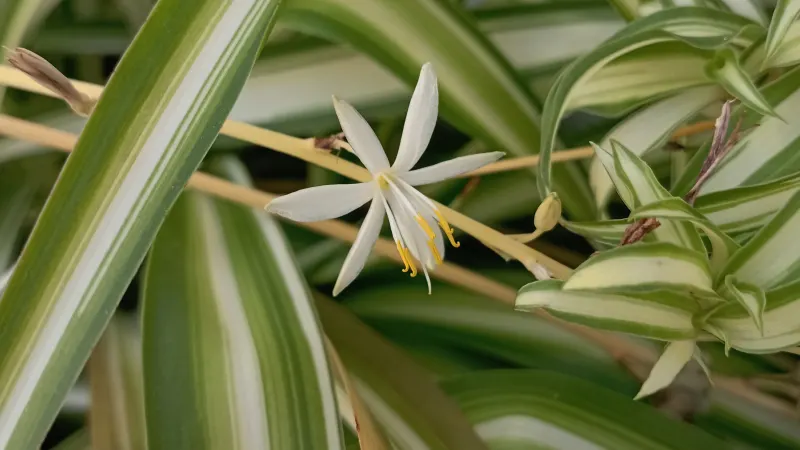
The plantlets — spiderettes, babies, the small plants that dangle from long arching stems — are the reason most people own a spider plant, and they arrive in a sequence. A mature plant flowers first, producing small white stars along wiry runners called stolons, and the plantlets form where the flowers were. The trigger is partly seasonal: shortening autumn days nudge a spider plant toward flowering, and a slightly rootbound pot helps. A young plant, a too-dark corner, or a roomy new pot each delay the show by a season or more.
Once plantlets appear, no houseplant is simpler to multiply. Each baby is a complete plant waiting for soil — many grow visible root nubs while still airborne. Rest one on a pot of moist soil while it is still attached to the parent, and cut the stolon once it has rooted; or snip off a plantlet that already has roots and root it in water or moist compost. Rooting while attached is the gentler path, since the plantlet stays connected to the parent until its own roots take hold. The method-by-method detail — and how to keep any cutting alive past week two — is in how to propagate plants.
Common problems
Brown tips are the headline problem, and the diagnosis is a short list: fluoride or chlorine in tap water, very dry air, salt buildup from overfeeding, or soil left to dry out too far. Often it is two at once. Trimming is fine for looks: use clean, sharp scissors and cut at an angle that follows the leaf's taper. But understand what trimming is: editing the report, not answering it. Change the water, ease the feeding, raise the humidity, and the new leaves grow in clean.
Pale, washed-out striping means too much direct sun — the variegation bleaches before the leaf scorches outright. Move the plant out of the direct beam and new growth recovers its contrast. The reverse failure exists too: in deep gloom, 'Vittatum' grows greener and duller. The stripe is a light meter; read it.
No plantlets is almost never illness. The plant is usually too young, sitting too dark to flower, or — most often — recently repotted into a pot with room to spare, which discourages flowering. Give it bright light, a snug pot, and an autumn of naturally shortening days, and the stolons come.
A mushy, collapsing base is the one genuinely urgent symptom: root rot from sustained overwatering, the failure mode those water-storing roots are most vulnerable to. Unpot the plant, cut away anything soft or sour-smelling, and repot what is firm into fresh potting mix. If only part of the root system has rotted, the plant can recover.
Frequently asked questions
How often should you water a spider plant?
When the surface of the soil has dried, and not before — far more often in a bright summer week than in winter. The tuberous roots store enough water that erring dry costs you nothing, while erring wet is the only reliable way to kill this plant. Water thoroughly when you do, and let the pot drain.
Are spider plants safe for cats and dogs?
Yes — Chlorophytum comosum is non-toxic to both cats and dogs per the ASPCA, which makes it one of the safest choices for a household with pets. If a cat chews the grassy leaves, the leaves end up ragged, and the ASPCA notes the risk to the cat is mild stomach upset, such as vomiting or diarrhoea. If you keep pets, Botanical Legacy surfaces pet-safety directly on each Specimen's card, so the safe and unsafe plants in your sanctuary are distinguishable at a glance.
Why is my spider plant not producing babies?
Three usual reasons: it is too young to flower, too dark to flower, or its pot is too roomy — plantlets follow flowering, and flowering favours a mature, slightly rootbound plant in good light. The trigger is also seasonal, since shortening autumn days push the plant toward bloom. Meet those conditions and wait a season; the stolons arrive on the plant's calendar, not yours.
Do spider plants really clean the air?
The claim traces to a real NASA study from 1989, and the spider plant did remove formaldehyde in it — inside sealed laboratory chambers. A real room is not a sealed chamber: it exchanges air constantly, and at realistic houseplant densities the effect on your air quality is far too small to matter. Researchers have since estimated you would need an impractical number of plants, between 10 and 1,000 per square metre of floor, to match what ordinary ventilation already does. Keep a spider plant because it is alive, generous, and safe for your cat, not as ventilation.
Can Botanical Legacy tell me what is causing my brown tips?
Not the water chemistry, no. The app does not test what comes out of your tap — no sensor we support reads fluoride or chloramine, and we are not pretending otherwise. What the Digital Shadow does track is everything around the chemistry: how quickly this particular pot dries, when you watered and fed, and how the plant's condition moves across your photos — usually enough to tell a watering problem from a water problem, and to date when the trouble began.
Start your sanctuary
Botanical Legacy's free Observer plan covers up to five Specimens, each with its own continuously running Digital Shadow — and on a spider plant, that means watering timed to the pot in front of you, pet-safety on the card, and a record of every plantlet you pot up. Every new account includes a 14-day trial of Cultivator, which adds the local weather feed and sensor support.
START YOUR SANCTUARY — FIVE FREE SPECIMENS, NO PAYMENT REQUIRED →
The brown tip is the message; the watering can is where you answer it.
Sources
The plant-care facts on this page were checked against these references.
- Missouri Botanical Garden: plantfinder.mobot.org/PlantFinderDetails.aspx
- SANBI: pza.sanbi.org/chlorophytum-comosum
- RHS: rhs.org.uk/plants/spider-plants/growing-guide
- Wisconsin Horticulture: hort.extension.wisc.edu/articles/spider-plant-chlorophytum-como…
- Cornell University (Boodley): hortscans.ces.ncsu.edu/uploads/b/a/back_to__5615720649be3.pdf
- NC State Extension: plants.ces.ncsu.edu/plants/chlorophytum-comosum
- Iowa State Extension: yardandgarden.extension.iastate.edu/faq/why-does-my-houseplant-…
- EPA: 19january2021snapshot.epa.gov/sites/static/files/2015-10/docume…
- UMD Extension: extension.umd.edu/resource/watering-indoor-plants
- EPA chloramine: 19january2017snapshot.epa.gov/www3/region9/water/chloramine.html
- UMD Extension: extension.umd.edu/resource/lighting-indoor-plants
- Clemson HGIC: hgic.clemson.edu/factsheet/spider-plant
- RHS light: rhs.org.uk/advice/understanding-plants/how-plants-use-light-to-…
- RHS houseplants: rhs.org.uk/plants/types/houseplants/growing-guide
- Penn State Extension: extension.psu.edu/repotting-houseplants
- Penn State Extension: extension.psu.edu/humidity-and-houseplants
- Clemson HGIC disorders: hgic.clemson.edu/factsheet/houseplant-diseases-disorders
- UMD Extension: extension.umd.edu/resource/grooming-indoor-plants
- ASPCA: aspca.org/pet-care/aspca-poison-control/toxic-and-non-toxic-pla…
- ASPCA: aspca.org/news/houseplant-safe-your-pets
- NASA: ntrs.nasa.gov/citations/19930073077
- Journal of Exposure Science & Environmental Epidemiology: europepmc.org/article/MED/31695112