Species care guide
Fiddle-leaf fig
Ficus lyrata
Fiddle leaf fig care without the drama: the light it actually needs, how often to water, and why a fig dropping leaves is answering a change you made.
.jpg)
- Light
- Bright indirect light or part shade close to a large window; some gentle morning sun is welcome, harsh afternoon sun can scorch
- Water
- A thorough drink when the top 5 cm (about two inches) of soil dries, then full drainage — consistency matters more than volume
- Humidity
- Medium humidity; ordinary room humidity is workable, away from heating and cooling vents
- Temperature
- 18–27°C; hates drafts; keep it above about 15°C, as colder air brings chilling injury and leaf drop
- Pets & toxicity
- Toxic to cats and dogs; the milky sap (ficin) irritates skin — wash after pruning
- Difficulty
- Demanding — not because it needs skill, but because it needs consistency
The fiddle-leaf fig is not the dramatic one in the relationship — it is the consistent one, and every leaf it drops is a reply to a change you made.
The reputation for drama is a reputation for inconsistent care
Ask around before buying a fiddle-leaf fig and you will hear the same warning: it is a diva, it sulks, it drops leaves out of spite. The truth is more useful. Ficus lyrata is one of the most predictable plants you can bring indoors. It does not act out at random — it responds: to a move across the room, to a cold draft, to a watering rhythm that swings between drought and deluge. Its one available response is to let a leaf go. The fig has exactly one negotiating tactic, and it uses it every time you change the terms.
That reframe changes everything about keeping one. If the snake plant forgives everything and the spider plant forgives most things, the fiddle-leaf fig forgives nothing — it files every inconsistency and answers each one with a leaf. The skill it demands is not rare knowledge or expensive equipment. It is consistency: the same spot, the same light, the same watering logic, week after week. Get that right and a fiddle-leaf fig grows steadily, year after year. Get it wrong and you own a bare trunk with three leaves at the top, wondering what it wants.
It wants what it grew up with. In tropical western and central Africa, from Sierra Leone to Cameroon and Gabon, Ficus lyrata is a tree that can reach 18 to 30 metres. A tree is built around light, and that is the most important fact about the one in your living room.
Light: the make-or-break factor
The fiddle-leaf fig needs bright light. "Bright indirect light or part shade" is what the botanical references list, and the word that matters is bright: think in hours, with genuinely bright light for most of the day, close to a large window. A few hours of gentle direct sun — morning sun especially — is not merely tolerated but welcome. Harsh afternoon sun through summer glass is what risks scorch.
One caveat: earn the direct sun gradually. Most figs arrive from greenhouse shade cloth, and a leaf raised in diffuse light bleaches into pale, papery patches if it meets full sun overnight. Step toward the brightest exposure gradually, over weeks, and the new leaves come in sun-hardened.
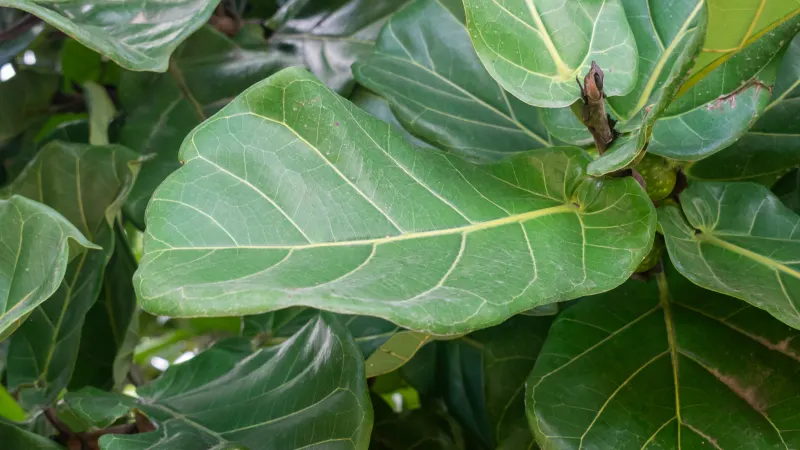
The leaves explain the appetite. Each lyre-shaped leaf — the "fiddle" — can reach 30 cm or more and works as a single enormous solar panel. Panels that size are costly: a plant that cannot fund a leaf with the light it receives quietly withdraws the funding. A light-starved fig drops leaves, stretches into leggy growth, and leans toward the glass: three versions of the same message.
The lean deserves its own habit: a fig angles its whole canopy toward the light, and left alone grows a curved trunk and a lopsided crown. A quarter-turn each week, always in the same direction, keeps it vertical and even — rotation changes the plant's angle to the window, not its conditions, the one move a fig never punishes.
Choose the spot before the plant arrives, and choose it once — every relocation restarts the fig's slow calibration, and the restart is paid in leaves. And if your only bright spot is small, look for 'Bambino', the compact cultivar: the same rules at half the scale.
How often to water a fiddle-leaf fig
Water when the top 5 cm (about two inches) of soil are dry, and not before. Push a finger two knuckles deep; if it comes up cool and damp, put the can down. When it passes the test, water thoroughly — until it runs freely from the drainage holes — then let the pot drain and empty the saucer. In a bright, warm room that comes round far more often in summer than in winter, when the plant needs much less. But the soil decides, not the date.
The number matters less than the steadiness, because volume is not what kills fiddle-leaf figs; whiplash is. The classic pattern: three weeks of forgetting, then a guilt-soaked double watering, then anxious daily sips, then another lapse. Drought stresses the plant; soggy, airless soil stresses it differently — and both extremes end in the same place, with leaves on the floor. A modest routine kept perfectly beats a perfect routine kept occasionally. The fuller method for reading a pot before you reach for the can — weight, feel, the difference between surface-dry and dry-at-depth — is in when to water houseplants.
This is also where a calendar quietly fails you: the right interval moves with the week's weather, and a fixed reminder is wrong in both directions within a month. For the houseplant that punishes change hardest, what helps is a model that knows your pot's rhythm rather than the species average — a running estimate of the moisture left in that specific pot, drawn down on the real temperature and light it lives in. That is what the Digital Shadow keeps for every Specimen in your sanctuary, and why its watering nudge lands on a different day each time — and is right more often than the calendar was.
Soil and potting
The fig is not fussy about soil chemistry, but it is unforgiving about drainage. A standard houseplant mix opened up with bark and perlite (roughly equal parts of each) drains the way this fig needs; a dense, peat-heavy compost stays wet and airless and invites the rot that gets misdiagnosed as everything else. Drainage holes are non-negotiable.
Repot when the roots tell you to: circling roots, water racing straight through without soaking in, a pot drying out much faster than it used to. Go up a single size: 2.5-5 cm wider, no more. An oversized pot surrounds the roots with soil nothing is drinking from, and that soil stays wet and airless. Repot in spring, when recovery is fastest.
One rule specific to this species: never stack changes. A repot in the same week as a relocation, or a relocation in the same week as a hard pruning, doubles the renegotiation and doubles the leaf drop. One change at a time, then stillness.
Humidity and temperature
Medium humidity keeps a fiddle-leaf fig comfortable, and ordinary room air is workable, as long as the air around the plant is not actively moving and dry. The real hazards are mechanical: a heating vent or radiator blasting hot air across the canopy, or an air-conditioning current in summer, will brown and spot the leaves. Before reaching for a humidifier, check what is blowing on the plant.
Temperature wants 18–27°C, and cold is the enemy worth planning around. Keep it above about 15°C: colder than that brings chilling injury, with dark, slimy spots on the leaves and heavy leaf drop. The fig's classic winter injuries are positional: a leaf pressed against single-glazed window glass at night, or a spot in the path of a balcony door that opens ten times a day. The thermostat reports the room's average; the plant lives in its exact spot.
Resist the instinct to relocate it for the season — moving the pot to escape a draft adds a second stress on top of the first, and because the damage from a cold shock can show only days later and the leaf drop can run on for weeks, owners reliably blame the wrong thing. Fix the draft where the plant stands: seal the gap, redirect the vent, pull the pot back half a metre rather than across the room.
Feeding
A fiddle-leaf fig in active growth is doing real work, and through the growing season it appreciates support: a balanced houseplant fertiliser at the label rate every two or three months, or a much weaker dilution more often, from spring through summer. Through autumn and winter, taper to nothing — a plant that has stopped producing leaves cannot use what you pour in.
Restraint is the rule, because fertiliser is salt. An excess accumulates in the soil, pulls moisture back out of the roots, and burns leaf tips and edges brown — damage that looks almost identical to dry air, which is how over-fed figs end up beside humidifiers while the real problem builds in the pot. If you have fed enthusiastically and the edges are browning, flush the pot through with plain water and resume more gently.
Common problems
Leaf drop is the signature complaint, and the diagnostic move is always the same: look backwards. Leaf drop after a change can run on for weeks, so the cause may be a change made weeks ago, not yesterday — a move, a rearrangement that altered the light, a new seasonal draft, a watering rhythm that swung. Find the change and undo it, or hold the new conditions steady and let the plant finish recalibrating; what a fig cannot survive is a guardian who answers leaf drop with another round of changes. One hard fact: a dropped leaf never grows back. New leaves come from the growing tips, so the trunk below stays bare unless pruning the tip wakes dormant buds lower down into side shoots. With this species, prevention is not the better option — it is the only one.
Brown spots are a triage problem — the pattern names the cause. Dark brown to black patches, wilting, and soil still wet days after watering: root rot, and more water makes it worse. Unpot and look: rotten roots are brown to black and soft. If only a few are affected, cut them out, repot into fresh mix, and water less. Brown, crispy tips and edges, on bone-dry soil in a light pot: drought stress, hot dry air or salt build-up. The fix is a steadier rhythm, not a flood. Many small, water-soaked, angular spots that turn yellow and then brown: bacterial leaf spot. Remove the affected leaves, keep water off the foliage, and improve the airflow. Reading the pattern before acting is the whole skill, and it generalises beyond this species — how to read plant health signs covers the method.
Red or rust-coloured speckling on new leaves alarms almost everyone and is easy to stop. It is usually oedema, a physiological disorder brought on by soil that stays too moist, especially with poor light and cool temperatures. The marked leaves will not clear, and if the cause continues leaves can yellow and drop, so water less often and improve the light to halt it.
A leaning, weak trunk is a light problem wearing a structural costume. A fig stretching toward a too-distant window grows a thin, curved trunk that cannot hold its own canopy. More light and the weekly quarter-turn address the cause — and then there is the strangest, most pleasing fix in houseplant care: wiggle the trunk. In habitat, wind stresses a young fig constantly and the trunk answers by thickening; indoors, no wind ever comes. Sway the trunk gently and regularly — the plant reads the movement as weather and builds wood to withstand it. A stake is a temporary splint at most; a permanent one removes the very signal the trunk needs, and keeps it weak.
Frequently asked questions
Why is my fiddle-leaf fig dropping leaves?
Because something changed, and dropping a leaf is the only answer it has. The usual suspects: relocation (including a rearrangement that altered its light), a cold draft from a window, door, or vent, and a watering rhythm that swung between drought and deluge. The drop can run on for weeks after the cause, so look backwards through the past month rather than at yesterday. Then undo the change, or hold the new conditions perfectly steady until the plant settles — answering the drop with yet another change is what makes it worse.
How often should I water a fiddle-leaf fig?
When the top 5 cm (about two inches) of soil are dry — far more often in a bright summer room than in winter, and the conditions decide, not the date. Water thoroughly until it runs from the drainage holes, let the pot drain fully, and never leave it standing in water. Steadiness matters more than volume: drought and soggy soil end in the same dropped leaves, so checking the soil on the same day each week is worth more than any fixed interval.
Will the leaves my fig dropped grow back?
Not in the same place. A fallen leaf is not replaced: new leaves come from the growing tips, which is how a mistreated fig becomes the familiar bare pole with a tuft at the top. Pruning the tip can wake dormant buds lower down into side branches, but it will not refill the bare trunk with leaves. The trunk you have is the record of every past inconsistency. The honest path to a full, leafy fig is keeping the leaves it has now, not waiting for replacements.
Is a fiddle-leaf fig safe for cats and dogs?
No. The plant is toxic to cats and dogs if chewed, and its stems carry a milky white sap, containing ficin, that irritates human skin — wear gloves or wash promptly after pruning. Keep it out of reach of pets that chew; if that is impossible in your household, a pet-safe species such as the spider plant is the kinder choice.
Can Botanical Legacy tell me exactly why a leaf dropped?
Not always, and it is worth being plain about the boundary. The photo diagnostics read what the leaf shows — spot patterns, colour shifts, the rot-versus-drought distinction — and the Digital Shadow holds the watering history and local weather, so a moisture swing or a cold-snap risk gets flagged with real evidence behind it. But a draft from a poorly sealed window is invisible unless a sensor in the room feels what the plant feels. Some causes leave no trace a camera can read, and the app does not pretend otherwise.
Start your sanctuary
Botanical Legacy's free Observer plan covers up to five Specimens, each with its own continuously running Digital Shadow — a fiddle-leaf fig included. Every new account starts with a 14-day trial of Cultivator, our paid plan, which adds the local weather feed and sensor support, so the Shadow reads the room your fig lives in rather than estimating it.
START YOUR SANCTUARY — FIVE FREE SPECIMENS, NO PAYMENT REQUIRED →
A fiddle-leaf fig does not ask you to be talented — it asks you to be the same person every week.
Sources
The plant-care facts on this page were checked against these references.
- NC State Extension: plants.ces.ncsu.edu/plants/ficus-lyrata
- Missouri Botanical Garden: plantfinder.mobot.org/PlantFinderDetails.aspx
- Clemson HGIC (houseplant disorders): hgic.clemson.edu/factsheet/houseplant-diseases-disorders
- UF/IFAS: edis.ifas.ufl.edu/publication/EP136
- UMD Extension: extension.umd.edu/resource/lighting-indoor-plants
- Clemson HGIC (indoor plants): hgic.clemson.edu/factsheet/indoor-plants-cleaning-fertilizing-c…
- Penn State Extension: extension.psu.edu/aloe-a-hardy-houseplant
- UMD Extension: extension.umd.edu/resource/watering-indoor-plants
- Clemson HGIC (soil mixes): hgic.clemson.edu/factsheet/indoor-plants-soil-mixes
- RHS: rhs.org.uk/container-gardening/how-to-repot-a-plant
- RHS overpotting: rhs.org.uk/prevention-protection/overpotting
- UC IPM: ipm.ucanr.edu/PMG/GARDEN/ENVIRON/frostdamage.html
- RHS: rhs.org.uk/advice/understanding-plants/how-plants-grow
- UF/IFAS: edis.ifas.ufl.edu/publication/PP308
- Badel et al. 2015, Frontiers in Plant Science: pmc.ncbi.nlm.nih.gov/articles/PMC4406077
- Colorado State Extension: extension.colostate.edu/resource/staking-trees
- Clemson HGIC (winter care): hgic.clemson.edu/end-of-winter-houseplant-care-how-to-prepare-i…
- ASPCA: aspca.org/pet-care/aspca-poison-control/toxic-and-non-toxic-pla…
- ASPCA: aspca.org/pet-care/aspca-poison-control/toxic-and-non-toxic-pla…