Species care guide
Rubber plant
Ficus elastica
Rubber plant care that explains the leaf drop: how much light Ficus elastica needs, why inconsistent watering and cold drafts shed leaves, and how to keep it glossy.
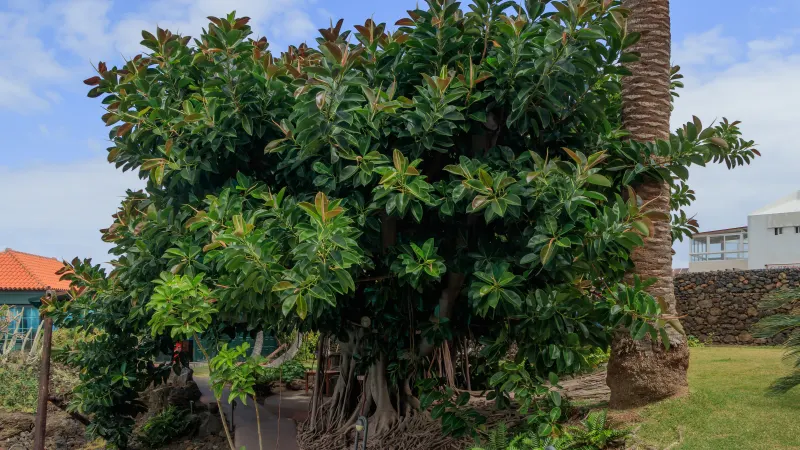

- Light
- Bright indirect light with some morning sun; growth slows and lower leaves drop in dim rooms; variegated cultivars need more light than the solid green
- Water
- When the top few centimetres of soil are dry; more often in summer, less in winter; soggy soil causes leaf drop
- Humidity
- Prefers humid air but tolerates normal indoor air; benefits from occasional leaf-wiping to keep dust from blocking light
- Temperature
- 18–27°C; sensitive to cold drafts and sudden temperature changes — leaf drop is often the result
- Pets & toxicity
- Toxic to cats and dogs; the milky sap also irritates human skin — wash hands after handling
- Difficulty
- Moderate; forgiving once settled but sensitive to sudden moves and cold drafts
A rubber plant rarely complains about how you care for it — it complains about how you changed it.
A forgiving plant with one short temper
The rubber plant is one of the great architectural houseplants: a single upright stem hung with broad, leathery, mirror-glossy leaves, growing from a tabletop specimen into a small indoor tree if you let it. It is sold as easy, and once it has settled it genuinely is — but it carries one quirk that turns a placid plant into a frustrating one, and it is worth naming up front. A rubber plant hates change. Move it, chill it, or let its watering lurch from bone dry to soaked, and it answers the only way it can: it drops leaves.
Ficus elastica is a fig from the warm, humid forests of South and Southeast Asia, where it begins life perched on another tree and eventually grows into a giant. The milky white sap that wells from any cut — the latex that once gave the plant its name and a brief role in rubber production — is the same sap that irritates skin and makes the plant toxic to pets, so gloves and a wiped blade are sensible whenever you prune or repot. Indoors it keeps the forest tree's preferences: bright but filtered light, steady warmth, and consistency above all. It is closely kin to the fiddle-leaf fig, a fellow Ficus, and like the other indoor figs it wants an even temperature, away from draughts and sudden swings.
Read its history and the care follows. Give it good light, water it on the soil's evidence rather than the calendar's, keep it warm and still, and a rubber plant will hold its leaves and add new ones for years. Most of what goes wrong is not a care failure so much as a change the plant disliked.
Light: the dividing line between the green and the variegated
A rubber plant wants bright, indirect light — near a window, with perhaps a little soft morning sun, out of the path of harsh midday glare that can scorch the leaves. In good light it grows steadily, holds its lower leaves, and keeps the deep shine that is the whole point of the plant. In a dim room it does not die; it slows, the new leaves come in spaced further apart, and over months the plant grows leggy as it reaches for the window.
The cultivar you own decides how much latitude you have. The solid-green and dark-leaved forms — the classic Ficus elastica, and dark cultivars like 'Burgundy' or 'Abidjan' — carry plenty of chlorophyll and tolerate a moderately lit spot with reasonable grace. The variegated forms are a different proposition: 'Tineke' and the other cream-marbled types have far less green tissue doing the photosynthetic work, so they need noticeably more light to sustain themselves, and they tell you when they are short of it — the variegation fades, the cream washes toward plain green, and the bright pattern you paid for quietly disappears. If a variegated rubber plant is reverting to green, the answer is almost always more light, not less.
Here is the distinction that trips people up: a healthy dark-leaved rubber plant and a light-starved one can look similar at a glance, because both are deep green. Read the other signals. A well-lit plant holds its lower leaves, spaces new growth tightly, and stands upright; a dim-adapted one drops from the bottom, stretches between leaves, and leans. The colour is not the tell — the posture and the leaf spacing are.
How often to water a rubber plant — and why inconsistency sheds leaves
The headline rule is simple: water when the top few centimetres of soil have dried out. Push a finger in to about the second knuckle, and if the soil is dry to that depth, water thoroughly until it runs from the drainage hole, then let the pot drain completely. In a warm, bright summer that comes round far more often than in a cool, dim winter. As with every plant, the interval is a property of the conditions, not the calendar — the same specimen drinks far faster in July than in January.
But the rubber plant adds a wrinkle the tougher houseplants do not have, and it is the key to the whole species: it punishes inconsistency specifically. Too much water and too little can each make a rubber plant drop leaves, and a rhythm that swings between them delivers both stresses in turn. A plant left bone dry for a fortnight, then guiltily drenched, then left dry again, is a plant being yanked between drought stress and waterlogged roots, and shedding leaves is how it copes. Soggy, permanently wet soil rots the roots and yellows the leaves; repeated drying to a crisp scorches the edges and crisps them brown. The plant is happiest on a steady, moderate rhythm — reliably watered when the top few centimetres dry, reliably drained, never sitting wet and never bone dry for long.
That steadiness is exactly what is hard to deliver from memory, because the right interval keeps moving with the light and the season. This is the gap a per-specimen model closes. Each Specimen in your sanctuary carries a Digital Shadow — a running estimate of the moisture left in that pot, drawn down on the real warmth and light of your room — so the watering tracks the plant's genuine drying curve instead of a fixed weekly slot. For a plant whose leaf drop is a consistency problem more than a quantity problem, a model that smooths the rhythm out is doing the most useful thing you can do for it. The deeper logic of why steady beats sporadic, for this plant and most others, is the whole case for a per-specimen model.
Leaf care: dust is a light problem
The rubber plant's broad, glossy leaves are unusually good at collecting dust, and dust is not merely cosmetic here — a film of it physically blocks light from reaching the leaf surface, throttling the photosynthesis the plant depends on. A dusty rubber plant in a bright window is effectively living in a dimmer room than it appears to.
The fix is a two-minute monthly job: wipe both sides of each leaf gently with a soft, damp cloth, supporting the leaf from underneath so you do not stress the stem. Skip the commercial leaf-shine sprays — they can clog the pores the leaf breathes through, and the plant's own polish, restored by a clean wipe, looks better anyway. While you are wiping, you are also inspecting: the undersides of the leaves are where scale and spider mites set up first, and a monthly close look catches them while they are still a nuisance rather than an infestation.
Humidity and temperature
A rubber plant prefers humid air, but it is far more tolerant of ordinary household air than its rainforest origins suggest, and you do not need a humidifier to keep one happy. Very dry winter air can brown the leaf edges over time, in which case grouping plants together or running a humidifier nearby helps, but humidity is rarely the thing that goes wrong with this plant.
Temperature and stillness are. The comfortable band is 18–27°C, and within it the plant is content; the trouble comes at the edges and in the transitions. Cold drafts are a specific enemy — a rubber plant beside a door that opens onto winter, against single-glazed glass, or in the path of an air-conditioning vent will drop leaves in protest, and a chill below about 10–13°C does real damage. Just as provoking is abrupt change of any kind: bring a new rubber plant home, or shift an established one to a different room, and some leaves may fall purely as a stress response to the move. This is not a care failure to chase in circles — it is the plant adjusting. Settle it in a stable spot with steady light and warmth, resist the urge to keep relocating it, and the dropping stops as it acclimatises.
Common problems
Lower leaves dropping. The classic rubber plant complaint, and it has several possible causes you separate by context. A few lower leaves shed slowly over time is natural senescence — the plant sheds its oldest as it grows taller, and there is nothing to fix. A sudden flush of dropped leaves usually traces to a change: a recent move, a cold draft, or a watering swing. Leaves yellowing before they fall point at watering: wet soil means overwatering, while bone-dry soil means the plant has been left thirsty. Work out which by what changed lately, not by guessing.
Yellowing leaves. Most often overwatering — check the soil, and if it is wet well below the surface, ease off and let it dry further between drinks before the roots suffer. A rubber plant standing in a saucer of water, or potted in dense compost that never dries, yellows and drops leaves. Occasional lower-leaf yellowing with age is normal; widespread or new-growth yellowing is a watering signal.
Brown, crispy leaf edges. The dry end of the scale: underwatering, very dry air, or cold exposure. If the soil has been bone dry too long, return to a steady rhythm; if the air is parched in winter, raise the humidity a little; if a leaf sat against freezing glass, move it back. The browned edges themselves will not green again, but the cause, once removed, stops the spread.
A leggy, bare-stemmed plant. Too little light over months — the plant has stretched and shed its lower leaves reaching for a window. Move it brighter, and consider pruning the top in spring to encourage branching and a fuller shape; the cut will weep sap, so glove up and have a cloth ready.
Propagation — cuttings, and the sap
A rubber plant propagates from stem cuttings, best taken in spring or early summer when the plant is growing. Cut a section of stem with at least one or two leaves and a node — the point where a leaf joins the stem, from which new roots emerge. The cut will immediately weep the milky latex sap, so keep it off your skin and blot the cut end clean. Pot the cutting into moist, free-draining mix, keep it warm and bright but out of direct sun, and give it patience.
For a leggy plant, air layering is the usual route to a full new specimen — wounding the stem, wrapping the spot in damp moss until roots form there, then cutting below — but a simple cutting is the place to start. Either way, wear gloves and keep the sap off your skin; this is the one houseplant where the propagation itself carries a small handling warning.
Frequently asked questions
Why is my rubber plant dropping leaves?
Almost always a reaction to change rather than a slow care failure. The usual triggers are a recent move to a new spot, a cold draft from a window or door, or a watering rhythm that swings between bone dry and soaked. A few lower leaves lost gradually with age is normal; a sudden flush falling at once means the plant has been disturbed. Settle it in a stable, warm, brightly lit spot, water it steadily, stop relocating it, and the drop stops as it acclimatises.
How often should you water a rubber plant?
When the top few centimetres of soil have dried out — push a finger in to the second knuckle, and water only when the soil is dry to that depth. In a warm, bright summer that is far more often than in winter. The exact interval depends on your light, pot, and season, not on a fixed schedule. What matters most for this plant is consistency: a steady rhythm holds its leaves, while lurching between drought and flood is what sheds them.
Why are my rubber plant's leaves turning yellow or curling?
A few of the oldest, lowest leaves yellowing and dropping with age is normal. Wider yellowing usually means the soil has stayed too wet — check that the top few centimetres dry between waterings and that the pot drains freely. Wilting or drooping leaves on dry soil point the other way: underwatering, sometimes made worse by very dry air. Read the soil first — wet and yellow means ease off the water; bone-dry and wilting means water more steadily.
Why is my variegated rubber plant turning green?
It needs more light. Variegated cultivars like 'Tineke' have far less green tissue to photosynthesise with, so in a dim spot they fade and revert toward plain green. Move the plant to a brighter window with good indirect light and some gentle morning sun. Prune out any shoot that has gone fully green, because reverted shoots are more vigorous than the variegated growth and can take over.
Are rubber plants toxic to pets?
Yes. Ficus elastica is toxic to cats and dogs, and the milky sap that weeps from any cut also irritates human skin and can aggravate allergies. Keep the plant out of reach of pets inclined to chew, wash your hands after pruning or repotting, and wear gloves if your skin is reactive. If you keep pets, Botanical Legacy surfaces pet-safety on each Specimen's card so the safe and unsafe plants in your sanctuary are clear at a glance.
Can Botanical Legacy help with a plant this sensitive to change?
Indirectly, in the way that matters most for it. A rubber plant's troubles are usually consistency problems — a watering rhythm that lurches, or a stress the plant is still recovering from — and the Digital Shadow's whole job is to keep the watering steady, timed to how your specific pot dries rather than to a calendar slot. It cannot stop you moving the plant into a draft, but it removes the watering swings that are the other half of why rubber plants drop leaves.
Start your sanctuary
Botanical Legacy's free Observer plan covers up to five Specimens, each with its own continuously running Digital Shadow — and a rubber plant, whose leaf drop is so often a consistency problem, is exactly the kind of plant a steady per-pot model settles. Every new account also includes a 14-day trial of Cultivator, the paid plan, which adds the local weather feed and soil sensor support.
START YOUR SANCTUARY — FIVE FREE SPECIMENS, NO PAYMENT REQUIRED →
Give a rubber plant light, warmth, and a steady hand — and then, hardest of all, leave it where it is.
Sources
The plant-care facts on this page were checked against these references.
- Missouri Botanical Garden: plantfinder.mobot.org/PlantFinderDetails.aspx
- NC State Extension: plants.ces.ncsu.edu/plants/ficus-elastica
- ASPCA: aspca.org/pet-care/aspca-poison-control/toxic-and-non-toxic-pla…
- RHS: rhs.org.uk/plants/ornamental-figs/growing-guide
- Clemson HGIC: hgic.clemson.edu/factsheet/rubber-plant
- Colorado State Extension: planttalk.colostate.edu/topics/houseplants/1326-rubber-plant
- UF/IFAS: ask.ifas.ufl.edu/publication/ep136
- UMD Extension: extension.umd.edu/resource/lighting-indoor-plants
- RHS 'Abidjan': rhs.org.uk/plants/187847/ficus-elastica-abidjan/details
- RHS 'Tineke': rhs.org.uk/plants/304267/ficus-elastica-tineke-%28v%29/details
- RHS light: rhs.org.uk/advice/understanding-plants/how-plants-use-light-to-…
- RHS reversion: rhs.org.uk/problems/reversion
- UMD Extension: extension.umd.edu/resource/watering-indoor-plants
- RHS houseplant problems: rhs.org.uk/plants/types/houseplants/how-to-help-a-poorly-housep…
- Clemson HGIC disorders: hgic.clemson.edu/factsheet/houseplant-diseases-disorders
- Ohio State Extension: u.osu.edu/knoxcountyag/2018/12/19/why-you-should-clean-the-leav…
- Clemson HGIC cleaning: hgic.clemson.edu/factsheet/indoor-plants-cleaning-fertilizing-c…
- Penn State Extension: extension.psu.edu/humidity-and-houseplants
- Penn State Extension: extension.psu.edu/repotting-houseplants
- Iowa State Extension: yardandgarden.extension.iastate.edu/faq/how-can-i-propagate-rub…