Plant care guides · 15 min read
Houseplant care for beginners: the 10 mistakes everyone makes
Most plants don't die from neglect — they die from the ten most common beginner mistakes. Here's what they are, how to recognise them, and how to stop making them before they cost you a plant you love.
Botanical Legacy · Field notes ·
Most houseplants don't die from neglect. They die from the same ten mistakes — repeated by every new plant parent, in every city, with every species.
Plants are not fragile. The advice is.
Almost everyone who loses a houseplant comes to the same private conclusion: they have a black thumb, plants are just hard, some people have the knack and they don't. It is a comforting story because it is nobody's fault. It is also wrong.
Plants are resilient organisms. They survived long before anyone was around to water them, and the common houseplants - pothos, snake plant, monstera, peace lily - are popular indoors in large part because they cope with the shade of an ordinary room and shrug off the occasional bad week. A healthy specimen will forgive a great deal. What it will not forgive is being treated, confidently and repeatedly, for a problem it does not have.
That is the real source of beginner plant loss, and it is not fragility. It is that the standard advice — "water when the top inch is dry," "bright indirect light," "feed once a month" — is generic enough to be wrong for most specific plants in most specific rooms. The advice is not lying to you. It is just describing an average plant in an average home, and you do not own the average plant. You own a particular specimen, in a particular pot, on a particular windowsill, in a particular month.
What follows is not a lecture. It is a diagnostic checklist: the ten mistakes that kill plants before their owners ever figure out what went wrong, written so you can recognise each one on your own shelf — and stop it — before it costs you a plant you love.
Mistake 1 — Overwatering, the quiet killer
This is the one that takes the most plants, and it almost never looks like what it is. Overwatering does not drown a plant the way you'd imagine. It suffocates the roots. Soil that stays saturated runs out of oxygen, the chemistry at the root zone turns anaerobic, and root tissue begins to rot. The leaves yellow and droop — and here is the trap — they yellow and droop in a way that looks almost identical to thirst.
So the beginner sees a sad, yellowing plant, assumes it needs water, and waters it. The rot accelerates. A week later the plant looks worse, so they water again. The plant is being killed by the very act meant to save it.
The single most useful signal: if the soil is still wet several days after you watered, overwatering is the likely culprit — not thirst. A heavy pot with a drooping plant is almost always overwatered. Before you reach for the watering can, push a finger two knuckles into the soil. If it comes up cool and damp, put the can down. The full symptom-by-symptom breakdown — and how to tell the difference between overwatering and underwatering when they look the same — is worth reading before you ever lose a plant to this.
Mistake 2 — Watering on a schedule instead of reading the plant
"Water every Sunday" feels responsible. It is also the second-fastest way to kill a houseplant, because a calendar knows nothing about your plant's actual week.
The same plant needs far more water during a hot, bright July than during a grey, cool November. It needs more water on a sunny south-facing windowsill than in a dim hallway two metres from the glass. A fixed weekly rhythm is roughly right for a few weeks, then wrong in both directions: a drought during a heat wave, a slow drowning in winter, when growth slows. The plant does not keep a calendar. Its soil dries on the temperature, the humidity, and the light it is living in.
The antidote is simple and it is the most important habit in all of plant care: check the soil, not the calendar. When a reminder fires, treat it as a prompt to look, not a command to pour. Push a finger into the soil. Lift the pot and feel its weight. Water only if the plant needs it. If you want the longer version — the reliable signals and the ones to ignore — we wrote it up in when to water your houseplants.
Mistake 3 — Getting the light wrong
Nearly every beginner guide says "bright indirect light" and stops there, as if the phrase were self-explanatory. It is not, and the vagueness costs plants.
In a real home, bright indirect light means close to a window, but not sitting in a beam of direct sun for hours at a time. Enough daylight to read a book by is roughly the minimum any houseplant needs, not a sign of bright indirect light. A corner across the room that feels "light enough" to your eyes is almost certainly far darker than your plant needs; your eyes adjust to low light far better than a leaf does.
The classic mistake is placing a light-hungry plant somewhere it looks good rather than somewhere it can live — on a bookshelf, a mantel, a dim corner that the room design wanted filled. The plant does not decline dramatically. It just slowly stops growing, pales, and drops a leaf every few weeks until one day it is gone, and nobody connects the death to a decision made months earlier.
Some species genuinely tolerate low light — pothos, ZZ plants, and cast iron plants will hold on in a dim spot for a long time. Others - fiddle leaf figs and nearly all succulents - will quietly fail there, and even a monstera, which copes with some shade, needs bright indoor light to grow well. Match the plant to the light you have, not the light you wish a corner had. (If a monstera is the plant you're trying to get right, our full Monstera care guide covers exactly the light it needs — and how to read its leaves when the light is wrong.)
Mistake 4 — The wrong pot size
The instinct is generous: give the plant room to grow, pot it into something big, save yourself the repotting. The instinct is wrong, and it kills plants the same way overwatering does.
A small-rooted plant in an oversized pot is surrounded by soil it cannot use. The roots draw moisture from their own small zone; the rest of that excess soil stays wet for days or weeks, because there are no roots in it to drink it. That standing moisture is exactly the anaerobic, root-rotting condition from Mistake 1 — except now you can be watering perfectly and still lose the plant, because the pot itself is holding water the roots can't reach.
The rule is to pot up one size at a time, not three. When roots are circling the bottom of the current pot or poking out the drainage holes, move the plant to a container no more than 2.5 to 5 cm wider. A plant is happier slightly snug than swimming.
Mistake 5 — Ignoring drainage
A pot without drainage holes traps water at the bottom, where the roots sit. There is no escape route for the excess, so the lowest layer of soil stays permanently saturated — and that is one of the fastest ways to kill a plant that is otherwise being cared for correctly.
If you love a decorative pot that has no drainage hole, do not plant directly into it. Use it as a cachepot: keep the plant in its plain nursery pot, set that inside the decorative one, and lift it out to water and drain. You get the look and the plant gets to breathe.
And resist the most persistent myth in houseplant care: adding a layer of gravel or stones to the bottom of a pot without drainage does not help. It does the opposite. The water does not neatly sink into the gravel; it perches in the soil just above it — a phenomenon called the perched water table — leaving the root zone wetter, not drier. Drainage holes are the only real fix. Everything else is theatre.
Mistake 6 — Using the wrong soil
Reach for a bag labelled "potting soil," fill every pot from it, and most of your tropical foliage plants will be fine — pothos, peace lilies, dracaenas, and the like are forgiving about substrate. But "most" is not "all," and the exceptions die quietly.
Succulents and cacti need a gritty, fast-draining mix; in standard potting soil they stay too wet and rot from the roots up. Most orchids sold as houseplants are not soil plants at all: they want a bark-based orchid mix, and packed into ordinary compost they suffocate. Aroids - monsteras, pothos, philodendrons - have thick roots that suit a chunky, aerated mix with bark and perlite, and they rot in compost that stays wet like a sponge.
The principle behind all of it: soil that stays too dense or too wet for a given species will stress the roots no matter how carefully you water. Watering technique cannot rescue the wrong substrate. If you want to take the guesswork out of how wet your soil stays between waterings, soil moisture monitoring shows you the drying curve directly instead of leaving you to infer it from the surface.
Mistake 7 — Over-fertilising
New plant owners tend to under-feed far more often than they over-feed — but when they do over-feed, the damage is faster and uglier. Fertiliser is salt. Excess concentrations build up in the soil over time, draw moisture back out of the roots, and scorch the plant from the tips inward.
The classic symptom is brown, crispy leaf tips and margins — which looks almost identical to the browning caused by low humidity, so beginners often misread fertiliser burn as dry air and reach for a humidifier while the real problem keeps building in the pot.
The correct cadence is restraint. Feed lightly during the active growing season — spring and summer — when the plant is using the nutrients, and at half the strength the bottle suggests. Stop almost entirely in autumn and winter, when most houseplants slow down and are not growing enough to consume what you give them. A plant that is barely growing does not need feeding; it needs to be left alone.
Mistake 8 — Ignoring early stress signals
Plants communicate, but slowly. A plant in trouble does not collapse overnight; it sends signals for days or weeks first — faint yellowing on a lower leaf, a slight droop that recovers by evening, new growth that comes in pale or undersized, a leaf that curls a little at the edge. Each of those appeared well before the morning the plant finally looks obviously sick.
The real skill gap in beginner plant care is not watering technique. It is learning to read the plant before a signal becomes a crisis — to notice, on a routine glance, that this week's new leaf is smaller than last month's, or that the colour has drifted a shade paler than it was. By the time a plant is unmistakably dying, the underlying problem has usually been running for a week or more, and the window to act gently has closed.
You do not need to become an expert diagnostician. You need to look, briefly, often, and with attention. The catalogue of what each signal tends to mean — and why a single symptom rarely tells you what to do on its own — is laid out in reading plant health signs. The habit of looking early is the thing that separates people who keep plants alive from people who don't.
Mistake 9 — Moving plants too often
A plant takes several weeks to acclimate to a new position: new light, new airflow, new temperature. During that adjustment it may drop a leaf or two or yellow slightly, not because the new spot is wrong but because adapting to any new spot costs the plant something.
Here is where it goes sideways: an anxious owner sees that adjustment stress, reads it as "this location isn't working," and moves the plant again. The clock resets. The plant, now adapting to a third position, sheds another leaf — which reads as further confirmation that something is wrong, prompting yet another move. The plant never gets the uninterrupted month it needs to settle anywhere.
Pick a spot that makes sense for the plant's light needs, and then leave it there for at least a month before you judge whether it is working. Stillness is a care strategy.
Mistake 10 — Following generic species advice instead of learning your specimen
This is the mistake that takes the longest to outgrow, because the entire ecosystem of beginner plant resources is built on it.
"Monsteras need water every seven days." That sentence is advice for a mythical average monstera, in an average pot, in an average climate, in an average month. It does not exist. Your monstera — in a 15 cm terracotta pot on a south-facing balcony in Rotterdam — has a completely different rhythm from the same species in a plastic pot on a shaded shelf in London. Same plant on the label; two entirely different lives. One might genuinely want water every five days in summer; the other every two weeks. A single species number cannot be right for both, and it is usually wrong for yours.
Beginner resources rarely admit this, because a clean number is easier to publish than the truth, which is messier: that real plant care eventually means building a model of this specific plant in this specific environment, not applying a species-level rule and hoping. The number on the care tag is a starting point, never an answer.
This is exactly the gap a Digital Shadow is built to close. Instead of a fixed schedule, it keeps a continuously running model of each plant you own — a live estimate of how much moisture is left in that pot, drawn down day by day based on the temperature, light, and conditions your specimen is really living in, and refined over time by your photos and care actions. The species tag tells you where to begin. The Digital Shadow tells you what your particular plant needs this week, in this room, in this weather — which is the only thing that was ever going to keep it alive.
How to move faster on all ten
If there is a single thread running through every one of these mistakes, it is this: better information, delivered earlier, prevents the damage. None of these plants died because their owners didn't care. They died because the owner found out what was happening a week too late, or acted on advice that was never about their specific plant.
You can shortcut most of it with three habits:
- Check soil moisture before every watering decision. Not the calendar, not the surface — a finger two knuckles deep, or the weight of the lifted pot. This one habit prevents Mistakes 1 and 2 outright.
- Look at each plant for ten seconds every week. Not to do anything — just to notice. Early signals only help you if someone is there to read them.
- Keep a simple log of when you watered and what the plant looked like. A trajectory tells you what a single glance cannot: that this droop is the third in a week, or that the new leaves have been shrinking since March.
That third habit is the one most people never sustain — which is precisely what the Digital Shadow automates. It keeps the log for you and builds the per-specimen model out of it, so the question stops being "what do monsteras need?" and becomes "what does this plant need, today." No app replaces looking at your plants. But the right one makes the looking count for more.
Frequently asked questions
Why do my houseplants keep dying even when I water them?
In most cases the watering itself is the problem, not the cure. Overwatering — and the root rot it causes — is the single most common reason beginner plants die, and it produces yellowing, drooping leaves that look almost exactly like thirst, so people respond by watering more. The other frequent culprit is light: a plant slowly starving in a spot that is too dark will fail no matter how attentively you water it. Before you water a struggling plant, feel the soil two knuckles deep. If it is still damp, the answer is almost never more water.
How often should beginners water houseplants?
There is no universal number, and any source that gives you one is simplifying to the point of being wrong. The same plant needs water on a different rhythm in summer than in winter, in a bright window than in a dim corner, in terracotta than in glazed ceramic. Check the soil and the plant instead of the calendar: water when the soil is dry a few centimetres down and the pot feels light, not when a set number of days has passed.
What are the easiest houseplants for beginners?
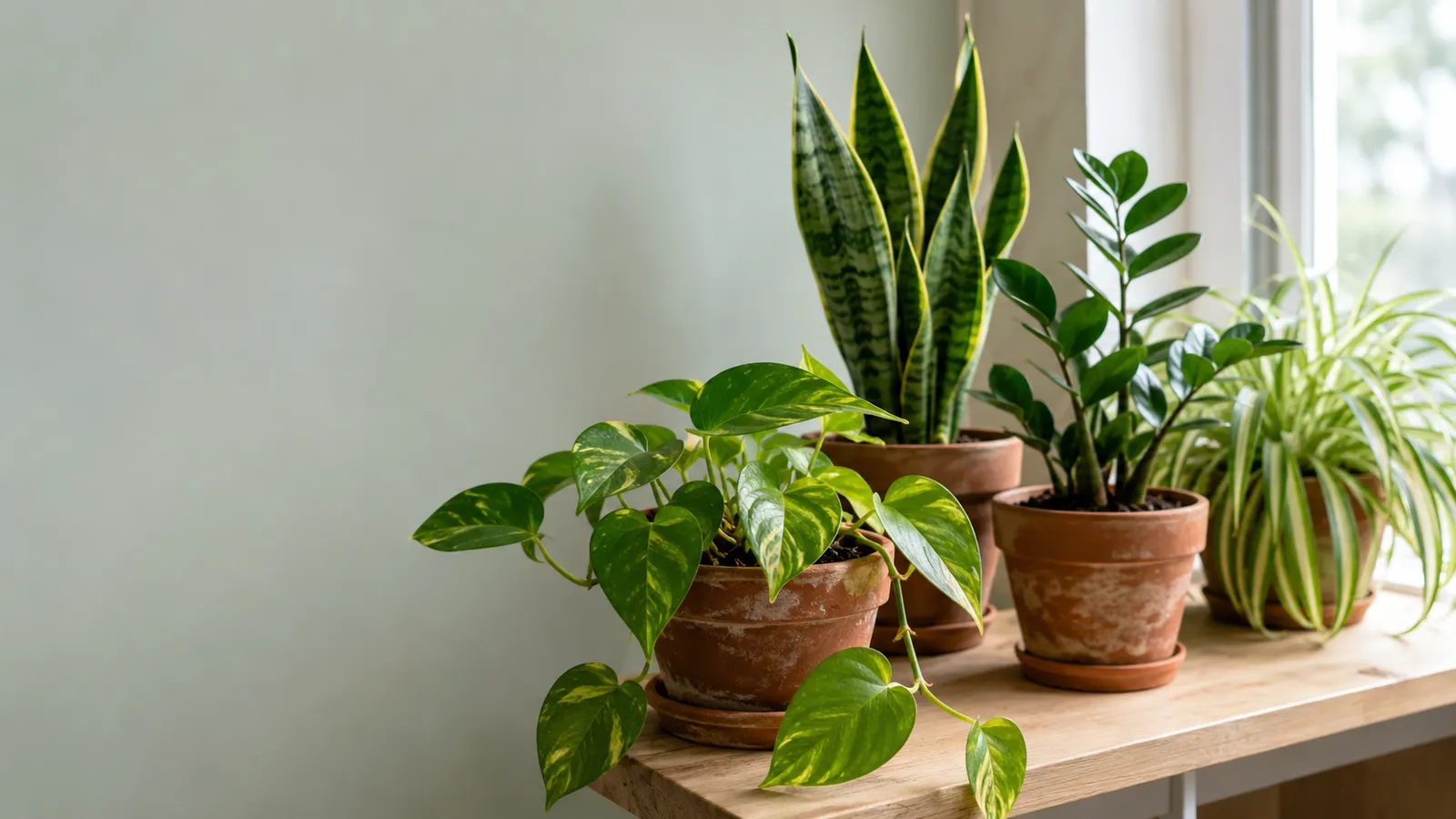
The most forgiving starter plants are pothos, ZZ plant, snake plant, and spider plant. They tolerate irregular watering, lower light than most species, and the occasional missed week — which makes them ideal for learning the habits in this guide without a fragile plant punishing every early mistake. Master the rhythm of looking and checking on these, and harder species become far less intimidating.
How do I know if my plant has root rot?
The clearest signs are a plant that wilts despite wet soil, soil that stays soggy long after watering, and — if you slide the plant out of its pot — roots that are brown or black, soft, and mushy rather than firm and pale, often with a sour, swampy smell. Caught early, root rot is often recoverable: trim the rotted roots back to firm tissue, repot into fresh, well-drained mix in a pot with a drainage hole, and water sparingly, just enough to stop it wilting, while new roots grow.
Is there an app that helps beginners avoid these mistakes?
Yes — that is what Botanical Legacy is built for. Most beginners start with a reminder-based app like Greg or PlantIn, and that is a reasonable first step — but a fixed reminder is Mistake 2 in app form. Every plant you add carries its own Digital Shadow: a continuously running model that estimates how much moisture is left in that specific pot, based on the real conditions your plant lives in, and tells you when that plant needs attention rather than firing a generic reminder. The free plan covers up to five plants. It will not do the looking for you, but it turns the guesswork in this guide into something you can read in a few seconds each morning.
Start your sanctuary
Botanical Legacy's free Observer plan covers up to five Specimens, each with its own continuously running Digital Shadow. Every new account also includes a 14-day trial of Cultivator, our paid plan, which adds the local weather feed and sensor support so the Shadow can read your room directly instead of estimating it.
You do not need to become an expert to keep plants alive. You need to make these ten mistakes a little less often — and to find out what your plant needs a little earlier.
START YOUR SANCTUARY — FIVE FREE SPECIMENS, NO PAYMENT REQUIRED →
Your plant is not the average plant. Stop caring for it as if it were.
Sources
The plant-care facts on this page were checked against these references.
- RHS: rhs.org.uk/plants/types/houseplants/houseplants-for-shady-rooms
- UMD Extension: extension.umd.edu/resource/overwatered-indoor-plants
- RHS: rhs.org.uk/plants/types/houseplants/how-to-help-a-poorly-housep…
- Iowa State Extension: yardandgarden.extension.iastate.edu/how-to/diagnosing-houseplan…
- SDSU Extension: extension.sdstate.edu/troubleshooting-common-problems-houseplan…
- UMD Extension: extension.umd.edu/resource/watering-indoor-plants
- UConn Home & Garden: homegarden.cahnr.uconn.edu/factsheets/ailing-houseplants
- UF/IFAS Gardening Solutions: gardeningsolutions.ifas.ufl.edu/plants/houseplants/light-for-ho…
- Missouri Botanical Garden: missouribotanicalgarden.org/PlantFinder/PlantFinderDetails.aspx
- NC State Extension: plants.ces.ncsu.edu/plants/ficus-lyrata
- RHS cacti: rhs.org.uk/plants/types/cacti-succulents/houseplants/growing-gu…
- Colorado State Extension: planttalk.colostate.edu/topics/houseplants/1316-houseplants-rep…
- University of Arkansas Extension: uaex.uada.edu/yard-garden/home-landscape/house-plants/repotting…
- WSU Extension (Chalker-Scott): wpcdn.web.wsu.edu/wp-puyallup/uploads/sites/403/2015/03/contain…
- Missouri Botanical Garden: missouribotanicalgarden.org/PlantFinder/PlantFinderDetails.aspx
- RHS indoor orchids: rhs.org.uk/plants/types/orchids/indoor
- RHS Phalaenopsis: rhs.org.uk/plants/phalaenopsis/growing-guide
- RHS: rhs.org.uk/plants/types/houseplants/growing-media-houseplants
- University of Missouri IPM: ipm.missouri.edu/MEG/index.cfm
- Clemson HGIC: hgic.clemson.edu/factsheet/weeping-ficus
- MoBot spider plant: missouribotanicalgarden.org/PlantFinder/PlantFinderDetails.aspx
- MoBot ZZ: missouribotanicalgarden.org/PlantFinder/PlantFinderDetails.aspx
- MoBot snake plant: missouribotanicalgarden.org/PlantFinder/PlantFinderDetails.aspx