Plant care guides · 17 min read
Monstera care guide: what your plant actually needs (not what the species card says)
Most Monstera advice is written for an average plant in an average home. Yours isn't average. Here's how to read what your specific specimen is telling you — and what to do about it.
Botanical Legacy · Field notes ·
There is no such thing as "a Monstera." There is your Monstera — in this pot, in this corner, in this week's weather — and it keeps a rhythm no care card has ever met.
Why generic Monstera advice keeps failing good plant parents
Search "how to care for a Monstera" and you will get the same paragraph, lightly reworded, a thousand times over: bright indirect light, water every seven to ten days, keep humidity up, feed monthly in summer. None of it is wrong, exactly. All of it is written for a plant that does not exist — an average Monstera deliciosa in an average pot, in an average room, in an average month.
You do not own the average. You own a particular specimen with a particular root mass, in terracotta or glazed ceramic, two metres from a north window or pressed against a south one, in a flat that swings ten degrees between a July afternoon and a January night. That plant has its own week, and the care card has never seen it. This guide is about reading the plant in front of you instead — and if you are still finding your feet with houseplants generally, the ten mistakes every beginner makes is the companion piece to start with. The same per-specimen thinking now extends to the rest of the shelf: the pothos, snake plant, and fiddle-leaf fig each have a guide of their own.
Light: the single decision that makes or breaks a Monstera
Everything you have read says "bright indirect light," and then stops, as if the phrase explained itself. It does not, and the vagueness costs more Monsteras than any watering can.
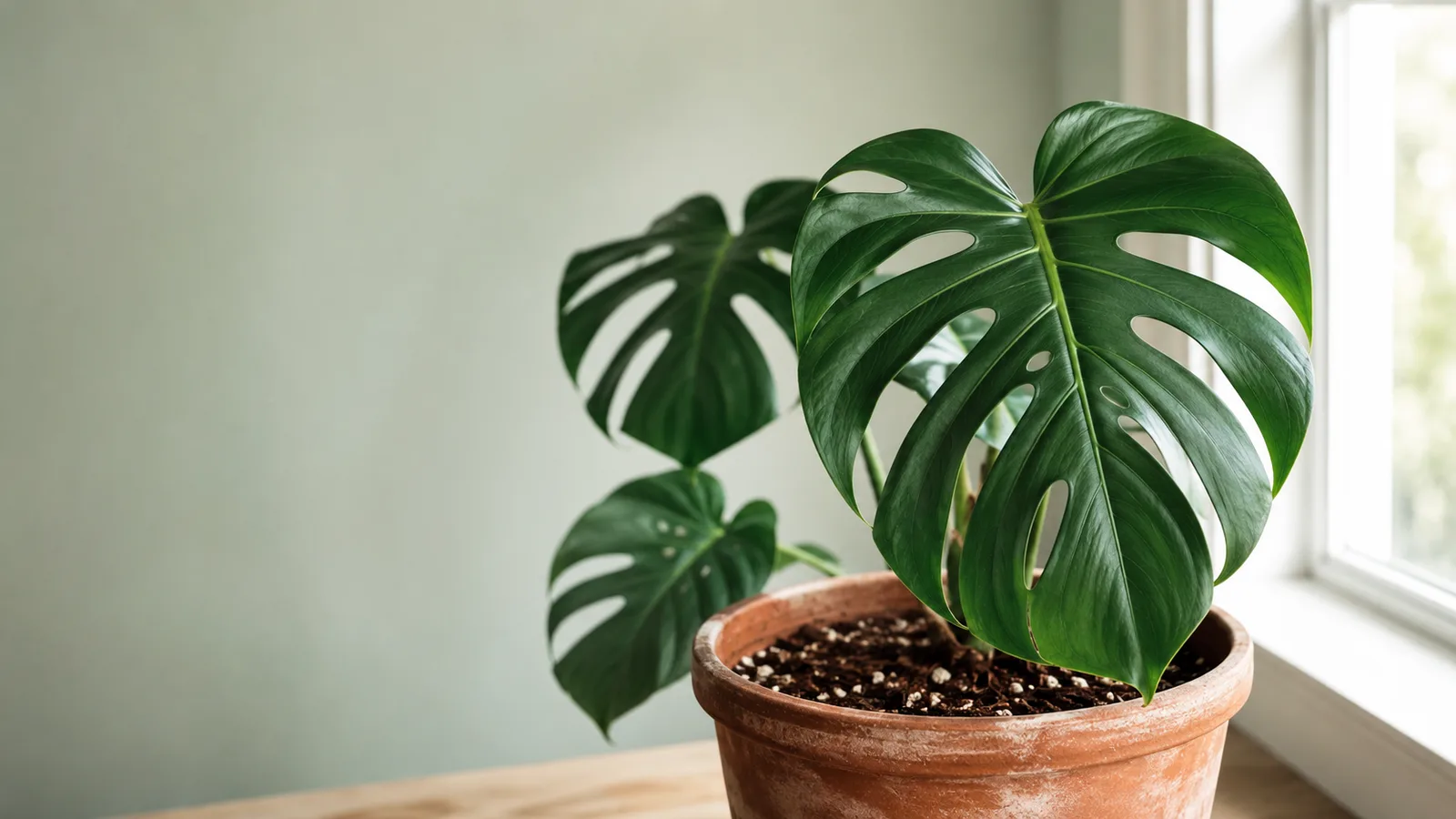
In the wild, Monstera deliciosa is a hemiepiphyte: it germinates on the forest floor of southern Mexico and Central America, then climbs the nearest trunk toward the canopy, trading deep shade for dappled, filtered brightness as it ascends. That climb is the whole story of how it uses light. Down low, in gloom, it grows solid, modest, juvenile leaves. As it reaches better light, the leaves enlarge and begin to split and perforate — the famous fenestration, those holes and notches that everyone buys the plant for.
This matters because fenestration is a light gauge you can read at a glance. A Monstera throwing large, deeply split new leaves is telling you it has enough light. A Monstera whose newest leaves come in smaller than the last, solid, with long bare stretches of stem between them as it stretches toward the window — that plant is light-starved, and no amount of water or fertiliser will fix it. The reach itself, the legginess, is the signal: the plant is hunting for a brightness that is not there.
So what does "bright indirect" mean in a room? A spot bright enough to read a paperback all afternoon without switching on a lamp, close to a window — within a metre or so — but out of the path of harsh, prolonged midday sun, which bleaches and scorches a Monstera leaf into pale, papery patches. A few hours of gentle morning sun from an east window is a gift; six hours of direct south-facing glare in summer is a sunburn. Compass orientation does quiet work most guides never mention: the same room offers radically different light on its north and south walls, and a Monstera that thrives by the east window in spring can struggle in the same flat's interior corner by autumn, when the sun sits lower and the days shorten.
This is exactly the kind of judgement that is hard to make by eye, because light intensity falls away rapidly with distance from a window: a corner that looks "light enough" to you can get a fraction of the light the windowsill does. It is also the kind of judgement Botanical Legacy is built to make for you. When the model tracks a specimen's light over weeks and concludes the current spot is falling short, it surfaces a placement hint — a quiet note that a brighter, better-oriented corner exists in your sanctuary, and which one, rather than leaving you to guess why the new leaves keep shrinking. When the placement is already adequate, it says nothing. That is the per-specimen logic: not "Monsteras like bright light," but "this Monstera, in this room, would do better one window over." It is the same per-plant thinking the whole Digital Shadow model runs on.
Watering: kill the "every 7–10 days" rule first
If light is where Monsteras quietly fail, water is where they fail fast — and almost always because someone is watering on a schedule.
"Every seven to ten days" is the most repeated number in Monstera care and the most dangerous, because a calendar knows nothing about your plant's actual week. The same Monstera drinks far more during a hot, bright stretch in July than during a grey, cool fortnight in November. It dries faster on a sunny sill than in a dim hallway. A fixed weekly rhythm is roughly right for a few weeks and then wrong in both directions: a drought during a heat wave, a slow drowning through winter dormancy. The pot does not keep a calendar. Its soil dries on the temperature, the humidity, and the light it is living in.
Two physical variables that the species card ignores swing the right interval enormously, and you already control both:
- Pot material. A porous terracotta pot breathes through its walls and wicks moisture out into the air; a glazed ceramic or plastic pot seals it in. Repot the same Monstera from terracotta into glazed ceramic and it will need water noticeably less often, with nothing else changed. If your plant suddenly seems thirstier or soggier than it used to be, the pot you chose for looks may be the reason.
- Substrate. Monsteras are aroids, and aroids want a chunky, airy mix — bark, perlite, coco coir, a handful of charcoal — not a dense, peat-heavy compost that holds water like a sponge. The right substrate drains fast and lets air to the roots; the wrong one stays wet for days and invites rot no matter how careful your watering hand is. Two Monsteras side by side, one in aroid mix and one in bagged potting soil, are on completely different drying curves.
So forget the interval and read the soil. The reliable method has not changed: push a finger two knuckles deep before you water. If it comes up cool and damp, put the can down; a Monstera wants the top quarter or so of the substrate to dry out between drinks, and it tolerates a little drought far better than a little drowning. When you do water, water thoroughly — until it runs freely from the drainage holes — then let it drain completely and never leave the pot standing in a saucer of water. A soil probe reads a little deeper than a finger; a real soil-moisture sensor reads the whole curve and removes the guesswork entirely. The longer version of how to read those signals lives in when to water your houseplants.
The trap underneath all of this is that an overwatered Monstera and a thirsty one look almost identical — both droop, both yellow — so the instinct to "give it a drink" is exactly how a struggling plant gets killed by the act meant to save it. Learn to tell the two apart first; the symptom-by-symptom breakdown in overwatering vs underwatering is worth reading before you lose a leaf to the wrong diagnosis.
Humidity and temperature: what your home really provides
Monsteras come from tropical forests where the air stays humid. Your living room does not: in winter, with the heating on, indoor humidity can easily fall below thirty per cent. Monstera deliciosa likes humid air, and the driest stretches show up at the leaf edges, as brown, crisp margins that are easy to misread.
This is where the misting debate belongs, so here is the honest answer: a quick spritz raises humidity for a few minutes and then it is gone, while water left in leaf joints can invite fungal spotting. Misting is a pleasant ritual, not a humidity strategy. If your air is genuinely dry and your Monstera is showing for it, what works is a small humidifier, grouping plants so they share the moisture they transpire, or a pebble tray beneath the pot — steady sources, not a passing mist.
Temperature is the quieter variable. Monsteras are happiest between roughly eighteen and twenty-seven degrees Celsius, and they dislike cold more than heat: sustained exposure below about ten to thirteen degrees does real damage. The two hidden stressors are both about swings rather than averages. A Monstera pressed against a single-glazed window in winter can take a nightly cold draught that the rest of the room never feels. And a plant sitting in the path of a heating vent or radiator gets blasted with hot, drying air that spikes its water use and crisps its edges — a microclimate the thermostat on the wall never reports. The plant lives in its specific spot, not in the room's average, which is the whole reason a per-specimen model beats a single house-wide setting.
Fertilising: less, and at the right time
New Monstera owners tend to under-feed far more often than they over-feed, but when they do over-feed, the damage is faster and uglier — so the rule worth internalising is restraint, not generosity.
Fertiliser is salt. Pour on more than the plant can use and the excess accumulates in the substrate, draws moisture back out of the roots, and scorches the leaf tips and margins brown from the edges inward. That burn looks almost identical to the browning caused by dry air, so the classic mistake is to misread fertiliser burn as low humidity, reach for the humidifier, and let the real problem keep building in the pot.
The cadence that works: feed lightly during the active growing season (spring and summer, when the plant is genuinely putting out new leaves) with a balanced liquid houseplant fertiliser about once a month. Then taper off almost entirely through autumn and winter, when most Monsteras slow down and stop growing enough to consume what you give them. A plant that is barely growing does not need feeding; it needs to be left alone.
Reading the leaves tells you which way to adjust. Uniform paleness across newer growth, or a plant stalled out despite good light and water, can point to a genuine nutrient shortfall. Crispy brown tips on a plant you have fed enthusiastically point the other way — back off, flush the pot with plain water to wash out the accumulated salts, and resume more gently. The leaf is the gauge; the calendar is not.
Repotting: when, and how big a jump
A Monstera tells you it is ready to repot, and the signals are unambiguous once you know them: roots circling the bottom of the pot and escaping through the drainage holes, water that races straight through and out without wetting the soil, a plant that dries out far faster than it used to, or growth that has simply stalled despite everything else being right. Most Monsteras want this every two to three years.
The instinct at that point is generous — give it a huge new pot and save yourself the trouble for years. The instinct is wrong, and it kills plants the same way overwatering does. Pot a modest root mass into an oversized container and you surround it with soil the roots cannot reach; that excess substrate stays wet for days because nothing is drinking from it, and a wet, airless root zone is exactly the rot risk you were trying to avoid. Pot up one size at a time — two or three centimetres wider than the current container, no more. A Monstera is happier slightly snug than swimming.
Two specifics for this species. First, the substrate: refresh into a proper chunky aroid mix, not straight potting soil, for all the drainage reasons above. Second, support: a Monstera is a climber, and giving it a moss pole or trellis to root into encourages larger, more deeply fenestrated leaves than it will ever produce sprawling sideways across a shelf. Time the move for spring or early summer, when the plant is in active growth and recovers fastest; a Monstera repotted in midwinter is slower to recover. And if you find thick aerial roots arcing out of the stem, leave them; more on those below.
Common problems, and how to read them
Most Monstera "problems" are a single visible symptom with several possible causes, and the entire skill is in telling the causes apart before you act. Reach for the wrong fix and you make it worse. Here is how to read the common ones.
Yellowing leaves are the symptom people panic over most and diagnose worst. The most common cause by far is overwatering — soggy substrate suffocating the roots — and the tell is that the soil is still wet days after you watered and the pot feels heavy. But a Monstera also yellows from the opposite extreme (bone-dry soil, a light pot), from too little light (slow, generalised paling), and from a nutrient shortfall. One thing not to worry about: the oldest, lowest leaf yellowing and dropping while everything above looks vigorous is usually just the plant retiring an old leaf, as long as the soil is not bone dry. Diagnose by the soil and the pattern, not the colour alone.
Brown, crispy leaf tips and edges usually mean the air is too dry, the watering has been inconsistent, or salts have built up from over-fertilising. If you feed often, suspect salt first and flush the pot. If you live somewhere dry and run heating, suspect humidity.
Drooping is the symptom that most needs the overwater-versus-underwater distinction. A thirsty Monstera in dry soil droops dramatically and then perks up soon after a thorough watering. A Monstera drooping in wet soil is the dangerous case: that is very likely root rot, and watering it again accelerates the decline. Feel the soil before you decide.
Leaf holes not forming — new leaves coming in solid, without the splits you bought the plant for — is almost always a light problem, not a defect. Young, immature plants produce solid juvenile leaves regardless; that is normal and patience fixes it. But on an established plant, flat or shrinking unfenestrated new growth means it is not getting enough light, and the climb toward a moss pole in better light is the remedy.
Aerial roots — the thick, pale roots that arc out of the stem and reach into the air — alarm a lot of new owners, who reach for the scissors. Don't. They are completely normal, the plant's natural climbing and anchoring apparatus, and there is no need to cut them. Tuck them toward a moss pole or down into the pot if the look bothers you, or simply leave them be.
Propagation: nodes only, and why a leaf will never grow
When your Monstera outgrows its corner, propagation turns one plant into several — and there is exactly one rule that matters, because nearly every first attempt breaks it.
You can only propagate a Monstera from a cutting that includes a node: the small joint on the stem where leaves, aerial roots, and new growth emerge. A cutting with a node (ideally with the nub of an aerial root attached) will root in water or substrate; a cutting without one will never grow into a new plant, no matter how long you wait. This is why the single most common Monstera propagation failure is trying to root a bare leaf. A Monstera leaf has no axillary meristem at its base, none of the tissue capable of generating a new growth point, so a leaf cut and dropped in water can stay green for months and may even push a few roots, but it will never produce a new shoot. It is not a technique failure; it is anatomy. Take a stem segment with a node, or take nothing. The same rule governs pothos, if you keep one alongside: both species root readily from a node cutting, and pothos also roots easily in water.
From there the choice is water (forgiving and visible) versus substrate (you cannot watch the roots form). Either way, the fragile cutting needs more attention than the parent, not the parent's schedule — the full method-by-method walkthrough, including how to keep a cutting alive past week two, is in how to propagate plants.
The per-specimen difference
Every section of this guide has circled the same point: the right answer for a Monstera is never the species answer. It is the answer for this plant — its pot, its substrate, its window, its weather this week — and that answer moves. Generic advice feels like it half-works because it does: right on average, wrong in the particular, and the particular is the only plant you own.
A fixed schedule cannot close that gap, because the gap is exactly what a schedule ignores. What closes it is a model of the individual plant. That is what a Digital Shadow is: Botanical Legacy keeps a continuously running simulation of each specimen in your sanctuary — a live estimate of how much moisture is left in that pot, drawn down day by day on the real temperature and light your plant is living in, anchored by your photos and care actions, and nudged by a placement hint when a better-lit corner exists. The species card tells you where to begin. The Shadow tells you what your Monstera needs today, in this room, in this weather.
If you are weighing that approach against the reminder and identification apps most people reach for first, the best plant care app comparison for 2026 lays out honestly where Greg, Planta, PlantIn, PictureThis and Blossom each fit — and the exact point where a per-specimen model picks up.
You can see what that looks like for a single plant before you commit anything: start with Botanical Legacy and add your Monstera as your first Specimen.
Frequently asked questions
How often should you water a Monstera?
There is no fixed number — any source giving you "every seven to ten days" is describing an average plant you do not own. The same Monstera drinks far more in a hot, bright summer week than a cool, dim winter one, and a plant in porous terracotta dries noticeably faster than the same plant in glazed ceramic. Read the soil, not the calendar: water when the top quarter or so of the pot is dry to a finger pushed two knuckles deep and the pot feels light, then water thoroughly until it drains and never leave it standing in water. In practice most indoor Monsteras need water noticeably more often in summer than in winter, but the conditions decide, not the date.
How much light does a Monstera need?
Bright, indirect light — close enough to a window to read a book by all afternoon without a lamp, but out of the path of harsh, prolonged midday sun, which scorches the leaves. A few hours of gentle morning sun from an east window is ideal. The plant tells you whether it has enough: large, deeply split new leaves mean the light is good, while small, solid leaves and long, leggy stretches of bare stem reaching toward the window mean it is starved and needs a brighter spot.
Why are my Monstera leaves turning yellow?
Most often, overwatering — the giveaway is soil still wet days after watering and a heavy pot, signalling roots suffocating in saturated substrate. But yellowing also comes from bone-dry soil, from too little light (a slow, even paling), and from nutrient shortfalls. One case that is usually not a problem: the single oldest, lowest leaf yellowing and dropping while new growth looks healthy and the soil is not bone dry is just the plant retiring an old leaf. Feel the soil and read the pattern before reaching for the watering can — adding water to an overwatered plant is how most yellowing Monsteras get killed.
Should I mist my Monstera?
Not as a humidity strategy. Misting raises the moisture around a leaf for only a few minutes before it evaporates, and water left in leaf joints can invite fungal spotting. If your air is genuinely dry — common in winter with heating running — and your Monstera shows crispy brown edges for it, use a small humidifier, group plants together so they share transpired moisture, or sit the pot on a pebble tray. Those are steady sources; misting is a pleasant ritual, not a fix.
When should I repot a Monstera?
When it tells you it is root-bound: roots circling the base and escaping the drainage holes, water rushing straight through without soaking in, faster-than-usual drying, or stalled growth despite good care — typically every two to three years. Pot up only one size, two or three centimetres wider, since an oversized pot holds wet, airless soil the roots cannot reach and invites rot. Refresh into a chunky aroid mix rather than dense potting soil, add a moss pole for the climber to root into, and time the move for spring or early summer when the plant recovers fastest.
Start your sanctuary
Botanical Legacy's free Observer plan covers up to five Specimens, each with its own continuously running Digital Shadow — your Monstera included. Every new account also includes a 14-day trial of Cultivator, our paid plan, which adds the local weather feed and sensor support, so the Shadow can read your room's real temperature and humidity instead of estimating them.
You do not need a greener thumb to keep a Monstera thriving. You need to stop caring for the average Monstera and start caring for the one in front of you.
START YOUR SANCTUARY — FIVE FREE SPECIMENS, NO PAYMENT REQUIRED →
Your Monstera is not the average Monstera. Stop caring for it as if it were.
Sources
The plant-care facts on this page were checked against these references.
- NC State Plant Toolbox: plants.ces.ncsu.edu/plants/monstera-deliciosa
- RHS: rhs.org.uk/plants/swiss-cheese-plants/how-to-grow-swiss-cheese-…
- Europe PMC: Muir 2013, Am Nat, doi 10.1086/668819: ebi.ac.uk/europepmc/webservices/rest/search
- NYBG Plant Information: libanswers.nybg.org/faq/222874
- UMD Extension: extension.umd.edu/resource/lighting-indoor-plants
- Clemson HGIC: hgic.clemson.edu/factsheet/indoor-plants-watering
- Colorado State PlantTalk: planttalk.colostate.edu/topics/houseplants/1315-houseplants-con…
- Virginia Tech Extension: pubs.ext.vt.edu/content/pubs_ext_vt_edu/en/SPES/spes-804.html
- UMD Extension: extension.umd.edu/resource/watering-indoor-plants
- Penn State Extension: extension.psu.edu/humidity-and-houseplants
- Iowa State Extension: yardandgarden.extension.iastate.edu/faq/air-our-home-extremely-…
- Nebraska Extension: lancaster.unl.edu/success-houseplants-humidity
- UF/IFAS EP429: ask.ifas.ufl.edu/publication/EP429
- RHS: poorly houseplant: rhs.org.uk/plants/types/houseplants/how-to-help-a-poorly-housep…
- RHS: repotting: rhs.org.uk/container-gardening/how-to-repot-a-plant
- RHS: overpotting: rhs.org.uk/prevention-protection/overpotting
- NC State Plant Toolbox: pothos: plants.ces.ncsu.edu/plants/epipremnum-aureum
- UF/IFAS Extension: blogs.ifas.ufl.edu/hillsboroughco/2026/09/22/a-gardeners-guide-…