Plant care guides · 21 min read
Pothos care guide: what your trailing specimen actually needs
Most pothos advice treats every vining plant the same. Yours isn't. Here's how to read what your specific specimen is telling you — and why a schedule will always get it wrong.
Botanical Legacy · Field notes ·
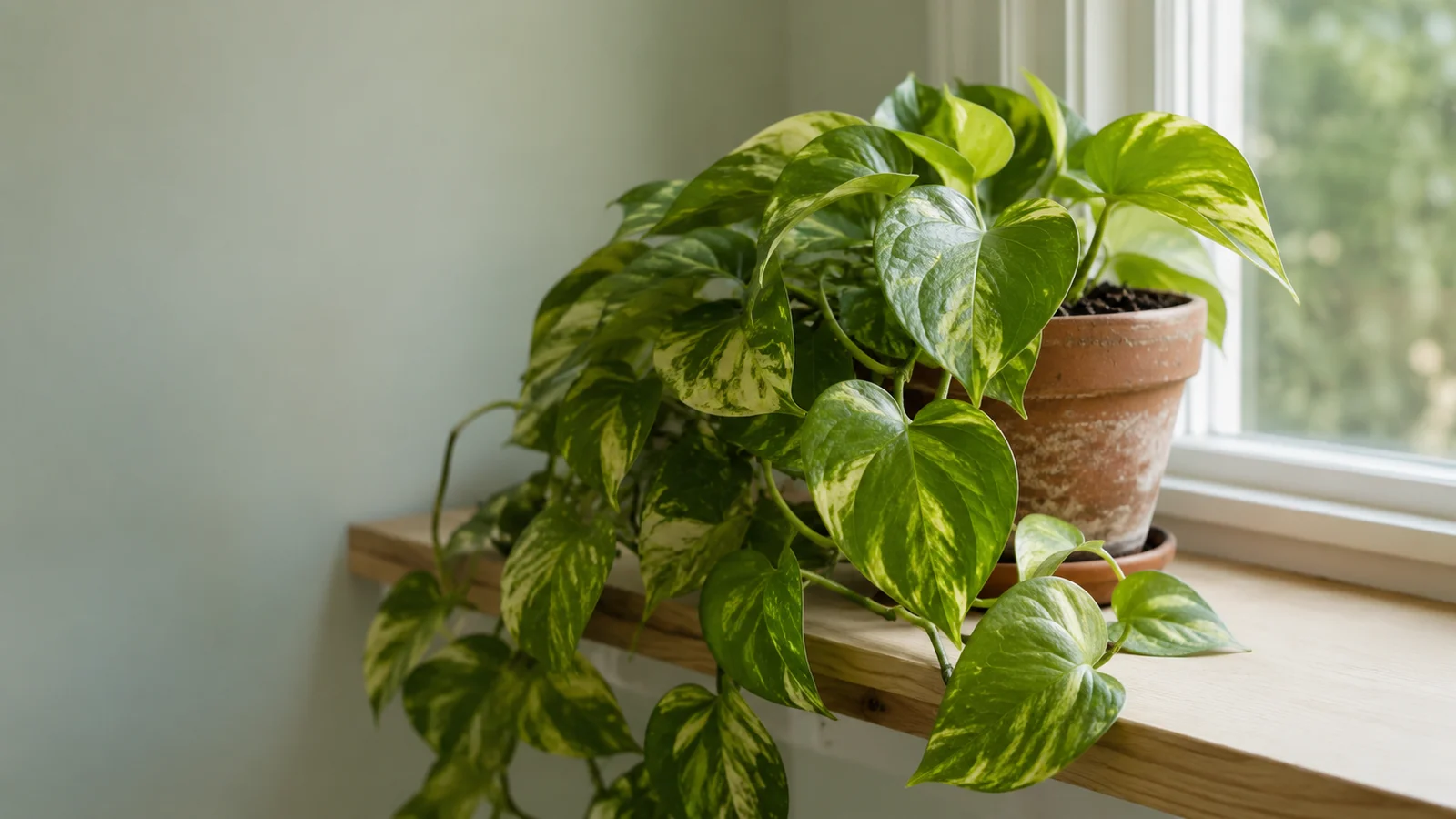
There is no such thing as "a pothos." There is your pothos — in this pot, on this shelf, in the light that one window gives it — and it keeps a week no care card has ever met.
Why generic pothos advice falls apart
Search "how to care for pothos" and you will get the same friendly paragraph, lightly reshuffled, in every result: easy plant, tolerates low light, water every week or so, almost impossible to kill. It is the reputation that sells the plant, and it is also the reputation that gets so many of them killed slowly. The advice is written for an average pothos that does not exist — an average Epipremnum aureum in an average pot, in an average corner, doing an average amount of growing.
You do not own the average. You own a particular specimen on a particular shelf, trailing toward a particular window, in a flat that warms and cools on its own schedule through the year. Two pothos of the exact same cultivar can live a metre apart and want completely different things. A golden pothos in a bright window drinks far faster than the same plant in a shaded corner, and its leaves come in larger and more vividly marbled. A Marble Queen parked in a dim hallway grows so slowly that the soil never really dries, and that slow, wet stillness is precisely how it rots. A Neon pothos, solid chartreuse with no variegation to lose, copes with a dimmer spot better than its marbled siblings. Same species. Different specimens, different lives.
This guide is about the plant in front of you rather than the species on the label — how to read what it is telling you, week to week, instead of running it on a calendar. If you are still finding your feet with houseplants in general, the mistakes every beginner makes is the companion piece to start with, and if you keep a Monstera on the same shelf, the Monstera care guide runs on exactly the same per-specimen logic — the two read well together.
Light: the variable that changes everything else
Pothos earned its low-light reputation honestly, and that reputation is the single most misread fact about the plant. "Tolerates low light" is true. "Grows best in low light" is not, and the gap between those two sentences is where most disappointing pothos live.
In the wild, Epipremnum aureum starts life on the forest floor and climbs. It is an understory vine that creeps along shaded ground until it finds a trunk, then hauls itself up toward the brighter, filtered light of the canopy, getting larger and bolder the higher it goes. Down in deep shade it survives, modest and slow. Up in good light it thrives. Your living room is the same story compressed into a few metres: the plant will live almost anywhere, but it only grows into itself where the light is genuinely good.
You can read the difference at a glance once you know what you are looking at. A pothos that is not getting enough light tells you in three ways. The new leaves come in smaller than the old ones rather than larger. The stem stretches — long, bare runs of vine between leaves, what gardeners call leggy growth, as the plant reaches for a brightness that is not there. And on any variegated cultivar, the pattern fades: the white or cream or yellow retreats and the leaf drifts back toward plain green, because variegated tissue carries little or no chlorophyll and the plant cannot afford to keep it in the dark. A well-lit pothos does the opposite — fuller leaves, tighter spacing, variegation holding its line.
Direction matters more than most guides admit, because the same room offers radically different light on different walls. An east window is close to ideal: a few hours of soft morning sun, then bright shade for the rest of the day. A north window is survivable but slow — enough to keep a plain golden ticking over, rarely enough to push real growth or hold strong variegation. A south or west window brings the most light and the most risk: hours of direct afternoon sun will scorch a pothos, bleaching pale, papery patches into the leaves and crisping their edges, and the cure is simply a sheer curtain to soften it rather than moving the plant into gloom.
Variegation raises the stakes specifically. The more white a cultivar carries, the more light it needs to earn its keep — a Marble Queen or an N'Joy, heavily splashed with cream, demands noticeably brighter conditions than a plain golden pothos to keep its pattern, because so little of each leaf is doing the photosynthetic work. Push them into low light and they revert toward green and sulk. Neon is the opposite case in the same family: its solid chartreuse leaves have no variegation to lose, and it tolerates lower light than the marbled cultivars. The lesson underneath all of this is that "low light tolerant" is a floor, not a recommendation, and the brighter you can place your particular specimen short of direct midday sun, the more it gives back.
Watering: the rule that gets most pothos killed
If light is where pothos quietly underperform, water is where they die — and almost always at the hands of someone watering on a schedule they read online.
"Every seven to ten days" is the most repeated pothos instruction and the most dangerous, because a calendar knows nothing about your plant's actual week. The same pothos in a bright south window in July can need water several times as often as it does in a dim corner in December. A fixed weekly rhythm is roughly right for a few weeks and then wrong in both directions at once — a drought in a heat wave, a slow drowning through the dark months. The soil dries on the temperature, the light, and the humidity it is living in, none of which the number on a care card has ever measured.
The real signal is the soil, read together with the plant. Push a finger into the substrate to the second knuckle. If it is dry that far down, it is time to water; if it comes up cool and damp, put the can down and check again in a few days. Pothos genuinely prefer to dry out a little between drinks, and they forgive a short drought far more readily than a wet sulk. When you do water, water thoroughly — until it runs from the drainage holes — then let it drain completely and never leave the pot standing in a saucer.
A word on the droopy leaf, because it gets misused as a watering cue. A pothos with limp, soft, downturned leaves is thirsty, yes — but droop is a stress signal, not a schedule. By the time the leaves go slack the plant has already been running dry long enough to flag it, and if you wait for the droop every time you are watering late every time. Use the soil to decide when, and let the occasional droop tell you that you waited a touch too long, not that you got it right.
Learn the two failure modes by sight, because they pull in opposite directions and the wrong guess is fatal. Overwatering shows up as the older, lower leaves yellowing first, soft or mushy stems near the soil, a sour, soggy smell from the pot, and often a haze of fungus gnats rising when you water — all of it the signature of roots sitting in airless, saturated substrate. Underwatering shows up as crispy brown leaf tips and edges, a plant that wilts, and soil that has pulled away from the sides of the pot even if the very top still looks dark. The tricky part is that a badly overwatered pothos and a thirsty one can both droop, so when in doubt, feel the soil before you reach for the water — adding water to a drowning plant is how most pothos meet their end.
Then there is the trap that catches careful waterers: the pot itself. A decorative cache pot with no drainage hole is a beautiful way to slowly kill a pothos, because every drink that drains out of the inner nursery pot collects in the bottom of the outer one and sits there, invisible, wicking back up into the roots. From above the plant looks perfectly tended. Below the soil line the roots are standing in a permanent puddle. If you grow in a cache pot, tip the excess out after every watering, or pot into something that drains. While you are diagnosing, the symptom-by-symptom breakdown in overwatering vs underwatering is worth reading before you lose a leaf to the wrong call.
Humidity and temperature: the indoor range pothos will forgive
Here is the genuinely good news about pothos, and one of the few places the easy-plant reputation holds up: it is more relaxed about humidity than many tropical houseplants. It prefers fifty to seventy per cent but copes with the thirty to sixty per cent of an ordinary home, and it does not need high humidity. You do not need a rainforest. An ordinary living room is fine.
What hurts a pothos is not dry air but cold and draught. It grows best between about eighteen and thirty degrees Celsius; below about fifteen degrees (fifty-nine Fahrenheit) growth stalls, a few hours near freezing leaves brown patches in the leaves, and a cold draught from a single-glazed window or an unsealed door in winter can chill a plant night after night while the rest of the room stays comfortable. The plant lives in its specific spot, not in the room's average, and the thermostat on the wall never reports the microclimate two centimetres from the glass.
Central heating creates the one humidity problem worth taking seriously, and it does so indirectly: warm, forced-air heat dries the room out, and a pothos sitting in that warm, dry air through a long winter often answers with brown, crisp leaf tips. It will survive — it almost always survives — but the tips are the tell. The fix is not misting, which raises the moisture around a leaf for a few minutes before it evaporates and is largely a pleasant ritual rather than a strategy. If your air is genuinely dry and your plant is showing for it, a small humidifier does steady, real work that a spray bottle or a pebble tray never will.
Two placements to avoid by name, because both are microclimates the room average hides. A pothos directly above or beside a radiator gets blasted with hot, drying air that spikes its water use and crisps its edges. A pothos in the path of an air-conditioning vent gets the same insult cold. Either one stresses the plant in a way that looks like a watering problem and is really a placement problem. And if you want to summer a pothos outdoors, you can, in a temperate climate — but only once nighttime temperatures reliably stay above fifteen degrees, in bright shade rather than direct sun, and back inside well before the first cool nights of autumn.
Fertilising: less than you think, more precise than you do
Pothos are light feeders, and the mistake new owners make is almost always too much rather than too little. The plant does not ask for much, and the times it asks for nothing at all are exactly the times an enthusiastic owner is most tempted to feed it.
A pothos in active growth — spring and summer, putting out new leaves you can watch unfurl — benefits from a balanced liquid houseplant fertiliser roughly every three to four weeks, at the strength on the label or a little under. That is the whole regimen for a well-lit, growing plant. A pothos in low light is a different animal entirely: it grows so slowly that it barely consumes anything, and fertiliser poured onto a plant that is not growing does not vanish — it accumulates in the substrate as mineral salt, draws moisture back out of the roots, and burns the root tips and leaf margins. Through winter dormancy, when most pothos slow or stop, the right amount of fertiliser is none.
The damage from overfeeding looks almost identical to the damage from dry air — brown, crispy leaf tips — which is why it gets misread so often. There is a tell that separates them: fertiliser burn frequently leaves a crusty white or yellowish crust on the soil surface or around the pot rim, the visible residue of accumulated salts. Dry-air browning leaves no such crust. If you have been feeding a plant with browning tips and you see that residue, the answer is to stop feeding, flush the pot with plenty of plain water to wash the salts through, and resume more gently later.
The one mistake to avoid above all others is feeding a plant that is already under strain — stressed, root-bound, or freshly repotted. A struggling pothos cannot use the nutrients and the salt only compounds the stress, and a freshly repotted plant needs less feeding than an established one. As with everything else here, the right interval is a property of your particular specimen, not the species. A fast-growing golden pothos in a bright window will happily take a monthly feed all summer; a Marble Queen creeping along in a dim bathroom wants a fraction of that, if anything at all.
Training and trailing: how you shape the plant you want
This is the section the Monstera guide does not have, because it is the choice that defines what a pothos becomes. More than almost any other houseplant, a pothos grows into the form you give it, and the form you choose changes the plant itself — not just where it sits, but the size of its leaves and the vigour of its growth.
Let a pothos trail. Set it on a shelf or hang it in a pot and let the vines spill over the edge, and you get the familiar look that sells the plant: long, cascading runners of small to medium heart-shaped leaves. It is easy, low-maintenance, forgiving decor, and there is nothing wrong with wanting exactly that. But understand the trade. A trailing pothos hangs in air with nothing to climb, and a pothos with nothing to climb stays in its juvenile form, and its leaves stay small.
Now give it something to climb. Stand a moss pole, a slab of rough bark, or a coir totem in the pot and train the vines upward against it, and the plant changes. Pressed against a damp, textured surface, a pothos throws out aerial roots — the small nubs along the stem that grip and anchor — and as it climbs, the leaves enlarge. This is the same forest-floor-to-canopy logic that governs its light: a climbing pothos believes it is ascending toward better conditions, and it commits to bigger, more mature foliage to match. The practical difference is real. A trailing pothos is pleasant background greenery; a climbing pothos rewards you with the larger, specimen-level growth the species is capable of.
Pruning is part of the same conversation, and it is worth losing the instinct that cutting a plant injures it. With pothos, the opposite is true: a cut is a growth signal. Snip a vine just above a node, the little bump where a leaf meets the stem and where aerial roots emerge, and the plant responds by sending new shoots from the leaf joints, filling out where it was bare. Prune to keep a plant full rather than straggly, to shorten leggy runs of low-light growth, and to harvest cuttings for propagation, all at once. Cut just above a node, never mid-internode, and the plant pays you back with denser growth.
Common problems, and how to read them
Most pothos trouble is a single visible symptom with more than one possible cause, and the entire skill is telling the causes apart before you act. Here are the common ones, each as symptom, most likely cause, and fix.
Yellowing old leaves (the lowest, oldest ones). Most likely overwatering — soggy soil suffocating the roots — though a single old leaf yellowing while everything above looks healthy is just natural senescence and nothing to worry about. Fix: feel the soil; if it is wet, let it dry well before the next drink and check the pot drains.
Yellowing new leaves (the youngest growth). A more serious sign: overwatering that has reached the roots yellows new foliage as well as old, and too little light or fertiliser can do it too. Fix: check whether the soil is sour and wet (unpot and inspect the roots); if the roots are sound, look at the light and your feeding.
Brown, crispy leaf tips. Low humidity from dry, heated air, or salt build-up from over-fertilising. Fix: look for a white crust on the soil — if present, flush the pot and stop feeding; if not, raise humidity with a humidifier.
Washed-out, fading variegation. Not enough light for a variegated cultivar to hold its pattern. Fix: move it brighter (an east window, or a south window behind a sheer curtain) and the new growth will come back patterned.
Leggy, sparse growth with long bare stems. Not enough light for any cultivar, variegated or plain. Fix: brighten the spot, then prune the leggy runs back to a node to force fuller branching.
Black or mushy stems. Root rot from sustained overwatering — the emergency case. Fix: unpot immediately, cut away every black, soft root and stem, and repot the healthy remainder into fresh, fast-draining mix; take a few clean cuttings as insurance.
Fungus gnats hovering over the soil. Soil kept too wet for too long, giving the larvae a home. Fix: let the top of the soil dry out properly between waterings, which breaks their cycle; the gnats are a symptom of overwatering more than a pest in their own right.
Propagation: the node is the whole game
When a pothos outgrows its shelf, propagation turns one plant into several — and there is exactly one rule, because nearly every first attempt breaks it.
You can only propagate a pothos from a cutting that includes a node: the small bump on the stem where a leaf attaches and where aerial roots emerge. The node is where the new roots and the new shoot come from. A cutting with a leaf but no node will sit in water looking handsome for weeks and never become a plant, because it has no bud to grow a new vine from. An internodal section — a length of bare stem with no leaf and no visible node — produces nothing either, for the same reason. Take a node, or take nothing.
The practical cutting is ten to fifteen centimetres of stem carrying one or two leaves and at least one node, ideally with a nub of aerial root already showing at that node, since those roots have a head start. Cut cleanly just below the node with clean scissors.
From there you have two routes. Water propagation is the forgiving, visible one: stand the cutting in a glass of water with the node submerged and the leaves above the surface, keep it in bright indirect light, change the water every few days, and you will usually see roots within two to four weeks — pothos roots readily this way. Soil propagation skips the transplant shock that comes when water-grown roots adjust to substrate: push the node into a small pot of moist, fast-draining mix, keep it lightly moist and in bright indirect light, and resist the urge to tug at it while it works. Either route gives you a new plant from a vine you would otherwise have pruned away.
The per-specimen difference
Every section of this guide has circled the same point: the right answer for a pothos is never the species answer. It is the answer for this plant — its shelf, its window, its pot, its week — and that answer moves through the year. Generic advice feels like it half-works because it does work, on average, and the average is the one plant you do not own.
Picture two pothos in the same flat. One sits on the sill of an east window; the other trails from a shelf in a windowless hallway. They are the same cultivar, bought the same day, potted in the same mix. And they live entirely different lives. The window plant dries its soil in days and wants water twice a week in summer; the hallway plant holds moisture for the better part of three weeks and would rot on the window plant's schedule. One number cannot serve both, and the moment you write a watering interval onto a calendar you have committed to being wrong for at least one of them.
What closes that gap is a model of the individual plant rather than the species. That is what a Digital Shadow is. Botanical Legacy keeps a continuously running simulation of each specimen in your sanctuary — a live estimate of how much moisture is left in that pot, drawn down day by day on the real temperature and light your plant is living in, anchored by your photos and care actions. When the model notices that your hallway pothos is holding moisture far longer than the species baseline expected, it does not keep recommending the bright-window schedule. It adjusts the interval to the plant in front of it, so the slow, shaded specimen is never handed a watering plan designed for a sunny sill.
It gets more precise when you give it more to read. Drop a soil-moisture sensor into a pot and the Shadow stops estimating and starts measuring — the sensor support lets a real reading override the model the moment the two disagree, so a probe out of the soil or a pot that drains faster than expected gets corrected rather than compounded. And when you upload a photo, Botanical Vision v5 reads the leaves for early stress — the first faint yellowing, the start of a crisp edge — often before your own eye catches it, and recalibrates the plant's care around what it sees. If you are weighing this against the reminder-and-identification apps most people reach for first, the best plant care app comparison for 2026 lays out honestly where each one fits and the exact point a per-specimen model picks up. The species card tells you where to begin. The Shadow tells you what your pothos needs today, on that shelf, in this week's weather.
Frequently asked questions
How often should you water a pothos?
There is no fixed number, and any source giving you "every seven to ten days" is describing an average plant you do not own. The same pothos drinks far more in a hot, bright summer week than a cool, dim winter one: several times as often in a sunny window in July as in a shaded corner in December. Read the soil, not the calendar: push a finger in to the second knuckle and water only when it is dry that far down, then water thoroughly until it drains and never leave the pot sitting in water. A pothos forgives a short drought far more readily than a wet sulk, so when in doubt, wait.
How much light does a pothos need?
Bright, indirect light gets the best from a pothos, even though it tolerates much less. An east window with a few hours of soft morning sun is close to ideal; a north window keeps a plain golden ticking over but slowly; a south or west window needs a sheer curtain to soften the direct afternoon sun that would otherwise scorch the leaves. Heavily variegated cultivars like Marble Queen and N'Joy need more light than golden pothos to hold their pattern. "Tolerates low light" is a survival floor, not a recommendation — the brighter you place it short of harsh midday sun, the fuller and more vivid it grows.
Why are my pothos leaves turning yellow?
Most often overwatering, and the giveaway is the oldest, lowest leaves yellowing first while the soil is still wet days after watering and the pot feels heavy — roots suffocating in saturated substrate. But the pattern matters: a single old leaf yellowing while new growth looks healthy is just the plant retiring an old leaf, which is normal, whereas yellowing that reaches the youngest leaves points to roots in trouble from overwatering, or to too little light or fertiliser. Feel the soil before you act. If it is wet, the cure is to let it dry and improve drainage, not to add more water — watering an overwatered pothos is how most yellowing ones get killed.
Can pothos grow in low light?
It can survive in low light, which is where the reputation comes from, but it does not grow well there. In genuine shade a pothos slows almost to a stop, the new leaves come in small, the stems stretch leggy as they hunt for brightness, and any variegation fades back toward plain green. It will live for a long time looking unremarkable. If a dim spot is all you have, choose a plain golden pothos over a heavily variegated cultivar — it copes far better with little light — and accept slow, modest growth. For anything fuller, move it brighter.
How do I propagate pothos in water?
Cut a ten-to-fifteen-centimetre length of vine that includes at least one node — the bump where a leaf meets the stem — and one or two leaves, snipping cleanly just below the node. Stand it in a glass of water with the node submerged and the leaves above the surface, keep it in bright indirect light, and change the water every few days to keep it fresh. Roots usually appear within two to four weeks, since pothos roots readily in water. Once the roots reach a few centimetres, pot the cutting into moist, fast-draining mix and keep it lightly watered while it settles.
Start your sanctuary
Botanical Legacy's free Observer plan covers up to five Specimens, each with its own continuously running Digital Shadow — your pothos included, whether it trails from a shelf or climbs a pole. Every new account also includes a 14-day trial of Cultivator, our paid plan, which adds the local weather feed and sensor support, so the Shadow can read your room's real temperature and humidity instead of estimating them. You can see exactly what that looks like for a single plant before committing anything on the platform preview.
You do not need a greener thumb to keep a pothos thriving. You need to stop caring for the average pothos and start caring for the one trailing across your shelf.
START YOUR SANCTUARY — FIVE FREE SPECIMENS, NO PAYMENT REQUIRED →
Your pothos is not the average pothos. Stop caring for it as if it were.
Sources
The plant-care facts on this page were checked against these references.
- NC State: plants.ces.ncsu.edu/plants/epipremnum-aureum
- MBG: plantfinder.mobot.org/PlantFinderDetails.aspx
- RHS: rhs.org.uk/plants/epipremnum/growing-guide
- Virginia Tech: pubs.ext.vt.edu/SPES/spes-804.html
- UF/IFAS EP151: ask.ifas.ufl.edu/publication/EP151
- SDSU: extension.sdstate.edu/pothos-devils-ivy-golden-pothos-house-pla…
- Clemson: hgic.clemson.edu/factsheet/how-to-grow-pothos-indoors-epipremnu…
- UMD lighting: extension.umd.edu/resource/lighting-indoor-plants
- RHS light: rhs.org.uk/advice/understanding-plants/how-plants-use-light-to-…
- UMD watering: extension.umd.edu/resource/watering-indoor-plants
- Clemson disorders: hgic.clemson.edu/factsheet/houseplant-diseases-disorders
- UC IPM: ipm.ucanr.edu/home-and-landscape/fungus-gnats
- Penn State: extension.psu.edu/humidity-and-houseplants
- UMD fertiliser: extension.umd.edu/resource/fertilizer-toxicity-or-high-soluble-…
- UMD salts: extension.umd.edu/resource/mineral-and-fertilizer-salt-deposits…
- Colorado State: extension.colostate.edu/resource/fungus-gnats-as-houseplant-and…
- Iowa State: yardandgarden.extension.iastate.edu/how-to/how-propagate-housep…