Plant care guides · 18 min read
Spider plant care guide: the most honest houseplant you'll ever own
The spider plant hides nothing. Brown tips report your water, faded stripes report your light, and a stem full of babies reports genuine contentment. Here's how to read what Chlorophytum comosum is telling you — and fix the cause, not the symptom.
Botanical Legacy · Field notes ·
Most houseplants make you guess. The spider plant just tells you — in brown tips, in fading stripes, in a stem full of babies — what it thinks of the home you've given it.
The plant that says everything out loud
There is a reason the spider plant has been on windowsills for a century, passed hand to hand in jam jars of water long before anyone owned a plant app. It is genuinely hard to kill, it makes free copies of itself, and it is safe to keep around a cat that chews everything. But the quality that makes Chlorophytum comosum worth writing about is subtler than any of those: it is the most legible plant you can own. It hides nothing.
Where a snake plant conceals weeks of quiet decline underground, and a Monstera can look fine right up until it doesn't, the spider plant narrates its life in real time. The leaf tips brown when your water isn't right. The cream stripes wash out when the light is too low. It sends out a stem of babies once it is mature and settled. Every major thing that can happen to this plant announces itself on the outside of the leaf, in a language you can learn in an afternoon.
That makes it the perfect plant to learn to read a plant on, which is the entire point of good care. Generic advice — "water once a week, bright indirect light" — half-works on every plant and fully works on none, because it describes an average plant in an average home, and you own neither. The spider plant is the plant that teaches you to stop following the label and start reading the specimen in front of you. If houseplants are new territory, the ten mistakes every beginner makes is the companion to this guide; and because so much of spider plant care is symptom-reading, how to read plant health signs is the other half of the skill this plant will teach you.
Light: the stripes are a gauge you can read across the room
Start with light, because for a spider plant the light level is written directly into the leaf.
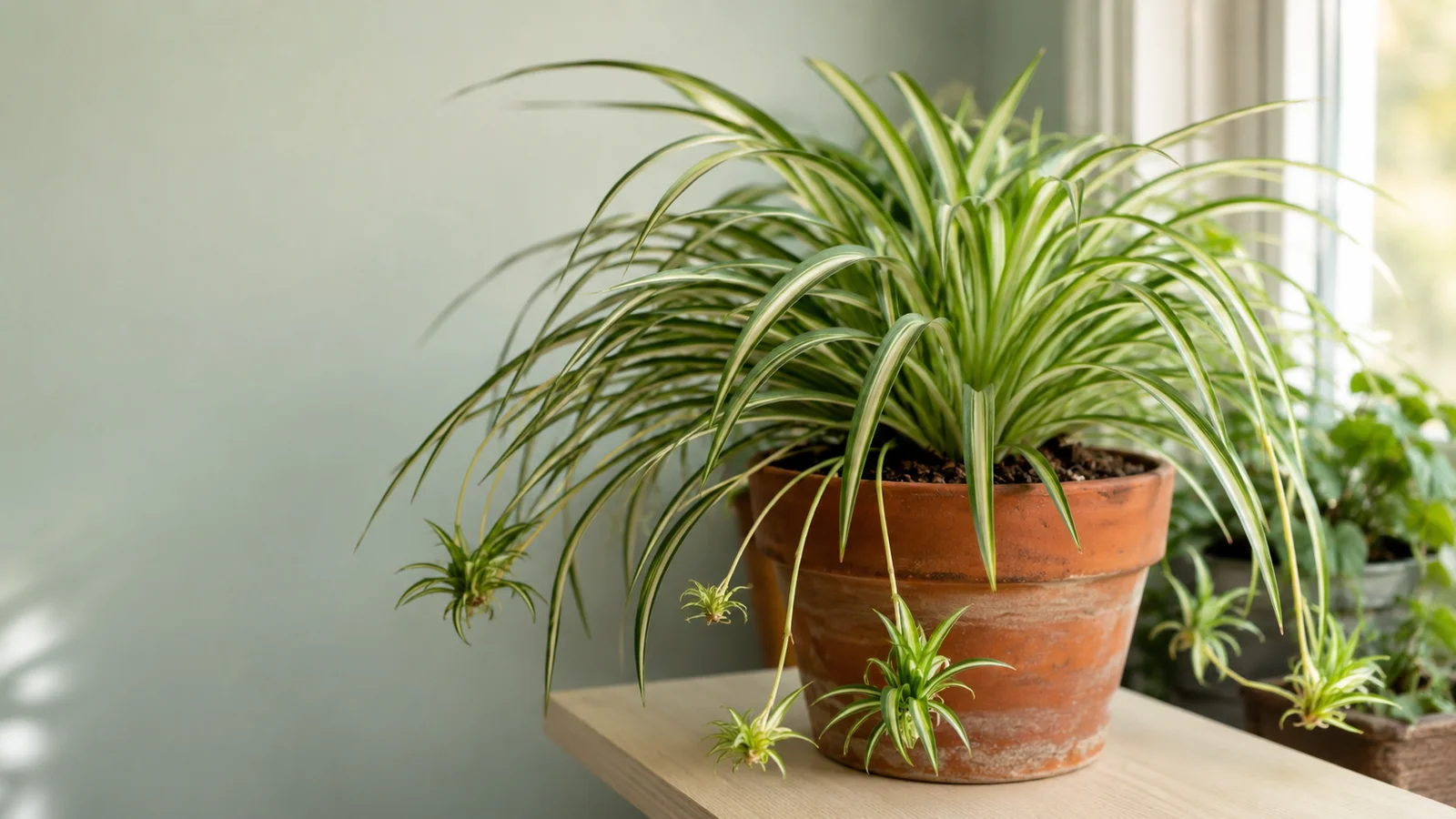
A spider plant wants bright, indirect light — a spot near a window that is filled with daylight but out of the path of harsh, direct sun. In that light it grows fast, arches full and grassy, and, most tellingly, holds its variegation: the crisp white or cream stripes that are the whole reason most people buy the variegated types in the first place.
Those stripes are your light meter. The pale parts of a variegated leaf carry no chlorophyll and do no photosynthesising — the plant feeds itself entirely from the green. In good light that trade is affordable, and the plant keeps its bold contrast. Push it into a dim corner and the plant does the sensible thing: it grows greener, flooding the new leaves with more chlorophyll to make up for the missing light, and the striping fades toward plain green. A spider plant losing its variegation is not sick. It is telling you, in the clearest terms it has, that the corner is too dark — and the fix is more light, not more of anything else.
The opposite extreme leaves its own mark. Harsh, prolonged direct sun — an unshaded south window in high summer — bleaches the green to a washed-out pale and scorches dry patches into the leaves. Between those two failure modes is a wide, forgiving band, which is why the plant thrives in so many homes. An all-green spider plant, with no variegation to protect, copes with lower light more gracefully than its striped siblings; the variegated ones ask for the brighter spot.
Here is the link that catches people out: light drives how fast the plant drinks. A spider plant in a bright window works through the water in its pot noticeably faster than the same plant in a shaded hallway, because light drives growth and growth drives thirst. Move a plant from bright to dim and keep watering on the old rhythm and you will slowly waterlog it. Judging indoor light by eye is genuinely hard: light falls away quickly with distance from the window, so a corner that reads as "bright enough" to you can get a small fraction of the light on the sill. It is exactly the judgement Botanical Legacy is built to make for you: when the model watches a specimen's light over weeks and concludes the spot is holding it back, it surfaces a placement hint — a quiet note that a brighter corner exists in your sanctuary, and which one. For a plant that will literally show you the light problem in its stripes, having the model confirm the cause before the colour drains away is the difference between adjusting and regretting.
Watering: forgiving, thanks to roots you can't see
If light is the spider plant's most visible signal, its roots are its hidden safety net — and understanding them is what makes watering this plant relaxed rather than fraught.
Dig gently around an established spider plant and you'll find thick, fleshy, almost tuberous white roots. Those are water-storage organs, a mild version of the trick a succulent runs, and they are why the plant shrugs off the missed week that would set a fern back. A spider plant would genuinely rather be a little too dry than a little too wet.
Through the growing months of spring and summer, the aim is soil that stays lightly, evenly moist — water thoroughly when the top two or three centimetres have dried, let the excess run out completely, and never leave the pot sitting in a saucer of water. In autumn and winter, when growth slows, back right off and let it dry further between drinks. This is a gentler regime than the "let it go bone dry for weeks" a snake plant wants and a firmer one than the "keep it constantly damp" a calathea demands — the spider plant sits comfortably in the middle, which is another reason it forgives beginners.
Overwatering is still the one way to genuinely kill it. Water pooling around those fleshy roots with no air turns them soft and brown, and the rot climbs into the base of the leaves as a mushy, collapsing yellow. The tell that separates rot from simple thirst is the same across every houseplant, and it is worth committing to memory: thirst comes with dry, light soil and leaves that crisp and pale; rot comes with wet, heavy soil and a base that has gone soft. Feel the soil and lift the pot before you reach for the can — the full breakdown is in overwatering vs underwatering, and the general habit of reading soil instead of a calendar is in when to water your houseplants.
Two things you control swing the right interval more than any watering schedule ever could. Pot material: porous terracotta breathes and dries the soil through its walls, while glazed ceramic and plastic hold moisture in, so the same plant can need water noticeably less often depending only on its pot. Drainage: a hole in the bottom is not optional — a spider plant in a pretty pot with nowhere for water to escape is sitting in an invisible reservoir at the roots. If you love a cachepot without a hole, keep the plant in a plain nursery pot inside it and lift it out to water.
Brown tips: the signature complaint, and why it's often not your fault
If you have owned a spider plant, you have seen it: the leaves are healthy and green, the plant is growing, and yet every tip has gone dry, brown, and papery. This is the single most-searched spider plant problem, and here is the part that reframes the whole thing — it is often not a care mistake at all, but a water-quality one.
Spider plants are unusually sensitive to the fluoride and, to a lesser degree, the chlorine and dissolved salts in ordinary tap water. Over weeks, those minerals move to the far ends of the leaves — the tips — and accumulate there faster than the plant can cope, and the tissue at the very tip burns. Your care can be flawless and the tips will still brown, because the cause is coming out of your tap, not out of your watering habits. It is the plant reporting on your water supply with real precision.
There are a handful of contributing causes worth ruling out, but water quality leads the list:
- Tap-water minerals — fluoride especially, which spider plants are famously intolerant of. This is the most common single cause.
- Salt build-up from fertiliser — feeding too often or too strong leaves salts in the soil that scorch the tips the same way. This one is within your control.
- Very dry air — sustained low humidity, common in winter with the heating on, dries the most exposed tissue first.
- Inconsistent watering — letting the pot swing from bone dry to flooded and back stresses the leaf margins.
The fixes follow the causes. Water with filtered, distilled, or collected rainwater if your tap water is hard or fluoridated — this tackles the most common cause, and it is the one change that matters most. (Letting tap water stand overnight lets chlorine escape, but the advice for fluoride-sensitive plants is rainwater or distilled water, so standing water is a partial fix at best.) Flush the pot with plain water every four to six months to leach out accumulated salts, and feed lightly. Once a tip has browned it will not turn green again, so trim the dead tissue away with clean scissors, cutting at a slight angle to mimic the leaf's natural point rather than leaving a flat stub. Treat browning as information, not as a verdict on your competence — the plant is simply telling you something true about the water it's drinking.
The babies: the superpower that makes one plant a shelf
Now the good part, and the trait that has kept this plant in circulation for generations. A happy, mature spider plant sends out long, arching flowering stems, often called stolons or runners, and on the ends of them it grows perfect miniature plants: the plantlets everyone calls babies, or spiderettes. Often a spray of tiny white star-shaped flowers comes first, and the babies form at the nodes of those same flowering stems. It is the easiest propagation in all of houseplant-keeping, and it is the plant's way of turning one specimen into a whole windowsill of gifts.
The reason a spider plant makes babies is worth understanding, because it doubles as a contentment signal. Plantlets appear when the plant is mature, slightly pot-bound, and getting long nights: most spider plants won't make them until they are at least a year old, a snug pot encourages them, and the runners are triggered by short days and long, uninterrupted nights, which is why they tend to arrive as the days shorten in late summer and autumn. A young plant will not make them yet. A plant drowning in an oversized pot may put its energy into roots instead. A heavily fed plant makes fewer, and one under lamps late into every evening may never get the long nights it needs. So a stem of babies is not just charming: it is the plant reporting that maturity, pot size and season have all lined up. No babies is the plant telling you one of those is off.
Rooting them could not be simpler, and you have two good options. The gentlest is to leave the baby attached to the mother plant and set a small pot of moist soil beside it, pinning the plantlet down onto the surface so it roots while still fed by the parent; snip the runner only once it has taken hold. The faster route is to cut a well-grown baby free — look for one already showing little nub roots at its base — and stand it in water or press it straight into moist potting mix. Either way you'll have an independent plant in a few weeks. The full method, including keeping a fragile cutting alive through its first weeks, is in how to propagate plants; the same reading-the-plant logic that governs pothos and Monstera propagation applies once you're working across several species at once.
Safe for the cat that chews everything
One more reason the spider plant earns its place, especially in a home with animals: it is non-toxic to cats and dogs. On the ASPCA's list it sits firmly in the safe column, which makes it a valuable exception: popular trailing plants such as pothos and philodendron are toxic to pets, and this one is not.
There is a twist worth knowing. Cats commonly chew houseplants, and a spider plant's dangling babies make an easy target: a cat may bat at the runners and nibble the foliage. The good news is that this is a nuisance, not a hazard: the ASPCA lists the plant as non-toxic, though it notes that nibbling it can bring mild stomach upset, vomiting or diarrhoea. Hang it high if you'd rather keep the babies intact, but you do not need to fear it the way you would a lily or a dieffenbachia. If you keep pets, Botanical Legacy flags each specimen's pet-safety status on its card once you've told it there are animals in the home — so the safe plants and the risky ones are visible at a glance instead of something you have to remember per plant.
Humidity, temperature, and feeding: the short list
After brown tips and babies, the rest of spider plant care is genuinely brief.
Humidity is a minor factor. The plant is happy in ordinary household air and does not need misting, though very dry winter air — the same heating-on dryness that scorches tips — is the one condition where a little extra humidity helps. If your tips brown badly every winter and your water is already filtered, dry air is the likely remaining culprit.
Temperature suits the plant across the normal comfortable range of a home, roughly thirteen to twenty-four degrees Celsius. The danger, as with most tropical-adjacent houseplants, is cold: keep it above about ten degrees, and away from a cold draught from a winter window or an open door. A plant lives in its specific spot, not the room's average — a leaf pressed to freezing glass on a January night is having a colder night than the thermostat knows about, which is the whole reason a per-specimen model beats a single house-wide setting.
Feeding should be light. A balanced houseplant fertiliser at half the label strength, once a month through spring and summer, is plenty; feed nothing in autumn and winter when growth pauses. Over-feeding is not just wasted — it's actively counterproductive here, because the leftover fertiliser salts are one of the direct causes of the brown tips you're trying to avoid. When in doubt with a spider plant, feed less.
Common problems, read as messages
Nearly every spider plant complaint is one visible symptom pointing back to one specific condition. Read the message before you act.
Brown, papery leaf tips on an otherwise healthy plant — water quality first (fluoride and salts in tap water), then salt build-up from over-feeding, then very dry air. Switch to filtered or rainwater, flush the pot, ease off the fertiliser. The green plant is fine; it's reporting on your tap.
Fading, washed-out variegation — stripes going plain green — too little light. The plant is compensating for a dark spot by growing greener. Move it somewhere brighter and the new growth will bring the contrast back.
Pale, bleached, or scorched patches — the opposite: too much harsh direct sun. Pull it back from the glass or filter the light.
A soft, mushy, yellowing base with leaves that pull out easily — root rot from overwatering, the one genuinely serious case. Stop watering, lift the plant, cut away everything soft and brown to firm white tissue, and repot into fresh mix. Salvage healthy babies as insurance.
No babies on a plant old enough to make them — often a pot so oversized the plant is investing in roots instead of reproduction, heavy feeding, or evenings lit so late that the plant never gets the long nights that trigger runners. It can also simply be young. Resist over-potting, feed lightly, and give it time.
Limp, drooping leaves — check the soil before deciding. Dry and light means thirst, fixed by a drink. Wet and heavy means the opposite problem, and watering again is the last thing it needs.
The per-specimen difference
Every section here has circled back to the same idea: spider plant care is not a schedule, it's a reading — of the light in the stripes, the water in the tips, the contentment in the babies — and the reading is specific to your plant, your window, and your tap. Generic advice is right on average and wrong in the particular, and the particular is the only plant you own.
The spider plant happens to make that reading unusually easy, which is exactly why it's such a good teacher. But the same principle governs every plant on your shelf, most of which are far less talkative. A Digital Shadow is Botanical Legacy doing that reading continuously, for every specimen at once: a live simulation of how much moisture is left in that pot, drawn down day by day on the real temperature and light your plant is living in, anchored by your photos and care actions, and nudged by a placement hint when a brighter corner exists. The species card tells you where to begin. The Shadow tells you what this spider plant needs this week — and, just as usefully, when the browning tip you just noticed is about your water rather than your care.
If you're weighing this against the reminder-and-identification apps most people reach for first, the best plant care app comparison for 2026 lays out honestly where each one fits and where a per-specimen model picks up. And for the quick-reference version of everything above — light, water, toxicity, at a glance — the spider plant species card is the companion to this longer read. The same per-specimen thinking runs through the snake plant and pothos guides, if you're building a shelf.
You can see what the running model looks like for a single plant before committing anything: start with Botanical Legacy and add your spider plant as your first Specimen.
Frequently asked questions
Why does my spider plant have brown tips?
Most often water quality rather than a care mistake. Spider plants are unusually sensitive to the fluoride, chlorine, and dissolved salts in ordinary tap water, and those minerals accumulate at the leaf tips over weeks and burn the tissue there. Salt build-up from over-feeding and very dry winter air are secondary causes. The fix for the most common cause is switching to filtered, distilled, or collected rainwater; also flush the pot with plain water every four to six months to leach out salts, and feed lightly. Letting tap water stand overnight lets chlorine escape but is not the advice for fluoride, so it's only a partial fix. Once a tip has browned it won't recover — trim it at an angle with clean scissors — but new growth will come in clean once the water is right.
How do I get my spider plant to make babies?
A spider plant produces its plantlets, the babies or spiderettes, once it is mature (usually at least a year old) and slightly pot-bound, triggered by short days and long, uninterrupted nights, which is why they tend to appear as the days shorten in late summer and autumn. If yours isn't making them, the usual causes are that it's still too young, it's in an oversized pot and putting its energy into roots instead, it's heavily fed, or lamps in the evening are cutting its nights short. Give it a bright spot out of harsh direct sun, resist the urge to pot it up too large, and be patient with a young plant. A stem of babies is one of the clearest contentment signals in houseplant-keeping: it means maturity, pot size and season have all lined up.
How do you propagate spider plant babies?
Two easy ways. The gentlest is to leave the baby attached to the mother, set a small pot of moist soil next to the plant, and pin the plantlet down onto the surface so it roots while still fed by the parent — snip the runner only once it has taken hold. The faster way is to cut a well-grown baby free (look for one already showing small nub roots at its base) and either stand it in water or press it straight into moist potting mix. Either route gives you an independent plant within a few weeks. Spider plant babies root very readily, which is why they've been passed hand to hand for generations.
How often should I water a spider plant?
Keep the soil lightly and evenly moist through spring and summer — water thoroughly when the top two or three centimetres have dried, let it drain completely, and never leave the pot in standing water. In autumn and winter, let it dry further between drinks. That's a middle-of-the-road regime: wetter than a snake plant wants, drier than a calathea demands. The plant's thick, fleshy roots store water, so it forgives a missed week far more easily than a fern. The exact interval depends on your pot and light more than any schedule — a plant in porous terracotta in a bright window drinks far more often than one in glazed ceramic in a dim corner — so read the soil rather than the calendar.
Are spider plants toxic to cats and dogs?
No — spider plants are non-toxic to cats and dogs, and sit safely on the ASPCA's non-toxic list. That makes them a genuinely pet-safe alternative to trailing plants like pothos and philodendron, which are toxic to pets, and a real advantage in a home with animals. The catch is that cats commonly chew houseplants and may bat at the dangling babies and nibble the leaves; the ASPCA notes that nibbling can bring mild stomach upset, vomiting or diarrhoea, but nothing more serious. If you'd rather keep the babies intact, hang the plant out of reach. Botanical Legacy can flag each specimen's pet-safety status on its card once you tell it there are pets in the home.
Start your sanctuary
Botanical Legacy's free Observer plan covers up to five Specimens, each with its own continuously running Digital Shadow — your spider plant included. Every new account also includes a 14-day trial of Cultivator, our paid plan, which adds the local weather feed and sensor support, so the Shadow can read your room's real temperature and light instead of estimating them.
You don't need to memorise a spider plant's care card. You need to learn to read the one in front of you — and the spider plant, more than any plant you'll own, is willing to tell you exactly what it needs.
START YOUR SANCTUARY — FIVE FREE SPECIMENS, NO PAYMENT REQUIRED →
The spider plant asks for very little, and reports back on all of it. Learn to read one, and you've learned to read them all.
Sources
The plant-care facts on this page were checked against these references.
- NC State: plants.ces.ncsu.edu/plants/chlorophytum-comosum
- MBG: plantfinder.mobot.org/PlantFinderDetails.aspx
- UAEX: uaex.uada.edu/yard-garden/resource-library/plant-week/spider-ai…
- RHS: rhs.org.uk/plants/spider-plants/growing-guide
- Clemson: hgic.clemson.edu/factsheet/spider-plant
- RHS light: rhs.org.uk/advice/understanding-plants/how-plants-use-light-to-…
- Virginia Tech: pubs.ext.vt.edu/SPES/spes-804.html
- UMD lighting: extension.umd.edu/resource/lighting-indoor-plants
- Wisconsin: hort.extension.wisc.edu/articles/spider-plant-chlorophytum-como…
- RHS sansevieria: rhs.org.uk/plants/sansevieria/growing-guide
- RHS calathea: rhs.org.uk/plants/calathea/growing-guide
- Clemson disorders: hgic.clemson.edu/factsheet/houseplant-diseases-disorders
- UMD watering: extension.umd.edu/resource/watering-indoor-plants
- Missouri IPM: ipm.missouri.edu/MEG/2021/1/leafTipburn-DT
- PNW Handbook: pnwhandbooks.org/plantdisease/pathogen-articles/nonpathogenic-p…
- UMD salts: extension.umd.edu/resource/mineral-and-fertilizer-salt-deposits…
- SDSU: extension.sdstate.edu/spider-plants-houseplant-how
- ASPCA: aspca.org/pet-care/aspca-poison-control/toxic-and-non-toxic-pla…
- ASPCA news: aspca.org/news/houseplant-safe-your-pets
- PMC: plant eating in cats: pmc.ncbi.nlm.nih.gov/articles/PMC8300339