Species care guide
Jade plant
Crassula ovata
Jade plant care: why Crassula ovata needs hours of real sun, why it must dry out completely between waterings, and how it builds a woody, bonsai-like trunk over years.
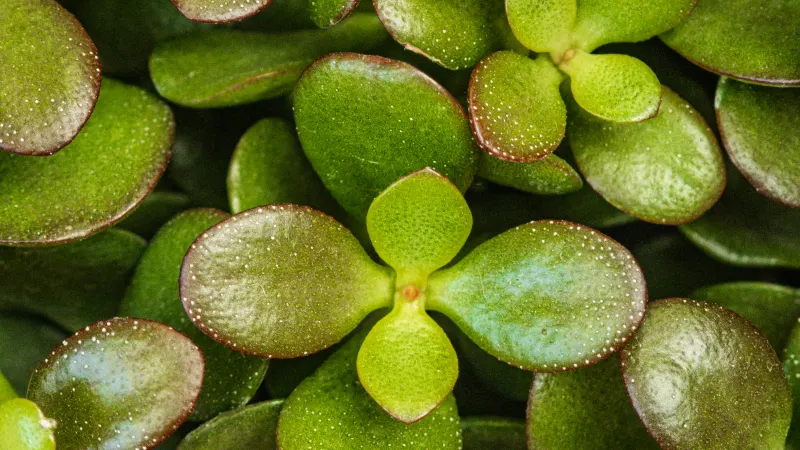
_Crassula_ovata_-_Serres_du_Museum_de_Toulouse.jpg)
- Light
- Bright direct sun for at least 3–4 hours — south-facing window; stretched, etiolated growth is the symptom of insufficient light
- Water
- Only when the soil is completely dry throughout — every 2–4 weeks in summer, once a month or less in winter; overwatering causes rapid root rot
- Humidity
- Unfussy; normal indoor air of 30–50% is fine
- Temperature
- 18–24°C in summer; cooler winters (10–15°C) often trigger flowering; protect from frost
- Pets & toxicity
- Toxic to cats and dogs; mildly toxic to humans
- Difficulty
- Easy to moderate; forgiving of neglect, sensitive to overwatering and insufficient light
A jade plant is patient with you in every way but one — it will not forgive a wet pot, and it will not fake the light it does not have.
The lucky plant that wants to be a tree
The jade plant is a fixture of windowsills and shop counters the world over, kept as much for luck and longevity as for looks — a thick-stemmed succulent with glossy, oval, almost gem-like leaves, reputed to bring good fortune and, with time and the right conditions, to grow into a miniature tree. That last part is not folklore: a well-kept jade really does build a stout woody trunk and a branching, bonsai-like crown over the years, which is a large part of why people keep the same plant for decades and pass it down. It is one of the most genuinely long-lived houseplants you can own.
Crassula ovata comes from the dry, rocky hillsides of South Africa and Mozambique, growing in strong sun and surviving long dry spells by banking water in its fat leaves and stems. That origin sets the two rules that govern its entire care, and they are the same two rules that govern its desert cousins the aloe and the snake plant: it needs real, direct sun, and its soil must dry out completely between drinks. Get those two right and a jade is close to indestructible — slow, forgiving, content to be neglected. Get either wrong and you meet its two failure modes: the stretched, floppy growth of a plant starved of light, and the soft, collapsing rot of a plant kept too wet. Almost all of jade plant care is just those two truths, applied patiently over a long time.
Light: jade is a sun plant, and it shows
The first thing to accept about a jade plant is that it is a true sun-lover, not a shade-tolerant foliage plant, and treating it like the latter is the most common reason jades grow badly. It wants at least three or four hours of direct sun a day, which in practice means a south-facing window — the brightest spot in the house, right against the glass. In that kind of light a jade grows the way it is meant to: compact, with short spaces between thick leaves, sturdy upright stems, and the tell-tale red or bronze blush along the leaf margins that marks a plant getting all the sun it wants. That reddish edge is not stress to fix; it is the sign of a well-lit, happy jade.
Deprive it of that light and it stretches. A jade in a dim spot etiolates — the stems elongate and thin, the gaps between leaves widen, the new leaves come in small and pale, and the whole plant grows weak, floppy, and reaching, leaning toward whatever window it can find. This leggy, drawn-out growth is the classic light-starvation signal, and it is worth recognising early because it does not reverse: the stretched stems stay stretched. Move the plant to your brightest window and future growth comes in tight and strong, but the etiolated section remains, and on a badly stretched jade the only real fix is to cut it back and start the compact form again from the pruned stems (which root readily, so nothing is wasted). The lesson is simple and worth taking before it happens: a jade in weak light becomes a weak jade, and no other care substitutes for the sun.
How often to water a jade plant — completely dry, every time
A jade plant follows the desert rule, the same one that keeps every succulent alive: water only when the soil is completely dry all the way through the pot, and not before. The leaves and stems are full of stored water, so the plant carries its own supply and does not need topping up on a schedule — and watering a jade by the calendar rather than by the soil is precisely how the plants sold as unkillable get killed. In bright summer warmth a jade in a gritty mix and a terracotta pot might dry through in two to four weeks; through a cool, dim winter, with the plant resting, it may go a month or far longer between drinks. Both are right. The interval is a property of the season and the conditions, never a fixed number.
When you do water, soak it thoroughly until water runs from the drainage hole, let the pot drain completely, and empty the saucer — desert rain, then a long dry. The danger, as with all the water-storing succulents, is that a jade gives little honest warning before it rots: kept too wet, the roots and the base of the stem soften and decay out of sight while the leaves above look fine, until the day the lower stem goes mushy and the plant topples. There is no slow, readable wilt to catch in time, so the defence is not vigilance but discipline — never water a jade whose soil is not bone dry, and when in doubt, wait. A jade shrugs off a long drought without harm; it does not shrug off a wet week. If you internalise only one thing, let it be that the overwatering-versus-underwatering balance is lopsided here — an underwatered jade plumps back up after a drink, an overwatered one is often already rotting.
This is also where the jade hides a specific trap that makes a moisture read genuinely useful: the soil dries from the top down, and a jade's roots run deep, so the surface — and even the top few centimetres your finger can reach — can feel bone dry while the lower soil the roots sit in is still holding water from the last drink. Watering on the dry surface alone is how careful owners overwater without realising it. A per-specimen model closes exactly that gap. Each Specimen in your sanctuary carries a Digital Shadow, a running estimate of the moisture left in the whole pot — not just the surface — drawn down on the real warmth and light it is living through, so it stays quiet until the soil is dry all the way down, not just at the top. For a plant whose only real enemy is the unnecessary watering, and whose deep roots disguise how wet the pot still is, a model that answers not yet with the lower soil in mind is doing the one thing that keeps a jade alive.
Soil and potting
Everything above depends on soil that can dry, and for a jade that means sharp, gritty drainage. Use a bagged cactus or succulent mix, or cut ordinary potting soil heavily — by a third to a half — with perlite, coarse grit, or pumice. The dense, moisture-retentive compost most jades arrive in is the enemy: it stays damp deep in the pot for a week or more after the surface dries, which is exactly where a jade's deep roots sit, and exactly how rot starts. The mix should drain in seconds, not hold water for days.
A terracotta pot suits a jade for two practical reasons. Unglazed clay breathes and wicks moisture from the soil through its walls, shortening the drying curve where this plant wants it short; and its weight matters, because a mature jade is genuinely top-heavy — a thick trunk and a dense crown of water-filled leaves will topple a light plastic pot. A drainage hole is essential in any material. Jade is slow-growing and content slightly root-bound, so repot rarely — only every few years, when the plant is truly crowded or unstable, moving up a single pot size in spring and leaving it a week before the first watering so disturbed roots can seal. An oversized pot is a liability, not a kindness: it surrounds the deep roots with a reservoir of wet soil nothing is drinking from, and that is the rot risk all over again.
Temperature, and the woody trunk that takes years
A jade is unfussy about humidity — ordinary indoor air of 30–50% is fine, and it never wants misting, which only invites rot in the leaf joints. Temperature is where it has mild preferences. It is comfortable around 18–24°C through the growing season, and it has no frost tolerance at all, so protect it from freezing glass and cold snaps. One quirk worth knowing: a cooler, drier winter rest of around 10–15°C, with much-reduced watering, is what can coax a mature jade into bloom — clusters of small white or pink star flowers — so a slightly cool, bright winter spot is not a hardship for the plant but a trigger. It still must stay above freezing.
The real reward of jade care, though, is measured in years. With strong light, disciplined watering, and time, a jade slowly thickens its stem into a genuine woody trunk and develops a branching, tree-like crown — the bonsai-like form that makes a decades-old jade a structural, almost sculptural plant. There is no shortcut to it; the trunk is the visible record of consistent care over a long span, and a jade is one of the few houseplants where simply keeping it well for many years is itself the achievement. You can encourage the shape by pruning judiciously — cutting back to a node forces branching below it, and the trimmings root into new plants — but mostly you grow a jade trunk by giving the plant its sun, withholding the watering can until the soil is dry, and being patient on a scale of years rather than weeks.
Common problems
A soft, mushy stem base or trunk. The emergency: root or stem rot from overwatering, the one thing that kills a jade quickly. Press the lower stem and the soil line — firm is healthy; soft, dark, wrinkled-then-mushy, or sour-smelling means rot. Act at once: unpot, cut back to clean firm tissue, let the cuts dry in open air for several days, and repot into dry, gritty mix, withholding water for a week or more. Any firm upper section usually re-roots as a cutting even if the base is lost.
Stretched, thin, leggy growth. Light starvation — the most-misread jade symptom, and the opposite of a watering problem. The stems have elongated and the leaves spaced out as the plant reaches for light it is not getting. Move it to your brightest window; new growth comes in compact, but the stretched stems stay stretched, so prune back a badly etiolated plant and let it rebuild from there. More water makes this worse, not better.
Shrivelled, wrinkled leaves. The honest thirst signal — the plant has drawn down its stored water because the soil has been dry for a good while. This is the one case where the answer is the watering can: a thorough soak, and the leaves plump back over the following days. A jade wears a long drought far more gracefully than a short flood.
Dropping leaves. Several possible causes you separate by context: a sudden chill or cold draft, a sharp change in conditions, or — the one to rule out first — overwatering, which causes leaves to drop along with a softening base. A few lower leaves shed slowly with age is normal; a sudden fall, especially with any stem softness, points at the roots.
Leaves with brown spots or scorched patches. Often a jade moved abruptly from dim conditions into fierce direct sun, sunburning before it acclimatised. Introduce strong light gradually after a move. Black soft spots, by contrast, are rot or cold damage — read the texture, dry versus mushy, to tell them apart.
Propagation — leaves and stems, and the patience to wait
A jade plant is one of the most satisfying succulents to propagate, from either stem cuttings or single leaves, and the key step is the one that feels counterintuitive: let the cut dry first. Take a healthy stem cutting, or gently twist off a whole plump leaf, and set it aside in a dry, shaded spot for a few days to a week until the cut surface calluses over and seals. Planting a fresh wound straight into damp soil is the classic propagation mistake here — it rots before it roots.
Once calloused, lay a leaf on top of, or set a stem cutting into, barely-damp gritty cactus mix, and then mostly leave it alone. Water sparingly — a light misting of the soil surface every several days, not a soak — until roots and, for leaves, a tiny new plantlet form at the base, which takes a few weeks. From there, treat the young plant by the adult rules: bright light and bone-dry-then-watered. A single mature jade gives you near-unlimited new plants this way, which is part of why the same lineage gets shared and passed down for generations. The general principles, and how to nurse any cutting through its fragile start, are in how to propagate plants — though for jade, the watchword is simply dry: dry the cut, dry the soil, and let the plant do the rest slowly.
Frequently asked questions
How often should you water a jade plant?
Only when the soil is completely dry all the way through the pot — in practice every two to four weeks in a bright, warm summer, and monthly or less through a cool winter. There is no fixed number, because the interval depends on your light, pot, and season rather than the species. When in doubt, wait: a jade carries its own water in its leaves and shrugs off a long drought, while a wet pot rots it fast. Watering a jade on a schedule rather than on the dry soil is the commonest way they are killed.
Why is my jade plant leggy and stretched?
It is not getting enough light. A jade is a true sun-lover, and in a dim spot it etiolates — the stems lengthen and thin, the leaves space out and pale, and the plant grows floppy and reaching. The fix is your brightest window, ideally south-facing with several hours of direct sun. New growth will come in compact, but the stretched stems will not shorten again, so a badly leggy jade is best pruned back to let it rebuild a sturdy, well-lit form from the cuts.
Why is my jade plant's base going soft and mushy?
That is root or stem rot from overwatering, and it is urgent. Kept too wet, a jade decays at the roots and stem base out of sight while the leaves still look fine, until the lower stem softens and the plant collapses. Unpot it, cut back to clean firm tissue, let the cuts dry in the air for several days, and repot into dry, gritty mix, holding off water for a week or more. The cause is almost always soil that never fully dried — switch to a sharply draining cactus mix and water only when bone dry.
Are jade plants toxic to pets?
Yes. Crassula ovata is toxic to cats and dogs, causing vomiting, lethargy, and incoordination if eaten, and it is mildly toxic to humans too. Keep it out of reach of pets inclined to chew, and wash your hands after handling cut stems. Botanical Legacy surfaces pet-safety directly on each Specimen's card, so the safe and unsafe plants in your sanctuary are clear at a glance.
Can Botanical Legacy stop me from overwatering my jade?
That is the core of what it does for a succulent. A jade's deep roots mean the surface can feel dry while the lower soil is still wet, which is how careful owners overwater without realising it. The Digital Shadow keeps a running estimate of the moisture in the whole pot — not just the top — based on how it dries in your light and season, and stays quiet until the soil is dry all the way down. For a plant whose only real danger is the watering can, a model that answers not yet with the deep soil in mind is the single most useful thing for keeping it alive.
Start your sanctuary
Botanical Legacy's free Observer plan covers up to five Specimens, each with its own continuously running Digital Shadow — and a jade, whose deep roots hide how wet the pot still is, is exactly the plant a whole-pot moisture model protects from the watering can. Every new account also includes a 14-day trial of Cultivator, the paid plan, which adds the local weather feed and soil sensor support.
START YOUR SANCTUARY — FIVE FREE SPECIMENS, NO PAYMENT REQUIRED →
Give a jade real sun and a dry pot, and the rest is just time — the trunk you want is years of restraint made visible.