Plant care · 12 min read
Should you fertilize houseplants in autumn and winter? Feed the growth, not the calendar
Most houseplants barely grow through a dim northern winter, and feed a plant can't use stays in the pot as salt. When to stop feeding in autumn, the plants that are the exception, and when to start again in spring.
Botanical Legacy · Field notes ·
Fertiliser feeds growth. In a dim December, most houseplants have almost no growth to feed.
Feed follows growth, and winter light stops most of it
A houseplant does not eat fertiliser the way a pet eats food. The nitrogen, phosphorus and potassium in a feed are raw materials, and the plant only draws on them as fast as it builds new leaves, stems and roots. What sets that pace indoors is light. The Clemson Home & Garden Information Center puts a number on it: foliage plants need at least about 200 foot-candles of light (a little over 2,000 lux) for 12 hours a day before fertilising makes any difference to them. Through a northern winter the days are short, and the RHS advice for that season is to give houseplants full sun while daylight is weak. A plant set back from the window gets much less.
So the plant slows down. Many houseplants grown without extra light go into what extension services call a resting stage over winter, and the University of Illinois Extension says plants need very little or no extra fertiliser through the short days. The RHS gives the growing season as March to October and limits winter feeding to about once a month, because light levels are too low for the plant to use fertiliser to make good growth.
Feed the plant can't use doesn't disappear. It stays in the compost as mineral salts, and every extra dose adds to them. Salt build-up damages roots, and the Illinois guidance is direct about when that risk is highest: too much fertiliser can harm plants, especially when dim light has slowed their growth. The symptoms are brown leaf tips and edges, lower leaves dropping, wilting, and a white crust on the compost or the rim of the pot. A winter of regular feeding on a plant that is barely growing is one of the easiest ways to get there.
The popular advice comes in two versions, and both miss the point. One says plants need feeding all year to stay healthy. The other says never feed in winter, full stop. The real rule is simpler and works in every season: feed a plant that is growing, and hold off on one that isn't. The Missouri Botanical Garden puts it the same way. How much and how often to feed depends on the plant, the season and the environment, so a plant in bright light in midsummer may want feeding weekly, and a mature plant spending a dim winter indoors may need none from autumn to spring.
Central heating doesn't change that. A warm room can keep a plant trying to grow, but the light is still short. The RHS warns that too much warmth with low daylight in winter makes a plant put out weak, unhealthy growth. Fertiliser can't make up for light the plant isn't getting.
What to do
Stop when the new growth stops, not on a fixed date. The Illinois guidance is to feed plants only while they are actively growing, so the last feed of the year is the one after which the plant stops putting out new leaves. Illinois gives March to September as the feeding window for most houseplants, and the RHS March to October, so in the northern hemisphere most plants have had their last feed by the end of October. In the southern hemisphere, the same point comes around March and April.
Hold feeding through the rest, and judge by the plant, not the date. A plant that has stopped growing doesn't need feeding. If it is still putting out healthy new leaves in December, it is still growing, and that is the case for a light feed. The RHS ceiling for winter is about once a month, and Clemson's advice for a plant in a true winter rest is none at all.
Check what is already in the pot. Slow-release pellets and sticks keep releasing feed long after they go in: the University of Maryland Extension puts the release period of slow-release pellets at three to four months. A pellet pushed in during September is still feeding in December. Don't add a liquid feed on top of one, and don't put new pellets in during autumn.
Never feed dry compost. The RHS warns that fertiliser on dry soil can burn the roots. If you do feed in winter, water the plant first, or feed into compost that is already moist.
Flush the pot if salt has built up. A white or grey crust on the compost or the pot rim, or brown leaf tips on a plant that has been fed all year, is the sign. Water the pot through with plenty of plain water and let it drain out of the bottom. Maryland Extension's method is to repeat that several times, each time with a volume of water at least the size of the pot. For a small pot that is badly crusted, fresh compost is the better fix. Empty the saucer afterwards so the plant isn't left standing in the salty run-off.
Don't feed a new plant straight away. A plant bought in autumn has just moved into a darker, drier room than the one it was grown in. The Missouri Botanical Garden's advice is to wait until it shows new growth, then begin feeding, lightly at first. In November that usually means waiting until spring.
Start again when the new growth starts. Fresh leaves unfurling and stems lengthening as the days draw out are the signal, usually from around March in the northern hemisphere. Use a feed made for houseplants and keep to the rate on the label or under it: Illinois is clear that you should never use a stronger mix than the one recommended.
Three ways this plays out
The monstera fed every fortnight
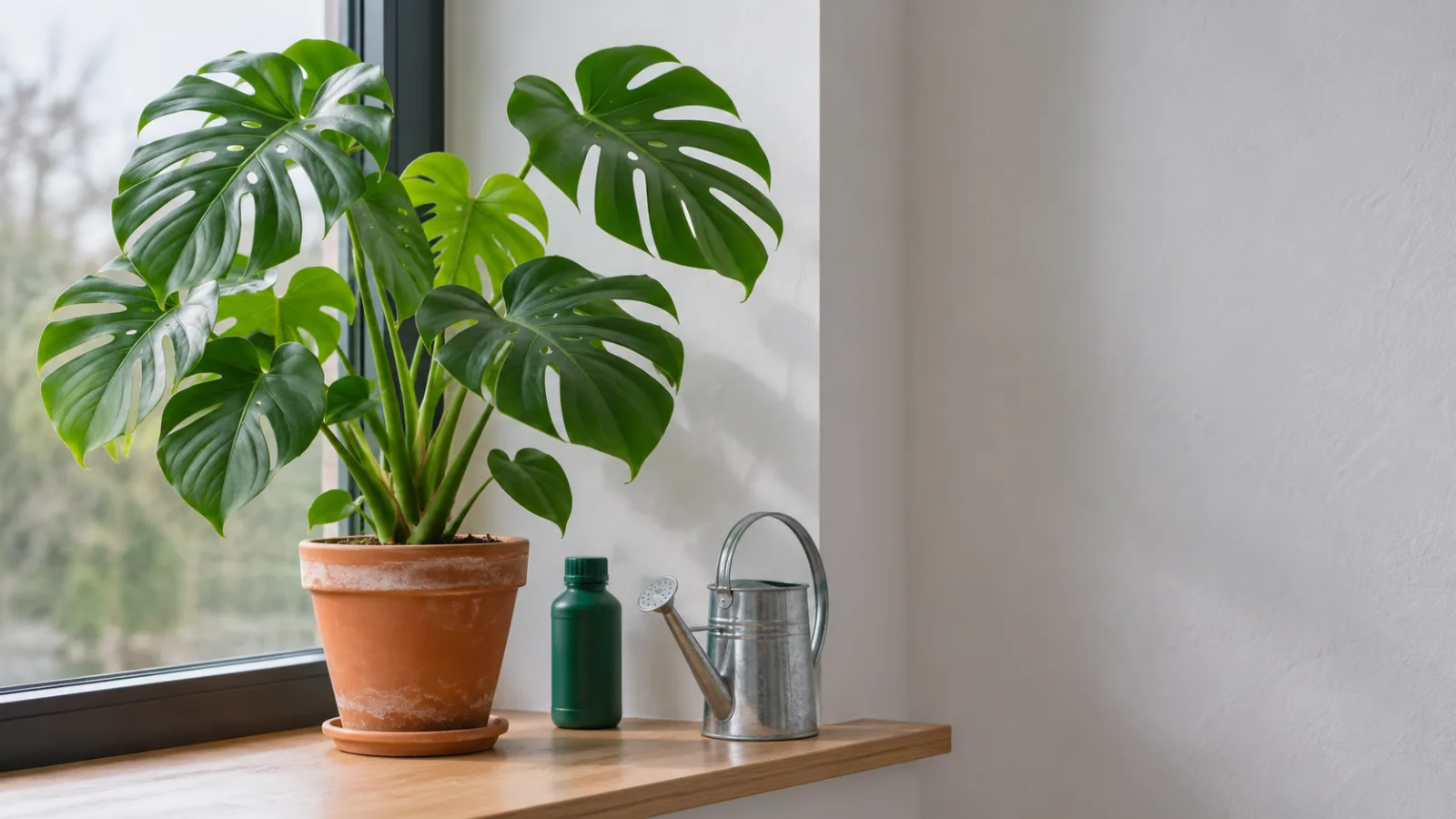
A monstera has lived two metres back from an east-facing window for three years, and its owner fed it every two weeks, all year, at the full rate on the bottle. By February the newest leaf is small and the older leaves have brown, crisp edges. There is a white crust on the top of the compost and round the drainage hole. The plant had stopped growing in November, and three months of feed went into the pot instead of the plant. The fix is to flush the pot through with plain water several times, stop feeding, and start again lightly in March when a new leaf appears. The lesson: winter feeding doesn't help a plant that isn't growing. It builds up as salt in the pot instead.
The Christmas cactus in flower
A Christmas cactus on a cool windowsill comes into bud in November and flowers through December. Its owner wants more flowers and reaches for a bloom feed. The RHS gives the Christmas cactus's flowering season as late November to late January, and gives its feeding window as April to the end of September. Feeding it now falls outside the season the RHS gives for it. The right move is to enjoy the flowers, leave the feed in the cupboard, and start again in April. The lesson: flowering in winter isn't the same as needing feed in winter. Look up the plant's own feeding season instead of guessing.
The pothos under a desk lamp
A pothos trails from a shelf above a desk, under an LED grow light on a 12-hour timer. In January it is still putting out a new leaf every couple of weeks. It is the one plant in the flat that hasn't slowed down, because for this plant the light hasn't changed with the season. It is growing, so it can use a light feed, kept to the RHS's winter ceiling of about once a month, into compost that has just been watered. The pothos on the bookcase in the next room gets no light from the lamp and gets nothing until spring. The lesson: the rule is about growth, not the calendar, and two pothos in the same flat can need different answers.
What Botanical Legacy does about it
A feeding reminder is only useful if it knows the season. The aim is for it to follow the plant, so a summer habit like a fortnightly feed doesn't carry on into winter by itself.
Each Specimen has its own feeding reminder. It runs on the interval since that Specimen's last logged feed, starting from a baseline for its kind. Log a feed and the next one moves on from there.
Seasonal care holds feeding while a plant rests. Turn on seasonal care, during setup or later in your preferences, on any plan. Each Specimen's profile records whether its kind has a dormant season, and which one. While the Specimen is in that season, its feeding reminder is held until the first day of the next season it grows in: 1 March for a plant that rests through a northern winter. The hold also covers feeds you log during the rest, so a feed given in December doesn't bring the reminder back in January. The hemisphere comes from where the Specimen was added, and seasons swap below the equator. The hold is worked out again every night, so it lifts on wake day without you doing anything.
The watering estimate slows too. With seasonal care on, the Digital Shadow reduces the modelled drying rate of a resting Specimen. The reduction is smaller for indoor pots than for plants outdoors, because a heated room already slows the estimate. A soil-moisture sensor's measured dry-down replaces the model on a Specimen that has one, so the reduction only applies where there's no sensor.
A conductivity sensor watches the salt. On the paid plan, a soil-conductivity (EC) sensor connected through Home Assistant tracks salt in the compost. A reading past the safe ceiling raises a salinity alert that tells you to flush the pot and pause feeding, and a rising trend projected to reach that ceiling within two weeks raises an earlier one that tells you to ease off. Plant moisture sensors for houseplants covers the hardware.
What the model can't see
It doesn't know about your grow light. The seasonal hold goes by the Specimen's kind and the calendar, so the pothos under the desk lamp in the story above is treated as resting if its kind has a winter rest. If one of your plants is growing well under a lamp, leave seasonal care on for the others and feed that one on its own, by its new growth.
It also only knows about feeds you log. It can't see a slow-release pellet you pushed into the pot in September, a feed someone else gave the plant, or hard tap water slowly leaving its own minerals in the compost. Without a conductivity sensor it has no reading of the salt at all, and the white crust on the rim is something only you will see. If a plant's kind is evergreen and has no dormant season in its profile, there's no hold: its reminder carries on at its usual interval, and the call on whether it is growing is yours.
Frequently asked questions
Should you fertilize houseplants in winter?
Most of them, no. Most houseplants grow very little through the short, dim days of a northern winter, so they can't use the feed, and the unused fertiliser builds up as salt that can damage the roots. The RHS limits winter feeding to about once a month, and some extension services advise none at all for a plant that is resting. The exception is a plant that is clearly still growing, for example one under a grow light, which can take a light feed.
When should I stop fertilising houseplants in autumn?
Feed only while the plant is actively growing, and stop once it stops putting out new leaves. In the northern hemisphere that is usually in September or October: the RHS gives the growing season as March to October, and the University of Illinois as March to September. In the southern hemisphere, the same point comes around March and April.
When should I start fertilising houseplants again?
When new growth starts as the days lengthen, usually from around March in the northern hemisphere. Use a houseplant feed at the rate on the label or under it, never stronger.
What happens if you fertilise a dormant plant?
The plant can't use most of the feed, so it stays in the compost as mineral salts. Over a winter these can burn the roots, and the signs are brown leaf tips and edges, lower leaves dropping, wilting, and a white crust on the compost or pot rim. Water the pot through with plenty of plain water to flush them out, and stop feeding until spring.
Should I fertilise plants under grow lights in winter?
If they are actively growing, yes, lightly. Feeding follows growth, and Clemson's threshold for fertiliser to make a difference is light, about 200 foot-candles for 12 hours a day, which a grow light on a timer can supply when a window can't. If the plant is putting out new leaves, keep the feed light, about once a month, feed only into moist compost, and watch for brown tips or a white crust as a sign it's getting more than it uses.
Should I feed a plant that flowers in winter?
Not just because it is flowering. Check the plant's own feeding season. The RHS gives the Christmas cactus a feeding window of April to September, even though it flowers from late November to late January. For moth orchids, the RHS advises feeding only sparingly, if at all, in winter.
Does Botanical Legacy stop feeding reminders in winter?
For plants that rest, yes, once you turn on seasonal care. When a Specimen's profile lists a dormant season, its feeding reminder is held while it is in that season, including after a logged feed, and comes back on the first day of its next growing season, such as 1 March for a plant that rests through a northern winter. Plants with no dormant season keep their usual feeding interval. Seasonal care is a preference you can switch on during setup or later, on any plan.
Start your sanctuary
Botanical Legacy's free plan covers up to five Specimens, indoors or out, with continuous Digital Shadow modelling, a feeding reminder for every Specimen and seasonal care that holds feeding while a plant rests. Every new account also gets a 14-day trial of the paid plan, which adds local weather and sensor support via Home Assistant, including conductivity sensors that watch the salt in the pot.
Start your sanctuary - five free specimens, no payment required →
Feed the plant that is growing. In December, that is usually the one under the lamp.
Sources
9 references
The plant-care facts on this page were checked against these references.
- Clemson HGIC: hgic.clemson.edu/factsheet/indoor-plants-cleaning-fertilizing-c…
- RHS: rhs.org.uk/plants/types/houseplants/growing-guide
- University of Illinois Extension: extension.illinois.edu/houseplants/care
- University of Maryland Extension: extension.umd.edu/resource/fertilizer-toxicity-or-high-soluble-…
- Missouri Botanical Garden: missouribotanicalgarden.org/gardens-gardening/your-garden/help-…
- University of Maryland Extension: extension.umd.edu/resource/fertilizer-indoor-plants
- Clemson HGIC: hgic.clemson.edu/factsheet/houseplant-diseases-disorders
- RHS: rhs.org.uk/plants/christmas-cactus/growing-guide
- RHS: rhs.org.uk/advice/profile