Species care guide
Dumb cane
Dieffenbachia spp.
Dieffenbachia care for the bold-foliage plant that most people overwater: how much light it actually needs, why the sap warrants caution, and what causes the lower leaves to yellow and drop.

- Light
- Medium to bright indirect light; variegated cultivars need more light than solid-green ones to hold their markings; avoid direct sun which bleaches leaves
- Water
- When the top 3–4 cm of soil are dry — every 1–2 weeks in summer, less in winter; overwatering causes persistent yellow leaves and root rot
- Humidity
- 50–70% preferred; tolerates normal indoor humidity but appreciates occasional misting or a pebble tray
- Temperature
- 18–27°C; very sensitive to cold drafts — below 15°C causes yellow leaves and slowed growth; below 10°C may cause permanent damage
- Pets & toxicity
- Highly toxic to cats, dogs, and humans — all parts contain calcium oxalate crystals that cause intense oral burning and swelling; wear gloves when pruning and wash hands thoroughly
- Difficulty
- Easy to moderate; the plant is vigorous and forgiving of low light and occasional drought, but sensitive to cold and overwatering
A dieffenbachia carries a tropical largeness into the room — broad painted leaves, a fast and generous habit — and one sharp warning written into its sap.
The bold-leaf plant with a bite
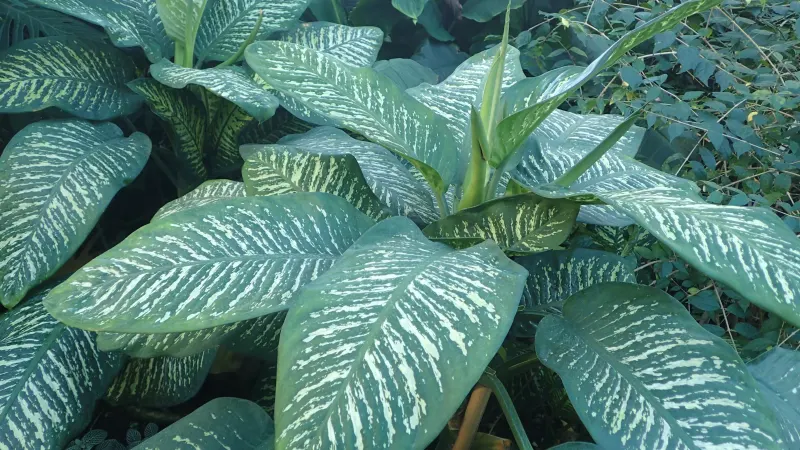
Dieffenbachia is one of the great foliage plants: broad, paddle-shaped leaves splashed and marbled in cream, white, yellow, and green, carried on an upright cane that grows fast and large in the right conditions. It has been a houseplant for generations because it delivers a lot of tropical drama for very little effort — it tolerates ordinary indoor light, forgives an occasional missed watering, and grows quickly enough to feel rewarding. For most of its care, it is genuinely easy.
There are two things to understand before you bring one home. The first is that its sap is seriously irritating — the common name "dumb cane" is a warning, not a quirk, earned by the way chewing a leaf can swell the mouth and throat enough to silence speech. The second is that, easy as it is, it has one reliable way to disappoint: overwatering, which shows up as the persistent yellow leaves that fill its help forums. Get the toxicity respected and the watering right, and a dieffenbachia is a vigorous, forgiving, fast-growing plant in the same easy-going tropical family as the heartleaf philodendron and the arrowhead plant.
It comes from the warm, humid understorey of tropical Central and South America, where it grows in dappled light beneath taller trees. That tells you what it wants indoors: bright but filtered light, steady warmth, and soil that stays lightly moist but drains freely — and what it cannot abide, which is cold and standing water.
The toxicity: respect the sap
Every part of a dieffenbachia — leaves, stems, cane, sap — contains calcium oxalate, packed into the tissue as microscopic needle-shaped crystals called raphides. When the plant is chewed, cut, or crushed, those crystals are released and embed in whatever soft tissue they touch: the mouth, the tongue, the throat, the eyes, the skin. The result is immediate and intense — burning, stinging, and swelling, with the swelling of the mouth and tongue serious enough, historically, to cause temporary loss of speech. That is where "dumb cane" comes from, and it is not folklore.
For people, the practical rule is gloves and care. Wear gloves whenever you prune, repot, or take cuttings; keep the cut sap away from your eyes, mouth, and any broken skin; and wash your hands thoroughly afterwards even if you wore gloves. Never handle a leaf you have cut and then rub your eyes. The reaction is painful but, for an adult, rarely dangerous beyond the discomfort — the real risk is to small children and to pets, for whom a chewed leaf is a genuine and frightening emergency.
This makes placement a deliberate decision. Keep a dieffenbachia well out of reach of cats, dogs, and young children — a high shelf, a room they do not access, or simply a different plant if reach cannot be controlled. It is too large and too fast a grower to perch out of the way casually, so think about where it goes before it gets there. If pets share your home and roam freely, the non-toxic peace lily is not a safe substitute — it shares the same calcium oxalate chemistry — but a parlor palm or a spider plant gives comparable presence without the hazard.
Light and variegation
The painted markings that make a dieffenbachia worth growing are a direct function of light, and the brighter the spot, the bolder they stay. In medium to bright indirect light, the cream, white, and yellow variegation reads vivid and high-contrast, and the plant grows densely and upright. Move it into a dim corner and the plant does something specific: it produces more chlorophyll to scrape a living from the low light, and the variegation fades back toward plain green as the green pigment floods the leaf. The pattern you bought it for quietly disappears.
So the rule for variegated cultivars — which is most of them — is to give them more light than you might think a foliage plant needs, while keeping that light filtered. A spot near a bright east- or west-facing window, or back from a south-facing one, holds the markings without scorching the leaves. The plant will lean toward the light source over time, so turn the pot a quarter-turn every week or two to keep it growing evenly rather than tipping toward the window.
The one excess to avoid is direct sun. The broad leaves, for all their size, are thin and shade-adapted, and a few hours of direct light through glass bleaches them into pale, washed-out, scorched patches. If the only bright spot you have is a hot direct window, filter it with a sheer curtain or set the plant back. Bright but indirect is the whole target: enough intensity to hold the variegation, soft enough not to burn.
Watering and the yellow-leaf diagnosis
Yellow leaves are the defining dieffenbachia problem, and the single most common cause, by a wide margin, is overwatering. The plant wants soil that dries out in its top few centimetres between drinks — water when the top 3–4 cm are dry, soak thoroughly, drain completely, and never let the pot stand in water. In a warm bright summer that might be every one to two weeks; in winter, distinctly less. Kept wetter than that, the roots begin to fail in soil that never dries, and the first thing you see is the leaves going yellow.
The art is in reading which yellow you are looking at. One or two of the oldest, lowest leaves yellowing and dropping over time is completely normal — a dieffenbachia builds a cane by shedding its bottom leaves as it grows taller, and a slow turnover from the base is just the plant ageing gracefully. What is not normal is many leaves yellowing at once, or yellowing spreading up from soggy soil, or new growth coming in yellow and weak. That pattern is roots in trouble, almost always from a pot kept too wet, sometimes compounded by cold. The read is positional and rate-based: slow, low, one-at-a-time is senescence; fast, widespread, soil-is-wet is overwatering. If timing the watering is where you struggle, the guide on when to water houseplants lays out how to read the soil instead of the calendar.
A single schedule cannot tell these apart, because "every week" knows nothing about whether your pot is dry today. A Digital Shadow — the running model Botanical Legacy keeps for each Specimen in your sanctuary — draws the moisture estimate down on the real light and warmth your plant is living through and holds off the next watering until the soil has genuinely dried, which is exactly the discipline a dieffenbachia needs. For a plant whose commonest failure is the one extra drink, a model that waits for the soil rather than the date is the difference between persistent yellowing and a clean, green plant.
Common problems
Persistent yellow leaves. Overwatering, until proven otherwise. Check the soil: if it is staying wet and heavy, stop watering, improve drainage, and let it dry before resuming. Cold is the second suspect — below 15°C the leaves yellow even in good soil.
Soft, mushy cane. Advanced root or stem rot from prolonged overwatering. Cut the cane back to firm, pale tissue with a gloved hand and a clean blade, let the cuts dry, and replant the healthy upper section as a cutting. The soft, water-soaked base will not recover.
Brown, crispy leaf edges. Usually low humidity or cold drafts, sometimes salt build-up from hard water or excess fertiliser. Raise the humidity, move the plant away from draughts, and flush the pot occasionally to wash out accumulated salts.
Rapid yellowing of new growth. A sign of root damage — the plant cannot supply its newest leaves. Almost always overwatering; check and correct the soil moisture, and consider unpotting to inspect and trim any blackened roots.
Propagation
A dieffenbachia is generously easy to propagate, which is fortunate, because it doubles as the rescue plan when the base rots. The plant propagates from its cane — the thick upright stem — and there are two ways to do it. The simplest is a tip cutting: with a gloved hand and a clean blade, cut a length of stem with a few leaves from the top, let the cut surface dry and callous for an hour or two, and root it in water or directly in moist, well-draining mix in a warm, bright spot.
The cane itself can also be cut into segments. Take a length of bare cane, cut it into pieces a few centimetres long each containing at least one node — the slightly raised ring where a leaf once grew — let them callous, and lay them horizontally half-buried in moist mix, or stand them upright keeping the original orientation. Each node can push out roots and a new shoot, so a single overgrown cane can become several plants. Warmth and patience are the requirements; rooting takes some weeks.
The gloves are not optional here. Cutting the cane releases the most sap of any routine task with this plant, and that sap is the irritant the whole guide has warned about. Work on a wipeable surface, keep the sap off your skin, away from your face entirely, and wash up thoroughly when you are done.
Frequently asked questions
How often should you water a dieffenbachia?
When the top 3–4 cm of soil are dry — in practice every one to two weeks in a warm bright summer, and less in winter, depending on your light and warmth. Soak thoroughly, drain completely, and never leave the pot standing in water. Overwatering is the main cause of the persistent yellow leaves this plant is known for, so let the soil dry between drinks rather than watering on a fixed day.
Why are my dieffenbachia leaves turning yellow?
Most often overwatering. If many leaves yellow at once, or the soil is staying wet and heavy, the roots are in trouble — stop watering, improve drainage, and let the soil dry. A few of the oldest, lowest leaves yellowing slowly is normal ageing as the cane grows. Cold below 15°C is the other common cause, so check the temperature and keep the plant clear of drafts.
Is dieffenbachia toxic to cats and dogs?
Yes — highly. Every part contains calcium oxalate crystals that cause intense burning and swelling of the mouth and throat if chewed, which is a genuine emergency for a cat, dog, or small child. Keep the plant well out of reach, wear gloves whenever you handle or prune it, and contact a vet or doctor immediately if any part is ingested.
How much light does a dieffenbachia need?
Medium to bright indirect light. Variegated cultivars need more light than plain-green ones to keep their cream-and-white markings vivid; in a dim spot the variegation fades back toward solid green. Keep the plant out of direct sun, which bleaches and scorches the broad leaves. A bright window with filtered light, or a step back from a sunny one, is ideal.
Why is my dieffenbachia drooping or losing lower leaves?
Losing the occasional lowest leaf is normal — the plant sheds old leaves as the cane grows taller. Widespread drooping usually means a watering fault in either direction: a soggy, overwatered pot rotting the roots, or, less often, soil left bone dry too long. Check the soil first. Cold drafts and a sudden temperature drop can also cause sudden drooping, so rule those out too.
Start your sanctuary
Botanical Legacy's free Observer plan covers up to five Specimens, each with its own continuously running Digital Shadow — and a dieffenbachia, whose signature problem is the overwatering that yellows its leaves, is exactly the kind of plant the model keeps on track. Every new account also includes a 14-day trial of Cultivator, the paid plan, which adds the local weather feed and soil sensor support.
START YOUR SANCTUARY — FIVE FREE SPECIMENS, NO PAYMENT REQUIRED →
Respect the sap, keep it warm, and let the soil dry between drinks — a dieffenbachia gives back bold tropical leaves for very little in return.