Species care guide
Peace Lily
Spathiphyllum wallisii
A peace lily care guide built on what the plant is telling you — why it droops, why the tips brown, why it won't flower, and how often to actually water it.

- Light
- Medium, indirect light; survives low light but will not flower without it — never direct sun
- Water
- When the top 2–3 cm of soil are dry, or at the first sign of droop — roughly weekly, more in summer
- Humidity
- Prefers 50%+; brown leaf tips are its complaint about dry household air
- Temperature
- 18–30°C; keep it above 12°C and well away from cold draughts
- Pets & toxicity
- Toxic to cats and dogs — insoluble calcium oxalates irritate the mouth and throat
- Difficulty
- Easy to keep alive, harder to keep flowering; its theatrical wilt makes it easy to read
A peace lily faints for the cameras — the trick is to water it before the performance, not because of it.
The easy-bloomer reputation is half a promise
The peace lily is sold as the plant that does it all: glossy green leaves, elegant white blooms, thrives in low light, tells you when it's thirsty. Every line of that is true enough to print and incomplete enough to disappoint. It does flower, but only with light most "low-light" placements never give it. It does signal thirst, but the signal — a full, theatrical collapse — trains exactly the wrong watering habit if you take it literally. The plant that markets itself as foolproof is the one whose owners most often ask why it has stopped blooming and started browning.
Both of its famous virtues come with a footnote. "Tolerates low light" means survives low light; the white spathes that sold you the plant are paid for in photons it isn't getting in a dim corner. And the dramatic wilt that makes it feel communicative is a last resort, not a routine prompt — a plant watered only when it faints lives in a slow oscillation between drought and flood that shows up, weeks later, as brown leaf tips. This guide is about reading the plant a little earlier than it would like, so neither footnote ever catches you. If houseplants are still new, the ten beginner mistakes are worth a look first — the peace lily forgives most of them, then quietly charges interest.
Light, and why your peace lily won't flower
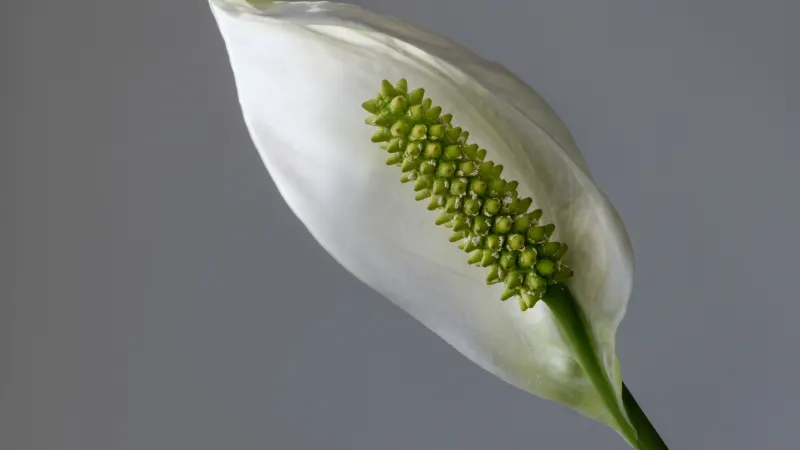
Spathiphyllum wallisii grows on the floor of Central and South American rainforests, in the green half-light beneath a closed canopy. That heritage is the whole of its light story: it is built for shade, genuinely comfortable in light far too low for a fiddle-leaf fig — and "comfortable" is not the same as "blooming." In the wild it flowers when a gap opens in the canopy and brightness floods in. Indoors, the same rule holds. Leaves are cheap; flowers are expensive, and the plant only spends on them when the light can pay.
So the single most common complaint — my peace lily won't flower — is almost always a light verdict. A plant kept alive in a dim hallway will throw leaf after healthy leaf and never a spathe, because from its point of view there is no canopy gap worth the investment. Move it somewhere with bright, indirect light — an east-facing sill with gentle morning sun, or a metre back from a south window behind a sheer curtain — and blooms become possible again. What it will not take is direct midday sun, which bleaches pale, papery scorch into those broad dark leaves within an afternoon.
Be sceptical of how bright a room looks. Human eyes adjust to dimness far past what a rainforest understory leaf can use for flowering, so a corner that reads "plenty bright" to you is often a maintenance ration, not a blooming one. If the leaves are green and the plant grows but never buds, you have your answer — and a snake plant is the better tenant for the dark corner you were hoping to fill with flowers.
How often to water a peace lily
There is no correct number of days, and the peace lily proves it more loudly than most. It drinks fast on a warm, bright week and slowly through a cool, grey one; it dries sooner in a porous terracotta pot than a glazed one, sooner root-bound than freshly potted. "Once a week" is a fair average and wrong in both directions for much of the year.
The trigger that replaces the calendar is simple: water when the top 2–3 cm of soil are dry to a finger. Push in to the second knuckle — dry means water, cool and damp means wait. Water thoroughly until it drains, then empty the saucer. The peace lily likes to stay evenly moist, a shade wetter than a pothos or ZZ plant would tolerate, but it does not want to sit wet, and the gap between those two states is exactly what the finger test reads.
The plant offers a second signal you should treat as a backstop, not a schedule: when it runs genuinely short, every leaf droops at once in a soft, total faint, and a drink revives it within a few hours. That recovery is real, and it is also a trap. A peace lily watered only on the droop lives in a repeating swing — bone-dry, flood, bone-dry — and the leaf tips brown in protest. Use the faint to forgive a missed week, not to plan the waterings. This is the gap a per-plant model is built to close: Botanical Legacy keeps a Digital Shadow of each Specimen in your Sanctuary, an estimate of how much moisture is left in this pot given the warmth and light it's living in — so you can water just before the performance instead of in response to it. The longer method lives in when to water your houseplants.
Soil and potting
A peace lily is an aroid, and aroids want air around their roots even while the mix stays evenly moist — the two are not in conflict if the soil is right. The mix to aim for is an ordinary houseplant compost opened up with a handful of perlite, with perhaps a little coir or bark to hold a touch of moisture without going dense. A heavy, water-logging compost is how attentive owners still drown a peace lily: the surface reads dry to a finger while the base stays sodden, and the roots rot unseen.
The pot matters as much as the mix. A drainage hole is non-negotiable — no watering discipline survives a sealed pot, and the peace lily's taste for even moisture makes a holeless cachepot especially dangerous. If you love a decorative pot without a hole, keep the plant in a plastic nursery pot inside it and lift it out to water and drain. Terracotta breathes and forgives a heavy hand; glazed ceramic and plastic hold moisture longer, which suits this plant's preference as long as you read the soil and not the calendar.
Repot every year or two, when the plant tells you: roots circling the surface and escaping the holes, water running straight through, the whole thing drying days faster than it used to. Go up a single size — 2–3 cm wider. A peace lily flowers better slightly root-bound, and an oversized pot wraps a modest root ball in wet soil it cannot drink, recreating the rot you were avoiding.
Humidity and temperature
The rainforest floor where this plant evolved rarely sees humidity below 60%, and unlike the pothos, the peace lily does notice the gap between there and a centrally heated living room. It will live in ordinary household air, but dry air is the leading cause of the browned, crisp leaf tips that owners so often blame on watering. It is happiest at 50% and up. Grouping plants together raises the local humidity in a way that lasts; standing the pot on a tray of pebbles and water does the same. Misting does not — a spritz evaporates in minutes, and water pooling in the leaf crowns invites fungal spotting. Treat misting as a ritual, not a remedy; a small humidifier in a dry winter room does more than a season of spray bottles.
Temperature is the easier ask, because the peace lily likes roughly what you do: a band of 18–30°C suits it, and it minds cold far more than warmth. Sustained exposure below about 12°C does real damage, and a single hard chill can blacken leaves overnight. The risks are local rather than thermostat-deep — a plant pressed to a cold single-glazed window takes a nightly draught the room average never shows, and one set above a radiator gets a stream of hot, dry air that spikes its thirst and crisps its margins at once.
Feeding
A peace lily is a modest feeder, and the failure that hurts it is enthusiasm. Fertiliser is mineral salt; give more than the plant can use and it accumulates in the soil, draws moisture back out of the roots, and scorches the leaf margins brown from the edge inward — damage almost identical to dry air or hard-water tips, so the cause gets misread and the over-feeding continues. More food does not buy more flowers. Light and a mature, established root system do that.
The rhythm that works is light and seasonal. From spring through late summer, while the plant is visibly growing, feed every six weeks or so with a balanced houseplant fertiliser at half the strength on the label. From autumn, taper to almost nothing — a plant that has slowed for the darker months cannot use what you give it, and the surplus simply salts the soil.
Common problems
Nearly every peace lily problem is one visible symptom standing in for several possible causes, and the whole skill is in telling them apart before you act — because the wrong fix usually deepens the real one.
Drooping. The signature behaviour, and usually the easiest. A peace lily that has gone short faints completely and revives within hours of a thorough drink; if the soil is dry and a watering fixes it, that was simple thirst. The dangerous version is the look-alike: a plant drooping in wet soil, with a heavy pot and a sour smell, is not thirsty — its roots are rotting, and another drink finishes them. Feel the soil before you reach for the watering can; it, not the wilt, names the cause.
Brown leaf tips. The most-searched peace lily symptom and the most over-attributed to "needs more water." The usual culprits are dry air, hard or chlorinated tap water collecting in the leaf, an erratic drought-and-flood watering rhythm, and salt from over-feeding. Work through them in that order: raise humidity, switch to filtered or stood water, water on the finger trigger rather than the faint, and ease off the fertiliser. Trimming the brown tips tidies the look but does not fix the cause.
Yellow leaves. Scattered yellowing across the plant, with soil still wet days after watering and a heavy pot, points to overwatering — the most common cause. A single older leaf near the base yellowing and dying back while the rest looks vigorous is just the plant retiring old tissue, and needs no response.
No flowers. Almost always too little light, occasionally a very young or recently divided plant that simply isn't ready. Move it to bright, indirect light and give it a season. The forced supermarket bloom, often chemically induced, also fades and isn't always repeated indoors for a year or more — that is normal, not failure.
Green flowers, or blooms that brown fast. Spathes emerging green rather than white, or whitening only briefly, usually mean the light is slightly off — too little to colour them fully, or occasionally too much — or simply that the bloom is ageing. Deadhead the spent ones at the base and adjust the light a notch.
Frequently asked questions
How often should you water a peace lily?
There's no fixed interval — the same plant drinks twice as fast in a warm, bright week as in a cool, dim one. Water when the top 2–3 cm of soil are dry to a finger, aiming to keep it evenly moist but never soggy, then water thoroughly and empty the saucer. In practice that lands near weekly, more often in summer. The plant will also faint dramatically when it runs short and recover within hours of a drink — useful as a backstop, but don't let wilting be your only cue, or the leaf tips pay for the swings.
Why is my peace lily drooping?
Most often thirst: dry soil, a light pot, and a full recovery within hours of watering confirm it. But a peace lily can droop just as badly from the opposite cause — roots rotting in soil that's stayed wet, with a heavy pot and a sour smell — and there another drink makes it worse. Always feel the soil before watering a droop. Dry, water it; wet, let it dry out and check the roots.
Why does my peace lily have brown tips?
Brown, crispy tips are usually about water quality, air, and rhythm rather than too little watering. The common causes are dry household air, chlorine or fluoride in hard tap water building up in the leaf, an erratic drought-then-flood watering pattern, and salt from over-feeding. Raise the humidity, switch to filtered or overnight-stood water, water on the soil trigger instead of on the wilt, and lighten the feeding. Existing brown tips won't turn green again — you're preventing the next ones.
Why won't my peace lily flower?
Almost always not enough light. Peace lilies survive in shade but only bloom in bright, indirect light, because flowers cost far more energy than leaves. Move it near a window that's bright without direct sun and give it a season. Very young or recently divided plants also skip flowering until they mature, and a forced supermarket bloom may not repeat for a year or more — both normal.
Is a peace lily toxic to cats and dogs?
Yes. The leaves and stems contain insoluble calcium oxalate crystals, which cause immediate mouth and throat irritation, drooling, pawing at the face, and vomiting if chewed. It's rarely life-threatening but genuinely painful, and a vet call is sensible if a pet has chewed more than a mouthful. Despite the name, a peace lily is not a true lily and doesn't carry the severe kidney toxicity true lilies pose to cats — but keep it out of reach all the same. If you want a genuinely pet-safe statement plant, a calathea is the safer choice.
Will Botanical Legacy tell me when my peace lily needs water?
It estimates it, which is the honest version of that promise. Each Specimen in your Sanctuary carries a Digital Shadow — a running model of how much moisture is left in that pot, drawn down on the temperature and light it's living in — so the app can prompt you before the plant faints rather than after. It can't feel the soil for you, and a finger in the pot remains the final check, but for a plant whose only built-in signal is a last-minute collapse, an earlier estimate is exactly the missing piece.
Start your sanctuary
Botanical Legacy's free Observer plan covers up to five Specimens, each with its own continuously running Digital Shadow — and a peace lily, expressive and quick to recover, makes an excellent teacher among them. Every new account also includes a 14-day trial of Cultivator, the paid plan, which adds the local weather feed and soil sensor support.
The plant will faint on cue for the rest of its life; the goal is to give it nothing worth fainting over.
START YOUR SANCTUARY — FIVE FREE SPECIMENS, NO PAYMENT REQUIRED →
A peace lily asks for very little — only that you read it a few hours before it insists.