Species care guide
Arrowhead plant
Syngonium podophyllum
Arrowhead plant care: why Syngonium podophyllum changes leaf shape as it matures, how to keep it bushy or let it climb, and how to read its wilting.
.jpg)
- Light
- Bright indirect light for best leaf colour; tolerates medium and low light but variegation fades in shade
- Water
- When the top few centimetres are dry; less in winter, but do not let it dry out; wilting on dry soil means you have waited too long
- Humidity
- 40–60%; appreciates humidity but tolerates normal indoor air, unlike calathea or Boston fern
- Temperature
- 18–26°C; avoid cold drafts and temperatures below 15°C
- Pets & toxicity
- Toxic to cats and dogs; irritating to humans - the sap contains calcium oxalate crystals
- Difficulty
- Easy; a highly adaptable foliage plant for varied light and indoor conditions
Buy an arrowhead plant and you buy two plants in one — the compact bush it is now, and the lobed-leaf climber it becomes if you let it.
One plant, two lives
The arrowhead plant is a highly adaptable, low-maintenance foliage plant, and it has a trick worth knowing about: it changes shape as it grows up. The young plant you bring home is a tidy mound of arrow-shaped leaves on short stems — the namesake silhouette — but that is only its juvenile form. Left to mature, the same plant lengthens into a climbing or trailing vine and its leaves transform, splitting into three, five, or more deep lobes that look so different from the original arrowhead that newcomers sometimes think they own a different species. They do not. It is the plant doing what it has always done.
Syngonium podophyllum comes from the tropical forests of Central and South America, where it begins on the forest floor and climbs the trunks of trees toward the light, shifting its leaf form as it rises — the juvenile arrowhead leaves give way to the lobed, mature foliage as the vine ascends. Indoors it carries both that adaptability and that climbing instinct, and it brings an easy-going temperament that sets it apart from the moisture-and-humidity-demanding tropicals: where a calathea or a Boston fern needs high humidity, an arrowhead tolerates ordinary household air. It is close in spirit to the heartleaf philodendron and the pothos — the same forgiving, vining, root-anywhere ease — and it comes in a paintbox of cultivars, from the classic green-and-white to the pink new leaves of 'Neon Robusta' and the bold patterns of the newer varieties.
The leaf-shape transformation
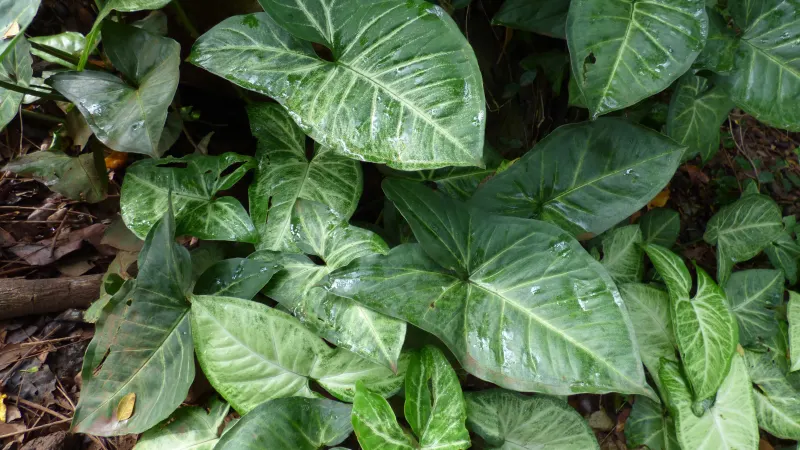
The single most confusing thing about an arrowhead plant, for someone who has not met one before, is watching its leaves change — so it is worth understanding rather than worrying about. In its juvenile stage the plant produces simple, undivided, arrow- or heart-shaped leaves, held on a compact, bushy plant. As it matures and begins to climb or trail, the new leaves emerge progressively more divided, developing the deep lobes — three, then five, sometimes more — that mark the adult foliage. A long-established arrowhead can look almost palmate, nothing like the neat little arrows it started with.
Both forms are entirely normal and both are the same plant; the shift is simply maturity, accelerated by letting the plant climb. There is nothing to fix and no cause for alarm when your tidy arrowhead starts producing strange lobed leaves — it is growing up. What you can do is influence which form dominates, because the transformation is tied to whether the plant is allowed to climb, and that is the lever behind the next decision every arrowhead owner makes.
Bush or vine — your choice
An arrowhead plant will become whatever you train it to be, and deciding early saves you fighting the plant later. Two paths:
To keep it a compact, bushy houseplant with the juvenile arrowhead leaves, pinch out the growing tips regularly. Each time you nip off the end of a stem as it begins to lengthen, the plant keeps its shrub-like habit, and frequent pinching holds it in its tidy, mounded form more or less indefinitely. This is the form the plant is usually sold in, and it takes only a minute every few weeks.
To let it become a vine, give it something to climb — a moss pole recreates the tree trunk it would scale in the wild — or set it on a high shelf and let the stems trail. As it climbs or hangs, it matures into the lobed-leaf adult form, the stems lengthening into a generous cascade or a tall column of foliage. A climbing arrowhead on a moss pole develops larger, more dramatic leaves than a pinched bush ever will.
Neither is more correct; it is purely a matter of the plant you want. The only mistake is indecision — letting a plant you wanted bushy grow long and leggy, or constantly cutting back one you would rather let climb. Pick the form, and the simple habit (pinch, or provide support) that produces it.
Light and variegation
An arrowhead plant tolerates a remarkably wide range of light, which is a large part of its easy reputation: it prefers medium to bright indirect light but tolerates low light. But "tolerates" and "looks its best in" are different claims, and the difference shows up in the leaf colour. The variegated cultivars — the white-marbled types, the pink 'Neon Robusta', the boldly patterned newer varieties — hold their colour and contrast in bright indirect light and lose it in shade, fading toward plain green in low light. If your variegated arrowhead is reverting to green, it wants more (still indirect) light.
The one light to avoid is harsh direct sun, which scorches the leaves and bleaches the pattern just as surely as deep shade dulls it. Bright but filtered — near a window, out of the direct beam — is the sweet spot that keeps both the green and the variegated forms vivid and growing well. A plain green arrowhead has no variegation to lose, so it is the better choice for a dimmer room; a heavily variegated one is asking for a brighter spot to earn its colour. Match the cultivar to the light you have and the plant rewards you accordingly.
How often to water an arrowhead plant
Watering an arrowhead is forgiving, which is the other half of why it suits beginners. The plant likes its soil to dry out slightly between drinks but not to bake: water thoroughly when the top few centimetres have dried, then let the pot drain completely. In a warm, bright summer that comes round far more often than in a cool, dim winter, when it stretches longer. As with every plant, the interval belongs to the conditions rather than the calendar — the same arrowhead drinks faster in July than in January.
What helps is its warning signal. When an arrowhead has gone too long between waterings, it wilts - the leaves and stems soften and droop. That visible thirst signal means the plant can flag a lapse before it becomes serious, but check the soil before you act, because an overwatered plant can wilt too. The failure mode to avoid is overwatering: an arrowhead in permanently soggy soil rots and yellows its leaves. Let the surface dry slightly between waterings, but do not let it dry out completely, even in winter.
Even a forgiving plant, though, has a moving target — the right interval shifts with the season, the warmth, and the light, and "water when the top few centimetres dry" still depends on knowing when that has happened. This is where a per-specimen model quietly helps. Each Specimen in your sanctuary carries a Digital Shadow, a running estimate of the moisture left in that pot, drawn down on the real light and warmth it is living through — so even with an easy plant you are watering on the soil's genuine state rather than a guess, and you are spared the mistake an arrowhead does punish, the well-meant overwatering that comes from topping it up before it has dried.
Common problems
Yellowing leaves. Often overwatering. If leaves are yellowing and the soil is staying wet, ease back, check the drainage, and let the top dry out more between waterings. If the soil is bone dry and the older, lower leaves are the ones yellowing, the plant is thirsty instead.
Drooping or wilting. Usually simple thirst - the plant's too-dry signal, fixed by a good watering. Check the soil to confirm it is dry; if it is wet and the plant is wilting, you have the overwatering problem instead, and the answer is to dry out, not add water.
Brown, crispy leaf edges or tips. Typically very dry air, underwatering, or salt buildup from hard water or overfeeding. An arrowhead tolerates ordinary humidity better than a calathea, but a plant in the dry air of a centrally heated room in winter can show it. Raise the humidity a little, keep the watering steady, and flush the soil occasionally to clear salts.
Variegation fading to green. Too little light. The variegated cultivars need bright indirect light to hold their pattern, and revert toward plain green in shade. Move the plant brighter (still out of direct sun) and new growth comes in with better colour.
Leggy, sparse growth. Either too little light, or simply a plant that wants to climb being kept as a bush without pinching. Brighten the spot, and either pinch the tips to keep it bushy or give it a pole and let it become the vine it is reaching to be.
Propagation — as easy as it gets
An arrowhead plant is one of the simplest houseplants to propagate, and pruning gives you cuttings for free. Take a stem cutting with at least one node — the point where a leaf meets the stem, often already showing a small aerial root, from which new roots form — using a clean blade, and put it in water or directly into moist soil. In water, rooting can take several weeks, after which you pot the cutting up; in soil, keep it lightly moist and warm while it establishes. It is one of the houseplants that root easily in plain water.
Two notes. First, glove up: the sap can irritate skin, and the calcium oxalate crystals in the plant make it toxic to pets and irritating to people who chew it, so handle cut stems with care and keep the plant out of reach of curious animals. Second, propagating is also how you refresh a leggy plant - cut it back, root the cuttings, and pot them up for a new, compact plant. The general method, and how to carry a cutting through its fragile first weeks, is in how to propagate plants.
Frequently asked questions
Why are my arrowhead plant's leaves changing shape?
Because the plant is maturing, and it is completely normal. Syngonium podophyllum produces simple arrow-shaped leaves when young and compact, and as it grows and begins to climb or trail, the new leaves develop deep lobes — three, five, or more — that look very different from the originals. It is the same plant at a later stage of life, not a new species or a problem. Letting the plant climb a pole accelerates the shift to the lobed adult form; keeping it pinched and bushy holds the juvenile arrowhead shape.
How do I keep my arrowhead plant bushy?
Pinch out the growing tips regularly. Each time you nip the end off a stem as it begins to lengthen, the plant keeps its compact, shrub-like habit and its tidy juvenile form. Do this every few weeks and the plant stays a neat mound rather than lengthening into a vine. If instead you let the stems grow unchecked, the plant will trail or climb and mature into its lobed-leaf adult form, so the bushy look is a matter of consistent pinching.
How often should you water an arrowhead plant?
When the top few centimetres of soil have dried out - far more often in a warm, bright summer than in winter, though it should never dry out completely. The plant helps by wilting when it is too dry, though an overwatered plant can wilt too, so check the soil first. The mistake to avoid is overwatering: soggy soil rots the plant, so let the surface dry slightly between drinks.
Are arrowhead plants toxic to pets?
Yes. Syngonium podophyllum is toxic to cats and dogs and irritating to humans, because the plant contains calcium oxalate crystals that cause mouth irritation, drooling and vomiting if chewed, and the sap can irritate skin on handling. Keep it out of reach of pets inclined to nibble, and wear gloves when taking cuttings. Botanical Legacy surfaces pet-safety directly on each Specimen's card, so the safe and unsafe plants in your sanctuary are clear at a glance.
Can Botanical Legacy help with such an easy plant?
It guards against the mistake an easy plant still punishes - overwatering. An arrowhead copes with its surface drying between drinks, but soggy soil rots it, and the well-meant habit of topping it up before it has dried is how that happens. The Digital Shadow keeps a running estimate of how much water your specific pot is holding, based on how it dries in your light and season, so you water on the soil's genuine state rather than a guess, and avoid the over-attention that leaves a pot soggy.
Start your sanctuary
Botanical Legacy's free Observer plan covers up to five Specimens, each with its own continuously running Digital Shadow — and an arrowhead, which wants its surface to dry between drinks but never a soggy pot, is a plant kept safest by watering on its soil's real state. Every new account also includes a 14-day trial of Cultivator, the paid plan, which adds the local weather feed and soil sensor support.
START YOUR SANCTUARY — FIVE FREE SPECIMENS, NO PAYMENT REQUIRED →
Decide whether you want the bush or the vine, water it when the soil has dried, and an arrowhead asks for almost nothing else.
Sources
The plant-care facts on this page were checked against these references.
- Missouri Botanical Garden: plantfinder.mobot.org/PlantFinderDetails.aspx
- Clemson HGIC: hgic.clemson.edu/factsheet/arrowhead-vine
- NC State Extension: plants.ces.ncsu.edu/plants/syngonium-podophyllum
- UF/IFAS: edis.ifas.ufl.edu/publication/EP244
- NC State Extension (calathea): plants.ces.ncsu.edu/plants/goeppertia
- NC State Extension (Boston fern): plants.ces.ncsu.edu/plants/nephrolepis-exaltata
- UMD Extension: marylandgrows.umd.edu/2017/11/20/make-more-plants-from-cuttings…
- RHS houseplant problems: rhs.org.uk/plants/types/houseplants/how-to-help-a-poorly-housep…
- UMD Extension: extension.umd.edu/resource/watering-indoor-plants
- ASPCA: aspca.org/pet-care/aspca-poison-control/toxic-and-non-toxic-pla…
- UF/IFAS (wildland weeds): edis.ifas.ufl.edu/publication/IN530
- RHS cuttings from houseplants: rhs.org.uk/plants/types/houseplants/how-to-take-cuttings-from-h…