Species care guide
Parlor palm
Chamaedorea elegans
Parlor palm care without the fuss: why it is one of the few palms genuinely suited to low-light homes, how to water it without root rot, and the brown frond tips that are almost never your fault.
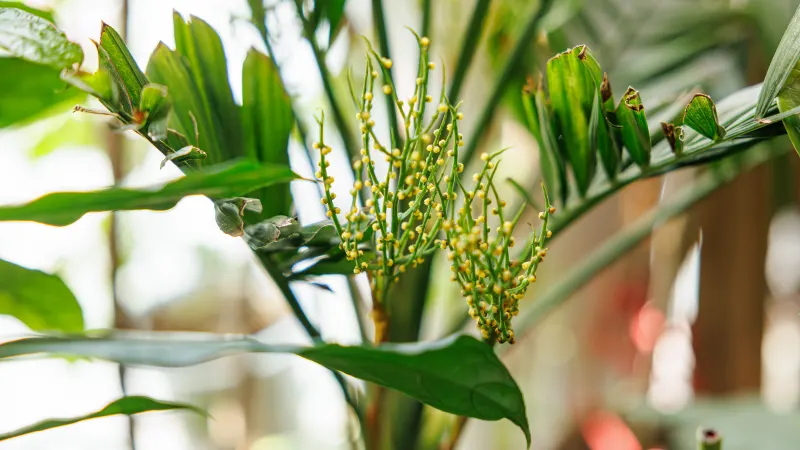

- Light
- Tolerates low to moderate indirect light — no direct sun, which scorches the fronds; one of very few palms comfortable in a north-facing room
- Water
- When the top 2–3 cm of soil are dry — roughly every 7–10 days in summer, less in winter; sensitive to both drought and overwatering, both of which cause frond yellowing
- Humidity
- 50–70% preferred; more tolerant than many tropical plants but appreciates occasional misting or a pebble tray in dry heated rooms
- Temperature
- 18–27°C; protect from cold drafts and temperatures below 13°C
- Pets & toxicity
- Non-toxic to cats, dogs, and humans — one of the safest palms for pet households
- Difficulty
- Easy; the main challenges are avoiding root rot and managing expectations about growth rate (slow in low light)
A parlor palm brings the soft green of a rainforest floor into the dimmest corner of a room — and asks, in return, only that you leave its roots room to breathe.
The palm built for the shade
The parlor palm has been a houseplant for nearly two centuries, and the reason is simple: it is one of the very few palms that genuinely thrives indoors, in ordinary rooms, without a sunny window. The Victorians filled their parlours with it — hence the name — precisely because it stayed lush in the low, filtered light of a curtained sitting room where almost every other palm sulked and died. Little has changed. It remains the palm to reach for if what you want is soft, arching, feathery green in a spot that does not get much sun.
It comes from the rainforests of southern Mexico and Guatemala, where it grows on the forest floor in the deep, dappled shade beneath the canopy. That origin explains everything about the plant. It is adapted to low light, to gentle filtered sun rather than direct rays, and to the steady, even moisture of leaf litter that drains freely — and it has no tolerance at all for the things that floor does not offer, namely scorching sun and standing water. A parlor palm asks you to recreate the forest floor, and the forest floor is dim, evenly damp, and never flooded.
It has one more quality worth naming up front: it is completely non-toxic. Among palms, and among large foliage plants generally, that makes it unusually safe for homes with cats, dogs, or small children — a genuine practical advantage that the equally pet-safe snake plant does not offer in the same soft, full silhouette.
Why it suits low-light homes
Most plants sold for "low light" merely tolerate it while quietly declining. The parlor palm is one of the rare exceptions that is adapted to it. On the rainforest floor, only a fraction of the sunlight that hits the canopy ever reaches the ground, and the parlor palm evolved to do all its living in that fraction. Brought indoors, it carries that adaptation with it: a north-facing room, a spot several feet back from a bright window, a hallway with borrowed light — these are not survival conditions for a parlor palm, they are home.
What it cannot take is direct sun. The fronds are thin and soft, built for shade, and a few hours of direct light through glass scorches them into crisp, bleached, brown patches that do not recover. This is the mirror image of most houseplant advice: where you might move a struggling plant toward a window, a struggling parlor palm usually needs moving away from one. Bright but indirect, or frankly moderate, is the target.
The trade-off for this shade tolerance is pace. In low light, a parlor palm grows slowly — sometimes very slowly — because there is only so much energy in dim light to build new fronds with. That is not a problem to fix; it is the deal. A parlor palm in a dim corner is a slow, steady, long-lived plant, and trying to accelerate it with extra water or fertiliser does harm, not good.
How to water a parlor palm without rotting the roots
If a parlor palm dies, the overwhelming odds are that it drowned. This is the one thing the plant is genuinely sensitive about. It wants soil that is evenly, lightly moist — never bone dry for long, but never waterlogged either — and the gap between those two states is where most parlor palms are lost. The forest floor it comes from drains freely even as it stays damp, and a pot of dense, water-logged compost is the opposite of that.
The working rule is to water when the top 2–3 cm of soil have dried, then water thoroughly and let the excess drain completely away. In a warm summer that might mean every seven to ten days; in a cool winter, considerably less. The plant's signal when you get it wrong is the same in both directions — yellowing fronds — which is why the soil, not the foliage, has to be your guide. Dry soil plus yellowing means you have let it go too long; wet, heavy soil plus yellowing means root rot is already underway, and the fix is to stop watering, not start. A pot with a drainage hole and a free-draining mix, emptied of any standing water after each drink, prevents nearly all of it. If the watering rhythm is new to you, the beginner's guide to houseplant care covers the finger test and drainage basics that keep a parlor palm out of trouble.
The trouble with a single watering schedule is that "every week" describes an average plant in an average room, and the rot risk lives in the gap between that average and your actual pot. A Digital Shadow — the running model Botanical Legacy keeps for each Specimen in your sanctuary — draws the moisture estimate down on the real light and warmth your palm is living through, so a parlor palm in a warm, bright summer and the same palm in a cool, dim winter get held to completely different curves. For a plant whose chief danger is the well-meant extra drink, a model that knows when the soil is genuinely ready is worth more than any fixed reminder.
Brown frond tips: usually not your fault
Brown tips on the fronds are the most-searched parlor palm worry, and the reassuring truth is that almost every indoor palm gets them, and on a healthy plant they mean very little. The thin frond tips are the points furthest from the roots, and they show the cumulative effect of everything mildly imperfect about indoor life — dry heated air, the fluoride and salts in tap water, the occasional slightly-too-dry spell, the natural ageing of an old frond. A scatter of brown tips on otherwise green, healthy fronds is cosmetic, not a sign of illness.
The distinction worth holding onto is between tips and whole fronds. Brown tips on green fronds are normal and largely unavoidable in a centrally heated home; you can reduce them by raising humidity with a pebble tray or occasional misting, switching to filtered or rainwater if your tap is hard or fluoridated, and keeping the plant evenly watered. But when entire fronds yellow and brown, lower down on the plant, that is a different signal — usually overwatering, sometimes cold, occasionally the natural retirement of the oldest fronds. The plant tells you which problem it has by where the browning is: at the very tips, relax and trim them; across whole fronds from the base, check the soil and the temperature.
Trim brown tips by snipping just the dead portion, following the natural taper of the frond so the cut stays inconspicuous. The browned tissue will not regrow, but trimming keeps the plant tidy while the cause is addressed.
Growth expectations and feeding
A parlor palm is a decade plant, not a season plant, and most disappointment with it comes from expecting otherwise. In good light it adds fronds steadily but unhurriedly; in the low light it tolerates so well, it can seem to barely move for months. This slowness is built in. It is a small, understory palm that lives a long time and grows at the pace its dim habitat allows, and no amount of intervention changes that fundamentally.
Resist, in particular, the urge to feed it into faster growth. A parlor palm needs very little fertiliser — a weak, balanced feed once or twice through spring and summer is plenty, and many do fine with even less. Over-fertilising does not accelerate a shade plant; it accumulates as salts in the soil, burns the fine roots, and shows up as exactly the brown tips you were probably trying to avoid. When growth is slow, the answer is patience and slightly more light, never more food.
It will, in time, reach perhaps 60 cm to a metre or more indoors, often grown as a clump of several stems for fullness. It rarely needs repotting and is happy slightly snug; move it up a single pot size only when it is genuinely root-bound, in spring, into fresh free-draining mix.
Common problems
Yellowing fronds. Usually overwatering — the commonest serious problem. Check the soil: if it is wet and heavy, stop watering, improve drainage, and let it dry out before resuming. If the soil is dry, the plant may have gone too long without water, but err toward the wet diagnosis, because that is the one that kills.
Brown, crispy fronds or tips. Underwatering or low humidity. A parlor palm left bone dry too long, or sitting in very dry heated air, crisps at the tips and along whole fronds. Raise the humidity, keep the soil evenly moist, and trim the dead portions.
Spider mites. The classic dry-air pest. Fine webbing on the undersides of the fronds, with faint stippling on top, signals an infestation that thrives in warm, dry rooms. Rinse the plant under a tap, raise the humidity, and check it weekly through winter — dry air is the underlying invitation.
Pale or scorched fronds. Too much direct sun. Bleached, dry, brown patches where the light hits hardest mean the plant needs moving back from the window into the indirect light it wants.
Frequently asked questions
How often should you water a parlor palm?
When the top 2–3 cm of soil have dried — in practice roughly every seven to ten days in summer and less in winter, depending on your light and warmth. Aim for evenly moist soil that drains freely, never waterlogged. The plant yellows its fronds whether it is too dry or too wet, so check the soil rather than the foliage, and always empty the saucer so the roots never stand in water.
Why does my parlor palm have brown tips?
Brown tips are normal on almost every indoor palm and usually mean very little — they come from dry heated air, fluoride or salts in tap water, or the natural ageing of older fronds. On a plant that is otherwise green and healthy, they are cosmetic. Raise the humidity, switch to filtered or rainwater, keep the watering even, and trim the dead tips at an angle to keep the plant tidy.
How much light does a parlor palm need?
Low to moderate indirect light — it is one of the very few palms genuinely comfortable in a north-facing room or several feet back from a brighter window. Keep it out of direct sun, which scorches the soft fronds. The trade-off for this shade tolerance is slow growth in dimmer spots, which is normal and not a problem to fix.
Why is my parlor palm turning yellow?
Most often overwatering. Parlor palms are sensitive to soggy soil, and yellowing fronds are the first sign of roots in trouble. Check whether the soil is staying wet and heavy; if so, stop watering, improve drainage, and let it dry before resuming. Cold drafts and the natural retirement of the oldest fronds can also yellow them, but the wet-soil cause is the one to rule out first.
Are parlor palms safe for cats and dogs?
Yes — the parlor palm is non-toxic to cats, dogs, and humans, which makes it one of the safest large foliage plants for a pet household. It delivers a full, soft, palm-like silhouette without the toxicity that comes with many popular indoor plants, so it is a reliable choice where curious pets share the room.
Start your sanctuary
Botanical Legacy's free Observer plan covers up to five Specimens, each with its own continuously running Digital Shadow — and a parlor palm, whose one real risk is the over-eager watering that rots its roots, is exactly the kind of plant the model protects. Every new account also includes a 14-day trial of Cultivator, the paid plan, which adds the local weather feed and soil sensor support.
START YOUR SANCTUARY — FIVE FREE SPECIMENS, NO PAYMENT REQUIRED →
Give a parlor palm gentle light and a pot that drains, and it will hold the green of the forest floor in your dimmest corner for years.