Species care guide
Areca palm
Dypsis lutescens
Areca palm care for the most popular large indoor palm: why it transpires enough water to measurably raise room humidity, what it needs to keep the fronds green, and the common errors that cause yellowing.
_Beentje_%26_J.Dransf._-_2013_000.jpg)
- Light
- Bright indirect light for best growth; tolerates moderate indirect but grows slowly and develops more yellow fronds in dim conditions; no harsh direct sun
- Water
- When the top 3–4 cm of soil are dry — roughly every 7–10 days in summer; consistent moisture is important; both prolonged drought and soggy soil cause frond yellowing
- Humidity
- 50–70% preferred; the palm transpires vigorously and actually raises local humidity — a benefit in dry rooms; brown tips are nearly always from low humidity or fluoride in tap water
- Temperature
- 18–27°C; sensitive to cold drafts and temperatures below 13°C which cause rapid frond yellowing
- Pets & toxicity
- Non-toxic to cats, dogs, and humans
- Difficulty
- Moderate; the light and moisture requirements are specific but the plant is otherwise tolerant and long-lived with correct care
An areca palm fills a corner with soft, arching green and quietly humidifies the room as it goes — a large, generous plant that gives back more air than it asks for in care.
The big, soft palm that works for its place
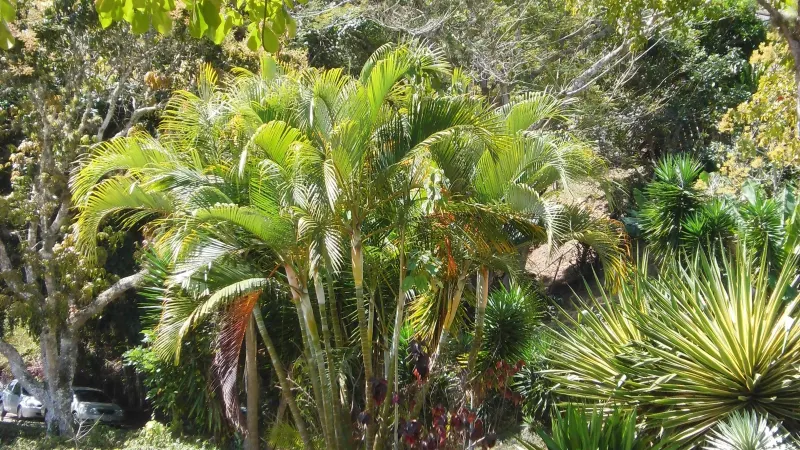
The areca palm is the large indoor palm most people picture when they picture an indoor palm: a full clump of slender, golden-stemmed canes carrying soft, feathery, arching fronds, filling a corner with the relaxed green of a resort lobby. It is the best-selling palm for indoor use, and deservedly so — it is large and dramatic without being difficult, non-toxic and safe around pets, and it does something most houseplants do not, which is measurably improve the air around it by raising the humidity. For a big statement plant, it asks for relatively little.
It comes from Madagascar, where it grows in bright, warm, humid conditions, and its care indoors follows directly: it wants bright filtered light, steady warmth, consistent moisture, and air that is not too dry. It is tolerant enough to forgive ordinary indoor conditions, but it tells you clearly when something slips — usually through yellowing fronds or browning tips, the two signals that account for almost every areca palm search.
Among large indoor plants, it is one of the genuinely pet-safe choices. Where a dragon tree or a peace lily carries some toxicity, the areca palm is non-toxic to cats, dogs, and people, which makes it a reliable way to bring real height and presence into a home with curious animals — the same safety the smaller parlor palm offers, scaled up to fill a corner.
The humidity benefit
The areca palm's most distinctive quality is one most plants do not have: it actively humidifies the room it stands in. This is not marketing language — it is the predictable physics of a large palm with many fronds. The plant draws water up through its roots and releases it as vapour through its foliage in a process called transpiration, and a big, healthy areca with dozens of fronds cycles a genuinely large volume of water this way every day. All that water leaves the plant as humidity, and in a closed room it measurably lifts the moisture in the air.
This makes the areca palm useful beyond its looks, particularly in the dry air of a centrally heated home in winter. The raised humidity benefits the plant's neighbours: humidity-sensitive plants like a prayer plant, ferns, and orchids do better grouped near a transpiring areca than alone in dry air. It is a plant that improves the conditions for the plants around it, which is why it so often anchors a corner planting of more demanding species.
The trade-off is that all that transpired water has to come from somewhere — the soil — which is exactly why a thriving areca needs consistent moisture and is unforgiving of being left bone dry. A plant moving large volumes of water through itself cannot run on an empty tank. The humidity benefit and the watering need are two sides of the same fact: this is a plant that drinks steadily and breathes out moisture, and keeping the soil evenly supplied is what keeps both working.
Light: read the frond colour
An areca palm grows best in bright, indirect light, and the colour of its fronds tells you whether it is getting enough. In good bright light — near a window but out of direct sun — the fronds hold a vivid, fresh yellow-green, the plant grows steadily, and it stays full and dense. Move it into a dimmer room and the changes are gradual but clear: growth slows, the overall colour darkens, and more of the lower fronds yellow and drop than new growth replaces, so the plant slowly thins from the bottom.
This is the familiar palm distinction between tolerating and thriving. An areca does not die in moderate light — it will persist in a fairly shaded room for a long time — but it does not flourish there either, and a plant kept too dim gradually loses fullness. If your areca is yellowing fronds faster than it makes new ones and growth has stalled, insufficient light is one of the first things to check, alongside watering and cold.
The one excess to avoid is harsh direct sun. The fine, soft fronds scorch in strong direct light through glass, bleaching and crisping where the rays land hardest, and pale, washed-out new growth can signal too much direct exposure. The target is bright but filtered — close to a bright window with the harshest sun diffused, or a step back from a south-facing one. Turn the plant every couple of weeks so all sides get light and it grows evenly rather than leaning toward the window.
Watering: consistent, never soggy
An areca palm wants consistent, even moisture, and the emphasis falls on consistent. It is not a drought-and-soak plant like a succulent, nor one that wants to dry out fully between waterings — it transpires steadily and wants its soil kept in a steady, lightly moist state. But it is equally intolerant of a permanently wet pot, which suffocates and rots the roots. The areca lives in a middle band: never bone dry, never waterlogged, and both extremes show up the same way, as yellowing fronds.
The working rule is to water when the top 3–4 cm of soil are dry, soak thoroughly, drain completely, and empty the saucer — roughly every seven to ten days in a warm summer and distinctly less in winter, but governed by the soil rather than the date. A well-draining, peat-free mix in a pot with a drainage hole holds the right balance, staying moist without going boggy. Feel the soil before each watering: dry in the top few centimetres is the cue, damp means wait, and standing water in the saucer must always be tipped away. If reading soil moisture by feel is new to you, the beginner's guide to houseplant care covers the finger test that keeps a palm like this in its band.
That middle band — moist but not soggy — is exactly what a per-specimen model is good at holding. A fixed "water weekly" reminder cannot know whether your particular pot has reached the top-few-centimetres-dry point an areca wants today, but a Digital Shadow — the running model Botanical Legacy keeps for each Specimen in your sanctuary — draws the moisture estimate down on the real light, warmth, and season your plant is living through, and prompts the drink when the soil reaches that point rather than on a fixed day. An areca in a warm, bright conservatory and the same palm in a shaded corner in winter drink at completely different rates; the Shadow tracks the actual curve, which is what keeps a steadily-transpiring palm reliably supplied without tipping it into a soggy pot.
Brown frond tips
Brown frond tips are the most-searched areca palm problem, and the cause is almost always the same pair of culprits: the quality of the water and the dryness of the air. Like its fellow Madagascan the dragon tree, the areca is sensitive to the fluoride and salts in tap water, which the plant draws up and concentrates at the frond tips — the points furthest from the roots — where they scorch the tissue into dry, brown, papery ends. Low humidity does the same thing by a different route, drying the tips faster than the plant can keep them supplied. Often both are at work together.
The reassurance, as with most tip-browning, is that it is cosmetic. An areca with browned frond tips on otherwise green, healthy fronds is in no danger; it is showing the mineral load of its water and the dryness of its air, not failing. The fixes are upstream of the symptom. Switch to filtered, distilled, or collected rainwater where your tap is hard or fluoridated; flush the pot occasionally with a thorough drench to wash accumulated salts out through the drainage hole; ease off fertiliser, which adds to the salt load; and raise the humidity — though the plant's own transpiration helps here, grouping it with other plants or running a humidifier helps more.
Trim the browned tips by cutting just the dead portion, following the natural taper and fine point of the frond so the cut stays inconspicuous. The browned tissue will not turn green again — leaf tissue does not heal — but once the water and humidity are addressed, new fronds come in clean, and the browning stops spreading.
Common problems
Yellowing lower fronds. Several causes converge here. A slow turnover of the oldest, lowest fronds is natural senescence as the plant grows. Faster, more widespread yellowing usually means overwatering — check whether the soil is staying wet — or, in winter, cold: temperatures below 13°C yellow the fronds quickly. Read the rate and the soil: slow and low is ageing; fast and wet is overwatering; fast and cold is temperature.
Brown frond tips. Fluoride and salts in tap water, low humidity, or both. Switch to filtered or rainwater, flush the pot, raise the humidity, and trim the tips at an angle. Cosmetic, not dangerous.
Pale, washed-out new growth. Usually too much direct sun bleaching the fronds. Move the plant back from the hottest glass into bright indirect light. Persistently pale, weak growth in a dim spot is the opposite problem and means too little light.
Slow or stalled growth. Often just the plant's natural pace, especially in moderate light — arecas are steady, not fast. But check for the correctable causes: insufficient light, inconsistent watering, or a plant overdue to move up a pot size. Resist the urge to force growth with extra fertiliser, which burns the roots.
Frequently asked questions
How often should you water an areca palm?
When the top 3–4 cm of soil are dry — roughly every seven to ten days in summer and less in winter, governed by the soil rather than the calendar. Aim for steady, even moisture: never bone dry, never waterlogged. Soak thoroughly, drain completely, and empty the saucer, because the plant rots in a permanently wet pot but also yellows if left too dry. Feel the soil before each watering.
Why are my areca palm's leaves turning yellow?
Several causes look similar. A few of the oldest, lowest fronds yellowing slowly is natural ageing. Faster, widespread yellowing usually means overwatering — check whether the soil is staying wet and heavy — or cold, since temperatures below 13°C yellow the fronds quickly. Too little light also causes gradual yellowing and thinning. Read the rate and the soil: slow and low is normal; fast and wet is overwatering; fast and cold is temperature.
Why does my areca palm have brown tips?
Almost always the fluoride and salts in tap water, low humidity, or both. The minerals concentrate at the frond tips and scorch them, while dry air dries them faster than the plant can supply them. It is cosmetic, not dangerous. Switch to filtered or rainwater, flush the pot to wash out salts, raise the humidity, ease off fertiliser, and trim the dead tips at an angle.
How much light does an areca palm need?
Bright indirect light for best growth — near a window but out of harsh direct sun, which scorches the fine fronds. It tolerates more moderate light but grows slowly and yellows more fronds in dim conditions. The frond colour is your gauge: vivid yellow-green means good light, while darkening and faster lower-frond loss means it needs to move brighter.
Do areca palms really raise humidity?
Yes. A large, healthy areca transpires a genuinely large volume of water through its many fronds each day, and that water enters the air as humidity, measurably raising the moisture in a closed room. It is a real benefit in the dry air of a heated home and helps nearby humidity-sensitive plants. The flip side is that all that transpired water comes from the soil, which is why a thriving areca needs consistent moisture.
Start your sanctuary
Botanical Legacy's free Observer plan covers up to five Specimens, each with its own continuously running Digital Shadow — and an areca palm, which drinks steadily and yellows at both extremes of moisture, is exactly the kind of plant a per-specimen model keeps reliably supplied. Every new account also includes a 14-day trial of Cultivator, the paid plan, which adds the local weather feed and soil sensor support.
START YOUR SANCTUARY — FIVE FREE SPECIMENS, NO PAYMENT REQUIRED →
Give an areca palm bright filtered light, water it suits, and steady moisture in its pot — and it will fill your corner with green and quietly humidify the room as it grows.