Species care guide
Prayer plant
Maranta leuconeura
Prayer plant care: why Maranta leuconeura folds its leaves at night, why humidity — not watering — is often behind brown edges, and how to keep the markings vivid.

- Light
- Bright indirect light to moderate shade; avoid direct sun which bleaches the markings; north or east window works well
- Water
- Keep the soil consistently moist but never waterlogged through the growing season; water less in winter, letting the soil dry out more between waterings
- Humidity
- Needs high humidity; it benefits more than most houseplants from a humidifier or a pebble tray
- Temperature
- Warm, roughly 16–29°C; keep it above about 16°C (60°F) and away from cold drafts, which it tolerates poorly
- Pets & toxicity
- Non-toxic to cats and dogs — one of the safer options for pet households
- Difficulty
- Moderate; the humidity and moisture requirements narrow the easy-care window
A prayer plant lifts its leaves to the dark each night and lowers them at dawn — a houseplant you can watch keep time.
The plant that moves
Most houseplants do their living too slowly to see. The prayer plant is the exception, and it is the reason people fall for it. Each evening, as the light fades, Maranta leuconeura folds its patterned leaves upward and inward, pressing them together like a pair of hands raised in prayer — the gesture that named it — and each morning it lowers them flat again to meet the day. The movement is real, daily, and visible: a plant that keeps time on your windowsill. It can also be a prompt: the movement is powered by water pressure in living cells, so a struggling plant may fold less, and a fold that stops is worth a look at the basics.
Underneath the theatre is a low-growing tropical plant from Brazil, at home in warm, humid shade. Everything it needs follows from that home: filtered light rather than sun, steadily moist soil rather than drought-and-flood, and — the requirement that trips most people up — humidity well above what a centrally heated room provides. It is a close relative of the calathea (both belong to the arrowroot family, Marantaceae), and shares that plant's love of moisture and its short temper about dry air. But make no mistake: this is a moderate-difficulty plant, not a beginner's set-and-forget one in the mould of a heartleaf philodendron. The humidity and the steady moisture are real demands, and meeting them is the whole game.
The nightly fold — and what it tells you
The leaf movement is worth understanding rather than just admiring, because it is a window into the plant's state. The technical name is nyctinasty — a daily rhythm driven by the plant's internal clock and by changing light, in which little hinges of tissue at the base of each leaf, called pulvini, pump water in and out to raise the leaves at night and lower them by day. Why plants do it is still debated, with suggested benefits ranging from shedding water off the leaves to discouraging night-feeding insects, but it is entirely normal: a prayer plant that folds up in the evening and opens at dawn is a prayer plant in good health.
The fold is not a precise health gauge, but because it runs on water pressure in living cells, a plant that is thirsty, chilled or otherwise struggling may move less. So if your plant has stopped its nightly movement, treat it as a prompt to check the basics — is it warm enough, humid enough, evenly watered, out of harsh sun? Few houseplants give you a daily, visible cue simply by existing; the prayer plant does.
Light: enough to colour the leaves, never enough to burn them
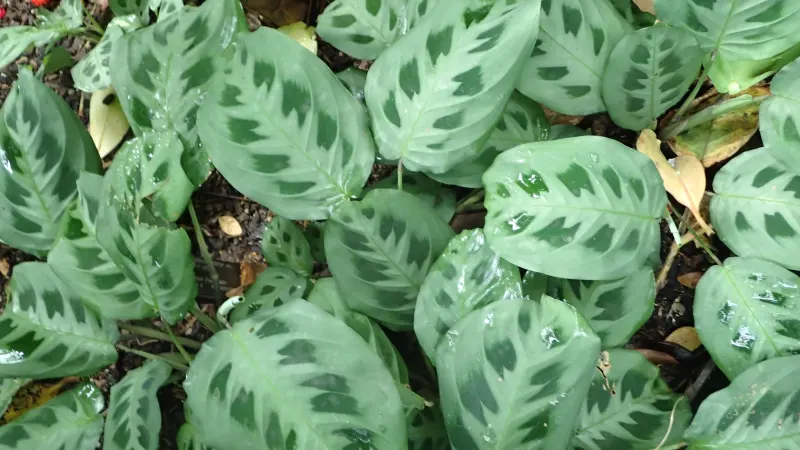
A prayer plant wants bright, indirect light, and it has a useful tolerance for moderate shade — a north- or east-facing window suits it well, as does a spot set back from a brighter window. In that filtered light the leaf markings come up at full intensity: the deep green, the herringbone veining, the red or cream patterning depending on the cultivar, all richest when the plant gets good light without direct sun.
The thing to avoid at all costs is strong direct sunlight. The patterning that makes this plant worth owning is exactly what the sun destroys — harsh direct light bleaches and washes out the markings, fades the colour to a tired pale green, and can scorch the leaves outright. The opposite error, too little light, is gentler but real: in deep gloom the colours dull, new growth comes in less vividly marked. Aim for the bright-but-shaded middle, and let the leaf colour be your guide — vivid and high-contrast means the light is right; bleached means too much; dull and flat means too little. Unlike many of the easy foliage plants, a maranta rewards a slightly brighter (still indirect) position with better colour, so do not bury it in a dark corner on the assumption that a shade plant wants gloom.
How often to water a prayer plant
Watering a prayer plant is a balance, and it sits at the opposite end of the spectrum from the succulents. This is a plant that wants its soil kept consistently, evenly moist — damp like a wrung-out cloth — and it does not want to dry out fully between waterings the way a snake plant or an aloe does. In practice that means checking the soil often through the growing season and watering before the top has dried out, keeping the root zone reliably damp. In winter you ease back as growth slows and let the soil dry out more between waterings; in the growing season, a prayer plant left to dry out browns at the leaf tips.
The catch is the other boundary: consistently moist is not the same as waterlogged, and soggy, airless soil rots the roots just as surely here as anywhere. The target is steady dampness with good drainage — a pot that holds moisture but never leaves the roots sitting in water. That narrow band, kept up reliably day after day, is what makes the prayer plant a moderate-difficulty plant: it punishes both neglect and overwatering.
Two refinements matter. First, this plant is sensitive to the fluoride and salts in hard tap water, which accumulate and worsen the brown leaf edges, so filtered, distilled, or rainwater at room temperature is noticeably kinder. Second — and this is where consistency gets genuinely hard from memory — the right watering frequency drifts constantly with the season, the warmth, and the humidity, and "keep it evenly moist" is far easier to say than to hit by feel every few days. This is the gap a per-specimen model closes. Each Specimen in your sanctuary carries a Digital Shadow, a running estimate of the moisture left in that pot, drawn down on the real warmth and light it is living through — so for a plant whose whole requirement is steady moisture, you have a live read on whether the soil is drifting too dry or sitting too wet, instead of relying on a finger and a guess. For maranta especially, where the margin for error is thin in both directions, that steadiness is exactly what the plant is asking for — and the case for measuring moisture directly, with a sensor feeding the same model, is laid out in how soil moisture sensors change houseplant care.
Humidity: the real challenge
If a prayer plant is struggling, humidity is the first thing to suspect, because this is where the gap between the plant's forest home and your living room is widest. Maranta leuconeura needs high humidity, and a centrally heated room in winter can drop below 30%. The result is the single most common prayer plant complaint: brown, crispy leaf edges and tips, which owners almost always misread as a watering problem and try to fix by watering more, with no effect, because when dry air is the cause, the soil was never the issue.
This is one of the houseplants that most clearly benefits from active humidity-raising rather than just tolerating it. A small humidifier running nearby is the most effective answer; standing the pot on a wide tray of pebbles topped with water, so evaporation rises around the plant, helps too, as does grouping it with other plants that transpire together. Misting is popular but does less than people hope — it raises humidity only briefly and can encourage fungal spots if the leaves stay wet — so treat it as a minor supplement, not the strategy. The honest version of prayer plant care is that if you cannot or will not raise the humidity around it, you will be fighting brown edges indefinitely; if you can, most of the plant's difficulty disappears.
Temperature rides alongside humidity here. Keep the plant warm, roughly 16–29°C, away from cold drafts and not below about 16°C (60°F); chilling can make leaves drop, and cold water can spot them. Cold and dry together is the classic winter combination that sends a maranta into a sulk.
Common problems
Brown, crispy leaf edges and tips. The signature problem, and most often low humidity rather than a watering fault — the soil can be perfectly moist and the edges still brown if the air is dry. Raise the humidity with a humidifier or pebble tray, switch to filtered or rain water to rule out fluoride and salt damage, and keep the plant out of dry heat. Trim badly browned edges for looks if you like, but understand you are treating the symptom; the cure is the air.
Yellowing leaves. Usually overwatering — the other boundary of that narrow moisture band. If lower leaves are yellowing and the soil is staying wet, ease back, improve the drainage, and let the top dry slightly more between waterings without ever going bone dry.
Spider mites. The classic consequence of dry air, and the reason humidity protects the plant twice over. Mites colonise the undersides of the leaves, leaving fine stippling and, in a bad case, faint webbing. Dry, heated winter rooms are prime conditions. Inspect the undersides regularly, rinse the foliage in the shower at the first sign, and treat with insecticidal soap or neem if they take hold — and raise the humidity, which discourages them in the first place.
Faded, washed-out markings. Too much direct sun bleaching the pattern. Move the plant out of the direct beam into bright indirect light, and new growth recovers its colour. The reverse — dull, flat colour in deep shade — calls for a brighter (still indirect) spot.
Leaves not folding at night. Often a sign of stress rather than disease. Check the warmth, the humidity, and the watering, since the movement depends on healthy, well-watered cells.
Propagation — division and stem cuttings
A prayer plant multiplies most reliably by division, and also from stem cuttings. To divide, slide the whole plant out of its pot and gently tease the root mass apart into clumps, each with its own roots and a few stems, then pot each section separately and keep it warm, humid, and evenly moist while it settles.
For cuttings, take a stem section just below a node (the point where leaves emerge, and where roots will form) with a clean blade, and root it in water or directly in moist soil. Keep the cutting warm and in high humidity — a covered propagator or a clear bag over the pot helps, because high humidity stops the cutting drying out before it roots. Rooting time varies, so pot it up once the roots have formed. The general method, and how to carry any cutting through its fragile first fortnight, is in how to propagate plants.
Frequently asked questions
Why does my prayer plant fold its leaves at night?
Because it is doing exactly what it evolved to do. The prayer plant has a daily internal rhythm — nyctinasty — driven by its body clock and changing light, raising its leaves upward each evening and lowering them by morning using little water-pumping hinges at the base of each leaf. It is completely normal and a sign of a healthy plant. If your maranta stops folding, treat it as a prompt to check for cold, dry air, or erratic watering.
Why does my prayer plant have brown edges?
Most often low humidity, not a watering mistake. The soil can be perfectly moist and the leaf edges still go brown and crispy if the surrounding air is dry, which is the normal state of a centrally heated room in winter. Raise the humidity with a humidifier or a pebble tray, and switch to filtered or rainwater, since the fluoride and salts in hard tap water make the browning worse. Watering more will not fix edges that are an air-humidity problem.
How often should you water a prayer plant?
Keep the soil consistently, evenly moist — check the soil often in the growing season and water before it dries out, aiming for damp but never waterlogged. Reduce the frequency in winter as growth slows and let the soil dry out more between waterings; in the growing season, soil left to dry out browns the leaf tips. The target is steady moisture with good drainage, which is a narrower band than easier plants ask for, and the main reason maranta rates as moderate rather than beginner-level.
Are prayer plants safe for cats and dogs?
Yes — the ASPCA lists the prayer plant as non-toxic to cats and dogs, which makes it one of the safer choices for a home with pets. Eating any plant can still upset a pet's stomach, though. Botanical Legacy surfaces pet-safety directly on each Specimen's card, so the safe and unsafe plants in your sanctuary are clear at a glance.
Can Botanical Legacy help me keep the soil evenly moist?
That is precisely where it earns its place with this plant. A prayer plant's whole requirement is steady moisture — never bone dry, never waterlogged — and that narrow band is genuinely hard to hold by feel from one watering to the next. The Digital Shadow keeps a running estimate of how much water your specific pot is holding, based on how it dries in your light and warmth, so you can see when it is drifting too dry or sitting too wet and act before the brown edges or the yellowing set in. Pair it with a soil sensor and the model reads the moisture directly.
Start your sanctuary
Botanical Legacy's free Observer plan covers up to five Specimens, each with its own continuously running Digital Shadow — and a prayer plant, whose narrow consistently-moist band is the whole difficulty, is exactly the kind of plant that benefits from having its moisture tracked. Every new account also includes a 14-day trial of Cultivator, the paid plan, which adds the local weather feed and soil sensor support.
START YOUR SANCTUARY — FIVE FREE SPECIMENS, NO PAYMENT REQUIRED →
Raise the humidity, hold the moisture steady, and the prayer plant will keep folding its leaves to the dark — content, and on time.
Sources
The plant-care facts on this page were checked against these references.
- Missouri Botanical Garden: plantfinder.mobot.org/PlantFinderDetails.aspx
- NC State Extension: plants.ces.ncsu.edu/plants/maranta-leuconeura
- Minorsky 2019, Biological Reviews: europepmc.org/article/PMC/PMC7379275
- Penn State Extension: extension.psu.edu/humidity-and-houseplants
- Herbert & Larsen 1985, Oecologia: europepmc.org/article/MED/28311317
- RHS: rhs.org.uk/plants/119598/maranta-leuconeura/details
- UMD Extension: extension.umd.edu/resource/lighting-indoor-plants
- UF/IFAS Extension: blogs.ifas.ufl.edu/nassauco/2017/06/21/q-prayer-plant
- Virginia Tech Extension: pubs.ext.vt.edu/SPES/spes-804.html
- Clemson HGIC: hgic.clemson.edu/factsheet/houseplant-diseases-disorders
- Nebraska Extension: lancaster.unl.edu/success-houseplants-humidity
- UC IPM: ipm.ucanr.edu/home-and-landscape/spider-mites
- Penn State Extension: extension.psu.edu/propagating-houseplants
- ASPCA: aspca.org/pet-care/aspca-poison-control/toxic-and-non-toxic-pla…
- ASPCA: aspca.org/pet-care/animal-poison-control/toxic-and-non-toxic-pl…