Species care guide
Alocasia
Alocasia spp. (Alocasia × amazonica and relatives)
An honest Alocasia care guide for a genuinely dramatic plant — the humidity it actually needs, how to read a droop, and why a plant that looks dead every winter usually isn't.

- Light
- Bright, indirect light; gentle morning sun is fine, but midday sun scorches the leaves
- Water
- When the top 5 cm of soil are dry to a finger — evenly moist in the growing season, much drier if the plant goes dormant
- Humidity
- Needs medium to high humidity; dry air is the fastest route to crispy, browning edges
- Temperature
- Grows best around 20–25°C; keep above 16°C while growing and never below 10°C, as a chill can trigger leaf drop
- Pets & toxicity
- Toxic to cats, dogs, and humans — insoluble calcium oxalates cause intense mouth and throat irritation
- Difficulty
- Moderate to fussy — humidity, drafts, and a dramatic dormancy cycle catch out first-time growers
An Alocasia that drops every leaf and goes bare isn't always dying. Sometimes it's exactly on schedule.
The plant that looks dead every winter
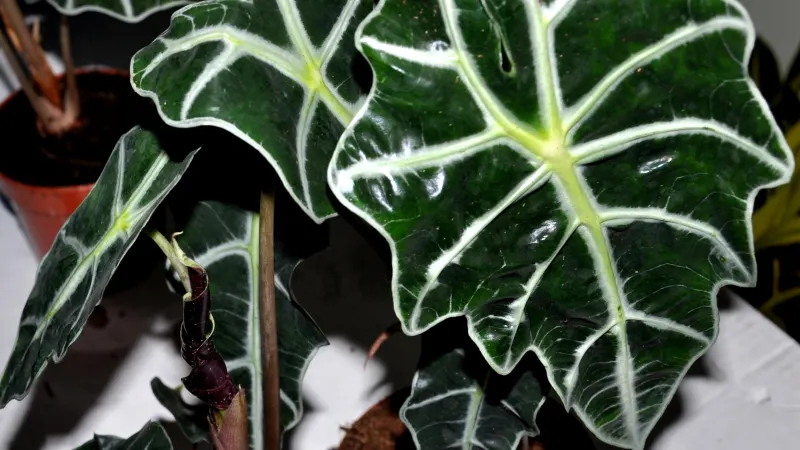
Plenty of Alocasia get thrown away while still alive, and the reason is usually timing, not neglect. Alocasia is a genuinely dramatic grower: dark, arrow-shaped leaves unfurl fast and dramatically in summer, and then, as light drops in autumn and winter, many popular cultivars let their leaves yellow and die back, and go dormant. To someone who bought the plant for its foliage, a bare pot with nothing left above the soil looks like a death certificate. Often it's just the plant doing what it does every year, and the rhizome underground is fine.
That misunderstanding is the thread this guide follows, alongside the two things that do kill Alocasia when it isn't dormancy: dry air and a pot that stays wet for the wrong reasons. If you're new to houseplants generally, the ten mistakes every beginner makes is worth reading alongside this, because several of them show up here in a more dramatic form than usual.
Light: bright, indirect, and more of it than you think
Alocasia comes from the tropical forests of Asia and eastern Australia — bright but filtered light, never the full glare of open sun. Indoors, that translates to a spot close to a window with the direct beam softened by distance or a sheer curtain. A little direct morning sun is fine. Direct midday or afternoon sun through unfiltered glass is a different story — it scorches pale, papery patches into the leaf, and the damage doesn't heal.
Too little light produces a quieter failure: growth slows, new leaves come in smaller than the ones before them, and the plant becomes noticeably more prone to rot, because a dim, sluggish plant uses water far more slowly than a bright, actively-growing one — so the same watering habit that suited it on a bright sill starts drowning it in a dim corner.
How often to water an Alocasia
There's a real difference between how an Alocasia drinks in active growth and how it drinks resting, and conflating the two is where most watering mistakes start. While it's actively pushing new leaves, check the top 5 cm of soil often: dry to a finger means water thoroughly until it runs from the drainage holes, then let the excess drain away completely. Alocasia isn't a plant that wants a long dry-down between drinks the way a succulent-leaning aroid does — the leaves are large and thin, and they'll tell you about underwatering quickly, with a soft droop that a good drink usually reverses.
Overwatering is the more dangerous mistake, and it compounds with cool temperatures and low light — exactly the conditions of a badly-placed winter windowsill. A pot that stays wet for days, especially in a dim or cool room, invites the root and rhizome rot that does kill the plant, as opposed to the seasonal leaf drop that only looks like it. The read that separates the two: rot turns the rhizome and roots soft and dark; a dormant rhizome stays firm underneath a bare pot.
This is the exact ambiguity a per-specimen model is built to sit inside. Botanical Legacy runs a Digital Shadow for every Specimen in your Sanctuary — a nightly estimate of how much moisture is left in that pot, drawn down against the temperature and light the plant is really living in, not a species-wide average that can't tell a resting plant from a drowning one. The longer method for reading soil generally is in when to water your houseplants.
Humidity: the one non-negotiable
If there's a single reason Alocasia has a reputation for being difficult, it's humidity. Alocasia needs medium to high humidity, more than ordinary heated air provides. In dry air, and especially below the 30% a heated room can fall to in winter, the leaf edges start browning and crisping inward, and the plant becomes more attractive to spider mites, which thrive in exactly that dry air.
Raising the humidity indoors usually takes deliberate effort: grouping plants so they raise the humidity around each other, standing the pot on a pebble tray of water (the roots stay above the waterline, only the air around the leaves gets more humid), or running a small humidifier nearby. Misting is the least effective option — the humidity boost lasts minutes, not hours, and leaves that are wet again and again are more prone to disease.
Dormancy: when drooping isn't dying
This is the section most care guides skip, and it's the one that saves the most plants. As days shorten in autumn, many Alocasia cultivars respond by resting in a cooler, drier winter dormancy. The leaves yellow and die back, growth stops, and the pot can end up as bare soil with nothing showing above it. It looks catastrophic. Underground, the rhizome is very often fine.
The response that keeps the rhizome alive is the opposite of instinct: water far less, not more. A dormant Alocasia has no leaves transpiring water, so a watering habit sized for an actively growing plant will sit in the pot and rot the resting rhizome — a common way people accidentally kill a plant that was only ever sleeping. Keep the pot above 10°C, water sparingly — just enough that the soil doesn't fully desiccate — and wait. New growth, when the plant is ready, usually emerges in spring as days lengthen again. That's the signal to resume normal watering and, once the new leaf has hardened off, feeding.
Not every specimen goes fully dormant every year; some keep their leaves through winter. But if yours does go bare on a predictable autumn schedule, that's a pattern, not a crisis, and it's worth learning to read the early signals that distinguish a plant winding down on schedule from one that's declining.
Temperature and drafts
Alocasia grows best around 20–25°C and reacts badly to cold. Keep it above 16°C while it is growing and never below 10°C. A sudden cold shock — a draught from a door left open in winter, a spell too close to a single-glazed window — can trigger leaf yellowing and drop even outside the normal dormancy window. The plant doesn't distinguish a deliberate autumn rest from a cold-induced emergency shutdown; both look similar from the outside, which is another reason location matters as much as the calendar when you're trying to work out what a droop means.
Feeding and repotting
Feed only while the plant is actively growing, from spring to early autumn, with a general liquid fertiliser at the strength on the label. Stop as growth slows in autumn — a plant heading toward dormancy or already resting can't use the nutrients, and they simply accumulate as salts in the soil, ready to burn the roots when growth resumes.
Repot every couple of years in spring, or sooner if offsets have crowded the pot, moving up only one size to avoid leaving a large volume of wet soil around a modest root system. Division is also how Alocasia propagates: separate an offset with its own roots, or divide the rhizome, and pot it independently, rather than trying to root a leaf or stem cutting.
Common problems
Drooping. The single most reported Alocasia symptom, and it has at least three causes that all look similar at a glance. A soft, sudden droop with dry soil is underwatering — a good drink usually restores it. A droop with soil that's stayed wet for days, especially paired with a soft rhizome at the base, is rot, and it's the one that needs intervention, not more water. A slow yellowing and droop arriving as the days shorten is very often dormancy starting — the fix there is less water, not more, and patience.
Crispy, browning leaf edges. Most often humidity, sometimes compounded by underwatering or a buildup of fertiliser salts. Raise the ambient humidity first; if the browning continues despite that, flush the pot with plain water to clear accumulated salts.
Yellowing leaves, one at a time, in autumn. Often the start of a dormancy cycle. Widespread yellowing across the whole plant at once, especially with wet soil, points to overwatering instead.
Small, pale new growth. Usually insufficient light. Move the plant closer to a bright window; the leaf already grown won't resize, but the next one should come in larger if the light genuinely improves.
Fine webbing or stippling on leaf undersides. Spider mites, drawn in by dry air. Raise the humidity, isolate the plant from others nearby, and treat with insecticidal soap or a neem solution, checking undersides regularly — by the time damage is visible from above, the infestation is already established.
Frequently asked questions
Why is my Alocasia drooping?
Three likely causes, and the soil and season tell them apart. Dry soil with a sudden droop is underwatering — water thoroughly and it should recover. Wet soil that's stayed damp for days is overwatering or rot. A slow droop and yellowing as autumn arrives is very often the plant heading into dormancy — cut back watering rather than increasing it.
Is it normal for an Alocasia to lose all its leaves?
Yes, for many cultivars, on a roughly annual cycle. Alocasia rests through winter and can lose its leaves, leaving what looks like a bare pot. The rhizome underground is usually still alive and will send up new leaves in spring — provided it wasn't kept wet through the resting period, which is the mistake that kills a dormant plant.
How do I get my Alocasia to come out of dormancy?
Patience and restraint, not intervention. Keep the pot above 10°C and away from cold draughts, water only sparingly so the soil doesn't fully dry out, and wait for lengthening days. A new leaf appearing, usually in spring, is the signal to resume normal watering.
Does Alocasia need a humidifier?
Not strictly, but it makes a visible difference. Alocasia needs medium to high humidity — in dry air, leaf edges start browning and the plant becomes more vulnerable to spider mites. A humidifier, a pebble tray, or grouping plants together all help; misting alone does very little because the effect fades within minutes.
Is Alocasia toxic to cats and dogs?
Yes. Like many aroids, the leaves and stems contain insoluble calcium oxalate crystals, which cause immediate mouth and throat irritation, drooling, and vomiting if chewed. It is genuinely painful for a pet, so call a vet or the ASPCA Animal Poison Control line if one has chewed it, and the same crystals irritate human skin and eyes — wear gloves when dividing or repotting.
Can I propagate an Alocasia from a leaf cutting?
No — this is the one place Alocasia differs from the aroids you can root from a node, like pothos or philodendron. Propagation goes through offsets and the rhizome: separate an offset that has its own roots attached, or divide the rhizome, and pot it separately.
Start your sanctuary
Botanical Legacy's free Observer plan covers up to five Specimens, each with its own continuously running Digital Shadow — genuinely useful for an Alocasia, where the difference between "resting" and "rotting" is exactly the kind of pattern a nightly model is built to track. Every new account also includes a 14-day trial of Cultivator, the paid plan, which adds the local weather feed and soil sensor support.
The next leaf it sends up will tell you plainly whether the wait was worth it.
START YOUR SANCTUARY — FIVE FREE SPECIMENS, NO PAYMENT REQUIRED →
Give an Alocasia humidity, bright indirect light, and the patience to let it rest when it wants to — and a bare winter pot stops being a scare and starts being a season.
Sources
The plant-care facts on this page were checked against these references.
- NC State Extension: plants.ces.ncsu.edu/plants/alocasia
- NC State Extension: plants.ces.ncsu.edu/plants/alocasia-x-amazonica
- RHS: rhs.org.uk/plants/alocasia/growing-guide
- UMD Extension: extension.umd.edu/resource/lighting-indoor-plants
- Virginia Tech Extension: pubs.ext.vt.edu/SPES/spes-804.html
- Clemson HGIC: hgic.clemson.edu/factsheet/houseplant-diseases-disorders
- Penn State Extension: extension.psu.edu/humidity-and-houseplants
- Nebraska Extension: lancaster.unl.edu/success-houseplants-humidity
- UF/IFAS: ask.ifas.ufl.edu/publication/FP033
- Penn State Extension: extension.psu.edu/propagating-houseplants
- ASPCA: aspca.org/pet-care/aspca-poison-control/toxic-and-non-toxic-pla…
- UC IPM: ipm.ucanr.edu/home-and-landscape/spider-mites