Species care guide
Monstera Thai Constellation
Monstera deliciosa 'Thai Constellation'
How to care for a Monstera Thai Constellation: the light its cream variegation needs without scorching, why it grows slower than a green Monstera, watering on the soil's evidence, and what to do about brown patches and green reversion.

- Light
- Bright, indirect light, more than a green Monstera needs; an east window is ideal; direct midday sun scorches the cream sections first
- Water
- When the top 2.5–5 cm of compost are dry; water thoroughly, empty the saucer, and water less from autumn to late winter
- Humidity
- Prefers humid air, above about 50%; keep the air around it more humid in winter, when the heating dries it
- Temperature
- 18–25°C suits it; RHS rates it hardy only to 10–15°C, so it lives indoors outside summer
- Pets & toxicity
- Toxic to cats and dogs; insoluble calcium oxalate crystals irritate the mouth and throat
- Difficulty
- Moderate; the green Monstera's care, with less room for error on light and a slower response to everything
Every cream speckle on a Thai Constellation is a piece of leaf that eats light and makes almost none of its own.
What a Thai Constellation is
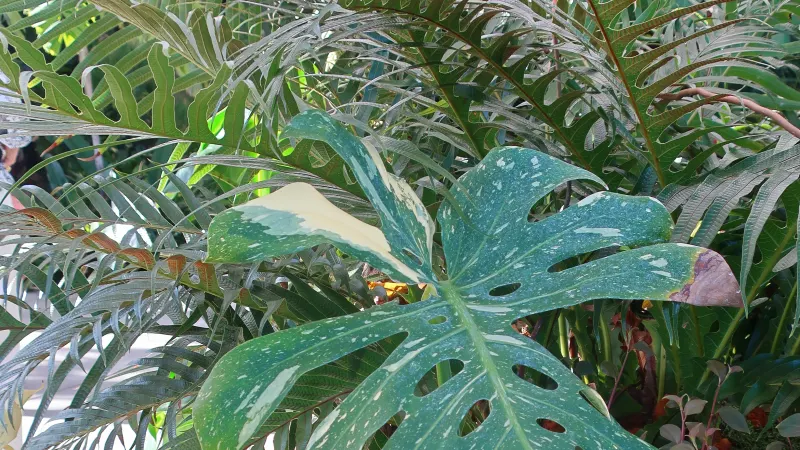
The Thai Constellation is a variegated cultivar of Monstera deliciosa, registered with the RHS as Monstera deliciosa 'Thai Constellation'. Its leaves are splashed, marbled and speckled creamy white over green, which is where the name comes from: the pattern looks like a night sky. It was developed in Thailand, the hype around it took off around 2020, and it is now in mass production, which is why a plant that was once scarce and expensive now turns up on garden centre shelves.
Under the speckles it is a Monstera deliciosa, and most of what that plant wants, this one wants too. In the wild the species grows from southern Mexico to Guatemala, starting on the forest floor and climbing trees, where it becomes epiphytic and clings on with long, cord-like aerial roots. Only mature leaves grow the famous holes and splits, and in low light even a mature plant makes fewer of them.
What changes with the Thai Constellation is the budget. Variegation comes from mutations, and University of Minnesota Extension notes that some last for the plant's lifetime while others are temporary. A University of Florida study describes the Thai Constellation as relatively genetically stable, so its pattern tends to hold as it grows. The price of the pattern is paid in light, and in time.
Why it grows slower than a green Monstera
A leaf grows on what it can photosynthesise, and the cream parts of a variegated leaf contain little or no chlorophyll. In a study of a variegated fig, the white sectors of the leaf showed no measurable photosynthesis at all. A Thai Constellation leaf is part solar panel and part passenger, and the passengers still have to be built and fed.
The result is a plant that, as the RHS puts it, is slightly slower growing than the species, with its leaves more closely spaced. Penn State Extension adds that the shorter internodes make it fuller and more compact. Expect fewer new leaves a year than a green Monstera in the same window, and expect the plant to respond more slowly to everything: a better spot, a repot, a mistake. That slowness is normal, and it is the reason this cultivar stayed rare for so long. University of Florida researchers note that it grows slowly and its cuttings can be hard to root, which drove the price up until it went into mass production.
A slow plant is not a weak one, but it is slow to show you anything. A change for the better takes a while to appear in new leaves, and so does a mistake, which is why the habits below are worth keeping even when the plant looks fine.
Light: more than a green Monstera, less than direct sun
This is the single decision that shapes a Thai Constellation. Because so much of each leaf is cream, the plant needs more light than a solid green Monstera to make the same food, and NC State Extension says as much about variegated Monsteras in general. In a dim corner it grows slowly even by its own standards, and the new leaves come in smaller with fewer holes.
Yet the cream parts are also the most fragile. The RHS notes that sun scorch is more likely on the paler sections of variegated leaves, and LSU AgCenter warns that this cultivar is more sensitive to direct sunlight, which can scorch the white parts. The answer is the brightest indirect light you have: close to a bright window, out of the hot midday beam. An east-facing window, with a little soft morning sun, is the spot LSU recommends. Behind a south or west window, pull the plant back from the glass or filter the light with a sheer curtain.
There is a second reason to keep it bright. The RHS says that when a variegated plant loses its pattern for good, and reversion has been ruled out, too little light is often the cause. A Thai Constellation sitting in the gloom is not only growing slowly. It is also the plant most likely to drift towards green.
How often to water a Thai Constellation
As with any Monstera, there is no fixed interval. Penn State Extension's rule is to let the top 2.5–5 cm (1–2 inches) of compost dry out between waterings. Push a finger in to the second knuckle: dry means water, damp means wait and check again in a few days. When you do water, water thoroughly until it runs from the drainage holes, then empty the saucer. The RHS warns never to leave the pot standing in water. From autumn to late winter, when growth slows, water less.
A schedule borrowed from a green Monstera, or from the label, describes a different plant in a different room. Read the compost, not the calendar. The longer method is in when to water your houseplants.
This is where a model of the individual plant helps. Botanical Legacy keeps a Digital Shadow of each Specimen in your Sanctuary, a running estimate of when that particular pot will be dry. On every plan, including the free one, you can log a quick soil check from the Specimen's page, from bone dry to wet. After three checks between waterings, the model starts correcting its drying rate for that plant from what you found. For a plant as slow and particular as a Thai Constellation, that means a schedule fitted to this pot, in this room, rather than to an average Monstera.
Soil, potting and a pole to climb
A Monstera wants an open, free-draining mix that holds some moisture without staying wet. The RHS suggests one part peat-free ericaceous compost to two parts orchid compost, for a slightly acidic mix. Penn State Extension suggests adding bark, perlite or charcoal to a soilless mix. Whatever the recipe, the pot needs a drainage hole.
Repot every one to two years, in late winter or early spring, when the roots fill the pot. Go up only a few centimetres in width. The RHS advises against a significantly larger pot, because a large volume of compost the roots cannot reach stays wet, and wet compost is where root trouble starts.
Give it something to climb. The RHS recommends a moss pole, which the aerial roots will root into if the moss is kept moist. Without support, Missouri Botanical Garden notes, the stems tend to grow sideways rather than up. Aerial roots you do not want can be trained onto the pole or removed.
Humidity and temperature
A Thai Constellation prefers humid air: Penn State Extension suggests above 50%. Ordinary room air will keep it alive, but the RHS lists dry air as a cause of brown leaf tips and edges, and LSU AgCenter advises keeping the air around this cultivar more humid, especially in winter, when central heating dries the house.
The RHS gives 18–25°C as the comfortable range, and rates the plant hardy only to 10–15°C. That makes it a houseplant that can go outside, at most, in a warm summer. Keep it away from cold draughts in winter, and from radiators and heating vents, which dry the leaves.
Common problems
Brown, crispy patches on the cream parts. Usually sun scorch. Pale tissue scorches first, going from bleached to brown and brittle, and University of Maryland Extension notes that dry compost makes scorch worse. Move the plant back from the glass or filter the light. Scorched tissue does not turn green again.
Brown tips and edges. The RHS links these to dry air, and crispy brown edges to underwatering. Raise the humidity and water on the compost's evidence.
Browning in the middle of the leaf. The RHS ties this to overwatering. Check that the pot drains, that it is not standing in water, and that the compost dries out at the top between waterings.
A shoot comes in all green. On variegated plants, the RHS explains, green shoots carry more chlorophyll, grow more vigorously and can eventually take over. Cut the shoot back to the point where variegated leaves begin. The Thai Constellation is relatively stable, so this is uncommon, but it is worth catching early.
Leaves losing their pattern, or new leaves small and plain. Most often too little light. Move it closer to the window, out of direct sun.
What to do with damaged leaves. The RHS advice is to cut off leaves that are completely brown or completely yellow, but to keep leaves that are still mostly green until new growth has come in. A partly scorched leaf is still feeding the plant.
Propagation
A Thai Constellation is propagated like any Monstera, from a stem cutting that includes a node. University of Minnesota Extension is clear that a cutting with no node, a single leaf on its own, will not produce new growth and will eventually rot. Cut a section of stem with a node, ideally with an aerial root, and root it in water or in moist, free-draining mix. Air layering and division also work.
Be patient. The same University of Florida researchers who describe it as stable note that its cuttings can be a challenge to root. A cutting from a stable variegated plant keeps the pattern, but seed does not. University of Minnesota Extension warns that seeds do not carry variegation, so seed sold as variegated Monstera is not what it claims to be. For the general method, and how to keep a cutting alive past the first few weeks, see the guide to propagating houseplants.
Frequently asked questions
Is a Thai Constellation the same plant as a Monstera deliciosa?
Yes. It is a cultivar of Monstera deliciosa, registered with the RHS as Monstera deliciosa 'Thai Constellation'. It shares the species' climbing habit, aerial roots and split mature leaves, and needs the same care, with two differences: it needs more light, because the cream sections of its leaves make little food, and it grows more slowly and more compactly than the plain green plant.
Why is my Thai Constellation growing so slowly?
Partly because that is its nature. The RHS describes it as slightly slower growing than the species, because the cream parts of each leaf contain little chlorophyll and make little food. If growth has stopped altogether, the usual cause is too little light: move it closer to a bright window, out of direct sun. Check, too, that the compost is drying out at the top between waterings and the pot is not standing in water.
Will a Thai Constellation revert to green?
It is unlikely. A University of Florida study describes it as relatively genetically stable, which is why it can be produced in large numbers and keep its pattern. If a shoot does come in all green, cut it back to where the variegated leaves begin: the RHS notes that green shoots grow more vigorously and can take over. Long spells in low light can also fade variegation, so keep it bright.
Why does my Thai Constellation have brown spots on the white parts?
Most often sun scorch. The RHS notes that the paler sections of variegated leaves scorch more easily, and LSU AgCenter warns that direct sun can scorch this cultivar's white parts. Move it back from the window or filter the light. Brown tips and edges point instead to dry air or underwatering, and browning in the middle of the leaf to overwatering.
Is a Thai Constellation toxic to cats and dogs?
Yes. The ASPCA lists Monstera deliciosa as toxic to both cats and dogs. The leaves and stems contain insoluble calcium oxalate crystals, which cause irritation and burning of the mouth, tongue and lips, drooling, vomiting and difficulty swallowing if chewed. Keep it out of reach, and call your vet if a pet has chewed it.
Can Botanical Legacy help with a plant this slow to respond?
That is the case where it helps most. A slow plant hides its mistakes for weeks, so a running record matters more than a single good look. Each Specimen gets its own Digital Shadow, an estimate of when its pot will be dry, and soil checks you log on any plan teach the model that plant's real drying rate. Progress photos build growth curves of height and leaf count, so a Thai Constellation's slow progress shows up as a trend instead of a feeling.
Start your sanctuary
Botanical Legacy's free Observer plan covers up to five Specimens, each with its own continuously running Digital Shadow and soil checks that teach it each pot's drying rate. A Thai Constellation, slow to grow and slow to show a mistake, is exactly the kind of plant a steady per-pot model is for. Every new account also includes a 14-day trial of Cultivator, the paid plan, which adds the local weather feed and soil sensor support.
START YOUR SANCTUARY - FIVE FREE SPECIMENS, NO PAYMENT REQUIRED →
Give a Thai Constellation all the light the cream can take and none it can't, and the constellation keeps its stars.
Sources
The plant-care facts on this page were checked against these references.
- RHS: rhs.org.uk/plants/520520/monstera-deliciosa-thai-constellation-…
- NC State Extension: plants.ces.ncsu.edu/plants/monstera-deliciosa
- LSU AgCenter: lsuagcenter.com/articles/page1778771189620
- Jing, Beleski & Vendrame 2023, Horticulturae: mdpi.com/2311-7524/10/1/1
- Kew POWO: powo.science.kew.org/taxon/urn:lsid:ipni.org:names:87478-1
- Missouri Botanical Garden: plantfinder.mobot.org/PlantFinderDetails.aspx
- RHS: rhs.org.uk/plants/swiss-cheese-plants/how-to-grow-swiss-cheese-…
- Clemson HGIC: hgic.clemson.edu/factsheet/philodendron-pothos-monstera
- UMN Extension: extension.umn.edu/garden-and-home/yard-and-garden/gardening-in-…
- Shih et al. 2019, Int J Mol Sci: pmc.ncbi.nlm.nih.gov/articles/PMC6470861
- Penn State Extension: extension.psu.edu/monstera-as-a-houseplant
- RHS: rhs.org.uk/plants/types/houseplants/how-to-help-a-poorly-housep…
- RHS: rhs.org.uk/prevention-protection/leaf-damage-on-houseplants
- UMD Extension: extension.umd.edu/resource/excess-light-indoor-plants
- RHS: rhs.org.uk/problems/reversion
- ASPCA: aspca.org/pet-care/aspca-poison-control/toxic-and-non-toxic-pla…