Species care guide
Staghorn fern
Platycerium bifurcatum
A staghorn fern care guide built on what makes it different — it's an epiphyte you mount on a board instead of potting in soil, it grows two completely different kinds of frond, and you water it by soaking the mount when it feels light, not by checking soil that isn't there.
_-_107.jpg)
- Light
- Bright, indirect light; a little gentle morning sun is welcome but harsh midday sun through glass scorches the fronds.
- Water
- Water by weight — when the mount or root ball feels light and dry, soak or drench it thoroughly, then let it drain and approach dry again before the next soak; keep the flat shield fronds from staying soggy.
- Humidity
- Prefers higher humidity, around 50% or more — it thrives in a bright bathroom or with a humidifier and appreciates the occasional misting.
- Temperature
- 18–24°C; it has no frost tolerance, so keep it away from cold draughts and winter windowsills.
- Pets & toxicity
- Non-toxic to cats and dogs — a genuinely pet-safe choice.
- Difficulty
- Moderate — watering by weight and the mounted habit feel unfamiliar at first, but it is forgiving once its rhythm clicks.
A staghorn fern is a plant you hang on the wall like a piece of living art — and the flat brown frond everyone itches to tidy away is the one part you must never touch.
The fern you hang on the wall
Most houseplants sit in a pot of soil on a shelf. A staghorn fern hangs on the wall. In the wild, Platycerium bifurcatum is an epiphyte — it grows perched on tree trunks and branches, its roots gripping bark rather than sinking into the ground — and indoors it's grown the same way: mounted on a board of wood, or tucked into a hanging basket, with no pot of compost in sight. That single fact rewrites the care. Every instinct you've built around checking soil, letting it dry between waterings, and worrying about drainage has to be translated into a different language — the same way it does for an air plant with no soil at all.
The other thing that trips up almost every new owner is that a staghorn grows two completely different kinds of frond, and one of them is meant to turn brown. The flat, round shield fronds that press against the mount start life green and age to a dry, papery brown — and the most common way people damage a staghorn is by peeling that browning frond away to "tidy it up". It isn't dead, and it isn't a problem. Learn to read the two fronds and to water by weight instead of by soil, and a staghorn becomes a striking, forgiving plant. If you've kept a conventional potted fern like a Boston fern before, be warned that a mounted staghorn plays by noticeably different rules.
Light
In the wild a staghorn grows in the dappled canopy of subtropical forests, catching bright but broken light filtered through the branches it clings to. Indoors, that translates to bright, indirect light — the sort of position a metre or so back from a bright window, or right beside a north- or east-facing one. A little gentle direct morning sun is welcome and often improves the colour and vigour of the antler fronds, but the plant's weak spot is harsh, direct midday and afternoon sun through glass, which scorches and bleaches the fronds faster than watering can compensate for.
Too little light is a slower problem. A staghorn survives in a dim corner for a good while, but growth stalls, new antler fronds come in small and few, and the plant loses vigour. If yours looks pale and static, more bright indirect light is usually the first fix.
The two kinds of fronds
Understanding the two fronds is most of what it takes to keep a staghorn well — and to stop yourself "fixing" things that aren't broken.
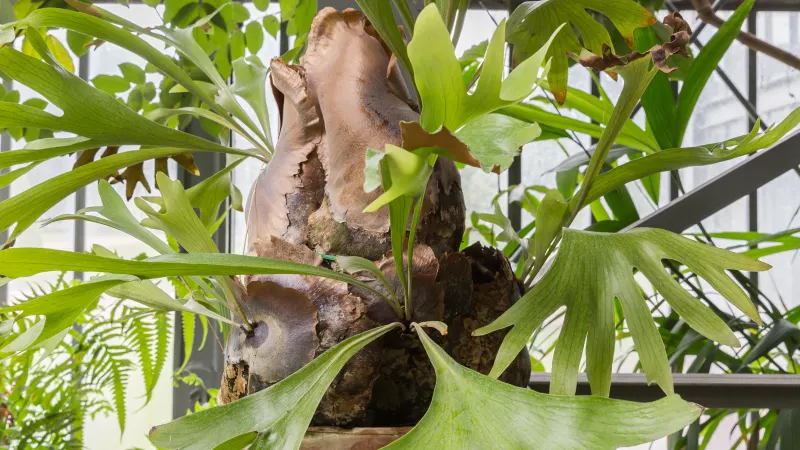
The first is the shield frond, sometimes called the basal or sterile frond — the flat, rounded, overlapping plates that press against the mount and clasp the base of the plant. Their job is entirely structural: they cover and protect the root ball, anchor the fern to its surface, and in the wild they catch debris that breaks down into nutrients. New shield fronds emerge a soft green, then — this is the part that alarms people — dry out, turn brown, and go papery with age. That browning is completely normal and healthy. A brown shield frond is not dead, diseased, or neglected, and you must not peel it, pull it, or cut it off. Behind those brown shields sit the roots the plant depends on; stripping them away exposes the roots and removes the plant's own armour. Left alone, old shields simply build up in layers as new green ones grow over them — exactly as the plant intends.
The second is the fertile frond, the forked, antler-shaped green frond that gives the plant its name. These are the working leaves: they photosynthesise, arch and branch like a stag's antlers, and they're the part you're really growing the plant for. On mature fertile fronds you'll notice patches of brown, velvety fuzz on the undersides, usually near the tips. That fuzz is spores — the fern's way of reproducing — not pests, not rust disease, and nothing to treat. It signals a healthy, mature plant and can be left entirely alone. The only grooming a staghorn genuinely needs is to remove a fertile frond that has died and gone fully brown and shrivelled.
Watering a mounted plant
Because there's no pot of soil, the finger test that governs almost every other houseplant is off the table. What replaces it is weight. A mount that's recently been watered feels distinctly heavy; as the moss and root ball dry out it becomes noticeably light, and that lightness is your cue to water. Over the first few weeks, lifting it teaches you its heavy-when-wet and light-when-dry extremes.
Watering is best done as a soak. Take the plant down and rest the root ball and base of the mount in a sink or bucket of room-temperature water for ten to twenty minutes, until the moss is thoroughly saturated. If it's too large to submerge, drench it heavily under the tap instead, until water runs freely through the moss. Then — this matters as much as the soak — let it drain completely before you hang it back up, and let it approach dryness again before the next watering. A warm, bright room in summer might mean a soak once a week; cooler, darker winter months can stretch to every two or three weeks. The two failure modes sit at opposite ends: a constantly soggy base rots the crown and the roots hidden behind the shield fronds, while a plant left bone-dry too long crisps at the antler tips. Swing between thoroughly watered and nearly dry, never sitting wet.
This is where an honest word about the Digital Shadow belongs. Botanical Legacy's simulation is built to model soil moisture — how fast a pot dries, how close a plant is to needing water — and a mounted staghorn has no soil for it to model. It's the same genuine limitation you meet with an air plant, a bromeliad watered from its central cup, or lucky bamboo grown in a vase of water: there's no substrate for a soil-moisture model to measure. What the app is genuinely good for here is the part that keeps a staghorn alive — the schedule: a dependable reminder to lift and soak on rhythm, adjusted for the seasons, plus somewhere to track humidity and log each soak. That's worth far more than a soil reading it would only have to invent. Watching the plant rather than the calendar is the same principle as in when to water your houseplants — the staghorn just swaps the finger test for a heft test.
Mounting, humidity, and feeding
A staghorn is usually sold in a small nursery pot or already mounted. Mounting one yourself is straightforward: sit the root ball on damp sphagnum moss against a board of untreated wood, and wrap fishing line or plastic-coated wire around it until the roots and the first shield frond grip the mount on their own. A moss-lined hanging basket works just as well. As the shield fronds spread across the board, remount the whole thing — mount and all — onto a larger backing rather than disturbing the roots. In time a healthy staghorn produces pups, small offset plants around its base, which can be separated with a section of root and moss to start a new plant; the principles are the same as in how to propagate plants.
Humidity is the environmental lever that makes the biggest difference. Staghorns come from humid forests and are happiest at around 50% or above, which is why a bright bathroom suits them so well. In the drier air of a heated home, a nearby humidifier or an occasional misting keeps the antler tips from browning. Warmth matters too — aim for roughly 18–24°C, and keep the plant away from cold draughts and frosty winter windowsills, since it has no frost tolerance at all.
Feeding is a light touch. Through spring and summer, a dilute balanced liquid fertiliser added to the soak water every four to six weeks is plenty, or you can tuck a little slow-release feed or organic matter behind the shield fronds, mimicking the way the plant traps and digests falling debris in the wild. Ease off entirely through autumn and winter. If you like low-fuss epiphytes that ask for a soak and little else, a staghorn sits happily alongside a plant like a hoya — both reward a hands-off rhythm far more than fussing.
Common problems
Blackened, mushy, or rotting base. Overwatering. A crown and root ball kept constantly wet — from watering too often, or water trapped against the base with no chance to dry — rots the plant from its centre. Let the mount dry out much more between soaks, make sure it drains fully, and never leave the base sitting in water.
Browning, crispy antler-frond tips. Usually too dry, too low humidity, or both — sometimes with a spell of harsh direct sun on top. Soak a little more often, raise the humidity, and check it isn't catching hot afternoon sun through glass.
Brown, papery shield fronds at the base. Normal — leave them alone. The flat, round shields are meant to brown and go papery with age; they protect the roots and must not be peeled or removed. This is healthy, not a problem to fix.
Brown, fuzzy patches under the antler fronds. Spores, and a sign of a mature, healthy plant. This is how the fern reproduces — not a pest, rust, or disease, and it needs no treatment. Leave it be.
Wilting or drooping antler fronds. Usually thirst. A staghorn left too long between soaks wilts as it dries; lift the mount to confirm it feels light, then soak it thoroughly. If the base is instead soft and dark, the cause is the opposite — rot from overwatering — so check which way the plant is failing before you reach for water.
Frequently asked questions
How often should you water a mounted staghorn fern?
There's no fixed schedule, because there's no soil to check — you water by weight instead. Lift the mount, and when it feels light and dry, give it a thorough soak: rest the root ball in room-temperature water for ten to twenty minutes, or drench it heavily until water runs through the moss, then let it drain and approach dryness before the next soak. In a warm, bright room that's often about once a week; in cool, dim winter it can stretch to every two or three weeks. Err toward letting it dry out rather than keeping the base constantly wet.
Why is my staghorn fern's shield frond turning brown?
Because that's exactly what it's supposed to do. The flat, round shield (or basal) fronds at the base start green and turn brown and papery as they age — a normal, healthy part of the plant's life, not disease or neglect. Crucially, don't peel, pull, or cut them off: those browning shields protect the roots underneath and anchor the plant, and new green ones grow over the old in layers. Removing them exposes the roots and does real harm — leave brown shield fronds exactly where they are.
Is a staghorn fern toxic to cats and dogs?
No — the staghorn fern (Platycerium bifurcatum) is non-toxic to cats and dogs, in line with the ASPCA's listing and with true ferns generally being pet-safe. That makes it a reassuring choice for a home with curious animals, and its usual spot mounted on a wall or hanging out of reach keeps it away from paws too. It's always sensible not to let a pet make a habit of chewing any houseplant, but a nibble of staghorn isn't a poisoning risk.
What is the brown fuzzy stuff on the underside of my staghorn's fronds?
Those are spores, and they're a good sign. As the antler-shaped fertile fronds mature, they develop patches of brown, velvety fuzz on their undersides — usually near the tips — which is simply how the fern reproduces. It's often mistaken for pests, rust, or disease, but needs no treatment at all. A staghorn producing spores is a healthy, mature one, so don't scrub or spray it off.
Can Botanical Legacy help me look after a staghorn fern?
Yes — with one honest caveat. Because a mounted staghorn grows on a board rather than in soil, the Digital Shadow can't model its soil moisture: there's no substrate to measure, the same limitation you'll meet with an air plant or a bromeliad watered from its cup. Where the app earns its keep is the schedule — a dependable reminder to lift and soak on rhythm, adjusted for the seasons — plus somewhere to track humidity and log each soak and check-in photo. Register it as a Specimen and let the reminders carry the routine the plant relies on.
Start your sanctuary
Botanical Legacy's free Observer plan covers up to five Specimens, and a staghorn fern is a striking one to build a Sanctuary around — living proof that a Guardian's most important skill here is knowing what to leave well alone. Every new account also includes a 14-day trial of Cultivator, the paid plan, which adds a local weather feed and soil sensor support for the potted, soil-grown plants in your collection.
Mount it well, water it by weight, raise the humidity, and — above all — leave the brown shield fronds exactly where they are.
START YOUR SANCTUARY — FIVE FREE SPECIMENS, NO PAYMENT REQUIRED →
Learn its two fronds, water it by heft rather than by soil, and resist the urge to tidy the brown one away — that is the whole art of keeping a staghorn.