Species care guide
Air plant
Tillandsia spp.
An honest air plant care guide for a genuinely different kind of houseplant — the soak-and-dry rhythm that replaces watering entirely, why the cute glass terrarium is usually the problem, and how to read the leaves for thirst.
.jpg)
- Light
- Bright, indirect light; a little gentle morning sun is fine, but intense direct sun scorches the leaves
- Water
- Soak fully in room-temperature water for 20–30 minutes, 1–2 times a week — then shake dry and let it air-dry completely within about 4 hours
- Humidity
- Happier above 50%; in drier air, water more often or mist lightly between soaks
- Temperature
- 13–27°C; no frost tolerance and no cold draughts
- Pets & toxicity
- Non-toxic to cats, dogs, and humans — genuinely pet-safe
- Difficulty
- Easy once the soak-and-dry rhythm is a habit; almost every death is trapped water, not thirst
An air plant has no soil to overwater. It still drowns — just somewhere you can't see, between the leaves.
The plant with no soil that still drowns
Air plants are sold on a genuinely true promise: no soil, no pot, no repotting. What the display shelf rarely explains is that "no soil" doesn't mean "less watering to think about" — it means a completely different watering mechanic, and the single most common way people kill a Tillandsia has nothing to do with too little water. It's water that goes in during a soak and never fully leaves the base afterward, quietly rotting the plant from the inside while the leaf tips still look fine.
That one gap — soaking correctly but skipping the drying step — accounts for more dead air plants than neglect does. This guide is built around the rhythm that works: submerge, drain, dry, repeat. If houseplants in general are new to you, the ten mistakes every beginner makes is worth a read too, though be warned that almost none of its watering advice about soil applies directly here — this genus plays by different rules from nearly everything else on a windowsill.
Light: bright, indirect, and genuinely necessary
In the wild, Tillandsia grows attached to tree branches and rock faces, often high up where light is strong but rarely under direct, unfiltered sun for hours at a stretch. Indoors, that translates to a spot with bright, indirect light — close to a window, filtered by distance or a sheer curtain. A little gentle direct morning sun is tolerated well, but a full afternoon in a hot, sun-facing window dries the plant out faster than even a good soaking schedule can compensate for, and can visibly scorch the leaf tips.
Too little light is a quieter failure. The plant survives on modest light for a long time, but colour dulls, growth slows to almost nothing, and blooming — which many owners buy an air plant hoping to eventually see — becomes very unlikely. If a Tillandsia has sat in the same dim spot for a year with no change at all, light is usually the first thing to increase.
How to water an air plant
Forget the finger test — there's no soil to check. The reliable method is a full soak: submerge the entire plant in room-temperature water for 20–30 minutes, once or twice a week, more often in a hot, dry room and less often in a naturally humid one like a steamy bathroom with good light. Tap water is fine in most areas; if your water is heavily chlorinated or very hard, letting it sit out for a few hours first, or using filtered water occasionally, reduces mineral buildup on the leaves over time.
A lighter daily or every-other-day misting can help top up a plant between soaks in a very dry room, but misting alone, without the periodic full soak, usually isn't enough hydration on its own — it wets the surface without giving the plant a genuine reserve to draw from. Read the plant's actual soak-day rhythm the way you'd read soil dryness elsewhere: the general logic of watching the plant rather than the calendar is the same principle covered in when to water your houseplants, even though the specific test looks nothing alike here.
The step everyone skips: drying
This is the part that separates a thriving air plant from a slowly rotting one, and it's the part most new owners never hear about. After every soak, gently shake the plant to knock water out from between the leaves and out of the central base, then rest it upside down or on its side — never right-side up, which lets water pool exactly where it's most dangerous — somewhere with open airflow until it's fully dry, usually within about four hours.
Water trapped at the base for longer than that starts to rot the plant's core, and by the time it's visible — a blackened, mushy centre, leaves that pull away with almost no resistance — it's usually too late to save. The fix is entirely preventive: dry it properly every time, without exception, and this failure mode essentially disappears.
Airflow and display: the terrarium trap
Air plants are marketed heavily inside sealed glass terrariums, decorative orbs, and shells — and it's worth knowing that the display most commonly sold alongside them works against the drying step that keeps them alive. A closed glass container traps humidity around the base with nowhere for it to go, turning every soak into a slow-motion version of the exact rot the drying step is meant to prevent.
The fix isn't to avoid attractive display entirely — it's to treat a sealed container as a place the plant visits between waterings, not somewhere it lives permanently wet. Take it out for every soak, dry it fully in the open air, and only return it to the glass once it's completely dry. An open dish, a piece of mounted driftwood, or a shell with the plant simply resting in it avoids the problem altogether and is the lower-maintenance choice if you're soaking it weekly regardless.
Reading the leaves
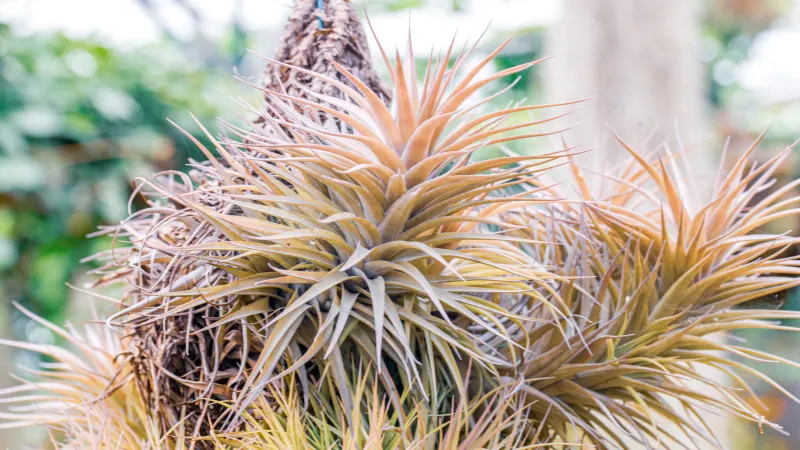
Unlike a plant rooted in soil, an air plant's hydration state shows up directly in its colour and texture, and it's worth learning to read before assuming a problem. The leaves are covered in tiny silvery scales called trichomes, which the plant uses to absorb water and nutrients directly from humid air and rain. A well-hydrated plant looks a slightly deeper, more saturated green, with leaves that sit open and relaxed. A thirsty one turns visibly more silver-grey as the trichomes flare open to catch more moisture, and the leaves curl inward toward the centre. That shift — greener and open versus silvery and curled — is a genuine, physically real signal, not a coincidence of lighting, and it's the closest thing this plant has to the "finger test" every soil-grown species relies on.
Humidity and temperature
Air plants generally prefer humidity above 50%, and in a naturally humid spot — a bright bathroom with good airflow is the classic example — they often need less frequent full soaking, topped up by the ambient moisture in the air. In a dry, heated home, lean toward the more frequent end of the soaking range, or add a light misting between soaks.
Temperature comfort sits between about 13–27°C, with no frost tolerance at all and a dislike of cold draughts, similar to most tropical and subtropical houseplants. A cold windowsill in winter is worth avoiding for the same reason it's avoided everywhere else in this category — sustained chill stresses the plant well before it does visible damage.
Feeding
Feeding isn't essential the way it is for a fast-growing foliage plant, but it measurably helps colour and the odds of blooming. A few times a year, dissolve a small pinch of fertiliser formulated specifically for bromeliads or air plants — well under the label strength — into the soak water. Standard houseplant fertiliser meant for soil-grown plants is typically too concentrated and can burn the leaves through direct contact, so it's worth seeking out the bromeliad-specific formulation rather than substituting a general one.
Blooming and pups
Most Tillandsia species flower exactly once in their individual lifetime — often a small but vividly coloured bloom, sometimes preceded by the whole plant's foliage flushing pink or red as a kind of announcement. After flowering, the mother plant typically produces one or more "pups," small offset plantlets growing from its base, before gradually fading over the following months to a year or more. This is the plant's natural life cycle, not decline from poor care, and it surprises a lot of first-time owners who assume a colour change or slow fade after blooming means something has gone wrong.
The pups can be left attached to form a growing clump over time, which is the lower-effort option and eventually produces an attractive cluster of multiple rosettes. Alternatively, once a pup reaches roughly a third the size of the parent, it can be gently separated and grown on independently, restarting the same soak-and-dry care from scratch.
Common problems
Blackened, mushy base or leaves that pull away easily. Rot from trapped water after soaking — the most common cause of death in this genus. Prevention is the only real fix: always shake off excess water and dry the plant fully within about four hours of every soak, positioned so water can't pool at the base.
Leaves curling inward and turning silvery-grey. Thirst. Increase soak frequency, check that the room isn't unusually dry or warm, and consider adding a light misting between soaks if the air is very dry.
Brown, crispy leaf tips. Usually underwatering, sometimes compounded by very dry air or a spell of direct hot sun. Increase watering frequency slightly and, if the plant sits in strong afternoon sun, consider moving it somewhere a little softer.
No blooming, ever, on a plant that's otherwise healthy. Often simply insufficient light or a plant that hasn't yet reached blooming maturity — not every specimen flowers on a predictable schedule, and some take a year or more in good conditions before they do. Increasing light and adding occasional dilute feeding are the two levers most likely to help.
Plant living in a sealed glass terrarium looks increasingly unwell. Airflow, almost certainly. Move it to an open display, or commit to taking it out of the glass for every soak and drying it fully before returning it.
Frequently asked questions
How often should you water an air plant?
Soak it fully in room-temperature water for 20–30 minutes, once or twice a week — more often in a hot, dry room, less in a naturally humid one. There's no soil to check, so the schedule is the main lever; watch the leaf colour (silvery and curled means thirsty, green and relaxed means well hydrated) to fine-tune it for your specific room.
Why is my air plant dying even though I water it regularly?
The most likely cause is trapped water rather than too little of it. If the plant isn't shaken dry and given several hours of open airflow after every soak, water pooling at the base rots the plant from the inside — a failure that shows up as a blackened, mushy centre, often well before the outer leaves look obviously unwell.
Can I keep an air plant in a closed glass terrarium?
Not permanently, if you want it to thrive. Sealed containers trap humidity with nowhere to go, working directly against the drying step the plant needs after every soak. It's fine as an occasional display — just take the plant out for watering and let it dry fully in open air before returning it to the glass.
Why did my air plant turn pink or red and then start dying?
That colour change usually signals the plant is about to bloom, and many Tillandsia flower exactly once in their life before slowly fading over the following months as they put their remaining energy into producing pups at the base. It's the natural end of one generation's cycle, not a care failure — look for small offset plantlets forming, which can be grown on once they're about a third the size of the parent.
Is an air plant toxic to cats and dogs?
No. Tillandsia is considered non-toxic to cats, dogs, and humans, making it a genuinely pet-safe option — useful for a household with curious animals, alongside other pet-safe picks like peperomia and spider plant.
Does Botanical Legacy work for a plant with no soil?
Mostly, with one honest caveat. The reminder and photo check-in loop works the same way for a Tillandsia as for any other Specimen — you can log each soak as a watering action and track its condition over time through check-in photos. What doesn't apply is the soil-moisture side of the Digital Shadow: there's no pot and no substrate to model virtual moisture in, so the simulation leans more on your logged soak rhythm and photos than it would for a potted plant with real soil physics underneath it.
Start your sanctuary
Botanical Legacy's free Observer plan covers up to five Specimens, and an air plant is a genuinely good one to add — its whole hydration story plays out visibly in colour and texture, which makes the photo check-in habit especially rewarding to keep. Every new account also includes a 14-day trial of Cultivator, the paid plan, which adds the local weather feed and soil sensor support for the rest of your collection.
Soak it, dry it properly, and an air plant asks for almost nothing else.
START YOUR SANCTUARY — FIVE FREE SPECIMENS, NO PAYMENT REQUIRED →
An air plant's whole care routine is two steps done consistently: get it fully wet, then get it fully dry. Skip the second one and the first one stops mattering.