Species care guide
Venus flytrap
Dionaea muscipula
A Venus flytrap care guide that breaks every normal houseplant rule on purpose — distilled water only, poor bog soil with no fertiliser, hours of direct sun, and a genuine winter dormancy that isn't the plant dying.

- Light
- Lots of direct sun — at least 6 hours; a bright sunny windowsill or a grow light, never a dim shelf or a closed terrarium
- Water
- Distilled, rain, or reverse-osmosis water ONLY — never tap or mineral water; keep the soil constantly wet by standing the pot in a shallow tray of it
- Humidity
- Average room humidity is fine if light and water are right; it does not need a sealed terrarium, which usually harms it
- Temperature
- Warm 20–32°C in summer; a cold winter dormancy near 0–10°C for about three months is essential
- Pets & toxicity
- Not considered toxic to cats and dogs; the traps are harmless to pets, though it's a plant to admire rather than let them chew
- Difficulty
- Moderate; simple once you accept its rules, but the wrong water and a skipped dormancy are what kill most of them
A Venus flytrap breaks every houseplant rule you know: give it terrible soil, never let it dry out, water it with rain, feed it nothing from the kitchen, and let it freeze all winter. Do all five and it thrives.
The plant that wants the opposite of everything
Almost everything you've learned about looking after houseplants is wrong for a Venus flytrap, and that's exactly why so many die within a month of coming home. Dionaea muscipula is a carnivorous bog plant with one of the smallest wild ranges of any famous species — a scattering of wet, sunny, nutrient-poor pine savannas in the Carolinas of the southeastern United States. Everything about its care follows from that strange native home: constantly waterlogged, mineral-free ground so poor in nutrients that the plant evolved to catch insects instead, under open sky with hours of direct sun, through hot summers and genuinely cold winters.
Translate that into a home and you get a care sheet that reads like a list of things you're normally told never to do. Don't use tap water — use rain or distilled. Don't let the soil dry between waterings — keep it permanently wet. Don't give it rich soil or feed it — give it poor, sterile bog mix and no fertiliser at all. Don't tuck it in a shady spot or a closed terrarium — put it in blazing sun. And don't keep it cosy and growing all year — let it go cold and dormant every winter. None of it is hard once you stop fighting it. The people who succeed with flytraps are simply the ones who accept that this plant plays by different rules, and the ones who fail are usually applying ordinary houseplant instincts to a plant that has none of the ordinary needs.
Water: the rule that decides its fate
If you remember one thing, remember the water. Venus flytraps evolved in rain-fed bogs where the water is almost completely free of dissolved minerals, and they never developed any tolerance for the salts and minerals in ordinary water. Tap water, filtered water, spring water, and bottled mineral water all carry dissolved solids that accumulate in the soil and slowly poison the plant — this is the single most common way flytraps are unknowingly killed. Use only distilled water, reverse-osmosis water, or clean rainwater, and use it exclusively. There's no "close enough" here; it's the difference between a plant that thrives and one that browns off over a few weeks for no visible reason.
The second half of watering is that a flytrap must stay wet. This is the opposite of the "let it dry out between waterings" rule that governs nearly every other plant, including the general watering guidance for the rest of your collection. The reliable method is the water tray: stand the pot in a shallow saucer holding around a centimetre of distilled water, and keep it topped up so the soil wicks moisture upward and stays constantly, evenly wet — mimicking the boggy ground it comes from. In the warm growing season it can sit in water more or less permanently; during the cool winter dormancy, ease off so the soil is just damp rather than sodden, since cold and wet together can rot the roots.
It's worth being honest about what a plant-care app can and can't do for a bog carnivore. Botanical Legacy's Digital Shadow is built around the normal houseplant question — "how dry has this pot become, and when will it need water?" — and a Venus flytrap inverts that entirely, because its correct state is always wet. Where a per-plant record genuinely helps is as a keeper of the two schedules that matter here: a reminder to keep the distilled-water tray topped up, and a note of when the plant entered and left its winter dormancy so you can manage the seasons deliberately. This is the same honest limitation you'll find with an air plant or a cup-watered bromeliad — the moisture physics doesn't map, but the routine still benefits from being tracked.
Light
Venus flytraps are sun plants, full stop. In the wild they grow in open, treeless savanna under direct sun for most of the day, and indoors they need as much of that as you can give them — a minimum of around six hours of direct sunlight daily, and more is better. A bright, unobstructed south-facing windowsill is the usual indoor answer; a sunny spot outdoors through spring and summer is even better; and a strong grow light fills the gap where natural light falls short.
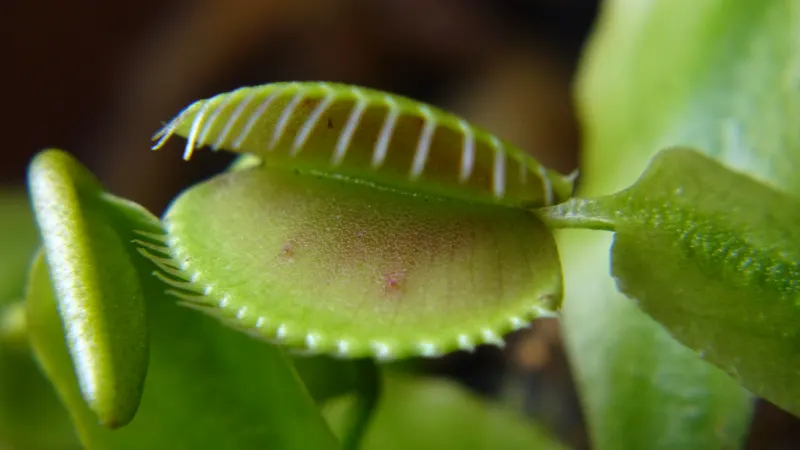
Light is also written directly into how the plant looks. A flytrap getting plenty of sun grows robust, well-formed traps that flush a deep red or pink on the inside — that colour is a sign of health, not stress. A flytrap starved of light tells on itself immediately: the traps stay entirely green, grow long, weak, and floppy, reach and sprawl instead of standing up, and the plant gradually weakens and declines. This is exactly why the classic gift-shop setup — a flytrap sealed in a little plastic dome on a shady shelf — is a slow death sentence. It's not a low-light terrarium novelty; it's a sun-worshipping bog plant, and it needs to be treated like one.
Soil and feeding
The soil requirement sounds like neglect and is essential: Venus flytraps need poor, acidic, nutrient-free ground. Pot yours in a proper carnivorous-plant mix — long-fibre sphagnum moss, or sphagnum peat cut with perlite or silica sand — and never use ordinary potting soil, compost, or anything enriched. The whole reason the plant catches insects is that its native soil offers no nutrients through the roots, so rich soil and fertiliser don't help it; they burn and kill it. Repot every year or two into fresh mix, again watered only with distilled or rain water, and don't be tempted to "improve" the soil.
Feeding follows the same logic. Outdoors, a flytrap catches its own flies, gnats, and spiders and needs no help at all. Indoors, where prey is scarce, you can offer the occasional meal — a live or dried insect small enough to fit the trap, roughly every couple of weeks in the growing season — but it's easy to overdo and never strictly necessary if the plant is otherwise healthy. The hard rules: only feed things it would naturally catch, only feed traps that can close fully around the food, and never, ever give it meat, cheese, or human food, which the trap can't digest — it just rots, blackens, and dies. Overfeeding stresses the plant; a well-lit flytrap in clean water is doing fine even if it rarely eats.
And leave the traps alone as toys. Each trap can only snap shut a limited number of times before it stops working, and every closure burns energy. Triggering traps to watch them close on nothing — the near-universal temptation — wastes that finite budget, and a trap poked repeatedly with no meal turns black and dies prematurely. Enjoy watching them catch real prey, and otherwise resist the urge to set them off.
Dormancy: the step almost everyone skips
The most misunderstood part of Venus flytrap care is winter dormancy, and misunderstanding it kills a great many plants — in two different ways. Venus flytraps are not tropical; they experience real winters in the Carolinas, and they need an annual dormancy of roughly three months of cold, somewhere in the region of 0–10°C, triggered by shortening days and falling temperatures. Deprived of it, kept warm and growing year-round on a cosy windowsill, a flytrap slowly exhausts itself and dies over a year or two of no rest.
The second way it kills is panic. During dormancy the plant looks awful — growth stops, many of the traps and leaves blacken, wither, and die back, and it can appear to be a goner. It isn't. That die-back is normal and expected, and the plant is very much alive at the root, waiting for spring to push out fresh growth. Owners who don't know this often throw a perfectly healthy dormant plant in the bin. To provide the dormancy, move the plant somewhere cold but not deep-freezing for the winter — an unheated windowsill, a cold porch, a garage, a cold frame, or a sheltered spot outdoors in milder climates — keep the soil just damp rather than wet, and expect it to look half-dead until it revives in spring. Plan for that cold rest deliberately, and a Venus flytrap can live for many years and multiply into a clump.
Common problems
Traps turning black. Some blackening is completely normal — individual traps age, die, and are replaced, and a trap blackens after it has digested a few meals. It becomes a warning sign when it's widespread and fast, which usually points to the wrong water (mineral build-up from tap water), repeated false triggering, or overfeeding. Trim off dead traps, and check that you're using only distilled or rain water.
The whole plant dying back in autumn and winter. Almost always dormancy, not death. Cold and shortening days make the plant die back and look lifeless; it's resting, not dying. Keep it cold and just damp, don't bin it, and wait for spring growth.
Weak, floppy, all-green traps that won't stand up. Too little light. Move it to full sun or under a strong grow light; healthy, well-lit traps stand firm and colour up red inside.
Sudden decline with no obvious cause. Very often the water. If you've been using tap, filtered, spring, or bottled mineral water, mineral accumulation is likely poisoning it — switch to distilled or rain water and repot into fresh carnivorous mix.
A blackened, rotting trap after "feeding" it. Caused by giving it something it can't digest — meat, cheese, or oversized food. Only ever offer small insects it would naturally catch, and only to traps that can seal fully around them.
Frequently asked questions
What water should you use for a Venus flytrap?
Only distilled, reverse-osmosis, or clean rainwater — never tap, filtered, spring, or bottled mineral water. Venus flytraps evolved in mineral-free bogs and have no tolerance for the dissolved minerals in ordinary water, which build up in the soil and slowly kill the plant. This is the most common cause of unexplained flytrap death. Keep the soil constantly wet by standing the pot in a shallow tray of distilled water and topping it up.
Do you have to feed a Venus flytrap, and what can it eat?
Not necessarily. Outdoors it catches its own insects and needs no feeding. Indoors you can offer an occasional small live or dried insect — something it would naturally catch, small enough for the trap to close fully around — roughly every couple of weeks in the growing season, but it isn't essential if the plant has good light and clean water. Never feed it meat, cheese, or human food, which it can't digest; the food just rots and the trap dies.
Why is my Venus flytrap turning black?
Some blackening is normal — traps age and die off, and a trap naturally blackens after digesting a few meals. Rapid, widespread blackening usually means the wrong water (mineral build-up from tap water), traps being triggered repeatedly for fun, or overfeeding. In autumn and winter, extensive die-back is dormancy, which is normal. Trim dead traps, use only distilled or rain water, and stop poking the traps.
Does a Venus flytrap really need a winter dormancy?
Yes. Venus flytraps are temperate, not tropical, and need about three months of cold dormancy each winter, roughly 0–10°C. Without it, a plant kept warm and growing all year gradually exhausts itself and dies. During dormancy the plant dies back and looks half-dead, which is normal — don't mistake it for death and throw it out. Provide the rest with an unheated windowsill, porch, garage, or sheltered outdoor spot, keeping the soil just damp.
Is a Venus flytrap toxic or dangerous to pets?
No. Venus flytraps aren't considered toxic to cats and dogs, and the traps are far too small and weak to hurt a curious pet — a closing trap can't harm a nose or paw. It's a plant to admire rather than let a pet chew on, both for the plant's sake and because you don't want it triggering traps, but there's no poison to worry about here.
Can Botanical Legacy help me look after a Venus flytrap?
Within honest limits, yes. Because a flytrap should be kept constantly wet rather than dried out, the Digital Shadow's soil-moisture model — designed for normal houseplants that dry between waterings — doesn't map onto it. Where logging it as a Specimen genuinely helps is the routine: a reliable reminder to keep the distilled-water tray topped up so it never dries, and a record of when it entered and left dormancy so you manage the seasons on purpose. The physics doesn't fit a bog carnivore, but the discipline of a tracked routine still does.
Start your sanctuary
Botanical Legacy's free Observer plan covers up to five Specimens, and a Venus flytrap is a fascinating, genuinely different one to grow — a full-sun bog carnivore that rewards you for unlearning your houseplant habits. Every new account also includes a 14-day trial of Cultivator, the paid plan, which adds a local weather feed and soil sensor support for the more conventional plants in your collection.
Give it rain water, full sun, poor soil, and a cold winter rest — and this strange little predator will thrive on rules that would kill anything else on your shelf.
START YOUR SANCTUARY — FIVE FREE SPECIMENS, NO PAYMENT REQUIRED →
Everything a Venus flytrap wants is the opposite of everything else you grow. Stop treating it like a houseplant, start treating it like a bog carnivore, and it rewards you for the whole strange list.