Plant care · 11 min read
Greenhouse plant care during a heat wave — venting, shading, and damping down that actually work
A greenhouse turns a hot day into a dangerous one — the same glass that saves your plants in spring cooks them in a heat wave. How to vent, shade, and damp down before the temperature runs away from you.
Botanical Legacy · Field notes ·
The glass that saves your plants in April is the same glass that kills them in July. Nothing about the structure changed — only the sun did.
Why a greenhouse is the hardest place to survive a heat wave
A greenhouse works by trapping short-wave sunlight, letting it warm everything inside, and holding onto the long-wave heat that radiates back off the soil, staging, and leaves. That's the entire point of it in spring and autumn — it buys you weeks at either end of the season by keeping the inside warmer than the air outside. In a heat wave that exact mechanism becomes the problem, and it becomes it fast. The inside of a closed greenhouse on a still, sunny day can run 10–20°C hotter than the air outside, which means a 35°C afternoon outdoors is a 50°C-plus afternoon under glass — well past the point where most plants stop growing and start taking damage.
That's the first thing that makes a greenhouse different from both a windowsill and an open garden bed. Indoors, a house has walls and thermal mass buffering the spike, and the heat comes through the glass of one window rather than surrounding the plant on every side. Outdoors, a plant in the ground has the whole sky to radiate heat back into and open air moving past it. A plant in a greenhouse has neither: it's surrounded by glass on every side, sitting in air that has nowhere to go, being heated from above and re-heated by everything around it.
The second thing that makes it dangerous is speed. A closed greenhouse heats up fast once the sun comes round, and it keeps climbing for as long as the sun is on the glass and the vents stay shut. This is why greenhouse heat damage so often happens on a single afternoon that got away from someone, rather than gradually over a hot week. You don't get the slow warning you'd get outdoors. By the time the leaves look wrong, the plant has already spent an hour or two somewhere it was never built to survive.
The third thing is that everything inside is usually in a pot or a grow bag, which stacks the container heat problem from outdoor growing on top of the greenhouse effect — a hot root zone inside a hot box.
What cools a greenhouse
The three levers that matter — ventilation, shading, and evaporative cooling — work best together and barely work alone. In a real heat wave you want all three running at once.
Open everything, and open it early. Roof vents, side vents, louvres, and the door should all be wide open before the day heats up, not once it already has — you're trying to stop the spike, not recover from it. Roof vents matter most because hot air rises and leaves through the top; opening only the door mostly moves air across the floor and leaves a dome of superheated air trapped up in the roof where it keeps radiating back down. If your greenhouse has automatic vent openers, a heat wave is exactly when to check they're opening fully and not jammed or set for milder weather. On a still day, a small fan to force air movement is worth more than it looks: it mixes the hot air pooling under the roof with cooler air lower down instead of leaving it trapped.
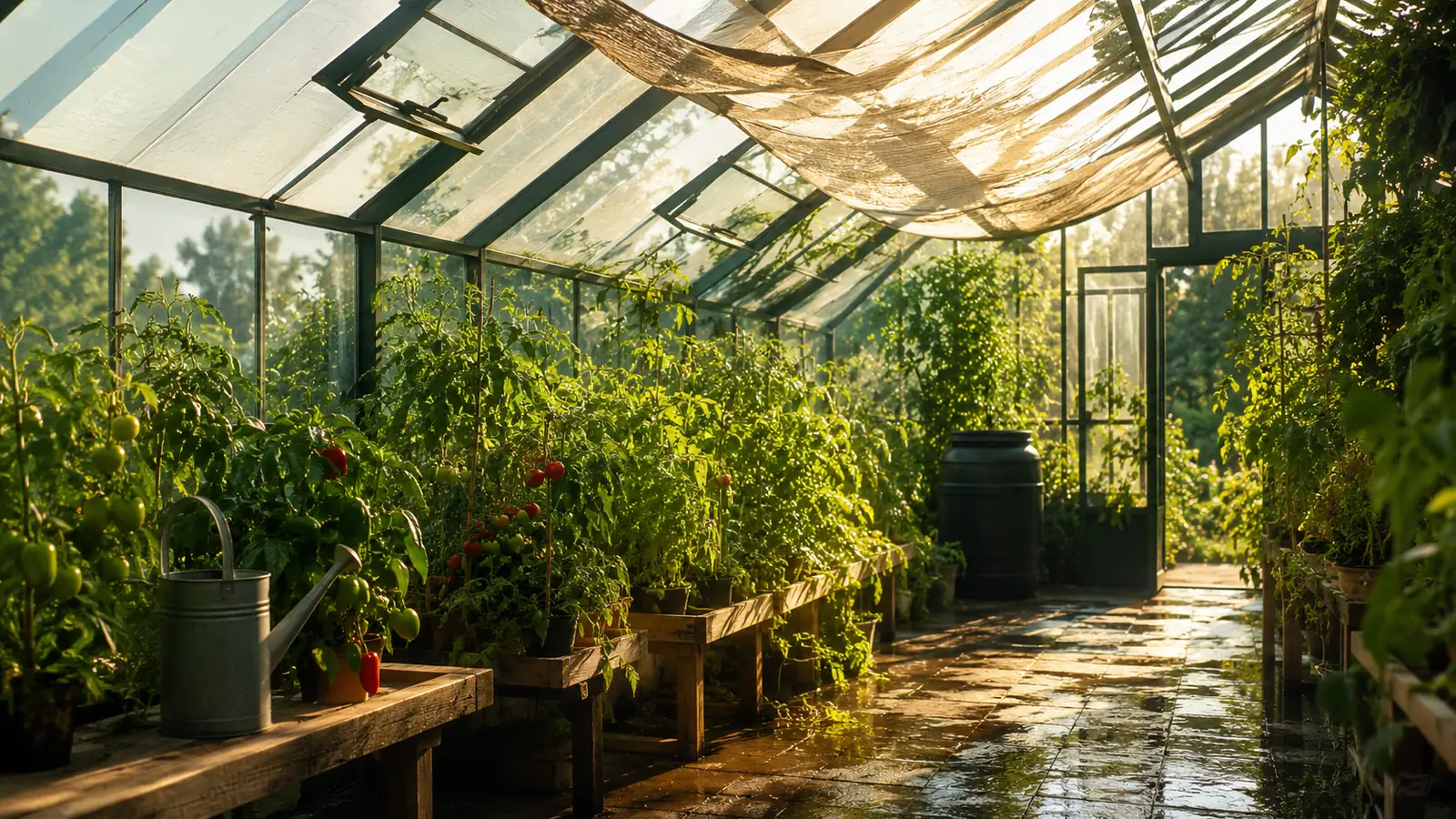
Shade the glass — this is the single biggest lever. Cutting the light coming in cuts the heat at its source, before it's trapped. In order of how well they work over a multi-day heat wave: external shade cloth or netting (30–50%) draped over the outside of the roof is the most effective because it stops the sunlight before it ever enters the glass; shade paint or "greenhouse whitewash" applied to the outside of the glass is a good seasonal option you put on once and wash off later; internal blinds or fleece are the least effective of the three because the light has already passed the glass and become heat inside before the shade intercepts it — but internal shade is still far better than none, and it's the fastest to put up in an emergency. Whatever you use, prioritise the side and roof facing the sun during the hottest part of the day.
Damp down the floor and staging. "Damping down" is the traditional greenhouse move for exactly this situation: wetting the floor, paths, and staging (not the plants) so the water evaporates and cools the air as it does, the same physics as sweat. It also lifts the humidity, which slows how fast the plants lose water through their leaves in bone-dry heat. The RHS suggests damping down at least three times a day in hot weather. It's the cheapest cooling you have.
Add thermal mass to slow the swing. Large containers of water on the floor — black barrels, buckets, anything that holds volume — absorb heat through the day and give it back slowly overnight, which flattens the peak and stops the greenhouse from swinging as violently between roasting afternoons and cold nights. It won't rescue a closed greenhouse on its own, but it takes the sharp edge off the daily spike.
Water at the roots, in the early morning, and keep the leaves dry. Same timing logic as outdoors — a morning soak gives roots hours to take up water before the peak, and the midday-watering-scorches-leaves idea is a myth here too. What is real in a greenhouse is that wet foliage in warm, humid, still air is a genuine invitation to fungal disease, so damp down the floor to cool the air but water the plants at soil level.
Don't feed or repot mid-heat-wave. A plant surviving 45°C afternoons isn't the plant you want pushing new growth, and a freshly disturbed root ball has no reserve left for a heat spike on top of transplant shock. Hold both until the weather breaks.
Three ways this plays out
The closed greenhouse on a workday
A greenhouse left shut on a morning that started mild, because the forecast only said "warm" and nobody was home to open it once the sun came round. By early afternoon the inside is past 50°C, the seedlings on the top staging are scorched, and the tomato flowers are at risk: sustained heat above roughly 32°C leaves tomato pollen sticky and nonviable, so the flowers open and simply drop. Nothing dramatic happened; the door was just shut on the one afternoon it mattered. The same greenhouse with the vents and door open from breakfast, a shade cloth over the roof, and a damped-down floor rides out the identical weather with the inside barely warmer than the shaded air outside. The plants didn't change. Whether someone opened the vents in time did everything.
The vents that opened too late
An automatic vent opener set months earlier, for spring, cracks the roof vent a few degrees open right on schedule — a setting that was perfect in April and is nowhere near enough in a July heat wave. The greenhouse still overheats because a partly-open vent on a still, blazing day can't shed heat fast enough to keep up with how quickly it's building. This is the same trap as a watering schedule set once and never revisited: a setting chosen at the moment it knew the least about the week that arrived. The fix isn't more hardware, it's checking that the settings match the weather that's coming, not the weather that was normal when you last touched them.
The fruit that stops setting before anything looks wrong
Tomatoes and peppers can look completely healthy through a heat wave, green, upright and not wilting, while quietly failing to set any fruit at all, because a few days of heat above their pollination threshold leave the pollen nonviable even while the foliage looks fine. The plant is fine; the harvest isn't. This is the greenhouse version of damage you can't see by looking, and it's the strongest argument for acting on the forecast rather than on symptoms: by the time the plant looks distressed you've usually already lost the flowers that opened during the hottest days.
What Botanical Legacy does about it
A greenhouse is a microclimate, and that's exactly the thing a general weather forecast can't see. What the Digital Shadow can do is give you the lead time — when the forecast high for your location crosses what a specific Specimen's recorded safe range can take, Botanical Legacy sends a heat wave alert for that plant by name, with the forecast high and a direct instruction to act. In a greenhouse that lead time is worth more than anywhere else, because the difference between opening the vents at breakfast and opening them at lunchtime is the difference between a normal day and a lost crop. The full mechanism behind the alert is covered in how predictive plant care works, and the heat-specific version — which signals lead, which lag, and what an app needs to catch it early — in how to monitor plant heat stress.
The other half of the answer is a sensor. Because a greenhouse routinely runs 10–20°C hotter than the outside air the forecast is describing, a modelled estimate based on regional weather is only ever a starting point under glass — a real temperature or soil-moisture reading from inside the greenhouse itself closes the gap between what the forecast says and what your plants are sitting in. Outdoors that gap is a few degrees; in a closed greenhouse it can be the whole difference between safe and lethal.
What the model can't see
The forecast describes the air over your region. It has no idea whether your greenhouse vents are open, whether you've put up shade cloth, whether the door is propped, or how hot it is under your glass right now — and in a structure that amplifies the outside temperature this much, that gap is enormous. A sensor inside the greenhouse narrows it, but even then the app can tell you a dangerous day is coming and which of your Specimens are least equipped for it; it can't open the vents for you. The heavy lifting in a heat wave — venting early, shading the glass, damping down, keeping air moving — is still hands-on greenhouse work. What the Digital Shadow gives you is the one thing a greenhouse heat wave punishes you hardest for lacking: enough warning to act before the sun comes round, not after.
Frequently asked questions
How hot can a greenhouse get in a heat wave?
A closed greenhouse in full sun can run 10–20°C hotter than the outside air, so a 35°C day outdoors can push past 50°C inside. That's well beyond the point where most plants stop growing and start taking heat damage, which is why ventilation and shading matter so much more under glass than in the open garden.
Should I open the greenhouse door and vents during a heat wave?
Yes — open the roof vents, side vents, and door wide, and do it early in the morning before the heat builds rather than once it's already hot. Roof vents matter most because trapped hot air rises and needs a way out of the top; opening only the door leaves a dome of superheated air stuck up in the roof. On a still day, add a fan to keep air moving.
What is "damping down" and does it really cool a greenhouse?
Damping down means wetting the floor, paths, and staging — not the plants — so the water evaporates and cools the air, while also raising humidity to slow how fast plants lose water. It's the cheapest greenhouse cooling there is, and in hot weather the RHS suggests doing it at least three times a day.
What's the best way to shade a greenhouse in a heat wave?
External shade — cloth or netting draped over the outside of the roof, or greenhouse shade paint on the outside of the glass — works best because it stops sunlight before it enters and becomes trapped heat. Internal blinds or fleece help but are less effective since the light has already passed the glass. Whatever you use, cover the roof and the sun-facing side first.
Why have my greenhouse tomatoes stopped setting fruit in the heat?
Several days with highs of roughly 32°C (90°F) or more, especially with warm nights, leave tomato pollen sticky and nonviable, and peppers suffer in the same way, so flowers open and drop without setting fruit even while the plant looks perfectly healthy. It's damage you can't see by looking at the leaves, and it's the main reason to cool a greenhouse based on the forecast rather than waiting for visible stress.
Can Botanical Legacy tell me how hot my greenhouse is?
Not from the forecast alone — a greenhouse is a microclimate that runs far hotter than the regional weather the model reads, so a general forecast is only a starting point under glass. The Digital Shadow gives you the lead time by sending a named heat wave alert when a plant's safe range is about to be crossed; pairing it with a temperature or soil-moisture sensor inside the greenhouse is what closes the gap between the forecast and the reality under your glass.
Start your sanctuary
Botanical Legacy's free plan covers up to five Specimens — greenhouse, windowsill, or garden — with continuous Digital Shadow modelling included. Every new account also gets a 14-day trial of the paid plan, which adds local weather, heat wave alerts, and sensor support: the layer that matters most in the one place a hot day turns dangerous fastest.
Start your sanctuary — five free specimens, no payment required →
In a heat wave, a greenhouse doesn't forgive a late start. Open it before the sun comes round, not after.
Sources
The plant-care facts on this page were checked against these references.
- Univ. of Georgia Extension B792: fieldreport.caes.uga.edu/publications/B792/greenhouses-heating-…
- Washington State Univ. Extension: extension.wsu.edu/pnw-gardeners-handbook/chapter-26-greenhouse-…
- Utah State Univ. Extension: extension.usu.edu/yardandgarden/research/extending-the-garden-s…
- Oregon State Extension EM 9556: extension.oregonstate.edu/catalog/em-9556-heat-wave-garden-how-…
- RHS greenhouse ventilation and shading: rhs.org.uk/garden-features/ventilation-and-shading-greenhouses
- Iowa State Extension, excessive heat: extension.iastate.edu/smallfarms/beat-summer-heat-protecting-yo…
- Grossiord et al. 2020, New Phytologist (PubMed): pubmed.ncbi.nlm.nih.gov/32064613
- Iowa State Extension: yardandgarden.extension.iastate.edu/faq/when-best-time-water-ga…
- Egri et al. 2010, New Phytologist (PubMed): pubmed.ncbi.nlm.nih.gov/20070538
- Univ. of Maryland Extension: extension.umd.edu/resource/expect-poor-fruit-set-tomatoes-week