Plant science · 15 min read
Predictive plant care: how a Digital Shadow learns what your plant needs before you ask
Watering reminders fire on a schedule. Predictive plant care fires when the soil actually needs it — by simulating soil moisture in real time for each individual Specimen. Here is how it works and why the difference shows up most in the plants most people kill.
Botanical Legacy · Field notes ·
The plant does not know what day it is. Predictive care is the admission that you need to catch up to that fact.
The problem with knowing it's Tuesday
The most reassuring thing a plant care app can tell you is also the least useful: water every seven days. It is a number you can plan around. It fits in a calendar. It asks nothing of you except attention on the right day. And for the plants most people kill, it is wrong far more often than it is right.
Take a fiddle-leaf fig on a seven-day reminder. In a bright room during a July heat wave, the soil can be dry by day four — the plant is transpiring hard, the pot is warm, the air is pulling moisture out faster than the schedule assumes. The reminder fires on day seven, three days late. The same plant, same pot, same shelf, in a dim and cool January: the soil is still damp on day seven because growth has slowed and evaporation has crawled. The reminder fires anyway. You water. The roots sit wet. You have just taken the first step toward the most common way an indoor plant dies.
Because that is the uncomfortable part. Overwatering kills more houseplants than underwatering does, and almost none of it is carelessness. It is people doing exactly what they were told — following a schedule one watering past the point where the plant needed it. The calendar does not know there was a heat wave. It does not know the plant moved to a shadier shelf last week. It does not know the radiator came on. It knows that it is Tuesday, and Tuesday is a watering day.
This is the ceiling every reminder-based app runs into, including the best-reviewed ones. The schedule is the product. It is set once, at the moment you add the plant, when the app knows the least it will ever know about how that specific plant behaves in your specific home. Everything after that is the calendar repeating itself, more confidently each week.
Predictive care starts from the opposite premise. The plant does not live on a calendar — it lives in a pot, in a room, in conditions that change daily. To care for it well you have to model the pot, not the date. The rest of this guide is about what that takes, and why the difference shows up most sharply in exactly the plants beginners lose.
What prediction requires
Prediction is not a guess dressed up in a progress bar. It is the continuous integration of three things, and you need all three or the model drifts.
The species baseline. A pothos and an aloe vera do not drink at the same rate, and no amount of cleverness changes that. The pothos is a tropical vine that uses water steadily; the aloe is a drought-tolerant succulent built to store it and rot if it cannot dry out. The baseline is where prediction starts — the rate at which a healthy plant of that species, in average indoor conditions, draws its pot down. Get the species wrong and everything downstream is wrong with it.
The environmental variables. Temperature, humidity, and light are not constants — they are the daily weather of your room. A plant in a warm, bright window is a different plant from the same one moved two metres back into shade, even though nothing about the pot changed. Warmer air pulls water from the soil faster. Drier air makes a plant lose water faster, and winter heating is the classic culprit. Light drives photosynthesis, and a plant photosynthesising harder drinks more. A model that ignores these is just a calendar with extra steps. This is also why a real soil-moisture sensor is so valuable: it measures the result of all these variables at once, instead of estimating them one by one.
The per-specimen history. This is the part reminder apps cannot reach. Every plant is an individual. A pot with compacted, peaty soil holds water and depletes slowly; the same species in a chunky, fast-draining mix dries noticeably faster. A root-bound plant drinks differently from a freshly repotted one. The only way to know how this particular pot behaves is to watch it over time and learn its actual depletion rate — not the species average, the real one for this exact plant on this exact shelf.
None of this is magic. Prediction is simply the act of holding those three inputs together, per plant, and updating them continuously — rather than reading them once at setup and never again. The species tells you where to start. The environment tells you what is happening this week. The history tells you how wrong the average was for this pot. Put them together and you stop guessing at intervals and start tracking moisture.
How the Digital Shadow models soil moisture
Inside Botanical Legacy, every plant you add gets a Digital Shadow — a running simulation of what is happening inside its pot, updated every night, for that specific Specimen. The number at the centre of it is a virtual soil moisture percentage. It is not a label you tick when you water; it is a value the model carries forward day by day, drawing it down as the soil dries and snapping it back up when you hydrate.
The rate it draws down starts from the species, and the gap between species is large. The model sets each plant's daily draw from how often its species needs water and how thirsty it is, then adjusts that for the pot, the soil and the room. A snake plant on a typical three-week interval, rated a drought-tolerant plant, draws down by roughly one and a half to two and a half percent a day in ordinary indoor conditions: it is built to ride out drought, and the model treats it that way. A calathea on a five-to-seven-day interval, rated a thirsty plant, draws down roughly fifteen to twenty-five percent over the same day, because it demands more water and punishes you for letting it dry out. Those are not interchangeable plants, and a single shared interval can only ever be right for one of them.
On top of the species rate, the environment modulates the daily draw. A sustained five-degree rise in temperature pushes depletion upward. A drop in humidity, the kind that arrives the week your heating comes on, pushes it up as well. Where it has readings for them, from a sensor or, on the paid plan, from local weather, the model folds these in every night, so the same plant dries faster in a hot, bright week and slower in a cool, dim one, without you touching a single setting. Without either, it assumes an ordinary room at 21°C and 50 percent humidity.
Here is the part worth sitting with: the model does not know what day it is, and it does not care. It knows the moisture level today, it knows the depletion rate, and from those two it knows when the level will cross the threshold where this plant genuinely needs water. The notification is not scheduled. It is predicted — the output of a calculation that says this pot will reach its low point in roughly two days, recomputed every night against the latest conditions. The threshold is the same for every plant, 20 percent of its virtual moisture; what separates a snake plant from a calathea is how fast each one gets there.
When you water, the simulation resets toward full and begins drawing down again, now anchored to the moment you acted rather than to a fixed cadence. Take a check-in photo and the Doctor reads growth and visible health from it; when it judges the plant stressed, its health score drops, but the watering curve keeps its pace, because a struggling plant is often overwatered rather than dry. The rate also tunes itself to the individual plant, from real moisture readings when a sensor supplies them and from waterings you keep postponing, so the estimate gets closer to the truth the longer the plant is on the platform. For the full mechanics of that nightly loop, your plant's Digital Shadow walks through it end to end.
This is the same physics-based approach used in plant care apps with sensor support — but available for every plant, not just the ones you have wired up. The simulation runs whether or not a probe is in the soil, which means prediction is the default and hardware is an upgrade, never a prerequisite.
Prediction you can watch move
Most "predictive" plant apps predict a watering date. Botanical Legacy predicts a trajectory — and now lets you see it move. Two v5 surfaces make the forecast legible:
- The live simulator. Toggle a care action and the Digital Shadow re-projects instantly — the projected vitality and moisture curves redraw from this plant's telemetry, on-device, in real time.
- Growth curves. Height, leaf count, and vitality plotted as a time-series per Specimen, appended automatically as the Shadow recomputes. The fuzzy question "is my Anthurium happy?" becomes a line you can read.
Export both in research-friendly formats (CSV, JSON) whenever you want. The forecast isn't a black box you trust — it's a model you can inspect, interrogate, and take with you.
What predictive care looks like in practice — six species
The clearest way to see the difference is to watch six plants with very different needs and notice where prediction and a fixed reminder pull apart. These are illustrative — your pot, your room, and your light all shift the exact numbers — but the shape of the behaviour holds.
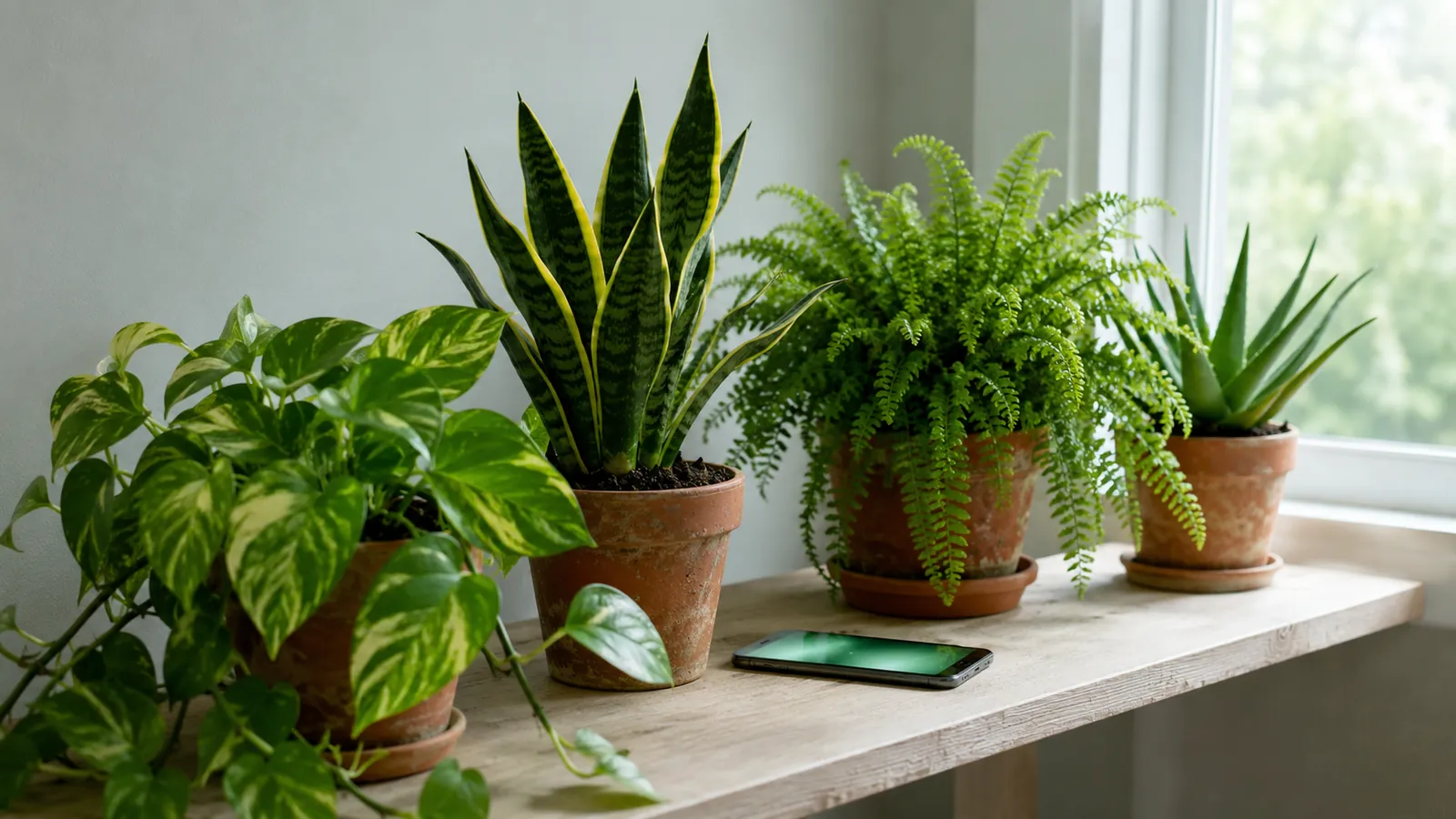
Pothos. A vigorous trailing vine that tolerates a dry spell without complaint. In summer it drinks quickly and the model fires on a short interval; in winter, as light drops and growth slows, prediction quietly stretches the interval out by a week or more. A reminder app holds the same number through both seasons and overwaters it for half the year.
Boston fern. A high-demand plant that wants its soil consistently moist and sheds fronds when it dries out. Prediction fires faster than most people expect — often well inside a week in warm, dry air — because the model knows the depletion rate is steep. A reminder app set to a comfortable weekly rhythm under-delivers, and you learn about it from crisping fronds rather than from a notification.
Aloe vera. A true succulent, and the canonical beginner casualty. Prediction's job here is restraint: it suppresses the waterings a calendar would trigger, holding off until the model is confident the soil has dried through. Aloe wants only moderate watering, and the bare minimum in winter; a fixed schedule is precisely what pushes people to give it more.
Croton. A plant whose moisture demand swings sharply with conditions — short intervals in a warm, bright window during active growth, much longer ones in a cool, dimmer season. Prediction tracks both ends of that swing as they happen. A reminder app picks one number and is wrong at whichever end of the year you are not currently in.
Snake plant. Drought-tolerant but quick to root-rot when overwatered, which makes it deceptively easy to lose. Prediction delays watering whenever the model shows moisture still adequate — which, for this plant, is most of the time. That deliberate patience is exactly the care it needs, and exactly what a calendar set to a tidy interval will not give it.
Prayer plant. Wants steady, reliable moisture and does not tolerate drying out. Prediction closes the watering window quickly because it knows the depletion rate is high, and it does not let the plant coast past its threshold. A reminder app working off a generic "tropical plant" interval misses the urgency and lets the soil go a day or two too far.
What makes each of these possible is the species data underneath. The twenty-five species guides each carry the parameters the simulation reads — the baseline intervals, the environmental sensitivities, the care cards that describe how that plant behaves. The vignettes above are those parameters playing out in a real room, on a real shelf, under your real conditions.
The role of sensors in predictive care
Predictive care works on two tiers, and it is worth being clear about what each one gives you.
Without sensors, the Digital Shadow runs entirely on simulation: the species baseline, adjusted for the pot, the soil, the light in the plant's spot where you have set it, and, on the paid plan, air conditions estimated from local weather. It fires a notification when that running estimate predicts the soil crossing the threshold for that plant. No hardware, no setup beyond adding the Specimen — and it is already meaningfully better than a fixed schedule, because it responds to conditions a calendar cannot see.
With sensors, the model stops estimating one of its hardest inputs and starts measuring it. Connect a soil-moisture probe — a Miflora, or any ESPHome-compatible device through Home Assistant — and every time it polls, the real reading anchors the virtual moisture to ground truth. That correction matters most for the things a model can only approximate: actual root density, the real behaviour of your specific soil mix, how fast this particular pot drains. The simulation keeps running in the background for when the sensor is offline or its battery dies, but whenever a real reading is available, it wins.
You can read how to connect real-time sensors to your plant care app for the hardware side, and the sensor feature page for what the integration covers and which devices it supports.
The honest framing is this: even without a sensor, prediction beats a calendar, because a simulation that watches your room is closer to the truth than a number that does not move. But if you have a plant whose soil behaves unpredictably — a chunky orchid mix, a self-watering pot, a fast-draining terracotta that dries before you expect — a sensor is how you close the last gap. It turns a good estimate into a measured fact, and it does it on exactly the plants where the estimate was always going to struggle most.
What predictive care does not do
A smart tool earns trust by being clear about its edges, so here are the model's.
It does not replace looking at your plant. The simulation tracks moisture and growth; it does not see a yellowing lower leaf, a spider mite on the underside of a frond, or a stem that has gone soft and mushy at the base. No moisture model catches those — they are read with your eyes. The guide to reading your plant's health signs is the companion to the Digital Shadow, not a substitute for it. The model tells you when to water; your attention tells you when something is wrong.
It does not know what you have not told it. Repot a plant without logging it, damage a root ball, or change the potting mix without updating the Specimen, and the model does not know until the new behaviour shows up in the data. Log the repot and set the new pot and soil, and it recalculates straight away and sets aside what it had learned about the old pot. The simulation is accurate because it tracks reality — but only the reality it can observe.
It is per-specimen, not a species lookup. This is the whole point, and it cuts both ways. A mature monstera thriving in a bright window and a young one struggling in a dim corner are the same species and nothing alike in how they drink. The model tracks the individual, not the category — which means two plants with the same name on the same account can sit on entirely different schedules, and both be correct.
None of this is hedging. It is the difference between a tool that claims to do everything and one that does a specific thing well and tells you where its job ends and yours begins.
Frequently asked questions
How is predictive plant care different from a watering reminder app?
Reminder apps set a recurring interval from a species lookup and fire on the calendar, regardless of what is happening in the soil. Predictive care simulates soil moisture for each individual Specimen, updates it continuously, and fires when the model determines the moisture level is genuinely approaching a critical threshold — not because a fixed number of days has passed.
Does predictive plant care work without sensors?
Yes. The Digital Shadow runs its simulation from species parameters and the environmental signals on your profile — temperature, humidity, and light — even when no physical sensor is connected. Adding a soil-moisture sensor makes the model significantly more accurate, because it grounds the simulation in a real reading, but the prediction is already meaningfully better than a fixed schedule without any hardware at all.
Which plants benefit most from predictive care?
Plants with highly variable moisture demand gain the most. A calathea and a prayer plant need water reliably and do not tolerate drought; a fiddle-leaf fig and a croton have sharply different summer and winter profiles. Even low-maintenance plants like a snake plant or a ZZ plant benefit, because the model suppresses the unnecessary waterings a reminder app would trigger.
How long does the Digital Shadow take to learn a Specimen's individual profile?
The simulation starts immediately from the species baseline, adjusted for the pot, soil and light you give it. From there it learns the individual plant from two things: measured dry-down, when a moisture sensor supplies readings, and waterings you postpone again and again, which tell it the plant dries more slowly than predicted. Without a sensor, expect it to stay close to the species model; with one, every real reading is another calibration point.
Can I see what the Digital Shadow is predicting for my plants?
Yes. Each Specimen's detail page shows its virtual soil moisture, the projected next-watering date, and the schedule the simulation is currently holding. The Sanctuary dashboard surfaces the plants the model considers most urgent at the top of the view, so you read your whole collection in one glance instead of one pot at a time.
Start tracking with precision
The fastest way to understand predictive care is to watch it run on a plant you already own. Add a Specimen, and from the first night the Digital Shadow begins drawing down its virtual moisture against your room's conditions; within a few watering cycles it has started to learn how that exact pot behaves. You do not configure intervals — you watch the model find them.
The 14-day trial exists for precisely this reason. Two weeks covers a watering cycle or two on most plants — enough to watch a schedule start moving off its species average, and to feel the difference between a notification that fires on a calendar and one that fires on a prediction. The per-specimen learning keeps settling well past that, and the free Observer plan carries five Specimens indefinitely, so nothing stops when the trial does. If you are still weighing your options, the honest plant care app comparison lays out where each one sits and what each one can and cannot do.
Predictive care is not a feature. It is a change in what the app is doing while you are not looking.
Sources
The plant-care facts on this page were checked against these references.
- Clemson HGIC: hgic.clemson.edu/factsheet/indoor-plants-watering
- MBG: plantfinder.mobot.org/PlantFinderDetails.aspx
- NC State Plant Toolbox: plants.ces.ncsu.edu/plants/epipremnum-aureum
- MBG: plantfinder.mobot.org/PlantFinderDetails.aspx
- MBG: plantfinder.mobot.org/PlantFinderDetails.aspx
- USGS: usgs.gov/special-topics/water-science-school/science/evapotrans…
- NC State Extension: content.ces.ncsu.edu/extension-gardener-handbook/18-plants-grow…
- Univ. Nebraska PASSEL: passel2.unl.edu/view/lesson/c242ac4fbaaf/6
- MBG: plantfinder.mobot.org/PlantFinderDetails.aspx
- MBG: plantfinder.mobot.org/PlantFinderDetails.aspx
- MBG: plantfinder.mobot.org/PlantFinderDetails.aspx
- MBG: plantfinder.mobot.org/PlantFinderDetails.aspx
- MBG: plantfinder.mobot.org/PlantFinderDetails.aspx
- MBG: plantfinder.mobot.org/PlantFinderDetails.aspx
- RHS: rhs.org.uk/plants/phalaenopsis/growing-guide