Plant care · 10 min read
Outdoor and potted plant care during a heat wave — watering, shade, and timing that work
Potted and garden plants overheat differently outdoors — the container is often as much the problem as the sun. When to actually water, how much shade helps, and the midday-watering myth worth retiring.
Botanical Legacy · Field notes ·
Watering at noon doesn't scorch a leaf. It just loses more to evaporation before it reaches the root.
The problem is the container, not just the sun
Garden beds and pots experience the same heat wave very differently, and the difference is thermal mass. A few centimetres down, garden soil is buffered by the earth around it — shaded from direct sun by neighbouring soil and roots, slow to heat and slow to cool. A pot has none of that. A small container, especially a dark plastic one, sits in full sun with thin walls on every side, and it heats through those walls directly, not just from the sun hitting the leaves above. The root zone in a dark pot can run considerably hotter than the surrounding air, often well over 10°C hotter near the container wall in full sun, and roots tolerate heat less well than shoots, so they can be suffering well before the leaves show anything is visibly wrong.
That's the reason potted and balcony plants are so often the first casualties of a heat wave even though they're technically outdoors, in the same weather as everything planted in the ground. It isn't that they're weaker plants. It's that their entire root system is living inside a small, thin-walled radiator instead of a few cubic metres of buffered earth.
Watering timing compounds the problem, and this is where one of gardening's most repeated pieces of advice turns out to be aimed at the wrong target. Watering in full midday sun does not scorch leaves — that's mostly a myth. When researchers tested it, water drops sitting on smooth, hairless leaves in summer sun caused no burn damage; only drops held above the leaf surface by waxy hairs, as on some floating ferns, could scorch it. The actual reason midday watering underperforms has nothing to do with burning and everything to do with waste: in full heat, a meaningful share of the water you apply evaporates off the soil surface before it ever reaches the root zone, so the same can of water does less good at 2pm than it would at 7am.
If you're weighing which plants to move or prioritise first, the drought-tolerant tier from our vacation guide — succulents, aloe, jade, most cacti — is the same tier that shrugs off a heat wave outdoors with the least intervention. The indoor side of a heat wave, where the mechanism is glass and airflow rather than containers, is covered in the companion guide to indoor plant care during a heat wave — and if you grow under glass, the greenhouse effect stacks on top of the container problem, covered in the greenhouse heat wave guide.
What protects outdoor and potted plants
Water early morning, not midday or late evening. Morning watering gives roots hours to take up moisture before the heat load of the day hits, and any water left on foliage dries out well before dark. Watering late at night leaves leaves wet overnight in warm, still air — good conditions for fungal problems, especially on anything already stressed. Midday watering isn't dangerous, as above, it's just inefficient: more of it evaporates before it helps.
Mulch everything you can — beds and large containers alike. A 5-7.5cm layer of organic mulch over moist soil moderates soil temperature swings and cuts surface evaporation. It's the single most effective change on this list, and it keeps working every day of the heat wave without you doing anything further.
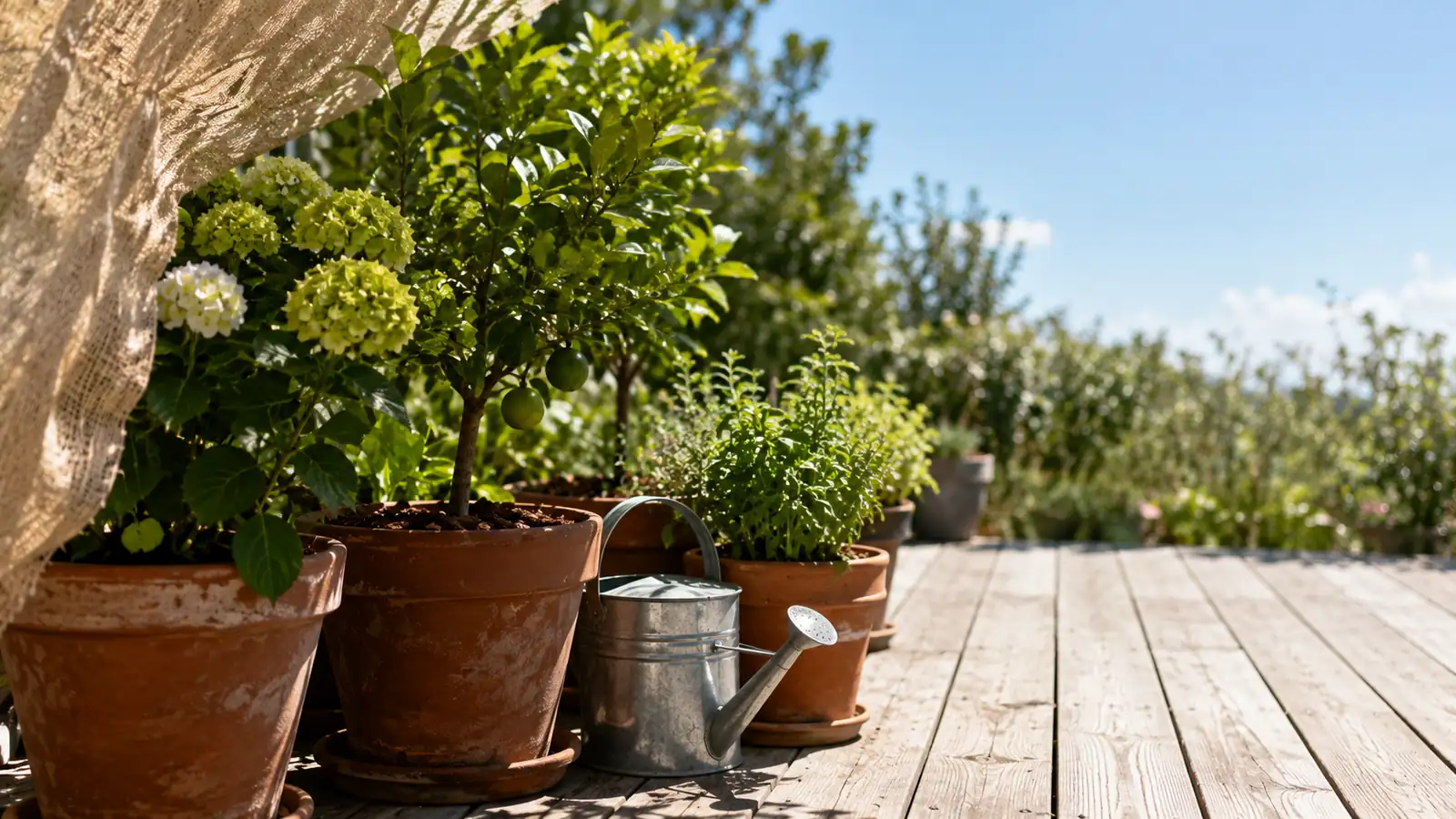
Put up temporary shade during the hottest hours. A 30–50% shade cloth draped or propped over anything not sun-adapted, for roughly the late-morning-through-mid-afternoon window, meaningfully lowers leaf and soil temperature without permanently reducing the light a plant needs the rest of the day. Temporary beats permanent here — you want it gone once the heat wave breaks.
Pay attention to pot material and colour. Light-coloured pots run cooler than dark plastic or dark glazed ceramic in full sun. If you're stuck with a dark nursery pot, slip it inside a larger, lighter decorative pot with an air gap between the two, or shade the pot itself even if the foliage stays in the sun — insulating the root zone matters as much as shading the leaves.
Group containers together. The same trick that helps humidity-loving houseplants indoors works outdoors too: clustered pots shade each other's walls and raise the local humidity in the gaps between them, both of which reduce how hard each pot has to work.
Skip the fertiliser and the repot until the heat breaks. Same logic as indoors — a plant spending its energy surviving heat isn't the plant you want pushing new growth, and a freshly disturbed root ball has no buffer left for a heat spike on top of transplant stress.
Water deeply and less often, rather than little and frequently. A deep soak encourages roots to grow down into cooler, more stable soil rather than staying shallow and dependent on a light daily sprinkle. It also builds a real reserve lower in the profile, out of the hottest surface layer, which matters most on exactly the days you need it most.
Three ways this plays out
The balcony tomatoes in black plastic pots
A row of tomatoes and herbs on a south-facing balcony, still in the black plastic pots they were bought in, hits a three-day spell above 38°C. By the second afternoon the pots are hot enough to be uncomfortable to hold, the surface soil is bone dry within hours of the morning watering, and the plants are visibly struggling by 3pm every day even though the beds one floor down in the communal garden look untouched. The same containers double-potted into lighter ceramic, mulched, and moved to catch morning-only direct sun tell a different story across the same three days — soil still damp at the surface by afternoon, no midday collapse. Nothing about the tomatoes changed. The container and its placement did all the work, in both directions.
The wilt that fixes itself by evening
Squash and tomato leaves are well known for rolling or drooping hard in early afternoon heat and standing back up on their own within a few hours — a genuine physiological response to reduce water loss while the sun is highest, not a distress signal. Watering a bed that's already moist because the 2pm droop looks alarming doesn't help the plant and can push a normally well-drained bed toward waterlogging if it happens every afternoon of a multi-day heat wave. The useful check is the same one that applies indoors: look again the next morning. A plant that's still drooping after the coolest part of the day has passed genuinely needs water. One that stood back up on its own by evening didn't need anything from you at all.
The irrigation timer that can't keep up
A drip line or sprinkler timer set weeks earlier, for a mild week, keeps firing on its old schedule straight through a heat wave that sharply speeds up how fast the same beds are drying out. Nothing fails outright — no burst pipe, no dead battery — the system just quietly stops being enough for four or five days running, and the shortfall doesn't show up until leaf damage does. This is the same blind spot that a fixed watering-reminder app has indoors, playing out in irrigation hardware instead: a schedule set once, at the moment it knew the least about the week that was coming. A system that reads the forecast and adjusts, rather than repeating last month's setting, is the difference between catching this on day one and finding out on day five.
What Botanical Legacy does about it
Specimens marked as outdoor in your Sanctuary lean on real local weather more heavily than indoor ones, because outdoor conditions genuinely swing faster and less predictably — there's no wall or window buffering anything. On the paid plan, with local weather turned on, each outdoor Specimen's Digital Shadow folds the actual forecast for your location into its nightly model, the same mechanism covered in full in how predictive plant care works, rather than relying purely on a modelled estimate.
When the forecast high crosses what a specific Specimen's recorded safe range can take, Botanical Legacy sends a heat wave alert for that plant by name, with the forecast high and a direct instruction: shade it, water it. The same alert fires for indoor and outdoor Specimens alike, but it's outdoor plants — with no walls between them and the weather — where the lead time matters most. That lead time is the whole point of monitoring plants for heat stress rather than reacting to it: catching the risk a day or two out instead of reading it off the scorch.
Outdoor conditions are also where a soil-moisture sensor pays for itself fastest. A modelled estimate is a good starting point anywhere, but outdoors, where a container can swing from comfortable to critical in an afternoon, a real reading closes the gap between estimate and reality faster than indoors, where conditions move more slowly to begin with.
What the model can't see
Weather data covers your general area, not your exact balcony or courtyard: a walled, south-facing patio with hot paving can run noticeably hotter than the nearest weather station on a still, sunny day, and the model has no way to know that without a sensor telling it directly. It also doesn't know whether you've already put up shade cloth, moved a pot into a cooler corner, or double-potted something that used to be in black plastic — those are placement decisions only you can make and only you can update. What the Digital Shadow gives you is a reliable heads-up that a heat wave is coming and which of your outdoor Specimens are least equipped for it. What you do with that heads-up — mulch, shade, move, water deeply and early — is still entirely the gardening.
Frequently asked questions
What time of day should I water outdoor plants during a heat wave?
Early morning, ideally before the heat of the day builds. Roots get hours to take up the water before peak heat arrives, and any moisture on the foliage dries out well before evening. Watering at midday isn't harmful, just less efficient — more evaporates before it reaches the roots. Watering late at night works but leaves foliage wet overnight, which favours fungal problems.
Do water droplets on leaves really cause sunburn?
Almost never, and it's one of gardening's most repeated myths. In experiments, water drops on smooth, hairless leaves in full summer sun caused no burn; only drops held above the surface by waxy leaf hairs, as on some floating ferns, did. Water in full sun if that's the only time you have; you're only losing some efficiency to evaporation, not risking the leaves.
Why do my potted plants wilt faster than the same species planted in the ground?
Containers heat up directly through their walls, especially dark plastic or ceramic in full sun, so the root zone can run considerably hotter than garden soil, which is buffered by the earth around it. The smaller the pot and the darker its colour, the faster and further it swings. Light-coloured pots, double-potting, and grouping containers together all reduce this gap.
Should I move potted plants into shade during a heat wave?
For anything not clearly sun-adapted, yes — temporary shade during the hottest few hours of the day, using cloth or a moved pot rather than a permanent structure, meaningfully lowers leaf and root-zone temperature. Drought-tolerant succulents and cacti generally don't need this and can be left where they are.
How much extra water do outdoor plants need during a heat wave?
More than usual, but "deeper and less frequent" beats "more often" — a thorough morning soak that reaches the full root zone builds a real reserve and encourages roots to grow down into cooler soil, which serves the plant better across the whole heat wave than several light daily sprinklings that only wet the surface.
Does Botanical Legacy track outdoor plants the same way as houseplants?
The same Digital Shadow model runs for both, but outdoor Specimens lean harder on your Sanctuary's local weather feature, which needs a paid plan and your location set to work. What it can't do is see your exact microclimate — a sheltered courtyard or an exposed rooftop can run noticeably different from the nearest weather station, which is exactly where a soil-moisture sensor is most valuable outdoors.
Start your sanctuary
Botanical Legacy's free plan covers up to five Specimens, indoors or out, with continuous Digital Shadow modelling included. Every new account also gets a 14-day trial of the paid plan, which adds local weather, heat wave alerts, and sensor support — the layer that matters most once the forecast turns extreme.
Start your sanctuary — five free specimens, no payment required →
The leaf that droops at 2pm and stands back up by 7 was never asking you for water. Trust it.
Sources
The plant-care facts on this page were checked against these references.
- Univ. of Kentucky Extension HO-119: publications.mgcafe.uky.edu/files/HO119.pdf
- Egri et al. 2010, New Phytologist (PubMed): pubmed.ncbi.nlm.nih.gov/20070538
- Iowa State Extension: yardandgarden.extension.iastate.edu/faq/when-best-time-water-ga…
- RHS heatwave advice: rhs.org.uk/garden-inspiration/get-gardening/what-not-to-do-in-a…
- Univ. of Kentucky, heatwave: exclusives.mgcafe.uky.edu/2024/hort/help-your-garden-weather-he…
- RHS mulches: rhs.org.uk/soil-composts-mulches/mulch
- Iowa State Extension, excessive heat: extension.iastate.edu/smallfarms/beat-summer-heat-protecting-yo…
- RHS watering containers: rhs.org.uk/container-gardening/how-to-water-containers
- RHS community heatwave tips: rhs.org.uk/get-involved/community-gardening/heatwave-tips
- Oregon State Extension EM 9556: extension.oregonstate.edu/catalog/em-9556-heat-wave-garden-how-…
- RHS, reduce water use in a heatwave: rhs.org.uk/garden-inspiration/conditions/reduce-water-use-durin…
- NC State Extension: beaufort.ces.ncsu.edu/2025/07/what-wilting-really-means-heat-st…
- Missouri Botanical Garden: *Aloe vera*: plantfinder.mobot.org/PlantFinderDetails.aspx
- Missouri Botanical Garden: *Crassula ovata*: plantfinder.mobot.org/PlantFinderDetails.aspx