Plant care · 13 min read
Plant care while you're on vacation — pre-trip prep and a house-sitter brief that works
How to keep your houseplants alive while you travel — what to do the week before you leave, the self-watering stopgaps that actually work, and how to brief a house-sitter so they don't drown everything.
Botanical Legacy · Field notes ·
More vacation plants die from a panicked sitter than from a missed watering.
Away mode - the app goes quiet, the safety net stays on
On the paid plan, turn on Away mode and pick how long you'll be gone, from three days to a month. From that day to your return date, routine water, feed, and photo reminders are not sent at all, so you're not pinged about a plant you can't reach. What stays on is the safety net: frost and heat warnings for outdoor Specimens with local weather on, salt build-up alerts from a conductivity sensor, and a warning if a sensor stops reporting, because those are the ones that matter when you're gone. When any plant needs water before you leave or during the trip, the app also builds a sitter sheet from each Specimen's Digital Shadow: what to water before you go, which plants a sitter should water on which dates and roughly how much, and what to leave alone. Share it from your phone, or print it from the web app. Away mode ends on your return date on its own; nothing to switch back.
The real risk isn't neglect — it's the wrong week
Most houseplants can coast for a week. The danger of a trip is rarely the missed drink; it is the timing. You leave on a mild Tuesday, a heat wave lands on Thursday, and a pot that would have stretched ten days is bone-dry by Saturday. Or the opposite: a well-meaning friend waters every plant "to be safe" the day they pop in, and your Snake Plant — which wanted nothing — sits in soggy soil for a fortnight and rots from the roots up.
So vacation plant care is two problems, not one. Before you leave, you reduce how much water your plants need and buy yourself a margin. While you're gone, you make sure the right plants — and only the right plants — get water at roughly the right time. Get both halves right and a two-week trip is a non-event.
This guide covers the pre-trip prep, the self-watering stopgaps that genuinely work (and the ones that don't), and how to write a house-sitter brief precise enough that an enthusiastic helper can't do harm. If you are new to all this, start with the beginner plant-care mistakes — most vacation disasters are the everyday mistakes, just amplified by your absence.
How long can houseplants survive without water?
The honest answer depends entirely on the plant, the pot, and the season. Use these as planning ranges, not guarantees. A small pot in a hot, bright room burns through its margin much faster than the same plant in a cool corner.
Two to four weeks: drought-tolerant specimens. Snake plants, ZZ plants, jade, aloe, and most cacti and succulents store water in their leaves and roots. Watered well the day before you leave, they will not notice a two-week absence — and in winter they will not notice a month. For these, the bigger risk is a sitter watering them, not you skipping it.
About a week: forgiving tropicals. Pothos, Monstera, Philodendron, Peace Lily, rubber plants, and most aroids sit comfortably in the one-week range under average indoor conditions, and in a cool room in winter they can go a week or two. A thorough pre-trip watering plus a few of the tricks below usually carries them through a week away without intervention.
Less than a week: thirsty and humidity-sensitive plants. Calatheas, Boston ferns, Marantas and indoor herbs want evenly moist compost and humid air, and suffer fast when either dries out. These are the plants that genuinely need a sitter — or a self-watering stopgap — for any trip longer than a long weekend.
If you only remember one rule: the species sets the range, but the room you leave them in decides where in that range they land. A Fiddle-leaf fig in a south-facing window in July is a different plant from the same fig in a shaded hallway in October. The full mechanism — temperature, humidity, light, and root health — is in the when-to-water guide.
The week before: prep that does most of the work
The single highest-leverage move happens before you pack. Done well, the prep below can turn a "needs a daily sitter" sanctuary into a "leave it and go" one.
Water thoroughly the morning you leave — not three days early. Soak each pot until water runs from the drainage holes, let it drain fully, and tip out any saucer water so roots aren't left standing. A pot watered the morning of departure starts your absence at 100%, not at whatever it had decayed to by mid-week.
Move plants out of direct sun. Sun and warmth drive transpiration. Pulling thirsty specimens a metre or two back from the window, or into a cooler room, slows how fast they dry out. Counterintuitively, plants do better slightly under-lit and evenly moist for two weeks than bright and bone-dry.
Group plants together. Clustering pots — especially in a bathroom or a kitchen with a tiled floor — raises the local humidity as they transpire into each other's air. A tight group of tropicals holds a noticeably more humid microclimate than the same plants scattered across the flat.
Lower the room temperature if you can. Every few degrees cooler slows water loss. If you'd normally leave heating or cooling running, a cooler (but not cold) flat is kinder to the plants. Keep it above the cold-damage threshold for tropicals — roughly 12–15°C.
Skip the fertiliser and the repot. Do not feed or repot in the week before a trip. Fertiliser pushes new growth that needs water you won't be there to give, and a freshly repotted plant is recovering, not coasting. Save both for when you're home to watch the result.
Pinch off spent blooms and dying leaves. Clear faded flowers and any already-dying leaves before you go, so a sitter isn't alarmed by normal senescence and "rescues" a healthy plant.
Self-watering stopgaps: what works and what doesn't
If no sitter is available, these are the unattended options, roughly best to worst.
Self-watering pots and reservoirs — best for long trips. A pot with a built-in reservoir lets the plant take up water as it needs it, which is exactly the behaviour you want. They suit plants that like to stay moist all year, so they work best as a permanent home for thirsty plants when you travel often without a sitter. Set one up well before a trip so you can confirm the wicking rate before you rely on it.
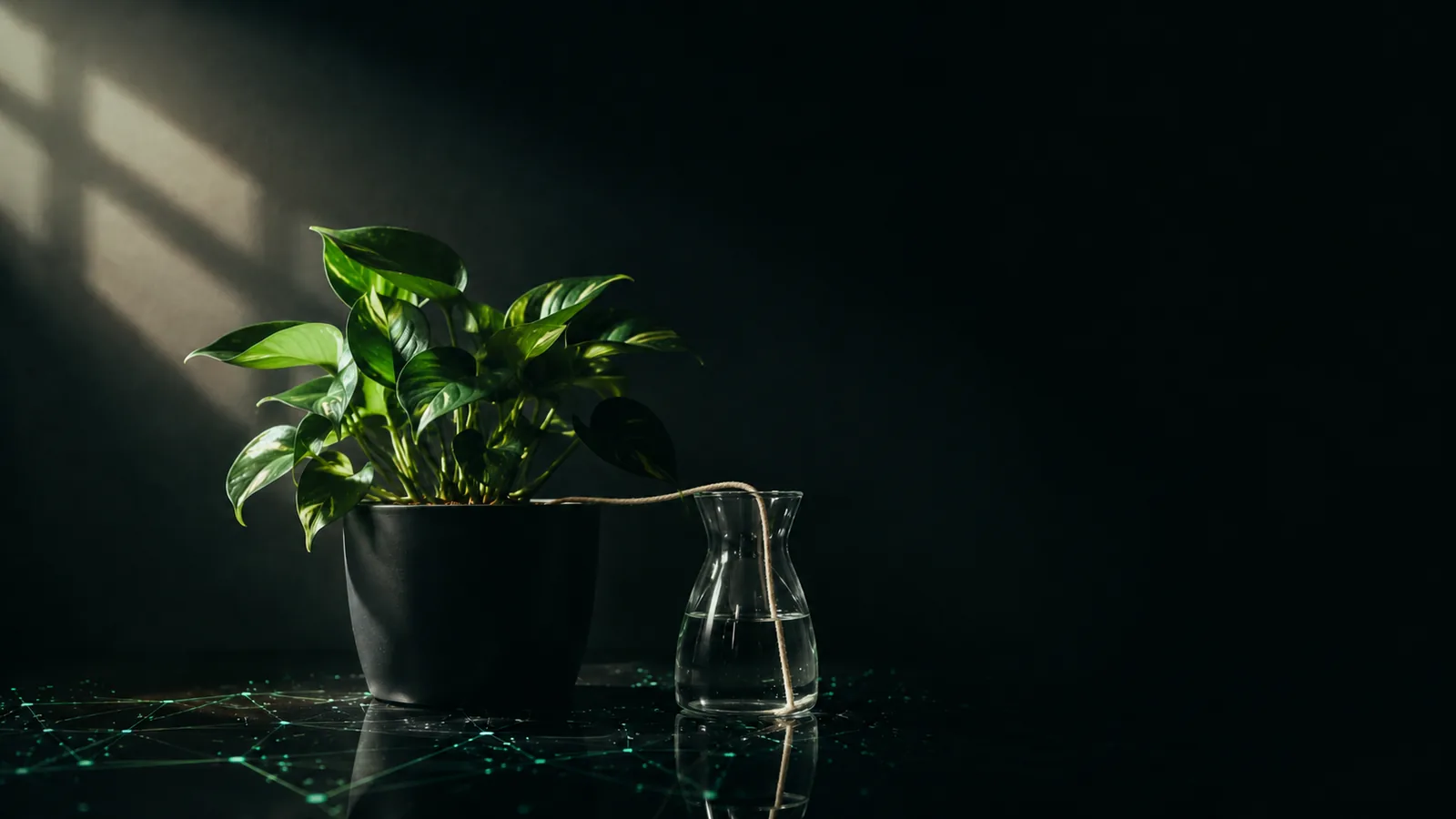
The wick method — reliable and cheap. Run a cotton cord, or a strip of capillary matting, from a jug of water into the soil. Capillary action keeps drawing water into the soil as it dries. Test it for two or three days before you leave: the soil should stay evenly moist, not soaked. One jug can feed several pots with one wick each.
The bathtub-and-towel trick — good for a cluster. Lay a wet towel in a bathtub or sink, set well-drained pots (no saucers) on it, and leave a few centimetres of water under the towel. The pots wick moisture through their drainage holes. It buys a group of moderate drinkers about an extra week. Keep the room light, but out of direct sun.
Hydrospikes and bottle stakes — short trips only. Terracotta spikes attached to a water bottle, or an upturned filled bottle pushed into the soil, are hard to regulate and are not among the methods horticultural advisers recommend. Test one for a few days first. Fine for a long weekend; unproven for two weeks.
Plastic-bag "greenhouses" — use with caution. A clear bag over a plant traps humidity and slows water loss, for about a week. It also traps heat, and in sun it warms up like a greenhouse, while still, humid air invites grey mould. Keep the bag off the leaves, use it for short trips only, and never in a sunny window.
Whatever you choose, test it before you trust it. The failure mode is always the same — a method that looked fine on day one had emptied or clogged by day four. Set it up early and watch it work.
If you have a house-sitter: write a brief they can't get wrong
A sitter is the best option for a long trip — but only if you remove the guesswork. The classic sitter failure is overwatering: faced with a dozen unfamiliar plants and no instructions, a kind person waters everything on every visit. The result is the soggy-soil root rot covered in the overwatering vs. underwatering guide. Your job is to make "water everything" impossible.
A brief that works has five parts:
1. A do-not-water list. Name the succulents and cacti explicitly: "The Snake Plant, the ZZ, and the three on the windowsill — do not water these at all. They are fine." This one line prevents most sitter disasters.
2. A dated water-this list. For the plants that will come due, give names and rough dates, not a vague "water the others." "Water the fern and the Calathea on the 8th and again on the 15th — until water runs out the bottom, then empty the saucer." Specific beats generous every time.
3. The check, in one sentence. Teach the finger test so the sitter waters on the soil, not the calendar: "Push a finger in two knuckles deep. Dry = water. Damp = leave it."
4. What to ignore. Tell them which signs are normal so they don't intervene. "A drooping Peace Lily perks up after watering. A few yellow lower leaves are normal." The plant-health-signs guide is worth sharing for anything that looks genuinely wrong.
5. One emergency rule and a contact. "If in doubt, do nothing and text me a photo." Under-watering is recoverable; over-watering often isn't. A confused sitter who does nothing will return your plants in better shape than one who improvises.
Print it, or text it as a list with photos of each named plant. The clearer the brief, the less your sitter has to guess — and guessing is where plants die.
How Botanical Legacy makes the handoff precise
The hardest part of a sitter brief is the dated list — which plants will need water on which days of your specific trip. Guess wrong and you've either left a plant to dry or told the sitter to water something that didn't need it. This is the gap a Digital Shadow closes.
Botanical Legacy runs a continuously updating model of each specimen you own — estimating soil moisture from the conditions that plant is living in, and projecting its next watering date. Before you leave, you can scan your sanctuary and see, per plant, when the next drink falls. The plants whose next date lands inside your travel window are exactly the ones that go on the sitter's dated list; everything else is a "leave it alone." No more guessing which is which.
For Guardians on the paid plan, Away mode handles the other half: your phone. Turn it on before you fly and routine Hydrate, Nourish, and Photo reminders stop for the length of the trip, so two weeks away isn't two weeks of notifications you can't act on. They are skipped, not saved up. The Digital Shadow keeps modelling the whole time, so when you're home the reminders pick up from each plant's current state instead of replaying a fortnight of stale ones. The paid plan also folds in local weather, so if that heat wave does land, the model already saw it coming — the predictive side is covered in the predictive plant care guide. And if you run soil-moisture sensors, a remote glance at a live reading beats any sitter's finger test.
You don't get a "share with my sitter" account — and you don't need one. The Shadow's job is to make your brief correct: a short, dated, confident list instead of a hopeful "water them sometime." See how the per-plant view looks in the platform preview, no account required.
When you get home: don't drown the welcome
The instinct on return is to water everything generously. Resist it — that's how a trip the plants survived turns into root rot the week after.
Check soil before you pour. Lift each pot or push a finger in; water only what reads dry. A plant that coasted on a wick or a cool room may still be perfectly moist. Plants that did dry out should be rewetted thoroughly: water slowly until it drains from the base, or stand the pot in a few centimetres of water until the surface turns damp, rather than dumping a litre and walking away.
Give everything a few days to readjust before you resume feeding or move plants back into bright windows. A little droop or a couple of yellow leaves after two weeks is normal and recovers fast. Anything that looks genuinely wrong, work through the overwatering vs. underwatering guide before reaching for the watering can — the fix for a sad plant is more often less water than more.
Frequently asked questions
How long can houseplants go without water while I'm on vacation?
It depends on the plant. Succulents, cacti, snake plants, and ZZ plants handle two to four weeks easily, especially in winter. Forgiving tropicals like Pothos, Monstera, and Peace Lily sit comfortably around a week. Thirsty or humidity-sensitive plants, such as ferns, Calatheas and herbs, need water or a self-watering setup within a week. A thorough watering the morning you leave, plants pulled out of direct sun, and grouping pots together all extend these ranges.
What's the best way to water plants while away for two weeks?
For a two-week trip, the most reliable unattended options are a self-watering pot with a reservoir or the wick method: a cotton cord running from a water jug into the soil, which keeps drawing water in as the soil dries. The bathtub-and-towel trick works for a cluster of moderate drinkers. Whatever you choose, set it up several days early and confirm it's keeping the soil evenly moist before you rely on it. For thirsty plants, a house-sitter with a clear, dated brief beats any gadget.
How do I tell a house-sitter which plants to water?
Give them three lists, not a vague "water the plants." First, a do-not-water list naming every succulent and cactus explicitly. Second, a dated list of which plants to water and roughly when. Third, the finger test in one sentence — dry soil two knuckles deep means water, damp means leave it. Add an emergency rule: "if in doubt, do nothing and text me a photo." Under-watering is recoverable; over-watering usually isn't, so a sitter who does too little is safer than one who does too much.
Should I water my plants right before I leave or a few days before?
Water thoroughly the morning you leave, not days ahead. Watering early just means the pots start your absence already partway dried out. Soak each pot until water runs from the drainage holes, let it drain completely, and empty any saucer so roots aren't left standing in water — standing water for two weeks causes rot. Skip fertiliser and repotting in the week before a trip; both push the plant to do work it needs you there to support.
Can a plant care app help with vacation plant care?
It helps most with the planning. Because Botanical Legacy's Digital Shadow projects each plant's next watering date, you can see before you leave exactly which specimens will come due during your travel dates — which turns a guessed sitter list into a precise, dated one. On the paid plan, Away mode pauses routine reminders while you're away so your phone stays quiet, while the model keeps tracking in the background and frost, heat, salt build-up, and sensor alerts still reach you. The deeper explanation of how the model works is in the Digital Shadow guide.
Start your sanctuary
Botanical Legacy's free Observer plan covers up to five Specimens, each with its own Digital Shadow recalculated every night, enough to know before any trip which plants will need water while you're gone. Every new account also gets a 14-day trial of Cultivator, the paid plan, which adds Away mode and its sitter sheet, local weather data, and sensor support via Home Assistant.
Start your sanctuary — five free specimens, no payment required →
A plant that coasted through your holiday doesn't need a welcome-home flood. Check the soil first.
Sources
The plant-care facts on this page were checked against these references.
- RHS holiday care: rhs.org.uk/plants/types/houseplants/holiday-care
- MBG snake plant: plantfinder.mobot.org/PlantFinderDetails.aspx
- RHS: how plants lose water: rhs.org.uk/advice/understanding-plants/how-plants-lose-water
- UF/IFAS ZZ plant: gardeningsolutions.ifas.ufl.edu/plants/houseplants/zz-plant
- UConn Extension: homegarden.cahnr.uconn.edu/2024/03/28/sensational-sansevieria
- RHS calathea: rhs.org.uk/plants/calathea/growing-guide
- Nebraska Extension: lancaster.unl.edu/houseplants-humidity
- RHS houseplants: rhs.org.uk/plants/types/houseplants/growing-guide
- UF/IFAS vacation plant care: gardeningsolutions.ifas.ufl.edu/design/outdoor-living/vacation-…
- Iowa State Extension: yardandgarden.extension.iastate.edu/faq/air-our-home-extremely-…
- UF/IFAS EP101: ask.ifas.ufl.edu/publication/EP101
- Illinois Extension: extension.illinois.edu/houseplants/care
- NC State Extension, Pender County: pender.ces.ncsu.edu/2022/02/how-to-save-your-houseplants-while-…
- RHS grey mould: rhs.org.uk/disease/grey-mould
- University of Missouri IPM: ipm.missouri.edu/MEG/2016/11/Houseplant_Acclimatization
- Illinois Extension: watering: extension.illinois.edu/houseplants/watering
- University of Maryland Extension: extension.umd.edu/resource/watering-indoor-plants
- UF/IFAS EP161: ask.ifas.ufl.edu/publication/EP161