Plant care · 13 min read
Indoor plant care during a heat wave — what actually protects your plants
A heat wave indoors is a window problem before it's a weather problem. What actually protects houseplants when the temperature spikes — and the panic-watering mistake that does more damage than the heat itself.
Botanical Legacy · Field notes ·
Indoors, a heat wave is not the outside temperature. It's what your windows do to the outside temperature.
The problem is your windowsill, not the weather report
A heat wave forecast says 35°C. Your living room, with the blinds half-drawn and a bit of airflow, probably never gets close to that — most homes buffer outdoor extremes considerably, more if you have air conditioning running. But the specific patch of windowsill sitting in direct, glass-filtered sun tells a completely different story, and it's the story that matters to the plant sitting on it.
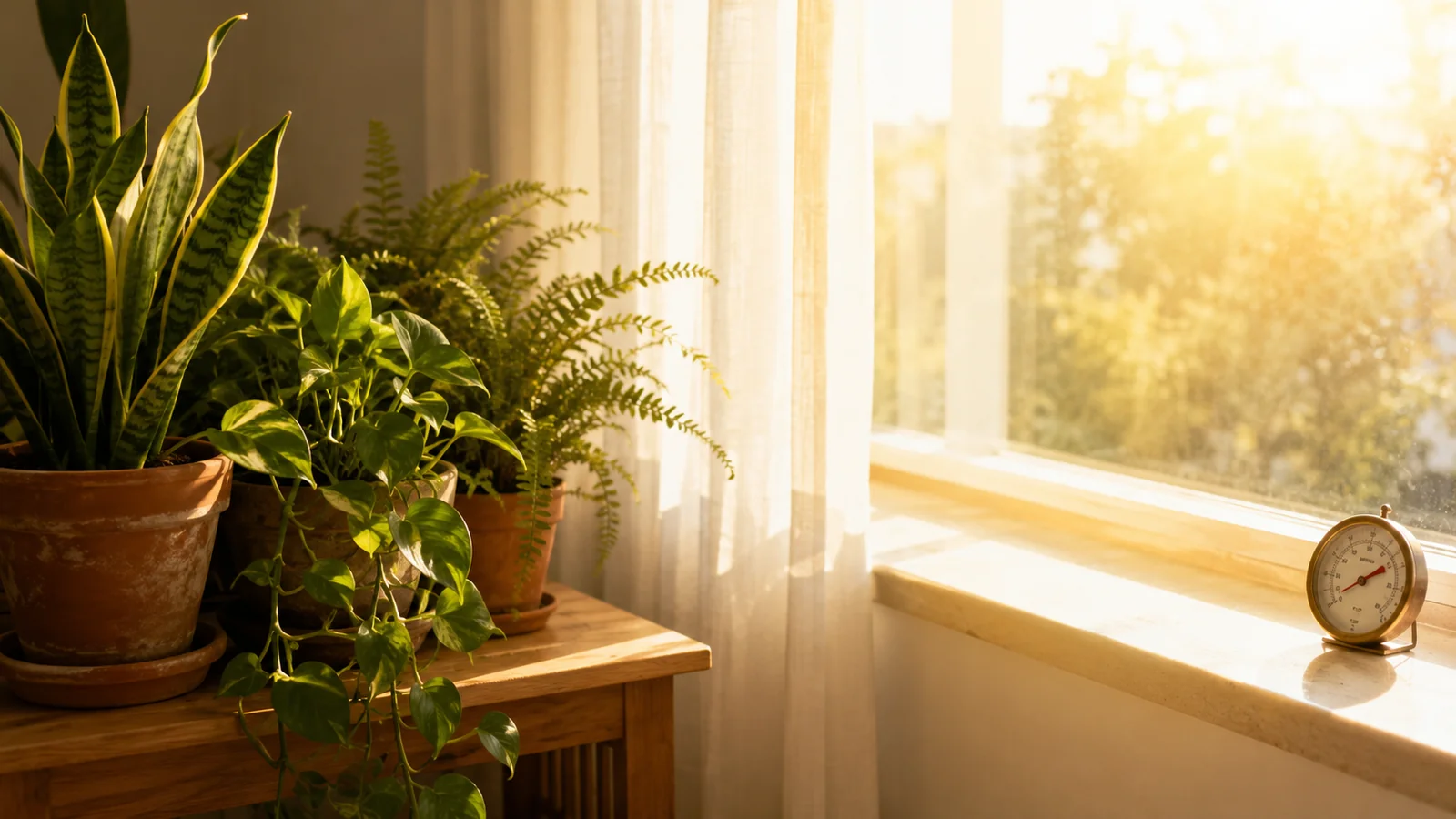
Glass lets short-wave sunlight in freely and then traps a large share of the infrared heat that tries to radiate back out: the same greenhouse effect that heats a parked car in the sun (most of the rise comes within the first half hour), playing out in miniature on your windowsill. A pot sitting in direct sun through glass on a hot day can run its soil and leaf surface considerably hotter than the room's air temperature, because direct sunlight, not the air, is doing most of the heating. This is why the plant that struggles hardest in a heat wave usually isn't the one in the warmest room by the thermostat — it's the one fifteen centimetres from south-facing glass that was perfectly content there in April.
Air conditioning adds a second, purely indoor stress. A vent blasting cold, bone-dry air directly onto foliage trades one problem for another: the leaves facing the vent dry out and can yellow or brown at the edges, while the pot itself is still losing water to the general heat everywhere else in the room. Neither the sun nor the AC is doing anything wrong on its own — the trouble is a plant caught between two extremes with no say in either.
If you're newer to indoor plant care generally, the mistakes that catch every beginner are worth reading first — most heat-wave disasters are the ordinary mistakes, just compressed into fewer days to notice them. If your Sanctuary also stretches onto a balcony or patio, the outdoor side of a heat wave runs on different physics entirely, covered in the companion guide to outdoor and potted plant care — and if you grow under glass, the greenhouse guide covers the one place a hot day turns dangerous fastest.
What helps when the temperature spikes
Move plants back from the glass, even a little. Moving the pot back far enough to take it out of the direct beam cuts the radiant heat while keeping the plant in bright, indirect light. You're not chasing shade; you're getting the pot out of the direct beam during the hottest stretch of the day, which for most south- or west-facing windows falls somewhere in the late morning through mid-afternoon.
Diffuse the light rather than blocking it. A sheer curtain or angled blinds cut the direct radiant load substantially without starving the plant of the brightness it still needs. Full blackout defeats the point — the plant still has to photosynthesise through this.
Expect humidity to fall even if you haven't changed anything. Hot air holds far more moisture than cool air, so relative humidity often crashes during a heat wave even when the absolute moisture in the room hasn't moved — and air conditioning actively pulls moisture out on top of that. Grouping pots together, or setting them on a pebble tray, raises the local humidity in the few centimetres of air around the leaves, which is the only air that matters to the plant.
Check the soil by touch, not by the calendar. During a heat wave, a plant on a comfortable weekly rhythm can be functionally dry by day three or four — heat and bright light compound each other, and depletion doesn't wait for your usual watering day. When to water covers the finger test in detail; during a heat wave, run it daily on anything in direct or bright light instead of weekly.
Hold off on fertiliser until the heat breaks. Roots take up nutrients less readily in hot, dry spells, so extra feed mostly adds to the salts building up in the pot, and a plant spending its energy surviving heat isn't the plant you want to push into new growth. Skip a feeding rather than force one.
Use a fan for air movement, not a fan pointed at the leaves. Gentle circulation keeps warm, stale air from pooling around the leaves. A direct blast of air on the foliage is a draught, and draughts dry and damage leaves.
How to adjust your indoor watering routine for potted plants
The instinct during a heat wave is to add a watering day. The better move is to stop running the routine on days at all — because what changed isn't the calendar, it's how fast each individual pot is now losing water, and that varies enormously from pot to pot inside a single room.
Indoors, the pot is doing more of the work than the weather is. A small terracotta pot sitting in a bright window can go from watered to bone-dry in two days during a spike. The same species in a large glazed pot two metres back from that same window can hold moisture for a week and need nothing at all. Both plants are in the same heat wave. Only one of them has a watering problem. A blanket "water everything two days early" gets the first one right by luck and waterlogs the second one on purpose.
So the adjustment is per pot, and it runs on three questions:
- How much direct light does this pot catch? Sun through glass is the biggest accelerator indoors — considerably bigger than the room's air temperature. The pots sitting in the beam are the ones whose intervals collapse. The pots across the room mostly carry on as they were.
- What is the pot made of, and how big is it? Terracotta is porous and dries out quickly; glazed ceramic and plastic hold moisture longer. Small pots hold a smaller reservoir and buffer less heat. Small-and-terracotta is the fastest-drying combination in the house, and the first to genuinely need a shorter interval.
- Is the soil dry right now, two knuckles down? This one overrides the other two. Every indoor heat-wave watering decision should end here rather than in a schedule.
The practical shape: keep your normal interval as the default, check the fast-drying pots daily rather than weekly, and let the finger test — not the forecast — decide each one on the day. When the heat breaks, the intervals return on their own. You never have to unwind anything, because you never changed the schedule; you only changed how often you looked.
The failure mode worth naming is the mirror of the panic-water below: staying on a heat-wave rhythm for a fortnight after the heat has passed, and slowly rotting every slow-drying pot in the house. If your plants also live on a balcony or patio, the container maths outdoors is different enough to be its own guide — outdoor and potted plant care in a heat wave covers why a pot outdoors behaves like a radiator rather than a reservoir.
Three ways this plays out
The fiddle-leaf fig two steps from the glass
Day one of a heat wave, the plant looks exactly as it did last week. By day three, the leaves closest to the pane show a faint bleached patch at the edge nearest the glass — localised, not spread evenly across the plant, which is the tell that separates heat scorch from a watering problem. Checked by finger, the soil is dry two knuckles down, four days before its usual watering day. The same fiddle-leaf fig pulled back fifty centimetres on day one shows none of this: leaves fine throughout, soil still holding moisture on the same date. Nothing else about the plant's week changed. The distance from the glass was the entire difference.
The panic-water reflex
Day two of the heat wave, someone comes home to a Peace Lily or Monstera with leaves visibly drooping and reaches straight for a full watering can — on top of soil that's still moist from three days ago. Drooping in heat is very often the plant's own defence, temporarily wilting or cupping its leaves to reduce the surface area exposed to light and heat, and it's usually reversible: the same plant often stands back up by evening, once the room cools. Watering on top of already-damp soil doesn't fix a heat problem — it adds a second one, waterlogged roots, on top of a plant that's already under stress. That combination is a common way a plant that would have simply recovered by dinner instead spends the next two weeks nursing root rot. The fix is the same discipline that saves a vacation house-sitter from the same mistake: check the soil before you add water, every time, no exceptions for how dramatic the leaves look. Reading what a wilting leaf is telling you is worth a proper read if this is a recurring source of anxiety.
The air conditioning that fails overnight
A compressor gives out, or a fuse trips, on night two of a five-day heat wave — and by morning a room that was a comfortable 24°C is pushing past 32°C with no airflow at all. The plants nearest the window take the compounding hit: heat, plus whatever residual glass exposure they still had. This is the scenario where the fastest-drying, most humidity-sensitive Specimens — ferns, calatheas, prayer plants, the same "three to six day" tier flagged in the vacation guide — need to move first, away from every window, into whichever room in the house is coolest, even if that's a windowless bathroom for a day or two. Snake plants, ZZ plants, and other succulents can simply wait it out where they are.
What Botanical Legacy does about it
Every Specimen's Digital Shadow already accounts for temperature in its nightly update — that's not a heat-wave-specific feature, it's the same model that quietly stretches a Monstera's schedule in a cool December and shortens it in a hot July, described in full in how predictive plant care works. On the paid plan, with local weather turned on, the model pulls the actual forecast for your location — not a generic seasonal average — and folds it into that night's calculation. A plant that would ordinarily coast for another four days gets its schedule pulled forward the moment the forecast turns hot, before you'd have noticed anything from looking at it.
When the forecast crosses into territory a specific Specimen's recorded safe range doesn't cover, Botanical Legacy sends a heat wave alert naming that plant, the forecast high, and what to do about it: give it shade, give it extra water. It's deliberately blunt. A heat wave isn't the moment for a nuanced notification — it's the moment for a plant's name and an instruction you can act on in ten seconds.
If you've got a soil-moisture sensor in the pot, this is where it earns its keep fastest. A heat wave is exactly the scenario where the gap between a modelled estimate and the plant's actual soil can open quickest, and a real reading closes that gap the moment it's polled. How to connect a sensor and what a sensor-backed Sanctuary looks like day to day cover the setup if you don't have one yet.
What the model can't see
The Digital Shadow works from your Sanctuary's location weather and each Specimen's recorded temperature range — it does not know your blinds are open, that your armchair blocks half the window, or that one particular pane runs hotter than the rest of the room because of the angle it catches the afternoon sun. That judgment is still yours to make. The model tells you a heat wave is coming and which of your plants are least equipped for it; it doesn't know which exact windowsill in your flat is secretly the hottest spot in the building. It also can't tell heat-wilt from thirst-wilt on sight the way your eyes can — which is exactly why learning to read the plant itself still matters, model or no model.
Frequently asked questions
Should I water my indoor plants more during a heat wave?
Often, but check before you assume. Heat and bright light both speed up how fast a pot dries, so plants in direct or bright light may need water well ahead of their usual schedule. Plants that are shaded, back from windows, or naturally drought-tolerant may need no change at all. Test the soil with a finger two knuckles deep rather than watering on a hunch — the when-to-water guide covers the full test.
Why is my plant drooping in the heat if the soil is still moist?
Drooping and leaf-cupping are often a defensive response to heat and bright light, not a sign of thirst: the plant is temporarily reducing the surface area exposed to sun and heat, and it commonly straightens back out by evening or the next morning, once conditions cool. If the soil tests moist, the drooping usually isn't a watering problem. Watch whether it recovers by evening before doing anything.
Can sunlight through a window really damage houseplants during a heat wave?
Yes, though it shows up as localised scorch — a bleached or crisped patch on the leaf area closest to the glass — rather than damage across the whole plant. That localisation is the useful diagnostic: heat scorch stays where the direct beam hits; a watering problem tends to show up more evenly across the plant.
Should I move plants away from the air conditioning during a heat wave?
Keep them out of the direct airflow from a vent, yes — the combination of cold and very dry air stresses the leaves it hits directly. The room being air-conditioned generally is a benefit, not a problem; it's the direct blast on the foliage that causes trouble, not the cooler air in the room overall.
Does Botanical Legacy know when a heat wave is coming?
For Specimens with local weather turned on — a paid-plan feature that needs your Sanctuary's location set — yes, and the alert names the specific plant at risk against the actual forecast. Without weather enabled, the Digital Shadow still responds to temperature through your check-in photos and care history, just without the few days of advance warning the forecast provides.
Is there an app that monitors plants for heat stress?
Yes — and the full version of that answer, including which signals to watch and which lag too far to be useful, is in our guide on how to monitor plant heat stress. In short, it works in two senses, and a useful app covers both. Watching the environment: Botanical Legacy folds your local heat forecast into each Specimen's Digital Shadow every night, so an approaching hot spell flags the specific plants least equipped for it and pulls their watering forward before any leaf changes — and a soil or temperature sensor in the pot anchors that to real readings instead of an estimate. Watching the plant: a check-in photo lets Botanical Vision pick up early heat-stress signs — scorch, leaf curl, drying margins — and fold them back into the model. What no app does is replace your own eyes: it can't tell heat-wilt from thirst-wilt on a plant it hasn't seen a photo of. A good app narrows the guesswork and warns you earlier; it doesn't remove the need to look.
Should I mist my indoor plants during a heat wave?
It's not the fix people hope it is. A misting gives a brief humidity bump around the leaf that fades within minutes. For plants that genuinely want higher humidity, grouping pots or a pebble tray does far more with far less effort. Misting isn't harmful, but don't let it stand in for checking the soil.
Start your sanctuary
Botanical Legacy's free plan covers up to five Specimens with continuous Digital Shadow modelling included, so you can see how a heat wave is affecting your plants' schedules before the leaves tell you the hard way. Every new account also gets a 14-day trial of the paid plan, which adds local weather, heat wave alerts, and sensor support.
Start your sanctuary — five free specimens, no payment required →
Most of what a heat wave asks of a houseplant is shade, not water. Give it that first.
Sources
The plant-care facts on this page were checked against these references.
- Univ. of Georgia Extension B792: fieldreport.caes.uga.edu/publications/B792/greenhouses-heating-…
- McLaren et al. 2005, Pediatrics (PubMed): pubmed.ncbi.nlm.nih.gov/15995010
- Univ. of Kentucky Extension HO-119: publications.mgcafe.uky.edu/files/HO119.pdf
- RHS, helping a poorly houseplant: rhs.org.uk/plants/types/houseplants/how-to-help-a-poorly-housep…
- Univ. of Maryland Extension: extension.umd.edu/resource/temperature-and-humidity-indoor-plan…
- Illinois Extension: extension.illinois.edu/houseplants/care
- Pacific Northwest National Laboratory: pnnl.gov/news-media/efficient-dehumidifier-makes-air-conditioni…
- US National Weather Service: weather.gov/lmk/humidity
- Univ. of Wisconsin Extension, Boston fern: hort.extension.wisc.edu/articles/boston-fern-nephrolepis-exalta…
- NC State Extension, *Goeppertia roseopicta*: plants.ces.ncsu.edu/plants/goeppertia-roseopicta
- RHS watering containers: rhs.org.uk/container-gardening/how-to-water-containers
- RHS heatwave advice: rhs.org.uk/garden-inspiration/get-gardening/what-not-to-do-in-a…
- Univ. of Kentucky, heatwave: exclusives.mgcafe.uky.edu/2024/hort/help-your-garden-weather-he…
- NC State Extension: beaufort.ces.ncsu.edu/2025/07/what-wilting-really-means-heat-st…
- NC State Extension, *Maranta leuconeura*: plants.ces.ncsu.edu/plants/maranta-leuconeura
- NC State Extension, *Dracaena trifasciata*: plants.ces.ncsu.edu/plants/dracaena-trifasciata
- NC State Extension, *Zamioculcas zamiifolia*: plants.ces.ncsu.edu/plants/zamioculcas-zamiifolia
- Penn State Extension: extension.psu.edu/humidity-and-houseplants