Plant care · 13 min read
How to start a vegetable garden in spring - the beginner's guide to site, soil and timing
Starting a vegetable garden from scratch comes down to three decisions: a sunny site, soil that is ready to work, and two spring start dates instead of one. What to plant first, the basic tools, and the best time to water.
Botanical Legacy · Field notes ·
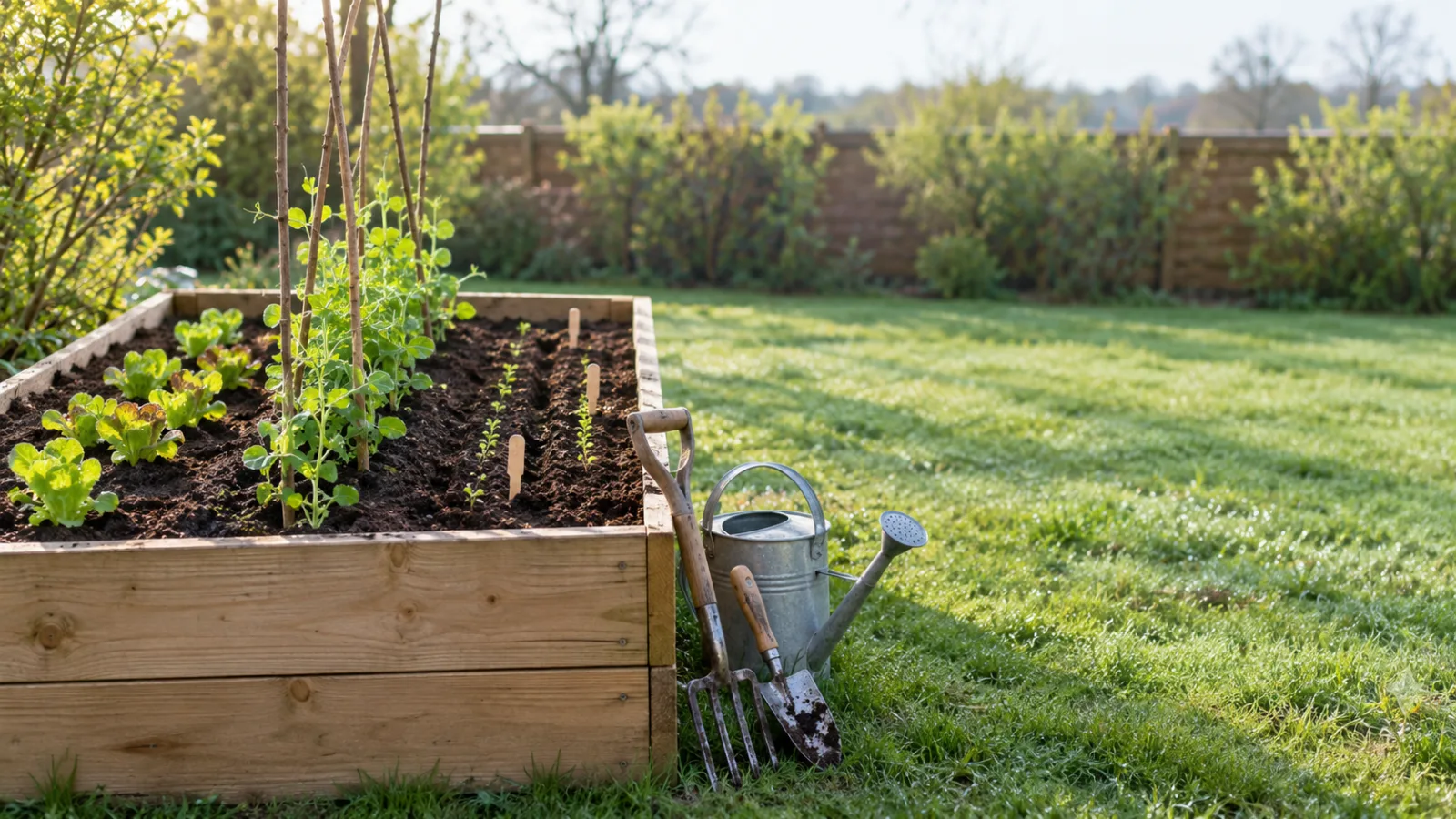
The first warm weekend of spring is the right day to dig a bed and sow peas. It is the wrong day to plant a tomato.
Spring has two start dates, not one
Most first vegetable gardens are planted on a single day: the first warm, bright weekend, when the garden centre fills with tomato plants and everything feels possible. Half of what goes in that day is early. The other half could have gone in weeks before.
The reason is that vegetables split into two groups with different relationships to cold. Hardy, cool-season crops - peas, lettuce, spinach, radishes, onions - are tough enough to be sown outdoors two to four weeks before the average last frost. Tender, warm-season crops - tomatoes, peppers, courgettes, cucumbers, French and runner beans, sweetcorn - are damaged by frost, so they wait until after it. Beans, sweetcorn, courgettes and cucumbers can go in around the last frost date; tomatoes and peppers do better a couple of weeks later, once nights stay above about 10°C. Colder nights than that can cause chilling injury.
The first warm weekend misleads for a second reason: soil warms far more slowly than air. A run of sunny afternoons says little about the soil a hand's depth down, or about the clear night that follows. Most seeds won't germinate in soil below about 7°C, and warm-season seeds want much more - French beans, courgettes and cucumbers around 16°C. Sown into cold, wet soil, they come up slowly or rot before they come up at all.
So the date that matters is your average last frost date, and the word to notice is average. It is a median, the middle of the range: in about half of years the last frost comes later. Frost tables also give a cautious date, the one with only a 10% chance of a frost after it, which you would expect to be wrong about one year in ten. In the UK, the RHS reckons the last frost usually comes two to four weeks before it is safe to plant tender crops out.
A beginner who learns that one rule has avoided the most common way a first vegetable garden fails in its first month. Everything else in this guide is about getting the site and the soil ready, so that when each date arrives, the plants have somewhere good to go.
What to do
Pick the sunniest spot you have, then start small. Vegetables need at least six hours of direct sun a day, and eight to ten is better, so watch where the sun falls for a whole day before you choose. Fruiting crops such as tomatoes and peppers need the most; lettuce, spinach, peas and radishes cope with some shade. Size matters as much as position: one bed, or a few large containers on a patio, is a garden you can keep watered and weeded in a busy week. A bed about 1.2m wide can be reached from both sides without treading on the soil, which keeps it from being compacted. Containers for most vegetables want to be at least 45cm deep and wide, with drainage holes in the base. You can always add a second bed next spring.
Get the soil ready before you buy a single plant. Clear the turf or weeds, then spread a layer of well-rotted compost or manure, about 5 to 8cm, and fork it into the surface. Only dig when the soil is ready: squeeze a handful, and if it crumbles when you open your hand it is workable; if it stays in a sticky ball it is too wet, and working it now leaves it compacted and cloddy. On cold, heavy clay a raised bed helps, because it drains better and warms earlier in spring, though it dries out faster in summer. A soil test is worth doing once, before you start: most vegetables grow best between pH 6 and 7.
Buy five tools, not twenty. A spade or garden fork for the first dig, a rake for levelling a seedbed, a hoe for weeds, a hand trowel for planting, and a watering can or hose with a gentle rose. Gloves are the sixth. Everything else can wait until you know what kind of gardener you are.
Find your average last frost date and count from it. Look it up for your town, then plan both start dates around it: hardy crops sown in the weeks before, tender crops planted out after. Anything raised indoors or bought from a heated greenhouse needs hardening off first: about two weeks of putting it outside for longer each day and bringing it in at night, so it adjusts to wind, sun and cooler nights before it goes in for good. Plants used to warm conditions need the longer end of that.
Choose crops that forgive a first year. Radishes are quick and easy, ready about four weeks after they come up, and tell you early whether your soil and watering work. Loose-leaf lettuce can be picked as cut-and-come-again. Peas, dwarf French beans, potatoes and herbs are reliable first crops. Courgettes crop so heavily that one or two plants are enough for most households. Grow what you like to eat, and sow short rows of lettuce and radishes every two weeks or so for a steady supply instead of a glut.
Sow shallow, then thin. Most seeds should go no deeper than two or three times their own width, and in cold spring soil shallower is safer; lettuce and radishes are sown about 1cm deep. The packet gives the depth and the final spacing. When the seedlings come up, thin them to that spacing. It feels wasteful, but crowded seedlings compete for light, water and nutrients, and crowded lettuces may never form a heart.
Water deeply, in the morning, at the soil. The best time to water a garden is early morning: less is lost to evaporation and the leaves dry during the day. Evening watering works, but leaves that stay damp overnight encourage slugs and fungal disease. Water less often but thoroughly, rather than a little every day, so the soil is wet deep down and roots follow it. As a rough guide vegetables need around 2.5cm of water a week, from rain and the can together, though the weather and your soil matter more than any fixed routine. Aim the water at the base of the plants rather than over the leaves. Containers dry out much faster than beds and may need water daily from spring to autumn.
Mulch once the soil has warmed, and hoe weeds while they are small. A layer of organic mulch about 5cm deep, kept off the stems, holds moisture in and keeps weeds down. Laid on cold soil in early spring it keeps the soil cold, so wait until it has warmed before mulching around warm-season crops. Hoe on a dry day, while the weeds are seedlings and before they flower: the cut weeds dry out on the surface and die, and a few minutes a week saves an afternoon later.
Three ways this plays out
The tomatoes planted on the first warm weekend
A week of sunshine in late April and six tomato plants go into a new bed, straight from the garden centre's warm greenhouse. Ten days later a clear night drops to a light frost. Two plants are blackened at the tips; the other four survive, but sit through May with dull, stalled leaves while the soil around them stays cold. A neighbour plants out the same variety three weeks later, after hardening the plants off for two weeks. By midsummer there is no visible difference between the two beds, except that one gardener bought six plants twice. The early start bought only risk: a frost, cold nights below the 10°C a tomato wants, and a harvest that came no sooner.
The patio that became a vegetable garden
No lawn, a south-facing patio and a budget for three large containers: a long trough of cut-and-come-again salad, a wide pot with a single courgette, and a tub of herbs by the door. It is a real vegetable garden, harvested from May to September. It also teaches the one rule containers do not let you forget: a pot holds a fraction of the water a bed does, with no ground beneath to draw on. In July the courgette needed water every morning, and the one weekend it was missed the leaves were lying flat by afternoon. A bigger pot and a layer of mulch on the surface made the difference the next summer.
The bed dug in a wet March
A new bed marked out on heavy clay, dug on the first dry afternoon in March after a week of rain. The spade came out with slabs that shone where the blade had cut them. By April those slabs had baked into clods that no rake could break, and the seedbed for carrots and lettuce never came right that year. The squeeze test would have caught it: a handful of that soil held its shape as a sticky ball. A week of drying, and the same soil would have crumbled. The fix for the following spring was compost spread on the surface in autumn, a raised edge to help it drain, and patience in March.
What Botanical Legacy does about it
Each plant or row you want to follow can be added to your Sanctuary as a Specimen, and the first question it asks is where it lives. Put your vegetable bed or patio in as an outdoor place and its Specimens are modelled against the outdoors, not a room. The identification photo, analysed by Botanical Vision v5, also judges whether a plant is in a container or growing straight from the ground, and you can correct it on the intake sheet. That matters for watering: a plant marked as growing in the ground is modelled as drying far more slowly than one in a pot, because a bed holds a reserve no container has, while a pot's estimated size sets how quickly it empties.
The frost after the warm weekend. On the paid plan, with local weather turned on, Botanical Legacy reads the forecast low for your location against each outdoor Specimen's own tolerated temperature band. The first time a coming night is set to fall within a couple of degrees of that plant's minimum, you get a frost alert for that plant by name, with the forecast low, ahead of the night in question. It doesn't repeat every night after that: while the cold spell lasts it stays quiet unless the forecast turns at least 2°C colder. A Specimen with no recorded minimum is protected as a tender plant by default. The threshold belongs to the plant, so the tomatoes can be warned on a night the peas will ride out.
The rain you didn't have to carry. If you turn on rain auto-watering, an outdoor Specimen that has had at least 5mm of rain over the previous 24 hours gets a watering logged for it, labelled as rain, so its Digital Shadow starts drying it down from that soaking instead of reminding you to water a bed that is already wet. It needs local weather, so it is part of the paid plan too, and drizzle below the threshold doesn't count.
Your finger test can teach it. On every plan, including the free one, you can log a quick soil check on a Specimen - bone dry, dry, damp, moist or wet. Three checks logged between waterings and the model starts correcting its drying rate from what you found, which is how a first summer's checking becomes a watering estimate that fits your soil. It is the same principle behind predictive plant care: learn the plant from its own record, then look ahead. A soil-moisture sensor connected through Home Assistant does the same job continuously.
And when a leaf turns yellow or spotted and you can't tell why, a photo to the Doctor, powered by Botanical Vision v5, gives you a second opinion on what you're looking at.
What the model can't see
The forecast covers your area, not your bed. Valleys and low-lying gardens are more prone to late frosts, so a garden in a hollow can frost on a night the forecast stays above freezing, while a sheltered patio against a warm wall can escape one the forecast predicts; the RHS reckons sheltered sites can plant out a week or two earlier and exposed ones up to three weeks later. The model also can't feel your soil. It does not know whether the bed is clay or sand, whether it is too wet to dig, or how warm it is a hand's depth down; the squeeze test and a soil thermometer are the instruments for that. And it doesn't know you covered the courgettes with fleece last night, or moved the pots against the house. Those are the gardener's decisions. What the Digital Shadow adds is the part that is easy to miss in a busy spring week: a warning, per plant, that the night ahead is colder than that plant can take.
When the summer turns the other way, the same container rules apply in reverse, and the guide to outdoor plant care in a heat wave picks up where this one ends.
Frequently asked questions
When should I start a vegetable garden in spring?
Start with the site and soil as soon as the ground is workable, which means a squeezed handful crumbles rather than staying in a sticky ball. Hardy crops such as peas, lettuce, spinach and radishes can be sown two to four weeks before your average last frost date. Tender crops such as beans, sweetcorn and courgettes go in around that date, and tomatoes and peppers a couple of weeks after it, once nights stay above about 10°C and after about two weeks of hardening off.
What are the easiest vegetables for beginners?
Radishes, loose-leaf lettuce and other salad leaves, peas, dwarf French beans, courgettes, potatoes and herbs are forgiving first crops. Radishes are ready about four weeks after they come up, which makes them a quick test of your soil and watering. Grow what you will eat, and start with two or three crops rather than a dozen.
How much sun does a vegetable garden need?
At least six hours of direct sun a day, and eight to ten is better. Fruiting crops such as tomatoes, courgettes and peppers need the most; lettuce, spinach, peas and radishes cope with some shade. If your sunniest spot is a patio, grow in containers there rather than putting a bed in the shade.
What is the best time to water a vegetable garden?
Early morning. Less water is lost to evaporation, and the leaves dry during the day. Evening watering works, but damp leaves overnight encourage slugs and fungal disease. Water at the base of the plants, and water thoroughly and less often rather than lightly every day; about 2.5cm a week from rain and watering together is a common guide. Containers dry out faster and may need water daily.
What basic tools do I need to start a vegetable garden?
A spade or fork for digging, a rake for making a level seedbed, a hoe for weeding, a hand trowel for planting, a watering can or hose with a fine rose, and a pair of gloves. That covers a first season. Buy good versions of the few you use most rather than a full set.
How big should a beginner's vegetable garden be?
Smaller than you think. A single bed about 1.2m wide, which you can reach across from both sides, or a few large containers, gives a real harvest and stays manageable when you are busy. A small garden that is watered and weeded well produces more than a large one that gets away from you by July.
Can Botanical Legacy track vegetables in a garden bed?
Yes. Add each plant or row as a Specimen in an outdoor place, and mark plants growing straight in the bed as in the ground so they are modelled as drying more slowly than pots. On the paid plan with local weather on, outdoor Specimens get frost alerts against each plant's own minimum, and you can opt in to have rain of 5mm or more in 24 hours logged as a watering. The forecast covers your area, not your exact garden, so a frost pocket or a sheltered wall can run colder or warmer than it predicts.
Start your sanctuary
Botanical Legacy's free plan covers up to five Specimens, indoors or out, with continuous Digital Shadow modelling and soil checks that teach each Specimen's drying rate. Every new account also gets a 14-day trial of the paid plan, which adds local weather, frost alerts, rain auto-watering and sensor support - the layer that watches the spring nights so you don't have to.
Start your sanctuary - five free specimens, no payment required →
Dig on the first warm weekend and sow the peas. The tomatoes can wait for a date you can look up.
Sources
33 references
The plant-care facts on this page were checked against these references.
- NC State Extension Gardener Handbook: content.ces.ncsu.edu/extension-gardener-handbook/16-vegetable-g…
- RHS: positioning vegetables: rhs.org.uk/advice/beginners-guide/vegetable-basics/positioning-…
- RHS School Gardening: growing vegetables: rhs.org.uk/education-learning/school-gardening/resources/food-g…
- RHS: no-dig gardening: rhs.org.uk/soil-composts-mulches/no-dig-gardening
- RHS: how to make a raised bed: rhs.org.uk/garden-features/how-to-make-a-raised-bed
- RHS: vegetables in containers: rhs.org.uk/vegetables/containers
- Colorado State Extension: container gardens: extension.colostate.edu/resource/container-gardens
- RHS School Gardening: get the soil ready: rhs.org.uk/education-learning/school-gardening/resources/gettin…
- Oregon State Extension: growing your own: extension.oregonstate.edu/catalog/em-9027-growing-your-own
- Iowa State Extension: managing garden soil: yardandgarden.extension.iastate.edu/how-to/managing-garden-soil
- RHS: pH and testing soil: rhs.org.uk/soil-composts-mulches/ph-and-testing-soil
- RHS: how to weed a bed: rhs.org.uk/garden-jobs/how-to-weed-a-bed
- Penn State Extension: tools: extension.psu.edu/programs/master-gardener/counties/pike/public…
- Colorado State Extension: vegetable planting guide: extension.colostate.edu/resource/vegetable-planting-guide
- RHS: when to plant out tender plants: rhs.org.uk/garden-jobs/when-to-plant-out-tender-plants-avoiding…
- University of Wisconsin-Madison Extension: check soil temperature: hort.extension.wisc.edu/articles/when-is-the-right-time-to-plan…
- Oregon State Extension: patience pays when planting: extension.oregonstate.edu/news/patience-pays-when-planting-vege…
- UC IPM: damping-off: ipm.ucanr.edu/QT/dampingoffcard.html
- RHS: seed-sowing techniques: rhs.org.uk/advice/beginners-guide/vegetable-basics/seed-sowing-…
- Oregon State Extension: soil temperature for germination: extension.oregonstate.edu/gardening/soil-compost/soil-temperatu…
- NC State Extension: interpreting freeze/frost probabilities: content.ces.ncsu.edu/interpreting-freezefrost-probabilities-fro…
- RHS: hardening off tender plants: rhs.org.uk/prevention-protection/hardening-off-tender-plants
- RHS: how to grow radishes: rhs.org.uk/vegetables/radishes/grow-your-own
- RHS: how to grow lettuce: rhs.org.uk/vegetables/lettuce/grow-your-own
- RHS: how to grow courgettes: rhs.org.uk/vegetables/courgettes/grow-your-own
- University of Illinois Extension: summer squash: extension.illinois.edu/gardening/summer-squash
- Penn State Extension: sowing annual seeds: extension.psu.edu/sowing-annual-seeds
- RHS: vegetable seeds sowing guide: rhs.org.uk/vegetables/seeds-sowing
- RHS: watering: rhs.org.uk/garden-jobs/watering
- Penn State Extension: garden myths, watering: extension.psu.edu/garden-myths-watering
- RHS: mulching vegetable gardens: rhs.org.uk/advice/beginners-guide/vegetable-basics/mulching-veg…
- RHS: non-chemical weed control: rhs.org.uk/prevention-protection/weeds-non-chemical-control
- Met Office: why frost can still occur in late spring: metoffice.gov.uk/blog/2026/why-frost-can-still-occur-in-late-sp…