Plant care · 12 min read
How to arrange houseplants - a room plan built on light, then humidity, then looks
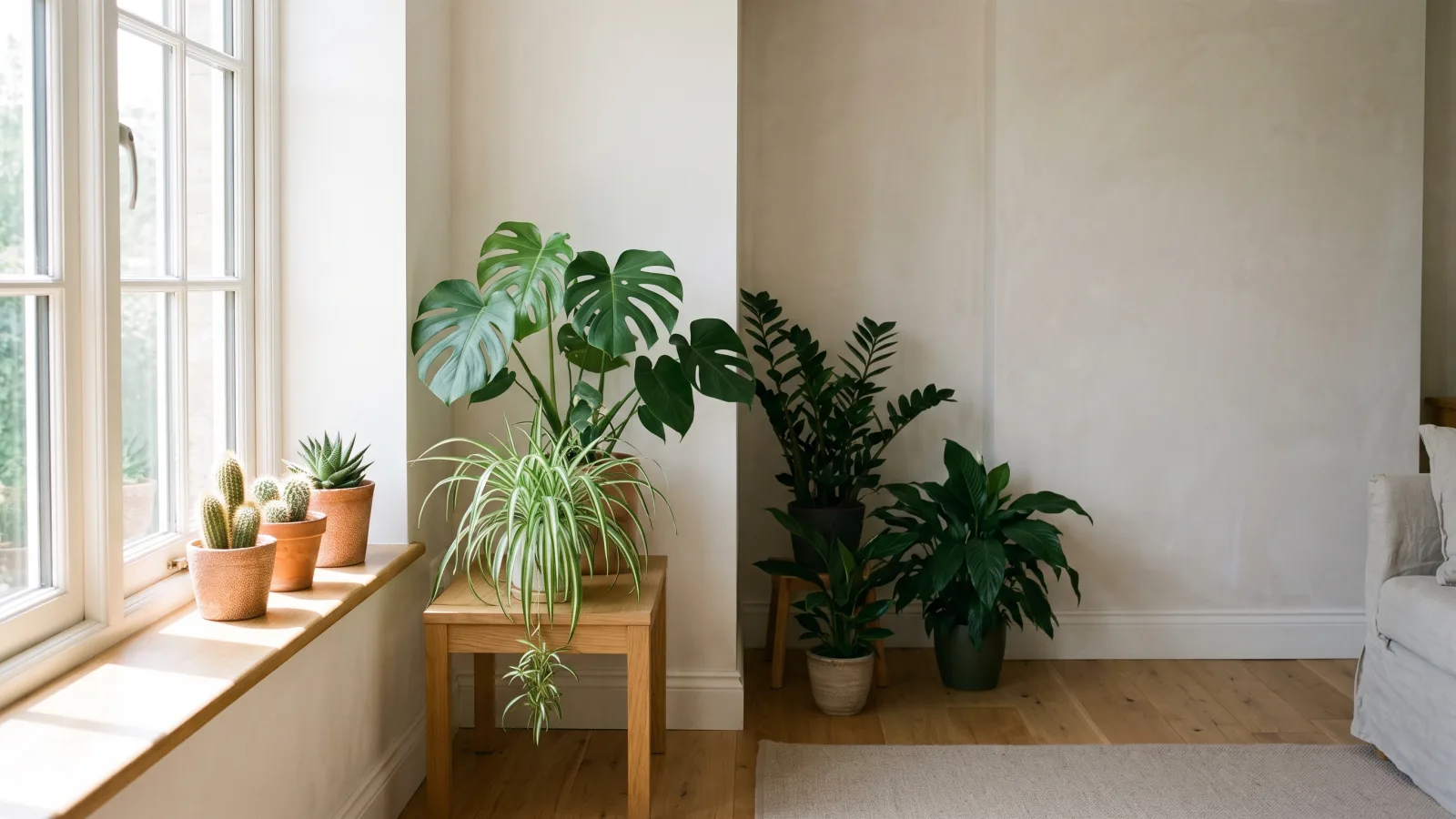
A room is several climates: a bright band by the glass, a gentler middle, a dim back wall, a dry patch over the radiator. How to map them, which plants belong in each, and how to stage a group so every plant still sees the window.
Botanical Legacy · Field notes ·
Arrange plants by what the window gives, then by how they look. The other order is how a fern ends up dying behind the sofa.
A room is several climates
Most advice on arranging houseplants is about styling: odd numbers, varied heights, a trailing plant on a shelf. It is good advice for the last step. It is the wrong first step, because a room is not one place for a plant. It is several.
Light is the largest difference. North Carolina State Extension notes that light intensity "rapidly decreases as you move away from a window", and that a plant moved about 8 feet (2.4 m) back from a strong south-facing window can end up in low light. Colorado State University Extension maps it more finely: high light within two feet (60 cm) of an east or west window, medium light two to six feet back or a foot to the side, and low light six to ten feet (1.8 to 3 m) back from south-facing glass in summer. The University of Florida's guide puts the scale in one image: the desk by the window may be ten times brighter than a spot across the hall that looks only slightly darker.
The window's direction sets the shape of the day. According to NC State, south-facing windows give the brightest light through the day, east-facing windows give direct morning sun and bright indirect light afterwards, west-facing windows give strong light in the afternoon and evening and run warmer, and north-facing windows give the least.
Air differs too, though less than light. Penn State Extension notes that indoor relative humidity can fall below 30% in the heating season, while most indoor plants do better with more, cacti and succulents being the exceptions. The RHS adds the local extremes: being too near radiators or fires can crisp delicate leaves, and a plant left on a cold windowsill behind the curtains can be damaged.
So a living room with one big window might hold a sunny strip along the glass, a bright middle, a dim back wall and a warm, dry patch over the radiator. The way to arrange plants in it is to find those zones first and give each plant the one it can live in. The look comes after, and it is easier than it sounds, because plants that share a zone usually look good together.
What to do
Map the light before you move a single pot. Walk the room at midday and note where the sun lands and for how long, then check again at another time of day. A light meter or a phone app gives you numbers; the University of Florida's guide says phone apps are accurate enough to detect a change in light levels, which is all a comparison between spots needs. A plant sensor moved round the room does the same job over whole days, as the sensor placement guide explains.
Give the brightest band to the sun-lovers. NC State lists cacti and succulents, citrus and orchids among the plants with the highest light needs, and the University of Florida's guide says succulents need more than four hours of direct light. They go in the first stretch of the brightest window, typically a south-facing one. Keep their leaves off the glass: Colorado State warns that foliage touching glass can be damaged by cold in winter and heat in summer.
Put the medium-light plants a step back, or beside the window. NC State names begonias, spider plants, peperomia, ferns and monsteras as plants that need a medium amount of light. In Colorado State's terms that is two to six feet back from an east or west window, or a foot to its side. This is the band most foliage plants want, and it is usually the largest part of a room that has decent windows.
Keep the back of the room for the low-light tolerators, and expect slow growth there. The plants NC State lists as needing the least light are ZZ plants, pothos, philodendron and peace lilies; Colorado State adds the cast iron plant, spider plant and fittonia, sold as the nerve plant. Low light is tolerated, not preferred. And there is a floor: Colorado State notes that few plants can tolerate light below 50 foot-candles, which is what a dark corner far from any window can be.
Stage heights so every plant can see the window. Light arrives from the window side. A tall plant between the glass and a group puts the whole group in its shade. Put the shortest plants nearest the window and the tallest furthest back, like seating in a theatre, and the tall plant's leaves still reach over the others. The exception is a tall plant that needs the most light: then it goes to the side of the window, not in front of it.
Group the humidity-lovers, but don't expect grouping to do it all. The RHS advises grouping plants together for shared humidity, and says many tropical houseplants are best grown in a steamy bathroom. Penn State is more cautious: grouping is widely recommended, but how much it helps depends on the number of plants and the size of the room, and pebble trays make almost no difference to the room's humidity. Ferns, calatheas and other thin-leaved plants belong together, away from the heater. Cacti and succulents do not need to be part of the group.
Keep everything clear of radiators, fires and draughts. The RHS advises placing houseplants away from extremes of temperature and avoiding draughts. A sill above a radiator is hot and dry by day and can be cold at night if the curtains close in front of it. Pull plants back from the glass on frosty nights, and bring them out from behind the curtains.
Turn the pots. A plant lit from one side grows towards it. The New York Botanical Garden suggests rotating plants fairly often, such as each time you water, to keep them symmetrical, and turning a plant that leans strongly away from the light until it straightens before going back to regular turns.
Rearrange with the seasons. The RHS suggests bringing plants out of dark corners in winter, when light levels are much lower, and moving houseplants to south- or west-facing windowsills, where the weaker winter sun suits them. The arrangement that worked in June needs a second look in October.
Three ways this plays out
The north-facing living room
A living room with one large north-facing window has no sun-lovers' band at all. The guardian stops trying to keep a jade plant alive on the sill and builds the room from the low and medium end instead: a spider plant and a peperomia directly on the sill, where Colorado State's guide puts medium light in summer, a pothos trailing from a shelf beside the window, a ZZ plant and a peace lily a couple of metres back. Nothing goes in the far corner except a lamp. The jade moves to a friend's south-facing kitchen. The lesson: a dim room is not a reason to have no plants, only a reason to choose them by the window you have.
The south-facing kitchen with a radiator under the window
The kitchen window faces south, with a radiator beneath it. The sill gets sun for most of the day, plus rising heat. That combination suits the cacti and a jade plant, which tolerate dry air, as long as their leaves do not touch the cold glass on winter nights. The Boston fern that sat there all summer, browning at the tips, moves to a shelf a metre to the side of the window: still bright, out of the direct sun and the radiator's draught. The lesson: the brightest spot in a room is also often the hottest and driest, and only some plants want all three.
The bathroom with a small east window
A bathroom with a small east-facing window and a shower in daily use looks ideal for a calathea and a fern, and on humidity alone it is. But Penn State points out that bathrooms often lack the light houseplants need. Here the window gives morning sun and bright indirect light afterwards, enough for the two plants on the sill and a shelf beside it, and not enough for the third the guardian wanted on top of the cabinet in the far corner. That one becomes a trailing pothos instead, which tolerates the gloom. The lesson: humidity is the second question. Light is still the first.
What Botanical Legacy does about it
Botanical Legacy keeps track of the places your plants live as well as the plants themselves, so it can tell you when one is in the wrong spot.
- Each Place carries its light. In Guardian → Places, every indoor room or outdoor spot you add can have a light level (Low, Medium, High or Mixed) and a compass facing. The level you set takes precedence. When a Place has no level, or is set to Mixed, its facing stands in, read for your hemisphere, so a north-facing window in the southern hemisphere counts as the bright one.
- Places shows who is in the wrong light. Once a Specimen's location matches a Place, the Placement summary compares the plant's light needs with the Place's light. Plants that don't fit are grouped as too dim or too bright in that Place, with a Move to suggestion naming another Place of the same kind (indoor to indoor, outdoor to outdoor) whose light suits them, or a note that no other Place does. Places with no light recorded are listed, so you can fill them in.
- The plant page says it too. A Specimen in a Place that is too dim or too bright for it shows a lighting warning on its page, with the same destination.
- Light changes the forecast, not only the advice. While a Specimen's forecast runs on the species model, before a soil probe has measured how fast its pot dries, its Place light (or its own light sensor, if it has one) adjusts how fast the Digital Shadow expects the pot to dry: brighter means faster, dimmer means slower, within limits. Moving a plant to a brighter Place can change its watering forecast as well as its spot.
- Outdoor Places do more. Marking a Place as outdoor is what lets weather features such as rain auto-watering reach the plants in it, on the paid plan.
Places and their light levels are on every plan, including the free one.
What the model can't see
A Place has one light level, and a room is a gradient. If your living room is set to High because of its big window, a plant three metres back from the glass is still read as being in High light. The fix is to describe the room the way the plants experience it: two Places, "Living room window" and "Living room back", each with its own level. The verdicts then follow the plants, not the room's best spot.
Nor can the model see the radiator, the draught under the door, the curtain that closes in front of the sill every evening, or the tall plant you have just put in front of the others. Those are the things that make two plants in the same Place live in different conditions, and they are yours to watch.
And light needs are a range, not a line. A plant flagged as too dim may live for years where it is, growing slowly. The verdict tells you it would do better somewhere else, not that it is dying.
Frequently asked questions
How should I arrange plants in my living room?
Start with the light. Find the bright band by the window, the medium zone a step back or to the side, and the dim back of the room. Put sun-lovers such as cacti and succulents by the brightest glass, most foliage plants in the medium zone, and low-light tolerators such as ZZ plants and pothos further back. Then stage them by height, shortest nearest the window, and style from there.
Which plants are best for a north-facing window?
Plants that tolerate low to medium light. A north-facing window gives the least light of any direction in the northern hemisphere. Pothos, philodendron, peace lily, ZZ plant, cast iron plant and spider plant are listed by NC State and Colorado State extension services as low-light plants, and they do best right by the glass in a north-facing room, not at the back of it.
Should I group houseplants together?
Group plants that want the same light and humidity, so each one gets the conditions it needs. The RHS recommends grouping for shared humidity. Penn State Extension notes the effect depends on how many plants there are and how big the room is, so grouping helps, but it does not replace a humidifier in a dry, heated home.
How far from a window can a houseplant be?
It depends on the window. Colorado State Extension counts the first two feet (60 cm) of an east or west window as high light and two to six feet back as medium. NC State notes that about 8 feet (2.4 m) back from a strong south window can already be low light. Few plants can tolerate the light found much further from any window.
Can I keep plants in a bathroom with no window?
Not without a grow light. Bathrooms offer humidity, but Penn State Extension notes they often lack the light houseplants need, and Colorado State says few plants tolerate light below 50 foot-candles. A bathroom with a window, even a small one, can suit humidity-loving plants placed close to it.
Is it bad to put plants near a radiator?
Usually, yes. The RHS warns that being too near radiators or fires can crisp delicate leaves, and advises keeping houseplants away from extremes of temperature and draughts. Cacti and succulents cope better with the dry heat than ferns or calatheas, but none of them should touch cold glass above a radiator at night.
How does Botanical Legacy know a plant is in the wrong place?
It compares the plant's light needs with the light of the Place you have put it in. Each Place in Guardian → Places can have a light level and a compass facing. If a plant's Place is too dim or too bright for it, the Placement summary and the plant's page say so and name another Place of the same kind whose light suits it, when there is one. This works on every plan.
Start your sanctuary
Botanical Legacy's free plan covers up to five Specimens, indoors or out, with continuous Digital Shadow modelling and Places that flag a plant in the wrong light. Every new account also gets a 14-day trial of the paid plan, which adds local weather, rain auto-watering for outdoor Places and sensor support via Home Assistant - so the spot you choose changes the forecast for the plant.
Start your sanctuary - five free specimens, no payment required →
Give the window to the plants that need it, and the back of the room to the ones that can live there. Then make it look good.
Sources
8 references
The plant-care facts on this page were checked against these references.
- NC State Extension: richmond.ces.ncsu.edu/news/light-considerations-for-indoor-plan…
- Colorado State University Extension: planttalk.colostate.edu/topics/houseplants/1352-interior-plants…
- UF/IFAS Gardening Solutions: gardeningsolutions.ifas.ufl.edu/plants/houseplants/light-for-ho…
- Penn State Extension: extension.psu.edu/humidity-and-houseplants
- RHS: rhs.org.uk/garden-inspiration/houseplants/winter-interest-house…
- University of Illinois Extension: extension.illinois.edu/houseplants/lighting
- New York Botanical Garden: libanswers.nybg.org/faq/222844
- RHS: rhs.org.uk/advice/understanding-plants/how-plants-use-light-to-…