Plant care · 14 min read
How to grow vegetables indoors - the light that decides what grows, and what to plant on a windowsill or balcony this winter
Indoors in winter, a vegetable rarely runs short of water or warmth. It runs short of light. Which crops a windowsill can carry, when a grow light earns its place, and what a renter's balcony can still take in late autumn.
Botanical Legacy · Field notes ·
A houseplant earned its place on the windowsill by putting up with the light there. A vegetable was bred for an open field, and in December a windowsill is a fraction of a field.
A windowsill is a shade garden
The usual advice about growing food indoors starts with the pot, the compost and the watering can. None of those is what stops a lettuce in a flat in December. Indoors, the most limiting factor for growing plants is light, and in winter it limits harder than anything else in the room.
The plants most of us already keep indoors were chosen for the opposite job. The RHS advises choosing houseplants for sun or for shade, and a pothos is a shade choice: it prefers bright, indirect light but survives for long periods in low light. Florida's extension service points out that a fern would burn in the four-plus hours of direct sun a succulent needs. A room that suits a houseplant can starve a vegetable.
Vegetables are field crops, and their light needs come in a clear order. Cornell's extension service puts fruiting crops such as tomatoes, peppers, squash and cucumbers at seven to eight hours of direct sun a day, root crops such as carrots, beetroot and radishes at five to six, and leafy crops such as lettuce, spinach and chard at three to four. That order is the whole plan for growing indoors: leaves first, roots a distant second, fruit last.
Winter makes the gap wider. The shortest day in London lasts just under eight hours, and that's daylight, not direct sun. Horticulturists measure the light a plant receives over a whole day as the daily light integral (DLI), in moles of light per square metre per day. Purdue's extension service gives leafy greens 15-20 for commercial growth, and Cornell's hydroponic lettuce target is 17. In winter in northern latitudes, the open sky outdoors can deliver as little as 3 to 5. Glass and structure cut that again: in greenhouses, Purdue puts the loss at 40-70%. A windowsill gets a fraction of the already low winter figure, and fruiting crops such as tomatoes want more than 20.
So retire the idea that anything grows on a sunny sill with enough care. In winter a windowsill grows the crops you eat young, the leafy crops that tolerate shade, and a handful of herbs. Everything else needs a lamp, a balcony in spring, or both.
Three groups for a winter windowsill
Sorting crops by what the light can carry makes the decision before the seed packet does.
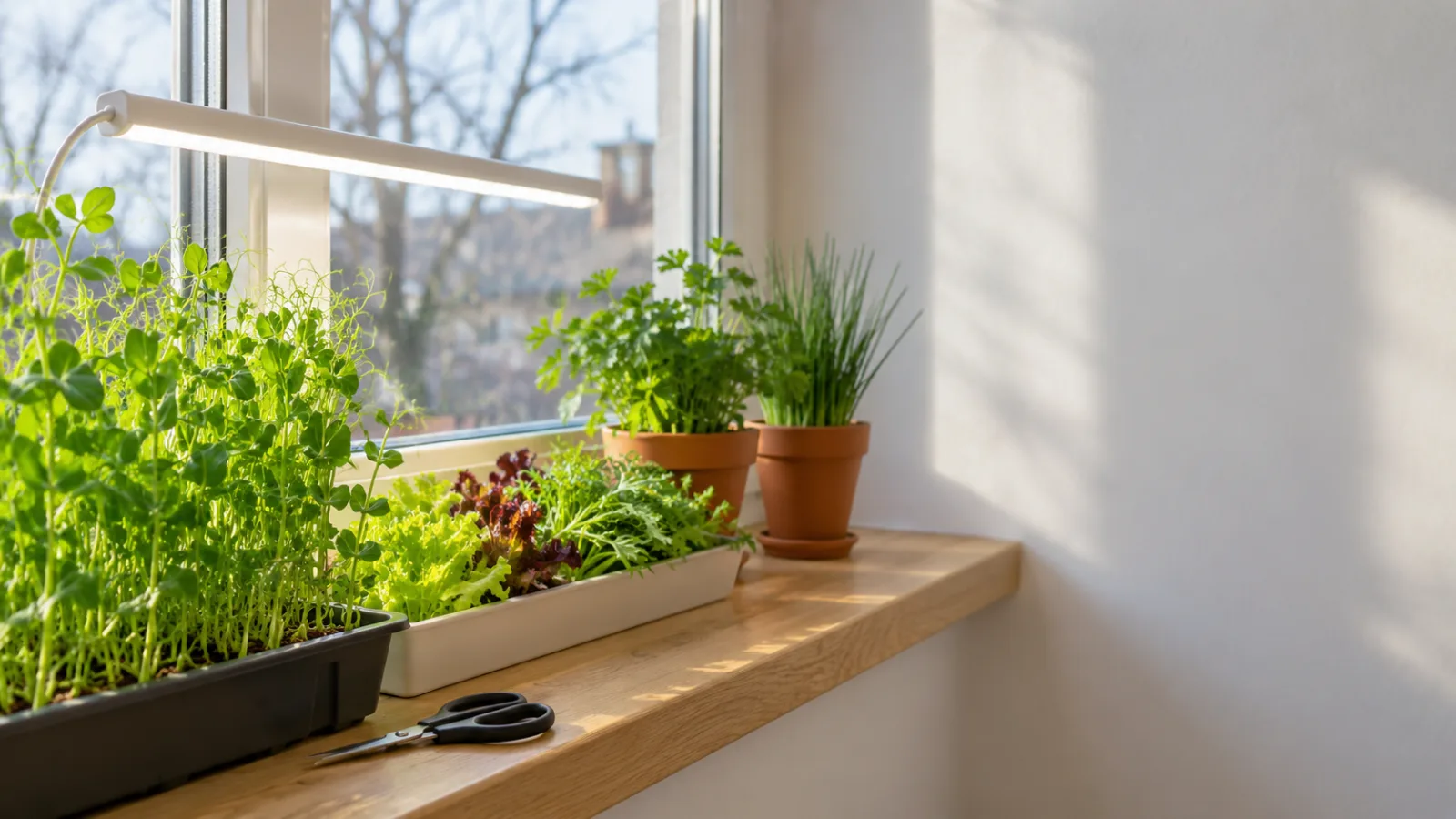
The windowsill alone. Microgreens, harvested 7 to 21 days after sowing when the first true leaves show. Pea shoots, cut in three to four weeks at 10-15 cm tall. Spring onions regrown from their root ends in a glass of water. Parsley, chives and mint, which do well indoors; chives and coriander also tolerate lower light than most herbs. Mizuna, mustards and other Asian greens, which grow acceptably in less-than-ideal light. The RHS notes that autumn-sown salad leaves can overwinter on a sunny windowsill, picked as cut-and-come-again.
Better under a lamp. Loose-leaf lettuce grown to full size, and herbs grown for steady picking. Illinois Extension puts lettuce and herbs at six to eight hours of bright light a day, and a winter window rarely supplies that. Basil belongs here too: it isn't hardy and needs warmth.
Wait for spring, or a bigger setup. Tomatoes, peppers, cucumbers and aubergines need the most light of all, and indoors their flowers need help to set fruit, since there's no wind or bees to move the pollen. Radishes sound like an easy windowsill crop, but the RHS grows them in pots at least 30 cm wide and deep; on a sill, grow them as microgreens instead.
What to do
Start with the crops you eat young. Microgreens are the fastest return on a dark sill. Sow seed densely in a shallow tray holding 2.5-4 cm of moist compost, keep it moist but not saturated, and cut the stems just above the compost with clean scissors once the first true leaves appear. They won't regrow, so sow a fresh tray every week or two. Pea shoots may give a second cut if you snip them about 2.5 cm above the base.
Match the crop to the hours of sun, not the photo on the packet. Count how many hours of direct sun your best window or balcony gets, ideally on a bright day this month. Three to four hours is enough for leafy crops: lettuce, spinach, chard, kale. Less than that, and you're growing microgreens, pea shoots and the shade-tolerant herbs. Put the salad trough in the brightest window you have, not the one where it looks best, and keep the glass clean.
Add a lamp before you add more pots. A grow light changes what a flat can grow more than any compost or feed. Extension services recommend LED or fluorescent fittings, run for about 14 to 16 hours a day on a plug-in timer. Keep them close: around 15-30 cm above leafy crops, and only a few centimetres above seedlings under fluorescent tubes. Light falls off quickly with distance, so a lamp hung high wastes most of what it makes. You don't need a special full-spectrum lamp for greens: Maryland Extension notes that ordinary cool-white tubes produce healthy, stocky salad leaves.
Keep the greens cool and the basil warm. Lettuce grows best at about 13-21°C and turns bitter when it gets too warm, so keep salad trays away from radiators; Illinois Extension suggests rooms of 21°C and below for indoor lettuce and herbs. Basil is the opposite. Its leaves show cold damage at 10°C, and Penn State advises keeping it off windowsills in winter. Grow it back from the glass, under a lamp on a shelf in the warm part of the room.
Water less than you think, and keep the air moving. Warmth, sun and wind drive water loss, and a winter windowsill has little of any of them, so compost stays wet for longer. That is where indoor growing usually fails. Damping off, a fungal disease that collapses seedlings, is favoured by wet compost, humid still air and thick sowing. Fungus gnats breed in moist potting mix. Let the surface dry between waterings, sow thinly, and run a small fan near the trays if the room is still. Yellow sticky traps catch the adult gnats.
Cut and come again. Snip salad leaves from about 10 cm tall and leave the base to regrow: the RHS expects two or three pickings from a sowing. Baby greens cut at 10-15 cm can regrow for one or two more harvests. A spring onion in water regrows about twice before its reserves run out, which is a smaller version of what propagation does with a houseplant cutting.
On a balcony, plant now for next year. Late October is the right time for a few crops and the tail end for others. Garlic goes in from mid-autumn to early winter and needs one to two months at 0-10°C for good bulbs; use a pot at least 25 cm deep. Overwintering onion sets planted in autumn give a crop in June and July. In milder or sheltered spots, broad beans such as 'Aquadulce Claudia' can be sown in October or November in pots at least 40 cm wide. For leaves through winter, kale is one of the hardiest leafy vegetables and chard survives winter outdoors unprotected. Lamb's lettuce and winter purslane are fully hardy, though their sowing window runs from late summer into autumn, so sow them now or leave them until next year.
Renting: think in containers, weight and wind. Every pot needs a drainage hole. Use peat-free multipurpose compost, and plan to water and feed more often than you would in the ground, since containers dry out faster than garden soil. In winter the risk flips: pots are prone to waterlogging, so take the saucers away before the wet months. Check the weight limit of the balcony before filling it with large pots of wet compost. Balconies are windy, and wind dries containers fast; lower-growing crops suffer less wind damage than tall ones. A balcony with plenty of light but no direct sun can still grow leafy crops such as mizuna.
Three ways this plays out
The basil on the cold glass
A pot of basil bought in October goes on the kitchen windowsill, pressed against the glass for the light. The days are mild, but the nights cool the pane, and the leaves touching it turn dark and limp within a week. The compost is still wet from the last watering, because nothing in that window is drying it. The fix was a few centimetres and a lamp: basil moved back from the glass at night, onto a shelf under a timer-run LED bar, keeps producing leaves through December. That basil had a cold problem and a light problem. It never had a watering problem.
The lettuce that stretched
A tray of lettuce sown on a north-facing sill comes up in a week and then keeps going up: pale, thin stems leaning hard towards the glass, leaves far apart. A few small dark flies appear over the permanently damp compost. Moving the tray under a light doesn't help much, because more light won't shorten a stem that has already stretched. The second sowing goes under an LED bar 20 cm above the tray from the first day, on 16 hours, watered only when the surface dries, and comes up short and dense. With seedlings that have stretched, resowing works better than trying to rescue them.
The east-facing balcony
A renter's balcony gets sun until about eleven in the morning, roughly three to four hours a day. A summer of tomatoes there produced leaves and a handful of fruit. This autumn the same space holds a trough of chard, two pots of kale, a pot of parsley and a long planter of lamb's lettuce. All four are crops that tolerate three to four hours of sun, and all four are hardy enough to stay out with little or no protection. The balcony feeds a salad bowl from November to March, and the tomatoes come back next summer, in the sunniest corner only. The balcony had the same light both times. Only the crops changed.
What Botanical Legacy does about it
A tray of salad or a pot of basil can be a Specimen like any houseplant. Identification, powered by Botanical Vision v5, isn't limited to a houseplant catalogue: photograph the plant and it names it, whether that's Ocimum basilicum or a lettuce. Each identification uses one photo read from your monthly allowance (three on the free plan). Or add it by description or from seed in the Grow Wizard, which uses no photo reads.
Indoors, every Specimen lives in a room, and the room's light level (or, without one, the direction its window faces) changes how fast its Digital Shadow expects the pot to dry. A lettuce tray in a dim room is modelled as drying more slowly than the same tray in a bright one, on every plan. That matters most in exactly the season this post is about, when overwatering, not thirst, is what kills windowsill crops; the habit of checking first is in when to water houseplants.
When something looks wrong, a photo to the Doctor gives a diagnosis that includes a lighting assessment, judged from the leaves themselves: pale colour, stretched growth or scorch. Pests it looks for include fungus gnats. A diagnosis uses one photo read.
On a balcony, the paid plan adds local weather. With local weather turned on, a Specimen in an outdoor place (the Balcony preset is one) is modelled against your local temperature and humidity instead of indoor conditions. With weather alerts on, the forecast low for your home location is compared with each outdoor Specimen's own minimum temperature, and a forecast that drops below it brings a frost alert for that plant by name, ahead of the night. A forecast that only comes within 2°C of the minimum is reported when that cold is unusual for the time of year, or when it is the first such night in a month. A Specimen with no recorded minimum is guarded as a tender plant. If you also turn on rain auto-watering, 5 mm or more of rain in the past 24 hours (counted from the last watering, if that was more recent) logs a watering for your outdoor Specimens, so the model doesn't tell you to water a planter the rain has already soaked.
What the model can't see
The Digital Shadow knows the light level you gave a room, not how many hours of light a tray gets, and it has no setting for a grow lamp. If you add a lamp, raise that room's light level in Places so the model expects the faster drying that comes with it. It doesn't track harvests either. Cutting a tray of salad back to stumps changes how much water it uses, and the model only learns that from your soil checks or a sensor.
The forecast covers your area, not your balcony. A planter against a sheltered wall a few floors up can run several degrees warmer at night than the weather station, and an exposed corner colder; without a sensor on the spot, the model can't tell which you have. Choosing crops for the light you have, moving the basil off the glass, and tasting the lettuce before it turns bitter are yours.
Frequently asked questions
What vegetables can you grow indoors in winter?
On a windowsill alone: microgreens, pea shoots, spring onions regrown from their root ends, cut-and-come-again salad leaves, Asian greens such as mizuna, and herbs such as parsley, chives and mint. With a grow light you can add loose-leaf lettuce grown to full size and basil. Fruiting crops such as tomatoes and peppers need far more light, and help with pollination, so most people leave them until spring.
Can you grow vegetables indoors without a grow light?
Yes, if you choose crops for the light. Microgreens and pea shoots are harvested young, and leafy greens and some herbs tolerate lower light. Extension services note that window light alone is seldom enough for strong seedlings, though, and plants grown short of light stretch and go leggy. A simple LED or fluorescent fitting on a timer makes the biggest difference.
How many hours of light do indoor vegetables need?
Lettuce and herbs grow best with six to eight hours of bright light a day, which few windows provide in winter. Under grow lights, extension services recommend about 14 to 16 hours a day, with the lights 15-30 cm above leafy crops and on a timer.
What vegetables grow in shade?
Leafy crops are the most shade-tolerant. Lettuce, spinach, chard and kale can be grown with three to four hours of direct sun a day, and herbs such as parsley and chives manage in partial shade. Root crops need around five to six hours, and fruiting crops such as tomatoes, peppers and cucumbers seven to eight.
What winter vegetables can I plant now?
In a temperate climate in late October, garlic and overwintering onion sets are on time, and garlic needs one to two months at 0-10°C for good bulbs. Broad beans such as 'Aquadulce Claudia' can be sown in October or November in milder or sheltered spots. Kale and chard are hardy enough to give leaves through winter, and hardy salads such as lamb's lettuce and winter purslane are at the end of their sowing window.
How do I start a balcony garden as a renter?
Use containers with drainage holes, filled with peat-free multipurpose compost, and check the balcony's weight limit before adding large pots. Count the hours of direct sun and choose crops to match: leafy crops for three to four hours, fruiting crops only for the sunniest balconies. Expect wind to dry pots quickly in summer, and remove saucers in winter so the compost doesn't waterlog.
Can Botanical Legacy track vegetables and herbs?
Yes. Identification powered by Botanical Vision v5 names any plant, including herbs and salad crops, and you can also add one by description or from seed. Indoors, the room's light level shapes how fast each Specimen is expected to dry, on every plan. On the paid plan with local weather on, Specimens in an outdoor place such as a balcony are modelled against local weather and can get frost alerts. The app doesn't track harvests or grow lights.
Start your sanctuary
Botanical Legacy's free plan covers up to five Specimens, indoors or out, with continuous Digital Shadow modelling shaped by each room's light. Every new account also gets a 14-day trial of the paid plan, which adds local weather, frost alerts and rain auto-watering for outdoor places - the layer that watches the balcony so you don't have to.
Start your sanctuary - five free specimens, no payment required →
A monstera forgives a dim windowsill. A lettuce needs the brightest window you have, or a lamp, and in December it still gets less light than it would outside.
Sources
50 references
The plant-care facts on this page were checked against these references.
- Illinois Extension: the edible indoor garden: extension.illinois.edu/blogs/ilriverhort/2015-02-20-edible-indo…
- RHS houseplants: rhs.org.uk/plants/types/houseplants/growing-guide
- NC State: pothos: plants.ces.ncsu.edu/plants/epipremnum-aureum
- UF/IFAS: light for houseplants: gardeningsolutions.ifas.ufl.edu/plants/houseplants/light-for-ho…
- Cornell CALS: sunlight: cals.cornell.edu/school-integrative-plant-science/school-sectio…
- Iowa State Extension: vegetables for partial shade: yardandgarden.extension.iastate.edu/faq/which-vegetables-will-g…
- UC Master Gardeners: under 6 hours of sun: ucanr.edu/site/uc-master-gardeners-placer-county/article/growin…
- Met Office: winter: weather.metoffice.gov.uk/learn-about/weather/seasons/winter
- Royal Museums Greenwich: winter solstice: rmg.co.uk/stories/time/when-winter-solstice-shortest-day
- Purdue HO-283-W: extension.purdue.edu/extmedia/HO/HO-283-W.pdf
- Cornell CEA lettuce handbook: cea.cals.cornell.edu/files/2019/06/Cornell-CEA-Lettuce-Handbook…
- e-GRO: managing light in a greenhouse: e-gro.org/pdf/DLI.pdf
- Purdue HO-238-W: extension.purdue.edu/extmedia/ho/ho-238-w.pdf
- UMD Extension: microgreens and baby greens: extension.umd.edu/resource/growing-microgreens-and-baby-greens-…
- RHS: growing microgreens: rhs.org.uk/education-learning/school-gardening/resources/food-g…
- RHS: peas: rhs.org.uk/vegetables/peas/grow-your-own
- UC ANR: scallions fact sheet: ucanr.edu/sites/default/files/2025-04/FactSheet_FruitVeg_Scalli…
- Iowa State Extension: kitchen scraps: yardandgarden.extension.iastate.edu/how-to/how-grow-vegetables-…
- Illinois Extension: herbs and lettuce indoors: extension.illinois.edu/blogs/good-growing/2017-11-17-grow-herbs…
- Penn State Extension: growing herbs indoors: extension.psu.edu/growing-herbs-indoors
- RHS: salad leaves: rhs.org.uk/vegetables/salad-leaves/grow-your-own
- UMD Extension: care of vegetable seedlings: extension.umd.edu/resource/care-vegetable-seedlings
- Illinois Extension: supplemental lighting: extension.illinois.edu/blogs/good-growing/2020-03-25-starting-g…
- UNH Extension: seedlings under lights: extension.unh.edu/resource/growing-seedlings-under-lights-fact-…
- RHS: basil: rhs.org.uk/herbs/basil/grow-your-own
- Illinois Extension: popular herbs: extension.illinois.edu/blogs/good-growing/2020-05-15-how-grow-p…
- Colorado State Extension: hand pollination: pueblo.extension.colostate.edu/hand-pollination
- Illinois Extension: dwarf tomatoes: extension.illinois.edu/blogs/rhonda-ferrees-ilriverhort/2017-05…
- Iowa State Extension: pollination: yardandgarden.extension.iastate.edu/how-to/pollination-and-fert…
- RHS: radishes: rhs.org.uk/vegetables/radishes/grow-your-own
- UMD Extension: grow lights: extension.umd.edu/resource/grow-lights-starting-seeds-indoors
- Clemson HGIC: lettuce: hgic.clemson.edu/factsheet/lettuce
- Illinois Extension: lettuce: extension.illinois.edu/gardening/lettuce
- RHS: how plants lose water: rhs.org.uk/advice/understanding-plants/how-plants-lose-water
- RHS: watering containers: rhs.org.uk/container-gardening/how-to-water-containers
- RHS: damping off: rhs.org.uk/disease/damping-off
- UC IPM: fungus gnats: ipm.ucanr.edu/home-and-landscape/fungus-gnats
- RHS: garlic: rhs.org.uk/vegetables/garlic/grow-your-own
- RHS: onions: rhs.org.uk/vegetables/onions/grow-your-own
- RHS: broad beans: rhs.org.uk/vegetables/broad-beans/grow-your-own
- RHS: kale: rhs.org.uk/vegetables/kale/grow-your-own
- RHS: chard: rhs.org.uk/vegetables/chard/grow-your-own
- RHS: Valerianella locusta: rhs.org.uk/plants/67250/valerianella-locusta/details
- RHS: Claytonia perfoliata: rhs.org.uk/plants/3903/claytonia-perfoliata/details
- RHS: vegetables for winter: rhs.org.uk/vegetables/growing-for-winter
- RHS: growing plants in containers: rhs.org.uk/container-gardening/growing-plants-in-containers
- RHS: vegetables in containers: rhs.org.uk/vegetables/containers
- RHS: edibles on your balcony: rhs.org.uk/advice/grow-your-own/features/how-to-grow-edibles-on…
- RHS: roof gardens and balconies: rhs.org.uk/garden-design/roof-gardens-balconies
- RHS: herbs for shade: rhs.org.uk/advice/grow-your-own/features/herbs-for-shade