Smart-home gardening · 13 min read
Where to place a plant sensor - one per plant or one per room, and why the light reading depends on the spot
A plant sensor's light reading describes the few centimetres around its own head, not the room. Where to put a soil probe, a light sensor and an air sensor, how many you need, and why the same Mi Flora reads a different room on the windowsill than on the floor behind the other plants.
Botanical Legacy · Field notes ·
A light sensor does not measure your room. It measures the few square centimetres around its own head, and the room changes every half metre.
A light reading belongs to one spot
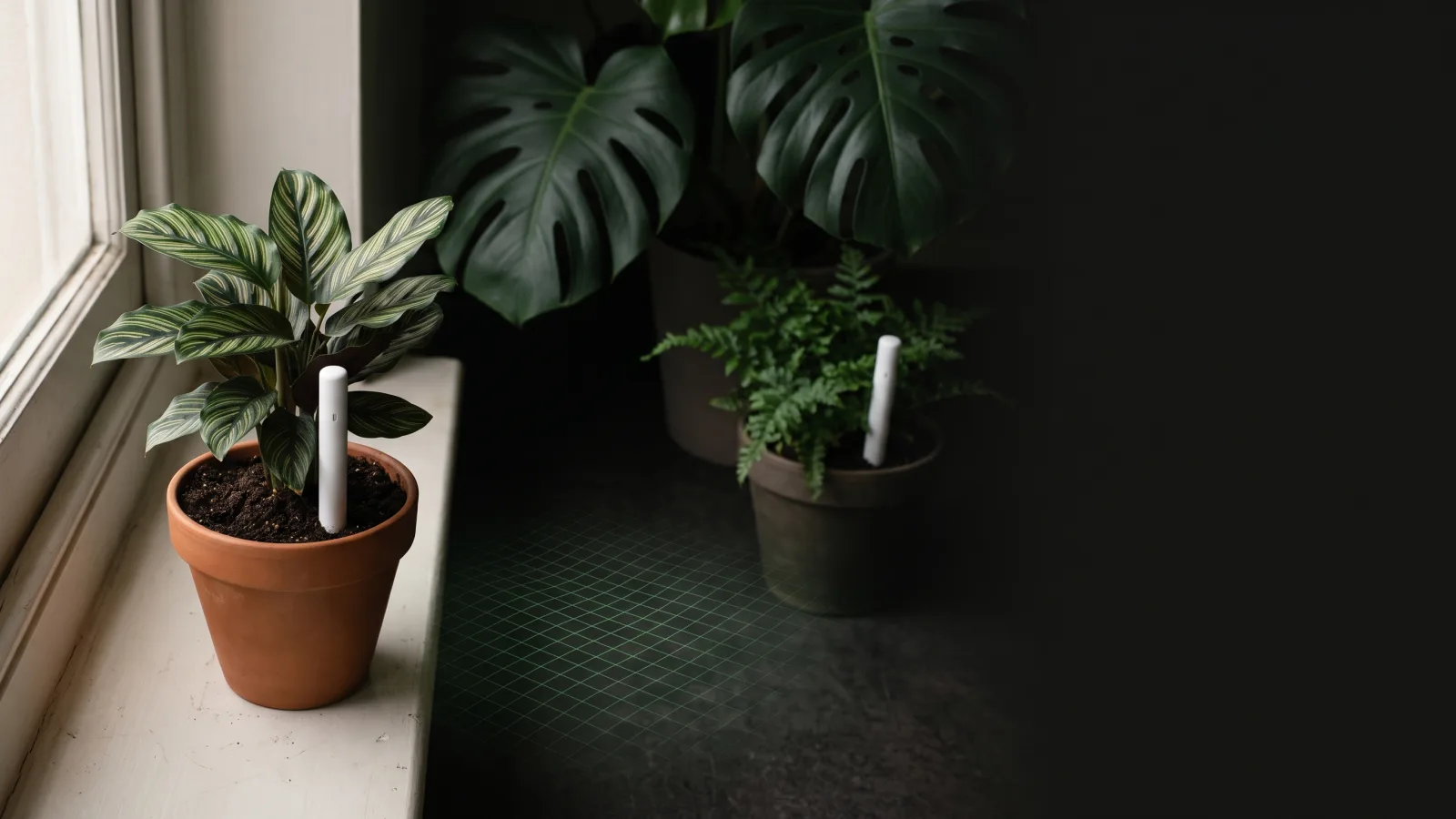
Put a Xiaomi Mi Flora in a pot on a south-facing windowsill and it might report tens of thousands of lux at noon on a clear day. Push the same probe into a pot on the floor at the back of the room, behind a monstera and a pothos, and the midday figure can drop to a few hundred. Neither reading is wrong. They describe two different places, and the difference between those places is larger than most people expect.
Light indoors falls away quickly from a window. North Carolina State Extension puts it plainly: light intensity "rapidly decreases as you move away from a window or light source", and a plant moved about 8 feet (2.4 m) back from a strong south-facing window can end up in low light. The University of Florida's guide to light for houseplants makes the same point from the other direction: the desk by the window may be ten times brighter than a workspace across the hall that only looks slightly darker.
Distance is only the first variable. Colorado State University Extension's light categories also change when a plant moves sideways: medium light at two to six feet (60 cm to 1.8 m) back from an east or west window, or one foot (30 cm) to the side of it. A sensor on the floor at the back of the room is far from the glass, below the sill line, and usually sitting under other plants' leaves, which are there precisely to catch the light before it reaches the floor. All three push its reading down.
Then there is time. A single reading is a moment. What a plant grows on is the total over the day: Iowa State University Extension defines the daily light integral as the amount of photosynthetic light delivered to an area in 24 hours, and calls it the figure that tells you how much photosynthesis can occur. An east window gets direct sun in the morning and indirect light afterwards; a west window gets its strongest light in the afternoon and evening, according to NC State. A sensor that reads 15,000 lux at 9:00 and 1,500 at 15:00 is telling you about the window's orientation, not about a fault.
And there is the unit. A Mi Flora reports lux, which Iowa State University Extension describes as a measure of the light the human eye perceives, not of the light useful to plants. Lux is still useful. It is best at answering one question well: is this spot brighter or darker than that one, measured by the same sensor?
So the popular advice, "put a light sensor in the room and it will tell you how bright the room is", has it backwards. A room has no single brightness. The useful question is where the leaves are, and what reaches them.
One per plant, or one per room
The answer depends on what the sensor measures, because the three readings a plant sensor takes describe three different volumes.
Soil moisture describes one pot. A probe reads the compost it is pushed into. It says nothing about the pot beside it, even if both were watered on the same day, because each pot dries at its own pace. The moisture sensor guide covers the kinds of probe.
Air temperature and humidity describe the room. Every plant in a room breathes the same air, so one thermometer and hygrometer on the wall covers all of them. The exceptions are spots with their own climate: a sill above a radiator, or a pane that gets cold at night.
Light describes one spot. It sits between the two. Plants a metre apart can live in different light, so a light reading speaks for the plant whose leaves are beside the sensor, and for little else.
For most homes that adds up to one air sensor per room, a soil probe in the plants that are hard to water well, and a light reading where light is the question: the plant at the back that has stopped growing, the one you are thinking of moving, or the new arrival you are not sure about.
What to do
Measure where the leaves are, not where the sensor is convenient. Iowa State's guidance on measuring light is to take the reading at foliage level. A Mi Flora's reading comes from its head, just above the compost, so in a tall plant it reports the light near the soil, not at the top leaves. If what you want to know is whether the canopy gets enough, hold a light meter or phone among the leaves for a comparison, and treat the probe's figure as a reading of the lower part of the plant.
Keep the sensor's head clear of leaves, its own and its neighbours'. A leaf lying over the sensor turns it into a shade meter. Check after watering and after the plant has grown: a new leaf can cover a probe that read correctly for months. If the plant is dense, set the probe on the side that faces the window, where the light arrives.
Survey a room by moving one sensor, a few days in each spot. One probe can map a whole room. Leave it two or three days in a spot, note the daily pattern and the midday peak, then move it. Do the survey in Home Assistant's history graph rather than in any plant app, because a probe moved between pots also reports soil moisture, and that reading belongs to whichever plant it has just been pushed into. Once the survey is done, bind the probe to the plant it will stay with.
Compare days, not moments. A cloudy day and a sunny day in the same spot can differ several times over. Compare the shape of the day and the peaks across a few days, and compare spots on similar days. A sharp spike for an hour usually means a patch of direct sun crossing the sensor, which tells you when that spot gets sun and for how long.
Read the figure against the bands, loosely. The University of Florida's guide gives midday ranges in foot-candles: low light 25 to 100, medium 100 to 500, high 500 to 1,000, and direct sun over 1,000. One foot-candle is 10.76 lux, according to Iowa State, so in lux that is roughly 270 to 1,100 for low light, 1,100 to 5,400 for medium, 5,400 to 10,800 for high, and above that for direct sun. Other extension services draw the lines differently (Colorado State's medium band is 500 to 1,000 foot-candles), so treat the bands as a guide to which plants belong in a spot, not a pass mark.
Recheck when the season turns. Colorado State's categories change with the months: the first two feet (60 cm) of north-facing glass counts as medium light from April to September and low light from October to March. The RHS notes that sunlight is much weaker in winter than in summer. A spot that suited a plant in June is not the same spot in December, even if nothing in the room has moved. The autumn checklist covers the plants coming in from outside at the same time.
Never compare lux across brands, or with PAR. A Mi Flora reports lux; a FYTA Beam reports a PAR figure in micromoles. They count different things: Iowa State notes that lux-based units do not measure the light useful to plants, so no fixed factor turns one brand's figure into the other's. Track each sensor against itself. The sensor comparison explains the two units.
Use a phone app for a quick second opinion, not a verdict. The University of Florida's guide says phone light apps are usually accurate enough to detect a change in light levels but should be used for approximations. That is all a survey needs: which of two spots is brighter.
Three ways this plays out
The probe behind the monstera
A calathea sits on the floor at the back of a south-facing living room, behind a monstera and a pothos on a low stand. Its Mi Flora's midday readings sit between 300 and 600 lux. The guardian moves the probe to the windowsill for a week, out of curiosity, and sees peaks above 20,000 lux on clear days. The first reaction is that the calathea's probe was faulty. It was not. It was reporting the calathea's spot accurately: far from the glass, below the sill and under the monstera's leaves. The useful conclusion is about the plant: it sits at the low end of medium light, and a metre to the side, out from behind the monstera, would give it more without the sill's direct sun. The lesson: the sensor answers for the place it stands, so put it where the question is.
One probe, one week, four spots
A guardian with one spare Mi Flora wants to know where a new fiddle-leaf fig should live. The probe spends two days each on the east sill, 1.5 m back from it, beside the west window and on a bookshelf across the room, with the readings watched in Home Assistant. The east sill peaks early and falls off by late morning. The spot 1.5 m back peaks at a fraction of that. The west window is dim until early afternoon and then reads the highest of all. The bookshelf never rises out of low light. The fig goes beside the west window, a little back from the glass, and the probe goes into its pot for good. The lesson: one sensor moved deliberately tells you more about a room than four left wherever they happened to fit.
The reading that dropped in October
A rubber plant has had a light probe in the same pot, in the same place, since spring. Through October its midday peaks fall week by week. Nothing in the room has changed. The days have shortened and the light has weakened, as the RHS describes for winter, and the plant's spot has slid from bright towards medium without anyone moving it. The guardian moves it closer to the glass for the winter and back again in spring. The lesson: a sensor that never moves is still useful, because it shows the season moving instead.
What Botanical Legacy does about it
Botanical Legacy reads sensors from your Home Assistant, so any probe Home Assistant can see works, Mi Flora included. The Home Assistant setup guide walks through the connection.
- A light sensor belongs to one plant. A Home Assistant entity with the illuminance device class, in lux, is read as light. It binds to a single Specimen, never to a room, because a light reading describes one spot. Soil moisture and conductivity bind to a plant the same way; humidity binds to a room; temperature can go either way.
- You see the reading as a line, not a grade. The Sensors page charts each plant's light in lux. Unlike moisture or temperature, light gets no target band, because lux has no single right answer for a plant.
- Light changes how fast the pot is expected to dry. Until a plant's own soil probe has measured how fast its pot dries, its Digital Shadow runs on the species model. In that model, a recent reading from the plant's light sensor adjusts the expected drying rate: brighter than the plant's light tier, faster; dimmer, slower, within limits. Once the soil probe has measured a drying rate, that measurement already reflects the light, so the light figure is not applied a second time.
- No light sensor? The Place stands in. Each Place in Guardian → Places can carry a light level (Low, Medium, High or Mixed) and a compass facing, and the same adjustment runs off them. The level you set wins; the facing, read for your hemisphere, fills in when there is no level. The arrangement guide covers how Places flags a plant in the wrong light.
Sensors belong to the Cultivator and Conservancy plans, and to the 14-day trial. Places, their light levels and the Digital Shadow are on every plan.
What the model can't see
A probe sees light at one height, in one direction, from one spot. It cannot tell that the top of a tall plant is in sun while the soil level is in shade, or that a leaf has grown over its head since last week. If the reading suddenly falls, the first thing to check is the probe, not the plant.
Lux also cannot tell a grow light from the sun. A lamp left on in the evening raises the reading, and the model takes it as light, which it is, at whatever strength the lamp gives. What matters for the plant is the spectrum and the total over the day, and a lux sensor sees neither directly.
And a sensor knows nothing about what you are about to do. Turning the pot, opening a blind, pulling the plant back from cold glass for the winter: all of these change the light at the leaves, and only the guardian knows they happened.
Frequently asked questions
Where should I put a plant light sensor?
In the pot of the plant whose light you want to know, with the sensor's head clear of leaves and facing the light source. Light changes over short distances indoors, so the reading speaks for that spot. For a tall plant, remember the probe measures light near the compost, not at the top leaves.
Do I need one plant sensor per plant or one per room?
It depends on the reading. Soil moisture needs a probe in each pot you want measured, because one pot tells you nothing about the next. Air temperature and humidity are shared, so one sensor per room covers every plant in it. Light is per spot: one sensor speaks for the plants right beside it.
Why does my plant sensor show low light when the plant is near a window?
Usually because the sensor is shaded. A probe below the sill, behind other plants or under its own plant's leaves reads far less than the glass a metre away. Check whether a leaf covers it, which way the window faces and what time of day you are reading it: an east window is brightest in the morning, a west window in the afternoon.
How many lux does a houseplant need?
The University of Florida's midday bands, converted from foot-candles, are roughly 270 to 1,100 lux for low-light plants, 1,100 to 5,400 for medium and 5,400 to 10,800 for high, with direct sun above that. Other extension services set the bands differently, so use them to judge which plants suit a spot rather than as exact targets.
Can one light sensor cover a whole room?
Not at once. It can map a room if you move it: two or three days in each spot, compared in Home Assistant's history, will show which spots are bright and when. After the survey, leave it in the pot of the plant it is meant to watch.
Does Botanical Legacy use the light reading from a Mi Flora?
Yes, through Home Assistant. A Mi Flora's illuminance reading binds to one Specimen and is charted in lux. Until that plant's soil probe has measured its own drying rate, a recent light reading adjusts how fast the model expects the pot to dry. Sensors are part of the paid plans and the 14-day trial.
Should the sensor stay in the same place all year?
For a plant it monitors, yes. A sensor that never moves shows the season changing: falling peaks through autumn tell you the spot is getting darker, and that the plant may need to move closer to the window for the winter.
Start your sanctuary
Botanical Legacy's free plan covers up to five Specimens, indoors or out, with continuous Digital Shadow modelling and Places that carry each room's light. Every new account also gets a 14-day trial of the paid plan, which adds local weather and sensor support via Home Assistant - so a soil probe or a light sensor in the pot changes the forecast for the plant.
Start your sanctuary - five free specimens, no payment required →
The windowsill and the floor behind the monstera are two different rooms. Put the sensor in the one the plant lives in.
Sources
6 references
The plant-care facts on this page were checked against these references.
- NC State Extension: richmond.ces.ncsu.edu/news/light-considerations-for-indoor-plan…
- UF/IFAS Gardening Solutions: gardeningsolutions.ifas.ufl.edu/plants/houseplants/light-for-ho…
- Colorado State University Extension: planttalk.colostate.edu/topics/houseplants/1352-interior-plants…
- Iowa State University Extension: yardandgarden.extension.iastate.edu/how-to/growing-indoor-plant…
- RHS: rhs.org.uk/advice/understanding-plants/how-plants-use-light-to-…
- RHS: rhs.org.uk/garden-inspiration/houseplants/winter-interest-house…