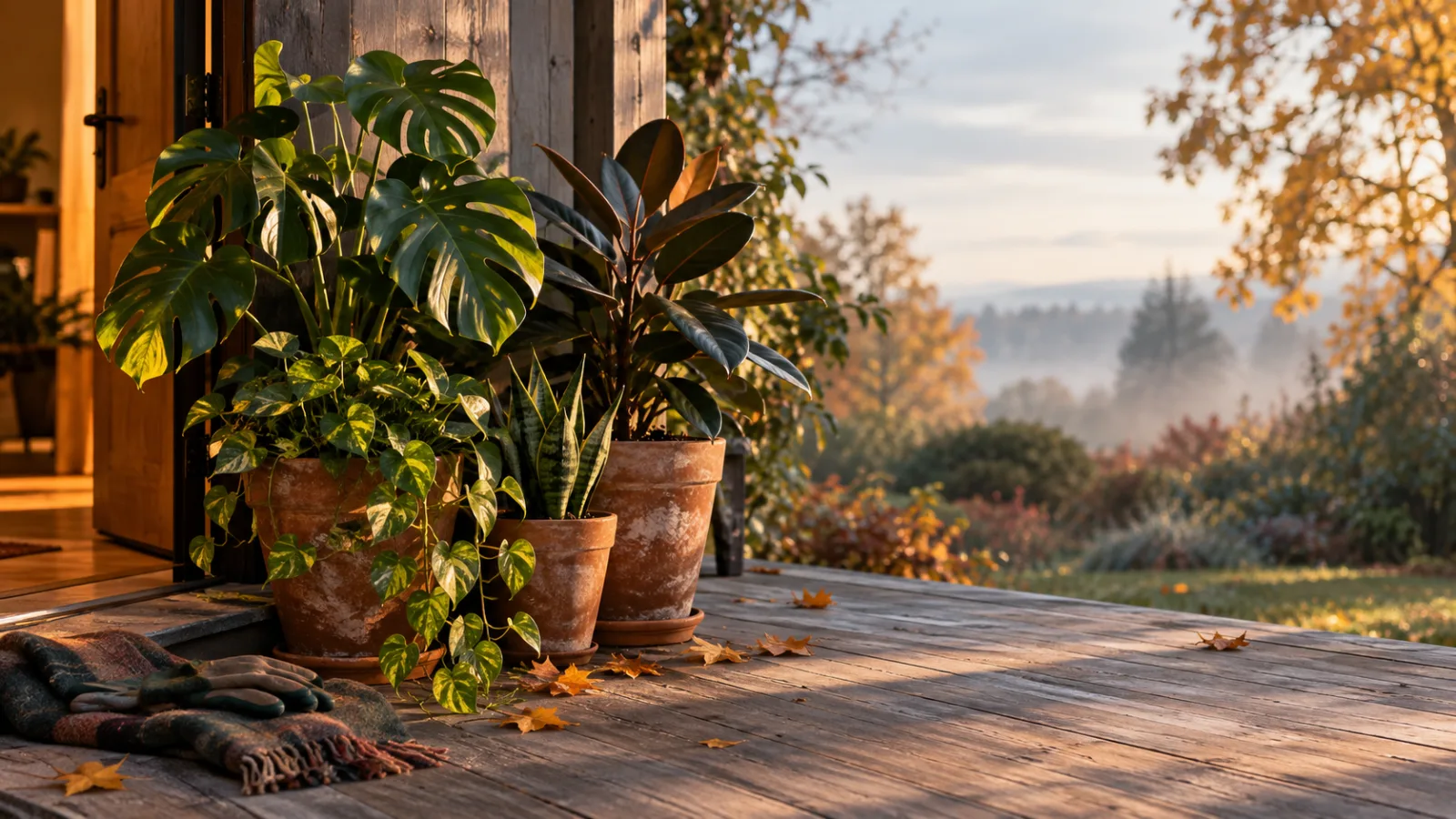
Plant care · 12 min read
When to bring plants inside for fall — the night temperature that decides it, and how to move them
Houseplants that spent summer outdoors need to come in well before the first frost. The night temperature that sets the date, the pest check to do on the doorstep, and why a plant drops leaves the week after the move.
Botanical Legacy · Field notes ·
The frost date is the deadline for a tomato. A monstera's deadline passed three weeks earlier.
The date is set by the nights, not the calendar
Most advice about bringing plants inside is anchored to the first frost, and for the plants most people are moving, that anchor is weeks too late. Frost matters to garden plants from temperate climates. The pots that spent summer on a balcony or patio are mostly tropical understory species — monstera, pothos, peace lily, calathea, fiddle-leaf fig — and nothing in their evolution prepared them for a night at 6°C, let alone one at zero. They're injured by cold long before water freezes.
The mechanism is chilling injury, and it's different from frost damage. Below roughly 10°C, the cell membranes of tropical plants are disrupted and tissue starts to fail without any ice forming at all. It shows up a few days later as dark water-soaked patches, limp new growth, or leaves that yellow and drop for no visible reason. By the time the forecast mentions frost, a tropical plant left outside has already been through a run of nights that did the harm.
So the number that sets the date is the overnight low, not the daytime high and not the month. A sunny 19°C afternoon in late September says nothing about the 7°C that follows it at 5am, and the plant lives through both. When night temperatures start landing near 10°C on a regular basis, the tender plants come in. In most temperate climates that comes well ahead of the first frost, often by several weeks.
There's a second reason not to wait, and it has nothing to do with cold. The longer a plant stays out, the bigger the gap between the conditions it leaves and the ones it arrives in. Move it while your windows are still open and the heating is still off, and indoors and outdoors are close to the same climate. Move it the night before a frost and it goes from cold, humid, bright air into warm, dry, dim air in a single afternoon. The second plant is the one that drops half its leaves.
Who comes in first
Not everything on the patio is on the same clock. Sorting the pots into three groups makes the job a few relaxed weekends instead of one panicked evening.
First in — nights near 10–12°C. The tropical foliage plants: monstera, pothos, heartleaf philodendron, calathea and prayer plant, alocasia, anthurium, peace lily, fiddle-leaf fig, rubber plant, croton, moth orchid. If it's sold as a houseplant and has broad, thin leaves, assume it belongs here.
Second in - nights near 7°C. The tougher, drier group: spider plant, jade, ponytail palm, most succulents and cacti, and hardier citrus such as lemons. They tolerate a cool night well as long as they're dry — cold and wet together is what rots them, so ease off the watering as the nights cool. Two succulents are exceptions and come in with the first group: snake plant is best kept above about 13°C, and aloe should be inside before nights dip below 10°C. Christmas cactus also wants cool nights, but not cold ones: nights of about 10-15°C, or long nights of 14 hours' unbroken darkness, are what set its flower buds, and it should be inside before nights drop below 10°C.
Staying out. Hardy perennials, shrubs, and anything planted for your climate zone. These need winter. Plants from temperate climates are adapted to a cool winter rest, and a heated living room is far warmer than they want.
If you don't know a plant's group, treat it as tender. Coming in two weeks early costs a plant nothing. Coming in two weeks late can cost the plant.
What to do at the door
Check for passengers before anything crosses the threshold. A summer outdoors means a summer of visitors, and outdoors they're kept in check by rain, wind, and predators. Indoors there's none of that, and a handful of aphids or spider mites on one plant becomes a problem on every plant by December. Look under the leaves, in the leaf joints, along the stems, and under the pot and in its drainage holes, where crawling pests hide. Rinse the foliage with a firm spray of water, wipe broad leaves down, and treat anything you find while the plant is still outside. The signs to look for are in the guide to common houseplant pests.
Quarantine the returners. Give everything that comes in two to three weeks apart from the plants that stayed indoors all summer. Most problems you missed at the door will show themselves in that window, on one plant instead of twelve.
Give them the brightest spot you have. Summer sun outdoors runs to many times the light of even a bright windowsill. A plant coming in is taking a large cut in light however well you place it, so put it at your best window and clean the glass — it's a small gain, and in October small gains count. If you have the time, soften the change: a week or two in a shadier spot outdoors first, or in for the nights and out for the days.
Water less than you did outside. Less light and cooler, still air usually mean the plant uses less water than it did in August, and the pot takes longer to dry. The summer rhythm carried indoors is the single most common way these plants are lost in autumn. Check the soil instead of the calendar, as covered in when to water houseplants, and know which way the symptoms point before you reach for the can.
Hold the repotting and the fertiliser. A plant that has outgrown its pot over summer can wait until spring. Disturbed roots heading into the lowest light of the year have little capacity to regrow, and feeding a plant that's slowing down pushes weak, stretched growth. One exception: if water runs straight through and the root ball is solid, move it up a single pot size and leave it at that.
Keep them off the radiator and out of the draught. The spot beside the balcony door feels like the natural landing place, and it's often the worst one in the house — cold air every time the door opens, and frequently a radiator underneath. Heated indoor air is also far drier than autumn air outside. Grouping plants together and keeping them away from heat sources does more for them than misting.
Three ways this plays out
The frost-date wait
A monstera and two calatheas spend the summer on a sheltered balcony and look better than they ever have. The plan is to bring them in "before the first frost," which the forecast puts in late October. Through the first half of the month the afternoons are mild and the plants look fine, so nothing moves. The nights, meanwhile, run between 5 and 8°C for two weeks. When the pots come in on the eve of the frost, the calatheas already have dark, translucent patches along the leaf edges, and the monstera's newest leaf collapses within the week. No frost ever touched them. The damage was done on a string of ordinary cool nights that didn't look like weather at all.
The leaf drop that isn't dying
A weeping fig comes in from the patio in late September, healthy and dense. Ten days later the floor under it is covered in leaves, and the reflex is to help — more water, some fertiliser, a move to a different room, then another. Each one makes it worse. The drop was the plant shedding leaves it built for outdoor light and could no longer afford at a window; ficus is famous for it, but most plants do a quieter version. Left in one bright spot, watered sparingly, it stops shedding within a few weeks and pushes smaller leaves suited to the room. The cure was to change nothing.
The passenger
A hibiscus that flowered all summer comes straight in from the terrace and takes the place of honour among the houseplants. Nobody looks under the leaves. There are spider mites there, a small population that outdoor humidity and rain had held down for months. In warm, dry indoor air a new generation can mature in under a week, and by late November there's fine webbing on the hibiscus and stippled, dusty-looking leaves on the three plants around it. Five minutes with a hose at the door, and a few weeks in a separate room, would have kept it to one plant.
What Botanical Legacy does about it
Every Specimen in your Sanctuary lives in a place — an indoor room or an outdoor spot — and outdoor Specimens are the ones that lean on real local weather. On the paid plan, with local weather turned on, Botanical Legacy reads the forecast low for your location against each outdoor Specimen's own tolerated temperature band. The first time a coming night is set to fall within a couple of degrees of that plant's minimum, you get a frost alert for that plant by name, with the forecast low — sent ahead of the night in question, which is the only time it's useful. It doesn't repeat every night after that: while the cold spell lasts it stays quiet unless the forecast turns at least 2°C colder. A Specimen with no recorded minimum is protected as a tender plant by default.
The detail that matters here is that the threshold belongs to the plant, not to zero. A calathea and a potted olive on the same balcony get warned on different nights, because they're in danger on different nights. That's the same sorting this guide does by hand, done per Specimen against the actual forecast — the principle behind predictive plant care, applied to cold instead of heat.
Once a plant is inside, move its Specimen to the room it now lives in. Its Digital Shadow stops modelling it against outdoor weather and starts modelling indoor conditions, so the watering estimate follows the room the plant is in now. That doesn't always mean slower — warm, dry heated air can dry a pot faster than a cool, damp autumn balcony did — which is one more reason to check the soil before trusting a date. If you've turned on seasonal care, dormancy goes a step further for species that rest in winter: the dry-down estimate lengthens and feeding holds until the season resumes, from your location and hemisphere.
And for the weeks after the move, when every dropped leaf looks like a verdict, a photo to the Doctor — powered by Botanical Vision v5 — gives you a second opinion on whether you're looking at adjustment, a watering problem, or something that came in with the plant.
What the model can't see
The forecast covers your area, not your balcony. A pot against a south-facing wall under an overhang can sit several degrees warmer at night than the nearest weather station, and one on an exposed rooftop several degrees colder; without a sensor on the spot, the model can't tell which you have. It also can't see under a leaf at the door. The pest check, the choice of window, and the decision to stop fussing over a plant that's shedding are all yours. What the Digital Shadow contributes is the part that's hard to do by feel — noticing, per plant, that the nights have turned before the plant has to tell you.
Frequently asked questions
What temperature is too cold for houseplants outside?
For most tropical houseplants, nights below about 10°C start causing stress, and nights near 5°C can cause visible damage — dark patches, limp growth, leaf drop — with no frost involved. Most succulents and cacti, jade and spider plants tolerate cooler nights, down to around 7°C, provided their soil is dry. Snake plant and aloe are exceptions and should come in with the tropicals.
When should I bring my plants inside for fall?
When overnight lows are regularly landing near 10°C, which in most temperate climates comes well before the first frost, often by several weeks. Go by the forecast lows for your location, not by the date or by how warm the afternoons feel.
Should I wait until the first frost warning?
No. A frost warning is a signal for the garden, but it's far too late for tropical houseplants, which are injured by cold well above freezing. Waiting also makes the move harder on the plant, because the gap between outdoor and indoor conditions is at its widest by then.
Why is my plant dropping leaves after I brought it inside?
Almost always because of the drop in light. Leaves grown outdoors are built for far brighter conditions than any window provides, and the plant sheds the ones it can no longer support. Keep it in one bright spot, water sparingly, and don't fertilise or repot. It typically settles within a few weeks and replaces them with leaves suited to the room.
How do I get rid of bugs before bringing plants inside?
Inspect under the leaves, in the leaf joints, and under the pot and in its drainage holes. Rinse the foliage thoroughly with a firm spray of water, wipe broad leaves, and treat anything you find with insecticidal soap while the plant is still outdoors. Then keep it apart from your other houseplants for two to three weeks, since eggs and small populations are easy to miss on the day.
Should I repot plants before bringing them in?
Generally no. Heading into the lowest light of the year, roots have little capacity to recover from disturbance, and a larger pot of fresh soil stays wet for longer at exactly the time the plant is drinking least. Wait for spring unless the plant is so root-bound that water runs straight through.
Does Botanical Legacy tell me when it's time to bring plants inside?
For outdoor Specimens on the paid plan with local weather turned on, yes — it compares the forecast low against each plant's own tolerated minimum and sends a frost alert by name before the first night that gets close to it, then stays quiet unless the forecast turns at least 2°C colder. It can't see your exact microclimate, so a sheltered or exposed spot can run warmer or colder than the forecast suggests.
Start your sanctuary
Botanical Legacy's free plan covers up to five Specimens, indoors or out, with continuous Digital Shadow modelling included. Every new account also gets a 14-day trial of the paid plan, which adds local weather, frost and heat wave alerts, and sensor support — the layer that watches the nights so you don't have to.
Start your sanctuary — five free specimens, no payment required →
A plant brought in two weeks early never notices. One brought in two weeks late remembers it until spring.
Sources
The plant-care facts on this page were checked against these references.
- UF/IFAS EP429: ask.ifas.ufl.edu/publication/EP429
- UF/IFAS MG025: ask.ifas.ufl.edu/publication/MG025
- UF/IFAS EP103: ask.ifas.ufl.edu/publication/EP103
- UF/IFAS EP530: ask.ifas.ufl.edu/publication/EP530
- Iowa State Extension: yardandgarden.extension.iastate.edu/faq/how-and-when-do-i-bring…
- Clemson HGIC: hgic.clemson.edu/factsheet/indoor-plants-moving-plants-indoors-…
- Clemson HGIC: hgic.clemson.edu/prepare-houseplants-to-move-back-inside
- University of Arkansas Extension: uaex.uada.edu/yard-garden/home-landscape/docs/Temperature Requi…
- UConn Extension: homegarden.cahnr.uconn.edu/2024/03/28/sensational-sansevieria
- MBG aloe: plantfinder.mobot.org/PlantFinderDetails.aspx
- MBG spider plant: plantfinder.mobot.org/PlantFinderDetails.aspx
- RHS citrus: rhs.org.uk/fruit/citrus/grow-your-own
- MBG ponytail palm: plantfinder.mobot.org/PlantFinderDetails.aspx
- MBG jade: plantfinder.mobot.org/PlantFinderDetails.aspx
- Clemson HGIC: hgic.clemson.edu/factsheet/thanksgiving-christmas-cacti
- UC IPM spider mites: ipm.ucanr.edu/PMG/PESTNOTES/pn7405.html
- Colorado State Extension: extension.colostate.edu/resource/managing-houseplant-pests
- Illinois Extension: extension.illinois.edu/houseplants/care
- Illinois Extension: extension.illinois.edu/houseplants/lighting
- RHS houseplants: rhs.org.uk/plants/types/houseplants/growing-guide
- RHS: how plants lose water: rhs.org.uk/advice/understanding-plants/how-plants-lose-water
- RHS overpotting: rhs.org.uk/prevention-protection/overpotting
- Nebraska Extension: lancaster.unl.edu/houseplants-humidity
- Iowa State Extension: yardandgarden.extension.iastate.edu/faq/air-our-home-extremely-…
- University of Missouri IPM: ipm.missouri.edu/MEG/2016/11/Houseplant_Acclimatization
- UF/IFAS EP101: ask.ifas.ufl.edu/publication/EP101