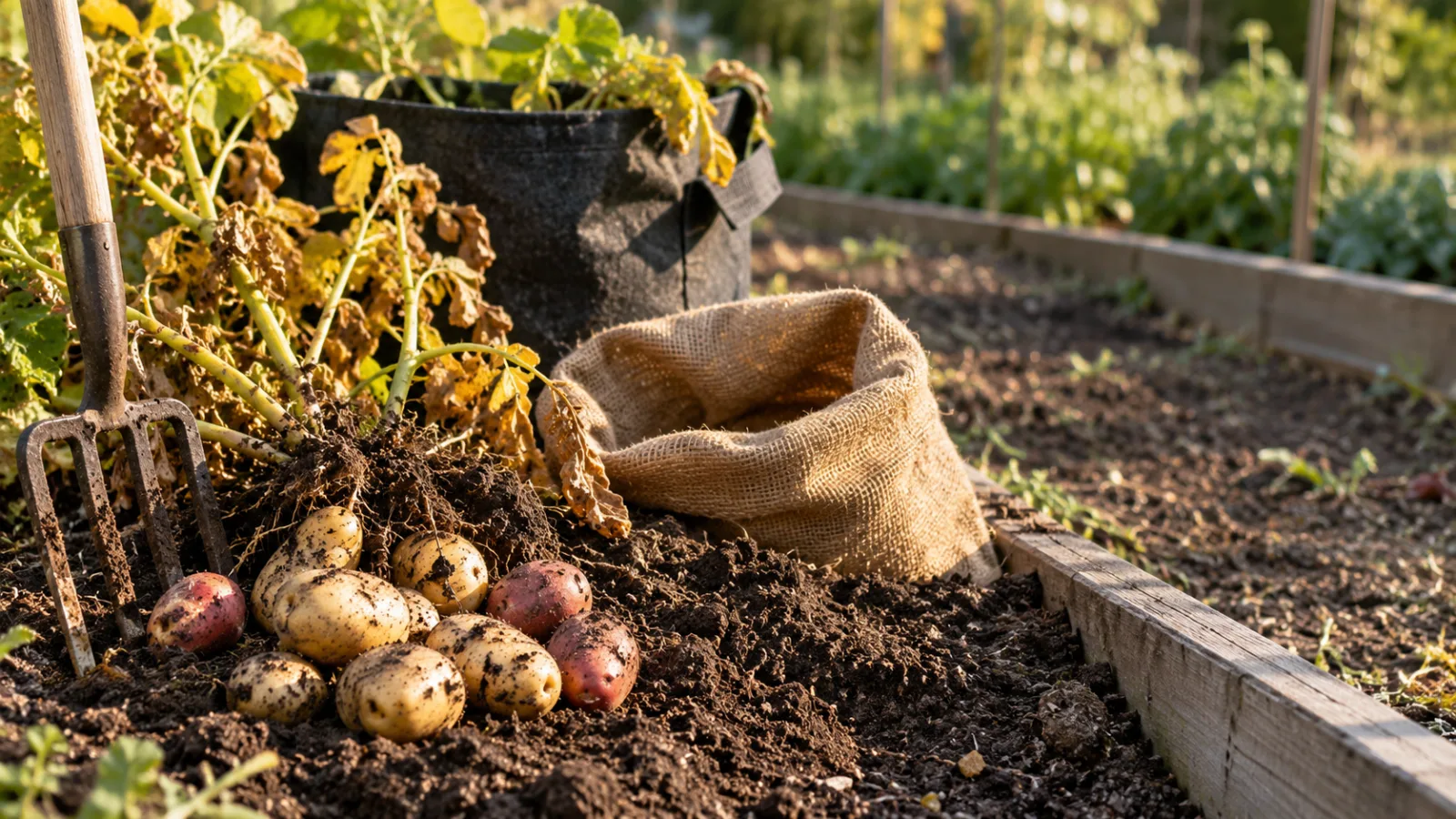
Plant care · 17 min read
When to harvest potatoes - new potatoes, maincrop, and how to store them
Earlies and maincrops are ready on different signals: new potatoes when the plants flower, maincrops after the foliage dies and the skins set. How to test-dig, when to lift, how to cure and store the crop, and the growing steps that lead up to it, in beds, containers and grow bags.
Botanical Legacy · Field notes ·
Flowers are the signal for new potatoes. For a sack that lasts the winter, the signal is dead leaves, and then ten more days.
Two harvests, two different signals
"When to harvest potatoes" has two answers, because a potato crop is grown for one of two purposes, and the plant tells you something different for each.
Potato varieties come in two broad groups. Earlies, split into first and second earlies, are the new potatoes: small, thin-skinned and fast. The RHS says they can be ready in as little as 12 weeks. Maincrops grow on through the summer into larger tubers with the thick skins that let them keep for months. In the UK, the RHS puts first earlies ready to lift in June and July, second earlies in July and August, and maincrops from late August through October. US extension services count it in days: most varieties are ready somewhere between about 80 and 120 days after planting, depending on the variety and the source.
The popular rule is to dig when the plant flowers. It is half right. The RHS advice for earlies is to harvest when the flowers are open or the buds drop. But the flowers are a rough cue rather than the event itself. By the University of Florida's count, tubers start forming on the tips of underground stems around 55 to 70 days in, and this usually happens before the plant flowers. A Wageningen field study of 238 potato genotypes found the timing of tuber formation was not closely related to the timing of flowering. So a flower says tubers are probably there. Only a look under the soil says how big they are.
For maincrops, the flowers are irrelevant. What matters is the skin. A tuber dug while the plant is still green has a thin skin that rubs off under your thumb; it bruises, peels and rots in storage. Once the foliage dies, the skin thickens and sets over the following days and weeks. The University of Illinois puts it plainly: waiting until the skin hardens reduces bruising, peeling and storage rot. That is why the RHS advice for a storage crop has a pause in it: when the leaves turn yellow, cut off and remove all the top growth, wait 10 days, then dig.
New potatoes are eaten within days, so their skins do not matter. A maincrop is a crop you will eat in February, and its skin is the packaging.
When to harvest potatoes, step by step
Know which group you planted. The seed potato bag or variety name says first early, second early or maincrop. It decides everything that follows: earlies are dug while the plant is green, maincrops after it has died back.
Lift earlies when the flowers open or the buds drop, after a test dig. Before you dig up a whole plant, the RHS suggests gently scooping away some soil to look at the tubers, and covering them again if they are not big enough. They are ready when they are about the size of a hen's egg. Lift them a plant or two at a time as you need them: new potatoes do not store, and Iowa State University Extension advises using them within 10 days.
For storage, wait for the foliage to yellow, cut it off, and wait 10 days. That is the RHS method for maincrops you want to keep. US extension services give a little longer: Nebraska Extension about two weeks after the vines die, Florida and Illinois two to three weeks. Any of these gives the skins time to set.
Rub a tuber before you lift the row. Dig one plant and rub a potato with your thumb. If the skin stays firmly attached, the crop is ready to store. If it rubs or peels away, Nebraska Extension advises waiting a few more days.
Do not leave maincrops in until you need them. Healthy maincrops can stay in the ground until mid-autumn, says the RHS, but slugs tunnel into maincrop tubers in damp autumn weather, and the RHS advice is to lift them as soon as they have matured. Earlies are usually unaffected, because they are out of the ground by midsummer.
Fork from well outside the plant. Insert the fork at least 30 cm from the base of the stem, as the RHS advises, to avoid spearing tubers. Nebraska Extension suggests a warm, dry day for digging. Set any speared, cut or damaged potatoes aside for the kitchen rather than the store.
Dry them on the soil for a few hours. The RHS advice is to leave lifted tubers in the sun for a few hours to dry, then brush off the soil. Brush, do not wash: Nebraska Extension notes that washing shortens storage life and raises the risk of rot.
Curing and storing potatoes
Cure them if you have somewhere suitable. US extension services add a curing stage before long storage: a couple of weeks somewhere cool and humid, which heals small cuts and bruises and thickens the skin. Iowa State gives 10 to 16°C (50 to 60°F) at 85 to 90% humidity for two weeks; Florida suggests 10 to 14 days at a slightly warmer 15 to 18°C (60 to 65°F), in the dark. The RHS guide goes straight from drying to storing, so treat curing as a refinement, not a requirement.
Store only sound, dry tubers in the dark. The RHS stores potatoes in paper or hessian sacks, or on slatted trays, in a dark, dry, cool and frost-free place such as a garage, and checks them every few weeks for rot. Darkness stops them sprouting and turning green. Take out any that soften, because a rotting tuber spoils its neighbours: Florida's advice is to remove damaged or rotten tubers before storage for that reason.
Aim for cold, not freezing. US extension services give an ideal long-term store of about 4°C (40°F) at high humidity; Maine says 3°C (38°F), and Illinois warns that below that the tubers can be damaged inside. Iowa State notes that potatoes kept below about 4°C develop a sweet taste, and that a few days at room temperature restores the flavour. A store above 10°C (50°F) may start them sprouting within two to three months.
The fridge is allowed again in the UK. The Food Standards Agency used to advise against keeping raw potatoes in the fridge, because the sugars that build up in the cold were thought to raise acrylamide when the potatoes are fried or roasted. After a study reviewed by the government's toxicity committee found fridge storage does not materially increase that potential, its current advice is that you can store them either in the fridge or in a cool, dark place. Utah State University Extension still advises against refrigerating, because the potatoes turn sweet and darken when cooked. Either way, the FSA advises cooking to a golden yellow colour or lighter.
Throw out green potatoes, or at least the green parts. Potatoes turn green when they are exposed to light, and green skin carries solanine, a bitter glycoalkaloid. The FSA advises cutting off any green parts before use, and notes that poisoning is extremely rare; the RHS advice for a home crop is to discard green potatoes. The small green berries that sometimes follow the flowers are a different matter: NC State Extension lists them as extremely toxic. Do not eat them, and keep them away from children.
Eat the stored crop before spring. The RHS suggests aiming to use stored potatoes up by early spring.
Growing potatoes to that point
Buy certified seed potatoes. The RHS recommends seed potatoes certified virus-free. Florida and Iowa State extension services add that supermarket potatoes can carry disease and may have been treated to stop them sprouting.
Chit earlies from late winter. Chitting means letting the seed potatoes sprout before planting. The RHS says it is worthwhile for early varieties and gives no real advantage for maincrops. Start from late January in milder areas to early March in colder ones: stand the tubers in egg boxes or seed trays with the eyes uppermost, in a bright, frost-free place, until the sprouts are about 5 cm long, which takes four to six weeks.
Plant in spring, in order. The RHS plants first earlies around late March, second earlies in early to mid-April, and maincrops from mid-April to early May, a little later in cold areas and earlier in mild ones. University of Illinois Extension waits for the soil to reach 7°C (45°F). Set them in a trench about 15 cm deep, sprouts upwards: earlies 30 cm apart in rows 60 cm apart, maincrops 37 cm apart in rows 75 cm apart.
Earth up when the shoots reach about 23 cm. Draw soil up around the stems to make a ridge, leaving the top 10 cm of the plant showing, and repeat as they grow, says the RHS. It does two jobs: it keeps the developing tubers in the dark, so they do not turn green, and it protects the shoots from late frosts. Potato shoots are at risk of frost in April and May; if a frost is forecast after they appear, the RHS suggests covering them overnight with hessian or straw, or drawing more soil over them.
In a container or grow bag, plant earlies and top up as they grow. The RHS says early varieties suit containers best, because the plants are smaller and faster. Use a pot or bag at least 30 cm wide and deep, with drainage holes, half-filled with about 15 cm of peat-free multipurpose compost. Plant one seed potato per 30 cm of width, just below the surface, and add compost as the shoots appear until it is just below the rim: that is earthing up, done in a bag. A container needs watering regularly all season, because it has only the compost it holds. If you are new to growing food, how to start a vegetable garden covers choosing the spot and the first crops.
Water most when the tubers are forming. Iowa State suggests about 2.5 cm (an inch) of water a week, and steady moisture once the tubers start to develop: alternating wet and dry spells cause growth cracks, hollow centres and knobbly tubers. Dry soil while the tubers form also makes common scab worse, according to the RHS, as do alkaline or recently limed soils. Its advice for scab-prone ground is to water, if needed, from two to three weeks after the shoots emerge, for about four weeks, at 20 litres per square metre.
Watch for blight in warm, wet summers. Late blight is the disease potatoes share with tomatoes, and the RHS says it is most common in warm, wet weather. AHDB's national warning system for Great Britain uses the Hutton Criteria: two consecutive days, each with a minimum temperature of at least 10°C and at least six hours at 90% humidity or more. The RHS points gardeners to the BlightSpy forecasts, and notes that first earlies, lifted before the disease usually builds up, are more likely to escape it, and that earthing up well gives the tubers some protection from spores washed down from the leaves. When about a quarter of the leaves are affected, or the stems show lesions, the RHS advice is to cut off the foliage, then dig the tubers once the skins have hardened, after about two weeks, and to eat blighted crops quickly rather than store them. Resistant varieties include the Sarpo types, such as 'Sarpo Mira', though none is immune. The tomato guide covers blight on the tomato side, and why the two crops should not follow each other.
Move the crop each year. The RHS rotation plans bring potatoes back to the same bed every three or four years. Where potato cyst nematode has turned up, its eggs can last up to ten years, and the RHS advises at least five to six years between potato crops.
Three ways this plays out
The grow bag dug at the first flower
A grow bag of first earlies goes onto a patio in early April, topped up with compost twice as the shoots climb. In June the plants flower. A hand scooped into the top of the bag finds a few tubers the size of a walnut, so the compost goes back and the bag is watered. Ten days later the same check finds eggs. The bag is tipped out a week before a family lunch, and the potatoes are eaten that evening and the next. The flowers said the tubers had started; the test dig said when they were ready.
The maincrop left in for convenience
A row of maincrops dies back at the end of August, and since the ground is a good store, they are left in to be dug as needed. September is mild and October is wet. By November, a third of the tubers lifted have holes tunnelled into them, the work of keeled slugs, which live mostly underground and tunnel into maincrops in damp autumn weather. The RHS advice was to lift them once mature. Ten days after cutting the yellowed tops, the whole row would have been in sacks in the garage.
The blight that came in July
A warm, humid week in late July, and the leaves on a row of second earlies develop brown patches, with a fine white growth on their undersides. Within days a quarter of the foliage is affected. The stems are cut near soil level, the debris raked up and sent to the council green waste rather than the compost heap, and the row is left for two weeks before digging, so the skins harden. The crop is smaller than it would have been and is eaten over the following weeks rather than stored. The tomatoes in pots by the back door are moved to the far side of the garden.
What Botanical Legacy does about it
A row of potatoes or a grow bag on the patio can be a Specimen in your Sanctuary like any houseplant: add it with a photo and put it in one of your places marked as outdoor, such as the vegetable bed or the patio. The app does not count the weeks to harvest, and it cannot see a tuber. What it watches is the weather over the crop and the water in the compost.
Frost alerts while the shoots are young. On the paid plan, with local weather turned on and your location set, Botanical Legacy reads the next two days' forecast for every Specimen in an outdoor place. When the forecast low comes within 2°C of that plant's recorded minimum temperature and stays there for two hours or more, you get a frost alert that names the plant, which is your cue to draw soil over the shoots or lay fleece on them. A night that comes close without passing the plant's own limit is reported if it is unusually cold for the time of year, or if the plant has had no frost alert for a month, so the first cold night after the shoots come up reaches you and ordinary cool nights do not repeat it every evening.
Rain can count as a watering. With local weather on, you can turn on rain auto-watering in your preferences. Each night, if 5 mm or more of rain has fallen at the plant's location within the last 24 hours, and since its last watering, the app logs a watering for each outdoor Specimen, and its Digital Shadow starts its moisture estimate again from there. Drizzle below that does not count.
The watering estimate for a bag or a bed. Each Specimen's Digital Shadow models how wet its compost is and sends the watering reminder when it reaches dry (how predictive plant care works). For an outdoor Specimen on the paid plan with local weather on, it takes the local temperature and humidity as the plant's surroundings. On every plan, the soil checks you log correct the estimate for that bag, and on the paid plan a soil-moisture sensor connected through Home Assistant does the same continuously.
The Doctor reads the leaves. A photo of a spotted or browning leaf to the Doctor, powered by Botanical Vision v5, comes back with a health verdict, the symptoms it sees and their likely cause, and a named disease or pest with its treatment where there is one. Each diagnosis uses one photo read from the monthly allowance that identification also draws on: 3 a month on the free plan, 120 on Cultivator. How to read plant health signs covers what to look for yourself first.
What the model can't see
It does not know which variety you planted, whether it is an early or a maincrop, or the day it went in, so it cannot tell you when to dig. The flowers, the yellowing leaves and the thumb test on the skin are yours to read.
It cannot see underground at all. The size of the tubers, a slug in the row, scab on the skins: a test dig is the only way to find out.
It sends no blight warning. Its weather alerts are for frost and heat; for blight, use the BlightSpy forecasts the RHS points to, and your own eyes on the leaves.
Rain auto-watering is one setting for your whole account, and applies to every Specimen in an outdoor place. A grow bag against a wall under the eaves gets none of the rain the forecast records, and potatoes forming tubers are the plants that suffer from an uneven supply. If your bags are sheltered, leave it off, or keep them in a place not marked outdoor, knowing they then get no frost alerts. Only you know which ones the rain reaches.
And a frost alert cannot tell whether you have already earthed the row up or thrown fleece over the bag.
Frequently asked questions
When should you harvest potatoes?
It depends on the type. In the UK, the RHS puts first earlies ready in June and July, second earlies in July and August, and maincrops from late August through October. Lift earlies when the plants flower or the buds drop and the tubers are about the size of a hen's egg. For maincrops you want to store, wait until the foliage turns yellow, cut it off, and dig 10 days later.
How do you know when potatoes are ready to dig up?
For new potatoes, scoop away some soil at the base of a plant once it flowers and look at the tubers: hen's-egg size is ready, and smaller ones can be covered back up. For storage potatoes, the foliage should have yellowed and died back, and the skin on a sample tuber should stay firmly attached when you rub it with your thumb. If it rubs off, wait a few more days.
Do potatoes have to flower before you harvest them?
No. Flowering is a rough cue that tubers have formed, not a guarantee of their size. Tubers usually start forming before the plant flowers, and research has found the two are not closely linked in timing. A test dig is the reliable check, and maincrops are judged by the dying foliage and the skin, not the flowers.
How long can you leave potatoes in the ground?
The RHS says healthy maincrops can stay in until mid-autumn, but advises lifting them as soon as they have matured, because slugs tunnel into maincrop tubers in damp autumn weather. Earlies are best dug as soon as they are ready and eaten fresh.
How do you cure and store potatoes after harvest?
Leave them on the soil in the sun for a few hours to dry, brush the soil off without washing, and set damaged ones aside rather than storing them. US extension services suggest curing them for about two weeks at 10 to 16°C and high humidity to toughen the skins. Then store them in paper or hessian sacks somewhere dark, cool and frost-free, ideally around 4°C, and check them every few weeks for rot.
Can you store potatoes in the fridge?
In the UK, yes. The Food Standards Agency changed its advice after a study found fridge storage does not materially raise the acrylamide that forms when potatoes are cooked; you can keep them in the fridge or in a cool, dark place. Some US extension services still advise against it, because cold-stored potatoes turn sweet and darken when cooked. Cook them to a golden yellow or lighter either way.
Can Botanical Legacy tell me when to harvest my potatoes?
No. It does not know your variety or planting date, and it cannot see the tubers. On the paid plan, with local weather turned on and your location set, it does send frost alerts for potatoes added as Specimens in a place marked outdoor, which matters most while the shoots are young in spring. It also models how fast a grow bag dries, and soil checks you log on any plan correct that estimate.
Start your sanctuary
Botanical Legacy's free plan covers up to five Specimens, indoors or out, with continuous Digital Shadow modelling and soil checks that teach each Specimen's drying rate. Every new account also gets a 14-day trial of the paid plan, which adds local weather, frost alerts for outdoor Specimens, rain auto-watering and sensor support via Home Assistant - the layer that learns how your grow bags dry so you don't have to guess.
Start your sanctuary - five free specimens, no payment required →
Dig new potatoes when the plants flower. Dig the winter's potatoes ten days after you have cut the plants down.
Sources
20 references
The plant-care facts on this page were checked against these references.
- RHS: rhs.org.uk/vegetables/potatoes/grow-your-own
- UF/IFAS Extension (HS933): edis.ifas.ufl.edu/publication/HS183/pdf
- Iowa State University Extension: yardandgarden.extension.iastate.edu/how-to/growing-potatoes-hom…
- Annals of Applied Biology (Celis Gamboa et al. 2003, Wageningen): research.wur.nl/en/publications/temporal-dynamics-of-tuber-form…
- University of Illinois Extension: web.extension.illinois.edu/hortanswers/plantdetail.cfm
- Nebraska Extension: lancaster.unl.edu/potatoes-harvesting-storage
- Iowa State University Extension (FAQ): yardandgarden.extension.iastate.edu/faq/when-should-i-harvest-p…
- RHS: slugs and snails: rhs.org.uk/biodiversity/slugs-and-snails
- University of Maine Cooperative Extension: extension.umaine.edu/publications/2077e
- Iowa State University Extension: yardandgarden.extension.iastate.edu/faq/how-should-i-store-pota…
- University of Illinois Extension: extension.illinois.edu/gardening/potato
- Food Standards Agency: gov.uk/government/publications/acrylamide/acrylamide
- Utah State University Extension: extension.usu.edu/nutrition/research/potatoes.pdf
- Food Standards Agency: gov.uk/government/publications/home-food-fact-checker/home-food…
- NC State Extension: plants.ces.ncsu.edu/plants/solanum-tuberosum/common-name/irish-…
- RHS: potato scabs: rhs.org.uk/disease/potato-scabs
- AHDB: potatoes.ahdb.org.uk/development-and-implementation-of-a-new-na…
- RHS: potato and tomato blight: rhs.org.uk/disease/potato-and-tomato-blight
- RHS: crop rotation: rhs.org.uk/vegetables/crop-rotation
- RHS: potato cyst nematodes: rhs.org.uk/biodiversity/potato-cyst-nematodes