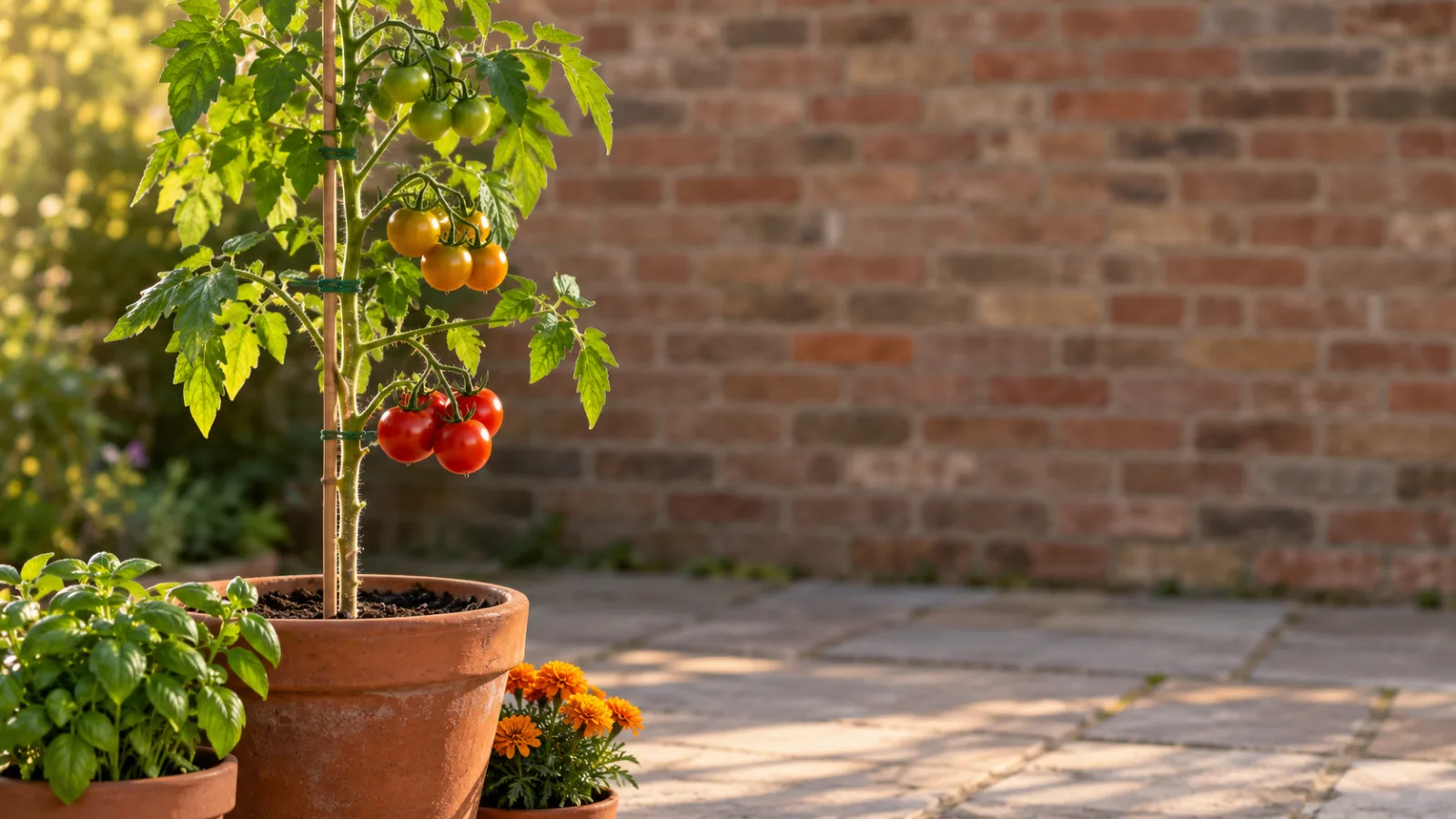
Plant care · 17 min read
How to prune tomato plants - sideshoots, companion plants and care in pots or beds
Whether to prune a tomato depends on how it grows: cordons lose their sideshoots, bush types keep them. When to pinch and when to stop the plant, which companion plants have real evidence behind them, and the watering, feeding and timing that matter more in a pot than in a bed.
Botanical Legacy · Field notes ·
Pinch out a cordon tomato's sideshoots and you get bigger fruit, sooner. Pinch out a bush tomato's and you have thrown away part of the crop.
Pruning depends on how your tomato grows
Almost every guide to pruning tomato plants starts with the same instruction: remove the suckers. It is good advice for one kind of tomato and the wrong advice for another, and the label on the plant tells you which one you have.
A sideshoot, which American guides call a sucker, grows in the leaf joint, between the main stem and a leaf stalk. It is a new stem, and given room it grows leaves, flowers and fruit of its own. Whether you want it depends on the plant's habit.
Cordon tomatoes, also called indeterminate or vine tomatoes, keep extending their main stem through the season. The RHS describes them as needing regular tying-in to a support and the removal of their sideshoots, so the plant puts its effort into a single stem and the fruit on it.
Bush tomatoes, also called determinate, are compact, and the RHS advice is the opposite: leave their sideshoots to grow, because those shoots carry much of the crop. Bush types suit large patio containers, troughs and window boxes. In between sit semi-determinate varieties, which Utah State University Extension groups with the cordons as needing support and some pruning.
It also helps to know what pruning buys you, because it is not more tomatoes. In a two-year field trial in North Carolina, published in the Journal of the American Society for Horticultural Science, unpruned plants gave a greater total weight of fruit than pruned ones, but few large fruits; pruning raised the early harvest and the share of big fruit. A later trial in Florida found pruning made no difference to marketable yield at all. University of New Hampshire Extension puts the trade plainly: removing sideshoots reduces the potential yield and improves airflow.
So pruning a cordon buys a plant that fits a cane and a pot, earlier and larger fruit, and air moving through the leaves, at the cost of some total weight. Prune too hard and you also lose shade: Iowa State, NC State and Ohio State extension services all warn that fruit left without enough foliage over it gets sunscald.
How to prune tomato plants, step by step
Find out which kind you have before you cut anything. The seed packet or plant label will say cordon or indeterminate, bush or determinate. If the label is gone and you are not sure, leave the sideshoots alone: on a bush tomato, a sideshoot removed takes part of the crop with it.
On a cordon, pinch out sideshoots while they are small. Pinch or snap off any shoot growing in a leaf joint, checking each time you water, as the RHS suggests. NC State Extension says to take them before they pass 5 to 10 cm, University of New Hampshire Extension under 5 cm. For one that has been missed and grown long, Ohio State describes "Missouri pruning": pinch off its tip just beyond its first two leaves, which keeps a little extra leaf over the fruit.
Tie the main stem in as it grows. A cordon trained to one stem needs a cane, string or stake, and the RHS advises tying it in regularly as it climbs. Use soft ties, and tie loosely.
On a bush tomato, leave the sideshoots. This is the RHS position. US extension services go slightly further: Iowa State and Ohio State say you can remove the sideshoots below the first flower cluster on a determinate plant, and leave everything above it. Iowa State also warns that topping a determinate tomato significantly reduces its yield. A heavily laden bush plant may need a few canes for support.
Stop a cordon once it has four trusses outdoors, or seven under glass. A truss is a cluster of flowers, and later of fruit. At four trusses outdoors, seven in a greenhouse, or the top of its support, the RHS advice is to remove the growing tip two leaves above the top truss. Iowa State gives the same instruction as a date: top plants four to six weeks before the first autumn frost, and remove new flowers from about four weeks before it.
Clear the lowest leaves, but not above the fruit. Iowa State and NC State suggest removing the leaves from the bottom 15 to 30 cm of the stem, which keeps soil-borne disease from splashing onto the foliage, plus any yellowing or diseased leaves. The RHS adds a limit: keep it to a minimum, and never strip higher than the lowest truss of ripening fruit, or ripening problems become more likely.
Stop pruning before the first fruit is ready. University of Wisconsin-Madison Extension suggests stopping one to two weeks before you expect the first harvest, so the canopy can close over the fruit. On a hot, south-facing patio, err towards more leaves rather than fewer.
Companion plants for tomatoes: what the evidence supports
Most lists of companion plants for tomatoes are folklore. Linda Chalker-Scott, a horticulturist at Washington State University, concluded that traditional companion charts have "entertainment, not scientific, value". Her later extension guide accepts a few mechanisms, chiefly flowers that feed the insects that eat pests. Here is each popular companion, and how strong the evidence is.
French marigolds: a real effect, under glass, if planted at the start. The best evidence there is. In two large UK glasshouse trials, published in PLoS ONE in 2019, French marigolds grown among tomatoes from the seedling stage slowed the build-up of glasshouse whitefly, through limonene, a scent they release. The difference only appeared after about 34 days, and marigolds brought in after the whitefly had built up made very little difference. So this is prevention planned in spring, shown in a greenhouse, not a treatment and not yet shown in an open bed. Washington State University adds that French marigolds can discourage some beneficial insects too.
Marigolds against root-knot nematodes: as a cover crop, not a border. The University of Florida's IFAS Extension says marigolds can reduce root-knot nematodes in the soil, but only when they are planted densely, on the same ground, at least two months before the tomatoes go in. It describes interplanting them among tomatoes as very risky. The effect has to be renewed each season, and is worth the effort only where root-knot nematodes are a known problem.
Basil: grow it for the kitchen. We found no evidence that basil improves the flavour of tomatoes. West Virginia University's garden-scale trials found pests on tomatoes did not respond to companion planting, and taste differences were not consistent from year to year. A field trial in Kenya cut whitefly on tomatoes by 68.7%, but with insect netting and basil together, so basil's own share is unknown. It is a reasonable neighbour all the same: in the West Virginia trials, pairs containing basil competed least.
Flowers for hoverflies and parasitic wasps: sound in principle. Washington State University supports "insectary" planting, a variety of flowers whose pollen and nectar keep hoverflies, ladybirds, predatory bugs and parasitic wasps near your crops. University of California researchers recorded lower aphid numbers in lettuce fields with insectary plants such as alyssum. Well founded, but not tested on tomatoes the way marigolds have been.
Nasturtiums: a trap crop with little trial evidence. Nasturtiums are widely recommended as a sacrificial plant that draws aphids away from tomatoes, but a 2017 scientific review of companion plants for aphid control does not mention them at all. If you grow them as a trap, clear infested plants, or they become a nursery for the aphids you meant to divert.
Potatoes: share a disease, so keep them out of the rotation. Tomatoes and potatoes are attacked by the same late blight, Phytophthora infestans, and the RHS names infected potato plants as the usual source of it each year. Its advice is to rotate crops for at least four years, keeping both tomatoes and potatoes out of a bed where blight has been.
Brassicas, fennel and black walnut: weaker cases than the charts suggest. We found no primary source showing that cabbages or their relatives harm tomatoes; in the West Virginia trials, Brussels sprouts simply competed hard for light and water. An extension specialist found there is not enough research on fennel to say whether it suppresses anything. Black walnut is the strongest case: extension services in Ohio, Wisconsin and Pennsylvania list tomato as sensitive to juglone, the compound the tree releases, with effects reported 15 to 24 m from the trunk, though Wisconsin notes its list rests on observation rather than formal testing.
Tomato care for beginners: pots, beds and the season
Sow indoors in late winter, and plant out after the last frost. The RHS sows greenhouse tomatoes from late February to mid-March and outdoor ones from late March to early April, at about 18°C. Plants go out in early summer, once temperatures are reliably above 16°C and nights are consistently above 7°C; tomatoes do better once nights stay above 10°C. Its regional guide puts that during May on the south coast, at the end of May across the Midlands and north-west England, and in early June in north-east England, southern Scotland and Northern Ireland. Harden plants off for two to three weeks first. That gets them used to outdoor conditions, but the RHS is clear it does not make a frost-tender plant hardy.
Plant deep. Bury the stem so the first set of leaves sits just above the surface: the RHS notes the buried stem grows extra roots.
Give a container tomato a pot 30 to 45 cm across. That is the RHS figure for one plant, or two to a standard growing bag; University of Illinois Extension sets the minimum at 5 gallons, about 19 litres. In the ground, the RHS spaces plants 45 to 60 cm apart.
Water evenly, and in a pot, more often than you expect. Container tomatoes can need water daily in hot weather, and in a hot spell the RHS says two or more times a day, two waterings being better than one of double the volume. Swings between dry and wet compost are what split fruit and cause blossom-end rot.
Treat blossom-end rot as a watering problem, not a calcium one. The sunken black patch at the base of the fruit is calcium failing to reach it, but the RHS notes that soils and composts very rarely lack calcium. Calcium travels in the water moving through the plant, so irregular watering starves the fruit of it, and calcium sprays do not help.
Feed with a high-potash fertiliser once the first fruits swell. For container plants the RHS suggests a high-potassium liquid feed every 10 to 14 days from that point. Keep to the dose on the bottle: too much potassium can bring on magnesium deficiency and, again, blossom-end rot.
Help pollination under glass. Tomato flowers pollinate themselves, but the pollen has to be shaken loose. Outdoors, wind and bumblebees do it; in a greenhouse, the RHS suggests opening the vents and tapping the trusses when the flowers are fully open.
Expect flowers to drop in extreme heat or cold. Ohio State Extension gives the conditions: nights below about 13°C, or days above 32°C with nights above 24°C. Flowers often fall without setting fruit then. It is the weather, not the pruning or the feed.
Watch for blight in warm, wet spells. Late blight spreads when leaves stay wet for several hours in warm weather, from June in the UK, and outdoor tomatoes are most at risk. Gardeners have no fungicide for it. The RHS advice is to dispose of infected plants rather than compost them and to consider resistant varieties such as 'Crimson Crush'.
Finish ripening off the vine. Tomatoes stop making their red pigment above about 29°C, according to Purdue University Extension, so fruit can be slow to colour in a heat wave. Fruit that has started to blush ripens off the vine with no loss of flavour, says Colorado State University Extension, and at the end of the season the RHS suggests ripening the last fruit somewhere warm, or in a drawer with a banana.
Three ways this plays out
The bush tomato pruned like a cordon
A compact bush variety goes into a 40 cm pot on a balcony in late May, and every weekend its sideshoots are pinched out, because every guide said to remove the suckers. By August it is one thin stem with two trusses. A second plant of the same variety, left alone beside it, is a dense mound with fruit on six or seven stems. The label said "bush", and the label was the instruction.
The growbag under the eaves
A cordon tomato in a growing bag against a south-facing wall gets watered whenever it looks limp, and skipped on rainy days. The wall sits under a deep overhang, so the rain never reaches the bag. By mid-July the lowest truss has sunken black patches at the base of every fruit, and the next is splitting after each heavy catch-up watering. The compost had plenty of calcium. What it lacked was a steady supply of water to carry it there, and a morning watering every day, with a second on hot afternoons, is the fix for the trusses still to come.
The marigolds that came too late
Whitefly turns up on greenhouse tomatoes in July, and a tray of French marigolds goes in among them the same week. It makes little visible difference, which is what the UK glasshouse trials found when marigolds were added to an established infestation. They worked when growing among the tomatoes from the start, and even then took about a month to show. Companion planting is a decision made in March.
What Botanical Legacy does about it
A tomato can be a Specimen in your Sanctuary like any houseplant: add it with a photo and put it in one of your places marked as outdoor, such as the patio or the vegetable bed. What the app does for it is mostly about weather.
Frost alerts around planting-out time. On the paid plan, with local weather turned on and your location set, Botanical Legacy reads the next two days' forecast for every Specimen in an outdoor place. When the forecast low comes within 2°C of that plant's recorded minimum temperature and stays there for two hours or more, you get a frost alert that names the plant. A night that comes close without passing the plant's own limit is reported if it is unusually cold for the time of year, or if the plant has had no frost alert for a month, so the first cold night after planting out reaches you and ordinary cool nights do not repeat it every evening.
Heat alerts for the hottest days. When the forecast high is more than 2°C above a Specimen's recorded maximum, and either unusual for your area at that time of year or at least 6°C above the maximum, a heat alert names the plant. A plant with no recorded maximum gets no heat alert.
Rain can count as a watering. With local weather on, you can turn on rain auto-watering in your preferences. Each night, if 5 mm or more of rain has fallen at the plant's location within the last 24 hours, and since its last watering, the app logs a watering for each outdoor Specimen, and its Digital Shadow starts its moisture estimate again from there. Drizzle below that does not count.
The watering estimate uses your weather and your checks. Each Specimen's Digital Shadow models how wet its compost is and sends the watering reminder when it reaches dry (how predictive plant care works). For an outdoor Specimen on the paid plan with local weather on, it takes the local temperature and humidity as the plant's surroundings. On every plan, the soil checks you log correct the estimate for that pot, and on the paid plan a soil-moisture sensor connected through Home Assistant does the same continuously.
The Doctor reads the leaves and fruit. A photo to the Doctor, powered by Botanical Vision v5, comes back with a health verdict, the symptoms it sees and their likely cause, and a named disease or pest with its treatment where there is one. Each diagnosis uses one photo read from the monthly allowance that identification also draws on: 3 a month on the free plan, 120 on Cultivator. How to read plant health signs covers what to look for yourself first.
What the model can't see
It does not know whether your tomato is a cordon or a bush, how many trusses it has set, or which sideshoots you pinched. Pruning, tying in and stopping the plant are yours entirely.
The weather it reads is for your area, not your wall: a south-facing patio with hot paving can run well above the forecast on a still afternoon (the outdoor heat wave guide covers that), and a greenhouse is a different climate again (greenhouse heat wave guide).
Rain auto-watering is one setting for your whole account, and applies to every Specimen in an outdoor place. A growbag under the eaves or a balcony with a roof over it gets none of the rain the forecast records. If your tomatoes are sheltered, leave it off, or keep them in a place not marked outdoor, knowing they then get no frost or heat alerts. Only you know which plants the rain reaches.
And a frost alert cannot tell whether you have already moved the pot into the porch or thrown fleece over the bed.
Frequently asked questions
How do you prune tomato plants?
Check whether the plant is a cordon (indeterminate) or a bush (determinate) type first. On a cordon, pinch out the sideshoots that grow in the leaf joints while they are under about 5 to 10 cm, tie the main stem to a support as it grows, remove the lowest leaves up to 15 to 30 cm from the ground, and stop the plant two leaves above the top truss once it has four trusses outdoors or seven under glass. On a bush tomato, leave the sideshoots to grow.
Should I remove all the suckers from my tomato plants?
Only on cordon, or indeterminate, varieties. On bush, or determinate, types the sideshoots carry much of the crop, and the RHS advises leaving them; US extension services allow removing only those below the first flower cluster. Even on a cordon, pruning trades total yield for earlier, larger fruit and better airflow: a North Carolina field trial found unpruned plants gave a greater total weight of fruit.
When should I stop pruning tomatoes?
Stop removing leaves about one to two weeks before you expect the first ripe fruit, so the foliage can shade it from sunscald. Stop the plant itself, by removing its growing tip, once a cordon has set four trusses outdoors or seven in a greenhouse, or about four to six weeks before your first autumn frost.
What are the best companion plants for tomatoes?
The strongest evidence is for French marigolds, which slowed glasshouse whitefly on tomatoes in UK trials when grown among them from the start of the season. A mix of flowers that feed hoverflies, ladybirds and parasitic wasps is sound in principle. Basil is a fine neighbour that competes little, but there is no good evidence that it improves flavour or protects tomatoes from pests on its own. Most companion planting charts are folklore.
What should you not plant next to tomatoes?
Potatoes are the clearest case, because they share late blight with tomatoes and are usually its main source; the RHS advises a rotation of at least four years that keeps both out of an affected bed. Black walnut trees are listed by several US extension services as harmful to tomatoes, though the evidence is based on observation. The common warnings about brassicas and fennel are not backed by research beyond ordinary competition for light and water.
How big a pot does a tomato plant need?
The RHS recommends a pot 30 to 45 cm in diameter for one plant, or two plants to a standard growing bag. University of Illinois Extension gives a minimum of a 5-gallon container, about 19 litres. A bigger pot holds more water, which helps with the even watering that prevents split fruit and blossom-end rot.
Can Botanical Legacy warn me about frost after I plant tomatoes out?
Yes, on the paid plan with local weather turned on and your location set, for tomatoes added as Specimens in a place you have marked as outdoor. It reads the next two days' forecast and sends a frost alert naming the plant when the forecast low comes within 2°C of its recorded minimum for two hours or more. It does not choose a planting-out date for you, and it cannot see fleece, a cold frame or a pot moved into the porch.
Start your sanctuary
Botanical Legacy's free plan covers up to five Specimens, indoors or out, with continuous Digital Shadow modelling and soil checks that teach each Specimen's drying rate. Every new account also gets a 14-day trial of the paid plan, which adds local weather, frost and heat alerts for outdoor Specimens, rain auto-watering and sensor support via Home Assistant - the layer that learns how your pots dry so you don't have to guess.
Start your sanctuary - five free specimens, no payment required →
A cordon gives up its sideshoots for bigger fruit. On a bush tomato, the sideshoots are the crop.
Sources
32 references
The plant-care facts on this page were checked against these references.
- RHS: rhs.org.uk/vegetables/tomatoes/grow-your-own
- Utah State University Extension: extension.usu.edu/yardandgarden/research/tomatoes-in-the-garden
- UW-Madison Extension: hort.extension.wisc.edu/articles/tomato-pruning
- J. Amer. Soc. Hort. Sci. (Davis & Estes 1993, via AGRIS): agris.fao.org/search/en/records/65dedfe4b766d82b18feae84
- Proc. Florida State Hort. Soc. (Santos et al. 2007): journals.flvc.org/fshs/article/view/86222
- UNH Extension: extension.unh.edu/resource/pruning-tomato-plants-fact-sheet
- Iowa State University Extension: yardandgarden.extension.iastate.edu/how-to/pruning-tomatoes-hom…
- NC State Extension: durham.ces.ncsu.edu/news/pruning-for-healthier-more-productive-…
- Ohio State University Extension: ohioline.osu.edu/factsheet/HYG-1624
- RHS: rhs.org.uk/problems/tomatoes-fruit-ripening-problems
- WSU Puyallup (Chalker-Scott): wpcdn.web.wsu.edu/wp-puyallup/uploads/sites/403/2015/03/compani…
- WSU Extension (EM128E): pubs.extension.wsu.edu
- PLoS ONE (Conboy et al. 2019): journals.plos.org/plosone/article
- UF/IFAS EDIS: edis.ifas.ufl.edu/publication/NG045/pdf
- West Virginia University (Bomford & Butler 2003): download.clib.psu.ac.th/datawebclib/e_resource/e_database/agron…
- Agronomy (Mutisya et al. 2016, via DOAJ): doaj.org/api/search/articles/doi:10.3390%2Fagronomy6030042
- UC ANR: ucanr.edu/county/monterey-county/insectary-plants
- WSU Extension (Skagit Master Gardener): wpcdn.web.wsu.edu/extension/uploads/sites/57/2020/07/Trap-Cropp…
- Insects (Ben-Issa et al. 2017, Europe PMC): ebi.ac.uk/europepmc/webservices/rest/PMC5746795/fullTextXML
- RHS: rhs.org.uk/disease/tomato-blight
- Ask Extension: ask.extension.org/kb/faq.php
- UW-Madison Extension: hort.extension.wisc.edu/articles/black-walnut-toxicity
- Penn State Extension: extension.psu.edu/landscaping-and-gardening-around-walnuts-and-…
- RHS: rhs.org.uk/garden-jobs/when-to-plant-out-tender-plants-avoiding…
- RHS: rhs.org.uk/prevention-protection/hardening-off-tender-plants
- Illinois Extension: extension.illinois.edu/blogs/good-growing/2016-04-20-small-spac…
- RHS: rhs.org.uk/problems/blossom-end-rot
- RHS: rhs.org.uk/problems/tomatoes-fruit-splitting-and-cracking
- University of Arizona Cooperative Extension: extension.arizona.edu/sites/extension.arizona.edu/files/attachm…
- University of Maryland Extension: extension.umd.edu/resource/tomato-pollination-and-bumblebee-vis…
- Purdue Extension: purdue.edu/hla/sites/yardandgarden/tomatoes-not-ripening
- Colorado State University Extension: extension.colostate.edu/resource/ripening-tomatoes-indoors