Species care guide
African violet
Saintpaulia ionantha
An honest African violet care guide for the classic beginner-flowering plant — why water on the leaves scars them, how to actually get it to rebloom, and the base-watering habit that changes everything.
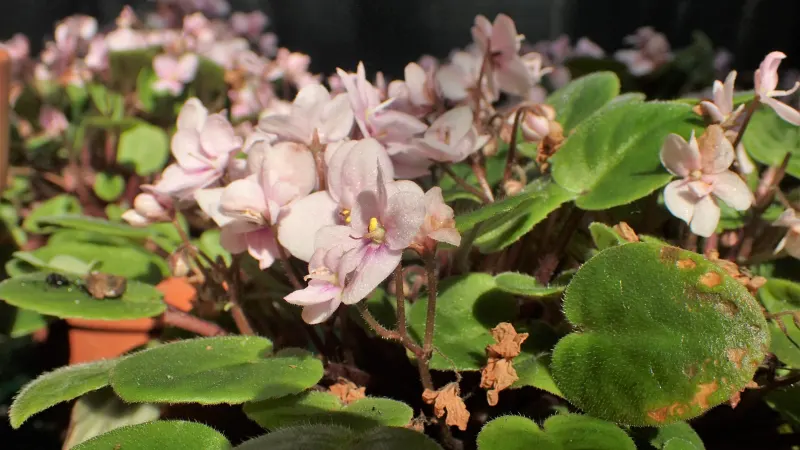

- Light
- Bright, indirect light, or 10–12 hours under a grow light; too little light is the main reason blooming stops
- Water
- From the base, not overhead — let the top 2–3 cm dry, then water into the saucer or use a wicking pot; never wet the leaves or crown
- Humidity
- Comfortable at 40–60%; the fuzzy leaves resent both very dry air and standing moisture
- Temperature
- 18–24°C; below 15°C slows or stops blooming, and cold water alone can scar the foliage
- Pets & toxicity
- Non-toxic to cats and dogs — a genuinely pet-safe flowering houseplant
- Difficulty
- Moderate — easy to keep alive, more particular to keep in near-constant bloom
An African violet doesn't ask for much. It asks for one thing not to happen: water on its leaves.
The flowering plant with one hard rule
African violets have been a beginner's flowering plant for the better part of a century, sold on windowsills and grocery-store shelves precisely because they're compact, genuinely willing to bloom indoors, and — with one specific exception — fairly easygoing. That exception is water on the foliage. The leaves are covered in fine hairs that trap moisture against the leaf surface, and cold water sitting there, especially in bright light, causes permanent pale or brown ring spots where the cell tissue has been damaged. Water pooling in the central crown, where new leaves and flower stalks emerge, is worse — it invites the rot that kills the plant.
Almost every African violet care guide leads with this rule, and it's worth understanding why rather than just following it, because the reason — fuzzy leaves plus cold water plus bright light equals scarring — explains most of the plant's other quirks too. If houseplants in general are new to you, the ten mistakes every beginner makes is worth reading alongside this guide, since several of those instincts are exactly what an African violet punishes hardest.
Light: bright, indirect, and enough of it to bloom
African violets want bright, indirect light — an east-facing window catching gentle morning sun, or a spot set back from a stronger south or west exposure, works well. Direct, hot sun through unfiltered glass can scorch the fuzzy leaves; too little light keeps the plant alive but stalls flowering almost entirely, which is the single most common reason a healthy-looking violet simply won't bloom.
This is one of the few common houseplants that genuinely thrives under artificial light, which is why African violets are a mainstay of plant stands and grow-light shelves. Run a small fluorescent or LED grow light for 10–12 hours a day, positioned 20–30 cm above the leaves, and most violets bloom as reliably as they would on a good windowsill — often more reliably, since grow-light exposure doesn't vary with the season the way a window does.
How to water an African violet
Water from below. Set the pot in a saucer holding a few centimetres of room-temperature water and let the soil draw it up through the drainage holes over 20–30 minutes, then tip out whatever hasn't been absorbed after that window — the roots shouldn't sit in standing water indefinitely. Many growers eventually move to a wicking self-watering pot, which keeps a constant, gentle moisture supply available at the roots without ever touching the leaves.
If you do water from above, pour slowly and directly at the soil, keeping the spout well clear of the foliage and the crown, and use room-temperature water — cold water straight from the tap is the specific cause of the pale ring spots this plant is known for scarring with. Check the top 2–3 cm of soil before watering either way; African violets want to dry slightly between drinks but never to the point of full, bone-dry desiccation, which stresses the shallow root system and can halt flowering just as effectively as overwatering does. The general logic of checking soil rather than following a fixed calendar is in when to water your houseplants.
Pot size: why a little snug helps
Unlike most houseplants, an African violet often blooms better when it's a little pot-bound. A large pot with plenty of unused soil holds more moisture than the compact root system can use, keeping conditions wetter than the plant wants and encouraging the plant to put energy into roots rather than flowers. Size up only when growth has clearly filled the current pot — new leaves crowding the rim, roots visible at the drainage holes — rather than proactively "giving it room to grow" the way you might with a larger foliage plant.
Getting it to rebloom
A violet that's merely alive and one that's in near-constant flower are separated by three habits more than any single trick: enough light (the single biggest lever — a plant getting under six hours of decent brightness a day will survive but rarely flower well), a snug pot, and steady dilute feeding rather than sporadic heavy doses. Deadheading spent blooms matters too — a flower left to fade and drop on its own schedule diverts energy that removing it promptly redirects toward the next round of buds.
Temperature plays a smaller but real role: African violets flower best in a stable 18–24°C, and a spell below about 15°C, or a draughty windowsill in winter, can pause blooming even with otherwise good light and feeding. If a violet stops flowering with no obvious cause, check light first, then temperature, before assuming something is wrong with the plant itself — very often nothing is, and the environment just needs a small correction.
Humidity and temperature
Ordinary household humidity in the 40–60% range suits African violets well; this isn't a genus that needs a humidifier. What it does object to is standing moisture on the leaves themselves, whatever the source — misting is actively counterproductive here in a way it merely underwhelms elsewhere, since droplets sitting on the fuzzy leaf surface are exactly the mechanism behind leaf-spotting.
Temperature runs a similar theme to watering: consistency matters more than any single number within the comfortable 18–24°C band. Cold draughts from a winter window or an opened door can shock the plant into dropping buds or pausing growth, and — as with the water itself — a cold splash of air is treated by the plant much like a cold splash of water.
Feeding
Use a fertiliser formulated for flowering plants, often sold specifically as "African violet food," which leans higher in phosphorus to support bloom production over pure leaf growth. The steadier approach works better than an occasional strong dose: quarter-strength with most waterings, rather than full-strength once a month, keeps a continuous, gentle supply available without the salt buildup that a heavier, less frequent feeding schedule risks in a small pot.
Propagation from a single leaf
African violets are propagated almost entirely from leaf cuttings, and it's one of the most dependable leaf-propagation methods among common houseplants. Select a healthy, mid-aged leaf — not the oldest, outermost ones, and not the newest, smallest ones at the centre — with roughly 2–3 cm of stalk attached, and set the stalk into water or moist potting mix at a slight angle so the leaf blade stays above the surface. Roots typically develop within a few weeks, and small plantlets emerge from the base of the stalk shortly after; once the plantlets have a few leaves of their own, they can be separated and potted individually.
Common problems
Pale or brown ring spots on the leaves. Cold water contact, almost always. The rings mark where cold droplets sat on the warm leaf surface, damaging the tissue underneath. The spots themselves don't heal, but they also don't spread — switch to base watering or room-temperature water applied carefully at the soil, and new leaves will be unmarked.
Soft, collapsing crown or leaf stalks near the centre. Crown rot, usually from water pooling where new growth emerges, often compounded by a pot that stays consistently too wet. This is more serious than leaf spotting — if caught early, stop all overhead watering and let the plant dry out somewhat; if the crown itself has gone soft and dark, the plant often can't be saved, though healthy outer leaves can sometimes be used for propagation.
No blooms despite an otherwise healthy plant. Almost always insufficient light. Move the plant closer to a bright window or add a grow light run 10–12 hours a day; also check that the pot isn't oversized and that feeding is happening on a light, regular schedule rather than not at all.
Lopsided, one-sided growth. The plant reaching toward its strongest light source. Rotate the pot a quarter-turn every week or two to even it out; a violet left facing one direction for months develops a permanently asymmetric rosette that a later rotation only partly corrects.
Fuzzy leaves look dusty or dull. Don't wipe them with a wet cloth — it recreates the same spotting risk as overhead watering. A soft, dry, small brush (a clean makeup brush works well) removes dust without introducing moisture to the leaf surface.
Frequently asked questions
Why can't you get water on African violet leaves?
The fine hairs covering the leaves trap water against the surface, and when that happens in bright light — especially with cold water — the leaf tissue underneath is damaged, leaving permanent pale or brown ring spots. It's cosmetic rather than fatal on the leaves themselves, but water pooling in the central crown instead of on a leaf can cause rot, which is far more serious. Watering from below, or carefully at the soil line with room-temperature water, avoids both.
Why won't my African violet bloom?
Insufficient light is the most common cause by a wide margin. African violets need bright, indirect light or 10–12 hours under a grow light to flower well; a spot that keeps the plant alive but dim rarely produces blooms. After light, check that the pot isn't oversized for the roots and that feeding is happening steadily rather than sporadically — both a too-large pot and inconsistent feeding can suppress flowering even with decent light.
How do you water an African violet properly?
From the base is safest: set the pot in a saucer of room-temperature water for 20–30 minutes and let the soil absorb what it needs, then discard the rest. If watering from above, pour slowly and directly onto the soil, keeping water off the leaves and the central crown entirely, and always use room-temperature rather than cold water.
Is African violet toxic to cats and dogs?
No. African violet is considered non-toxic to cats and dogs, making it one of the few genuinely pet-safe flowering houseplants — a useful pick alongside moth orchid and peace lily for a home with curious animals, though peace lily is toxic and shouldn't be confused with this one on that point.
How is an African violet different from a moth orchid to care for?
Both are popular flowering houseplants, but they part ways almost everywhere else. A moth orchid is epiphytic, grows in bark rather than soil, and typically blooms once or twice a year for months at a stretch between rests. An African violet grows in ordinary potting mix, can bloom in flushes nearly continuously under the right light and feeding, and has the specific wet-leaf sensitivity a moth orchid doesn't share. If continuous colour is what you want, the violet is the more reliable bet; if a long-lasting, dramatic single bloom cycle appeals more, the orchid suits that better.
Can I grow an African violet from a single leaf?
Yes — this is the standard propagation method. A healthy leaf with about 2–3 cm of stalk attached roots in water or moist soil within a few weeks, and small plantlets form at the base of the stalk shortly after. It's one of the most reliable leaf-propagation techniques among common houseplants.
Start your sanctuary
Botanical Legacy's free Observer plan covers up to five Specimens, each with its own continuously running Digital Shadow — useful even for a plant whose main risks are more about technique than moisture math, since the photo check-ins make it easy to track whether a bloom cycle is building or light needs adjusting. Every new account also includes a 14-day trial of Cultivator, the paid plan, which adds the local weather feed and soil sensor support.
Keep the leaves dry and the light generous, and the flowers do the rest.
START YOUR SANCTUARY — FIVE FREE SPECIMENS, NO PAYMENT REQUIRED →
One rule carries most of African violet care: keep the water off the leaves, and a genuinely willing bloomer takes care of the rest.