Species care guide
Basil
Ocimum basilicum
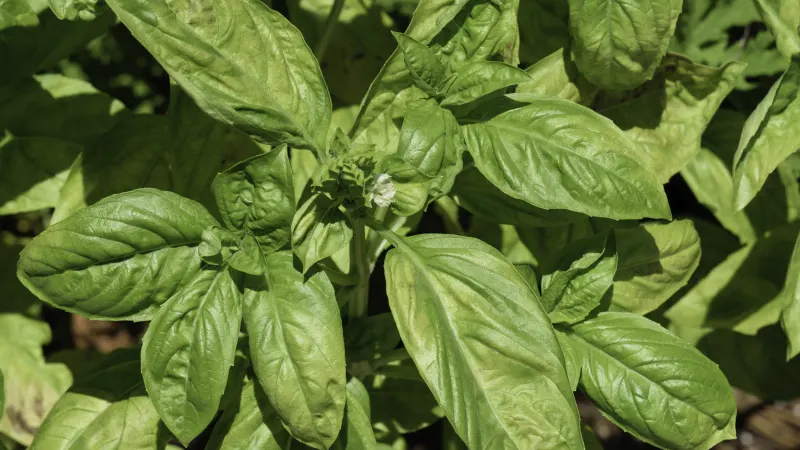
How to keep a pot of basil growing on a windowsill: what to do with a supermarket pot, how much light it needs, where to pinch it, why it flowers, and why a cold winter window damages the leaves.

- Light
- Full sun: about six hours of direct sun a day, or a grow light; too little gives thin, leggy stems and small leaves
- Water
- Keep the compost evenly moist and never let it dry out completely; water the compost in the morning, not the leaves, and never leave the pot standing in water
- Humidity
- Average room humidity with good air movement; damp, still air and wet leaves invite downy mildew and grey mould
- Temperature
- Warm: leaves can show cold damage at 10°C, so keep it off a cold windowsill in winter and away from cold glass
- Pets & toxicity
- Non-toxic to cats and dogs per the ASPCA
- Difficulty
- Easy in a warm, sunny summer window; harder through winter, when the light is short and the glass is cold
A pot of basil is a tropical annual sown far too thickly. Give it room, warmth and sun, and it stops behaving like a disposable one.
What basil is
Basil is Ocimum basilicum, a herb in the mint family, Lamiaceae. NC State Extension and Penn State Extension both give its native range as tropical Africa and Asia, and Clemson HGIC notes that it originally came from India. Penn State adds that it has been cultivated for thousands of years, and that it reached England from India in the 16th century. The sweet basil sold in pots is one form of it; NC State notes that Genovese and Thai basil are cultivars of the same species, and that purple-leaved cultivars are grown as ornamentals.
It is an annual. Illinois Extension and Penn State both describe it as one, and Penn State adds that it is hardy only in warmer climates; NC State gives USDA zones 10a and 10b. The plant grows from about 10 cm to 90 cm tall, according to NC State, with soft, aromatic leaves. Left to itself, it flowers in high summer: Penn State and Iowa State Extension put the white, pink or purple flower spikes in July and August. Iowa State notes that the leaves lose flavour once seed forms.
Those two facts, tropical origin and annual habit, explain almost everything about keeping it alive on a windowsill. It needs warmth and strong light, and it is always trying to flower and set seed. Most of the care below is about giving it the first and delaying the second.
Why a supermarket pot of basil dies so fast
A pot of basil from the supermarket is not one plant. It is dozens of seedlings sown together to look full on the shelf. The RHS describes supermarket pots as designed for short-term harvesting, and says they often hold thin, overcrowded plants that succumb to fungal disease or flower quickly. That is why so many go limp or grey within a couple of weeks of coming home.
The RHS also gives the remedy: they may survive if divided and repotted promptly. Ease the root ball out of its pot, split it into a few smaller clumps, and pot each one in fresh compost. The RHS recommends peat-free multi-purpose compost, and a container at least 20 cm wide and deep for a plant that will grow on. Each clump then has air around its stems and room for its roots, and the crowding that brought on disease and early flowering is gone.
Crowding matters for a reason beyond disease. The RHS notes that overcrowding brings on flowering sooner, and once basil flowers, leaf production slows. Thinning a supermarket pot is the single change that does most to make it last.
The RHS also suggests growing supermarket basil indoors in containers, to reduce biosecurity risks, so the windowsill is the right place for it.
Light: as much sun as you can give it
Basil is a sun plant. NC State Extension prefers full sun, six or more hours of direct sun a day, and Clemson HGIC calls full sun best. Penn State Extension says most herbs grown indoors need about six hours of direct sunlight a day. Iowa State Extension gives four to six hours, and calls light the most limiting factor when growing herbs indoors.
A south-facing window in summer gives that easily. A north-facing one, or any window in a short winter day, does not. Penn State describes what too little light looks like: plants become thin and leggy, with smaller leaves and less aroma. If your basil is stretching towards the glass, light is the problem. Turn the pot every few days, as Penn State and Illinois Extension both suggest, so it grows evenly rather than leaning.
When the window is not enough, use a grow light. Iowa State suggests a full-spectrum LED or fluorescent grow light on a timer for 12 to 16 hours a day. Penn State's version is two cool white fluorescent tubes held 15–30 cm above the plants for 14 to 16 hours a day. Illinois Extension notes that artificial light is less effective than sunlight, so plan on about two hours under the lamp for every hour of sun it replaces. The longer method, with the crops that need a lamp and the ones that do not, is in how to grow vegetables indoors.
If you use Botanical Legacy, the place you put a Specimen in carries the light you described for it, as a level or as the window's direction. When a plant's light needs and its place don't match, the app flags it and names a better place you already have. Moving the pot to the brightest warm spot is still your job.
Warmth, and the cold winter window
Basil needs warmth, and it is more sensitive to cold than most herbs. Penn State Extension says most herbs handle temperatures down to about 4–7°C, but that basil cannot survive below about 10°C. Illinois Extension notes that the leaves can show cold damage at 10°C, and Penn State's herb profile says the leaves deteriorate below that. For comparison, Penn State suggests about 18–21°C by day and 13–16°C at night for herbs indoors in general.
That is why the brightest spot in winter is often the wrong one. Penn State Extension advises that basil should not be kept on windowsills during the winter months. In winter, move the pot back from the glass, or onto a shelf under a lamp in the warm part of the room.
Outdoors, the same rule sets the calendar. The RHS says basil is not hardy in the UK and should go outside only in early summer, once night temperatures stay above 10°C. Clemson HGIC also gives 10°C as the night-time minimum. If a pot spends the summer on a balcony, bring it in before the nights cool: the RHS suggests bringing plants indoors at the end of the season to keep them going into autumn.
How to water basil
Basil wants steady moisture. Penn State Extension says the compost should never fully dry out, and that basil needs more consistent moisture than herbs such as rosemary. The RHS says to keep the compost evenly moist, and notes that dry conditions can trigger early flowering. A small pot of basil in a sunny, warm window can dry out quickly, so check it often.
Steady does not mean wet. Clemson HGIC advises watering regularly without overwatering, and never letting pots sit in standing water. Use a pot with a drainage hole and empty the saucer after watering. Penn State lists fungal root rot among basil's problems, and Clemson advises improving drainage against root rots.
How you water matters as much as how often. The RHS advises watering in the morning, avoiding splashing the leaves, and avoiding wet roots overnight. Clemson HGIC is direct about it: do not wet the foliage, as it will be more prone to disease. Iowa State Extension adds that night-time watering raises the risk of disease. Water the compost at the base of the stems, in the morning.
Do not water by the calendar. The same pot dries in days in a July window and much more slowly under a lamp in December. The method is in when to water your houseplants.
A model of the individual plant helps here. Botanical Legacy keeps a Digital Shadow of each Specimen in your Sanctuary, a running estimate of when that particular pot will be dry. On every plan, including the free one, you can log a quick soil check from the Specimen's page, from bone dry to wet. After three checks between waterings, the model starts correcting its drying rate for that plant from what you found. For basil, which flowers early when it dries out and rots when it stays wet, that is a timing fitted to this pot in this window.
Pinching and picking: where to cut
Pinching is how a pot of basil becomes a bush. Clemson HGIC says the tip of the plant can be pinched out periodically to encourage branching, which gives a fuller plant with more tender leaves. Illinois Extension says the same: pinching the tips of the stems gives a bushier plant and more to harvest.
Penn State Extension gives a precise routine. Once a seedling has its first six leaves, pinch it above the second set. After that, every time a branch has six to eight leaves, cut it back to its first set of leaves. Each cut sits just above a pair of leaves, and the stem branches from there, so one stem becomes two.
Picking and pinching are the same act. The RHS advises picking shoot tips regularly to keep plants bushy and productive, and Clemson suggests picking individual leaves or pinching branch tips with one or two sets of leaves, leaving enough foliage for the plant to regrow.
Flowering
Basil flowers because it is an annual, and flowering is how an annual finishes. The RHS says plants usually flower from mid to late summer, which affects the flavour of the leaves. Penn State Extension advises watching for early flowering after about six weeks, and pinching off flower buds as soon as they appear. The RHS says to remove flower stems as soon as you see them to prolong the leafy harvest.
Some of what brings flowering on is in your hands. The RHS lists dry conditions and overcrowding, and warns against potassium-rich feeds such as tomato feed, which encourage flowering. If the plant needs feeding, the RHS suggests a balanced, organic-based liquid fertiliser instead. Penn State suggests a low dose of water-soluble fertiliser about every two weeks for herbs indoors, and notes that feeding more often can reduce their aroma and flavour; Clemson HGIC makes the same point about rapid growth.
Letting a few flowers open is not a mistake if you have more than one pot. The RHS notes that the nectar-rich flowers feed bees and other insects, and Penn State suggests letting ornamental cultivars such as 'African Blue' flower for pollinators.
Propagation: cuttings in a glass of water
The easiest way to keep basil going is to start new plants from the old one. Penn State Extension says basil cuttings root easily in water. Iowa State Extension gives a method for herbs, basil among them: take cuttings 5–10 cm long, strip the leaves from the bottom half, and stand them in a glass with the upper leaves above the water. Change the water once or twice a week, and do not let the level fall far enough to expose the new roots to air. Once the roots are about 2.5 cm long, pot each cutting into potting compost.
Iowa State adds a caution: roots grown in water are coarser than roots grown in soil, and the young plants may wilt or drop leaves for a while after potting, so keep their care steady until they settle. The general method for houseplants is in the guide to propagating plants.
From seed, the RHS suggests sowing from March to July in small pots of damp, peat-free seed compost, with a germination temperature of about 20°C, and sowing small batches a few weeks apart for a longer harvest. Keep seedlings warm and bright, and water without overwatering: the RHS notes that they are prone to damping off.
Common problems
Dark, limp or blackened leaves after a cold night. Cold damage. Illinois Extension notes that the leaves can show it at 10°C. Move the pot back from the window, away from cold glass, and keep it in the warm part of the room.
Tall, thin stems with small, pale leaves. Not enough light. Penn State Extension describes exactly this. Move it to the sunniest spot you have or add a grow light, and pinch the stems back so new growth comes in bushier.
Flowers appearing early. Usually stress or crowding. The RHS lists dry compost, overcrowding and potassium-rich feed. Pinch the flowers off, water more evenly and split a crowded pot.
A whole clump collapsing in a supermarket pot. Crowded seedlings and fungal disease, which the RHS links to supermarket pots and to overwatered seedlings. Split the clump, discard the collapsed stems, and give the rest room and air.
Yellowing between the veins, with grey fuzz underneath. Downy mildew. Iowa State Extension describes the early sign as yellowing between the veins that can look like a nutrient shortage, then a grey, fuzzy growth on the undersides of the leaves, which blacken and die. Penn State calls it basil's most serious disease and notes that sweet basil varieties are very susceptible. Iowa State and Penn State both advise bagging and removing affected plants right away rather than composting them, keeping the leaves dry and giving the plants air. Resistant cultivars carry "DMR" in the name, according to Iowa State.
Sudden wilting in moist compost. Clemson HGIC describes Fusarium wilt as stunting followed by sudden wilting, and root rots as yellowing and dieback with poor drainage. Remove a wilted plant, and check that the pot drains.
Grey mould on cut stems. Clemson HGIC notes that grey mould enters through harvest cuts, and advises against harvesting in wet conditions or watering overhead.
Insects. Clemson HGIC lists aphids, spider mites and whiteflies, which insecticidal soap can control, sprayed onto the undersides of the leaves. The RHS adds aphids among the common problems. Indoors, Penn State suggests yellow sticky traps and a change of watering for fungus gnats, and cutting off branches infested with aphids. Wash leaves before you use them. A photo to the Doctor, powered by Botanical Vision v5, returns a health verdict, the likely cause of what it sees, and what to do. The guide to common houseplant pests shows how to tell them apart.
Frequently asked questions
Why does my supermarket basil keep dying?
Because it is many seedlings crowded into one small pot. The RHS describes supermarket pots as designed for short-term harvesting, often with thin, overcrowded plants that succumb to fungal disease or flower quickly. Divide the clump into a few smaller groups soon after you buy it, pot each into fresh peat-free compost, and give them a warm, sunny spot.
How much light does basil need indoors?
As much as you can give it. NC State Extension prefers six or more hours of direct sun, and Penn State Extension says most indoor herbs need about six hours. In winter a window rarely provides that, so use a full-spectrum LED or fluorescent grow light on a timer for 12 to 16 hours a day, as Iowa State Extension suggests.
Where should I pinch basil?
Just above a pair of leaves. Penn State Extension suggests pinching a seedling above its second set of leaves once it has six, then cutting each branch back to its first set of leaves every time it reaches six to eight. The stem branches from the leaves below the cut, so the plant grows bushier.
Should I let my basil flower?
Not if you want leaves. The RHS notes that flowering affects the flavour of the leaves, and advises removing flower stems as soon as you see them. If you have several plants, letting one flower feeds bees and other insects, according to the RHS.
Can basil live on a windowsill in winter?
Not on the sill itself. Penn State Extension advises against keeping basil on windowsills during winter, because it cannot survive below about 10°C, and Illinois Extension notes that the leaves can show cold damage at that temperature. Keep it in the warm part of the room, back from the glass, under a grow light.
Is basil toxic to cats and dogs?
No. The ASPCA lists basil, Ocimum basilicum, as non-toxic to dogs and to cats. Its entry does not cover horses.
Can Botanical Legacy help me keep a basil plant going?
It helps with the watering, which is where most pots of basil fail. Each Specimen gets its own Digital Shadow, an estimate of when its pot will be dry, and soil checks you log on any plan teach the model that plant's real drying rate. If a spot is too dim for it, the place you set it in carries the light you described, and the app flags the mismatch and names a better place you already have. A photo to the Doctor, powered by Botanical Vision v5, gives a verdict on yellowing or spotted leaves; each one uses a photo read from your monthly allowance, three on the free plan.
Start your sanctuary
Botanical Legacy's free Observer plan covers up to five Specimens, each with its own continuously running Digital Shadow and soil checks that teach it each pot's drying rate. Basil, which flowers early when it dries out and rots when it stays wet, is exactly the kind of plant a steady per-pot model is for. Every new account also includes a 14-day trial of Cultivator, the paid plan, which adds the local weather feed and soil sensor support.
START YOUR SANCTUARY - FIVE FREE SPECIMENS, NO PAYMENT REQUIRED →
Give basil room, warmth and sun, and pinch it before it flowers, and one pot keeps giving through the summer.
Sources
12 references
The plant-care facts on this page were checked against these references.
- NC State Extension: plants.ces.ncsu.edu/plants/ocimum-basilicum
- Penn State Extension: basil: extension.psu.edu/herb-garden-plants-basil
- Clemson HGIC: hgic.clemson.edu/factsheet/basil
- Illinois Extension: popular herbs: extension.illinois.edu/blogs/good-growing/2020-05-15-how-grow-p…
- Iowa State Extension: yardandgarden.extension.iastate.edu/how-to/growing-basil-home-g…
- RHS: rhs.org.uk/herbs/basil/grow-your-own
- Penn State Extension: herbs indoors: extension.psu.edu/growing-herbs-indoors
- Iowa State Extension: herbs indoors: yardandgarden.extension.iastate.edu/faq/can-i-grow-herbs-indoor…
- Illinois Extension: herbs indoors: extension.illinois.edu/blogs/good-growing/2017-11-17-grow-herbs…
- Penn State Extension: summer favourite: extension.psu.edu/basil-a-summer-favorite
- Iowa State Extension: kitchen scraps: yardandgarden.extension.iastate.edu/how-to/how-grow-vegetables-…
- ASPCA: aspca.org/pet-care/aspca-poison-control/toxic-and-non-toxic-pla…