Species care guide
Olive tree
Olea europaea
How to care for an olive tree in a pot: how cold it can take, when to bring it under cover or indoors, how to water it summer and winter, when and how to prune it, and why a potted olive rarely gives you olives.

- Light
- Full sun, six hours or more a day; indoors, a south-facing window away from heat vents
- Water
- Regularly from April to late September; barely moist over winter, with the pot raised off the ground
- Humidity
- Not a humidity plant: it does best with hot, dry summers; indoors, keep it away from heat vents and draughts
- Temperature
- Hardy to about -5 to -10°C in the ground (RHS H4); a pot's roots are less hardy, so give it shelter in a hard frost
- Pets & toxicity
- Not listed by the ASPCA; the RHS and NC State Extension record no toxicity, which is not the same as proven pet-safe
- Difficulty
- Easy in a sunny, sheltered spot outdoors; the hard part in a pot is getting it through winter without hard frost or wet compost
An olive tree laughs at a dry summer and stands a hard frost in the ground. In a pot, the roots are the part that feels the cold.
What an olive tree is
The olive is Olea europaea, a slow-growing evergreen tree in the olive family, Oleaceae. The RHS gives its range as the Mediterranean, and NC State Extension notes that it performs best with hot, dry summers and mild, wet winters. That climate explains nearly everything about how to grow one in a pot.
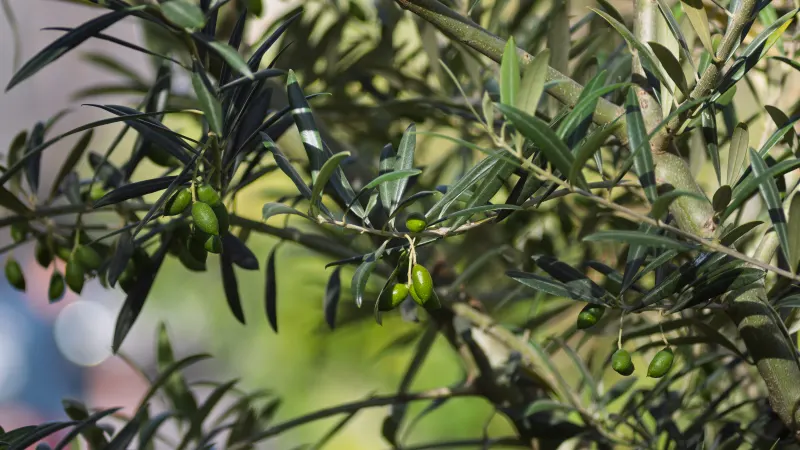
In the ground it becomes a gnarled, rounded tree. NC State Extension gives a mature height of about 6–9 m, and the RHS a rugged, much-branched plant of 4.5–9 m, taking 20–50 years to reach full size. The leaves are narrow and leathery, grey-green above and silvery beneath, which is what makes an olive so recognisable on a patio. In summer it carries small, fragrant white flowers, and the fruit that follows is a drupe with a single stone, green at first and ripening to purplish-black.
Olives are sold in many sizes, from half standards to mature trees with gnarled trunks. The RHS notes that, because olives rarely fruit in the UK, they are usually chosen for their shape or foliage.
How cold an olive tree can take
An olive is hardier than its Mediterranean look suggests. The RHS rates Olea europaea H4, hardy through most of the UK, and its growing guide says many olives tolerate about -5 to -10°C. NC State Extension rates it for USDA zones 8a to 10b, with some cultivars hardier still. Severe frost can still damage leaves and branches, the RHS warns, and in very cold winters it suggests wrapping the canopy in two layers of fleece or hessian.
A pot changes the numbers. Iowa State Extension notes that the roots of container plants are far less cold-hardy than their parts above ground. So the RHS advice for containers is stricter than for trees in the ground: move containers under cover or into a sheltered spot in winter, and wrap the pot and canopy against severe frost. Unwrap it in mild spells, and wrap it again when a severe frost, below -5°C, is forecast.
The pot itself matters. The RHS recommends a thick, frost-proof container at least 30–35 cm wide and deep, with plenty of drainage holes, and raising it off the ground on pot feet or bricks over winter.
Where winters are colder than an olive can take, the answer is to grow it in a container and move it. NC State Extension notes that in colder areas it can be grown in a container and brought indoors or into a greenhouse. The full method for deciding when, and for moving any plant in, is in when to bring plants inside for fall.
Bringing it in: under cover, or indoors
Bringing an olive in is a question of where you have light. An olive wants full sun: NC State Extension specifies six hours or more of direct sun a day, and the RHS gives it full sun, a south-facing aspect and a sheltered position. Under glass, the RHS says to grow it in full light.
That is why a greenhouse or conservatory suits an olive's winter, if you have one: NC State Extension names a greenhouse as one way to overwinter it. In a house, light is the limit. Illinois Extension, writing about olives as indoor plants, recommends a south-facing window, because the plant grows best with at least six hours of sun a day, and advises keeping it away from heat vents and draughts.
Before it comes in, check it over at the door. Scale insects, which the RHS and NC State Extension both list for olives, sit on stems and the undersides of leaves, so look there first. The guide to debugging plants before bringing them inside covers the check step by step.
When spring comes and the hard frosts are over, it goes back out into the sun.
How to water an olive tree in a pot
An olive is drought tolerant once established: both the RHS and NC State Extension say so. A pot needs more: the RHS says potted olives need regular watering through the growing season, from April to late September.
Winter is different. The RHS advises keeping the compost barely moist over winter, with the pot raised off the ground. Indoors, Illinois Extension suggests watering when the top 2.5 cm or so of compost has dried out. NC State Extension lists root rot among the problems to watch for.
Watch the leaves too. The RHS notes that dry conditions, especially in containers, can cause leaves to drop and brown leaf edges on the sunny side of the plant. Not every fallen leaf is a problem: olives shed some of their older leaves in spring, which the RHS describes as normal.
Do not water by the calendar. A pot on a hot patio in July needs far more than the same pot under cover in January, and the RHS rhythm above, regular in growth and barely moist in winter, is the frame to fit it into. The longer method is in when to water your houseplants.
A model of the individual plant helps here. Botanical Legacy keeps a Digital Shadow of each Specimen in your Sanctuary, a running estimate of when that particular pot will be dry. On every plan, including the free one, you can log a quick soil check from the Specimen's page, from bone dry to wet. After three checks between waterings, the model starts correcting its drying rate for that plant from what you found. For an olive that spends summer on a patio and winter under cover, that means a timing fitted to this pot where it stands now, rather than to a label.
Compost, feeding and repotting
The RHS recommends a peat-free, soil-based compost such as John Innes No. 3, mixed with about 20% horticultural grit by volume. For a plant under glass, its plant profile suggests John Innes No 3 with added sharp sand. Either way, the point is a heavy compost that drains fast.
Feeding is light. The RHS notes that olives in the ground rarely need feeding. For containers, its advice is to replace the top 5 cm of compost each spring with fresh compost.
Pruning an olive tree
Pruning keeps a potted olive in shape and in proportion to its pot. The RHS says to prune in late spring or early summer, and to avoid pruning after August, because new growth made late in the year will not harden before the frosts.
What to cut. Remove dead, diseased or dying branches, cutting back to a side shoot, the RHS advises. Thin the branches to let light into the centre of the crown, and take out any that spoil the shape. For a clear stem, remove shoots near the base and along the trunk.
Keeping it bushy. For a tree in a container, the RHS suggests pinching out the growing tips in summer once it reaches about 1.5 m, to encourage bushier growth. Under glass, its plant profile says to prune in spring to restrict size.
Not too hard. The RHS warns against hard pruning, which produces vigorous upright shoots that then have to be thinned. Its page on olive scab makes the same point from another angle: pruning too hard can produce water shoots that do not fruit.
After frost damage. Wait until late spring, then prune off dead stems back to new shoots, the RHS says.
Will a potted olive tree fruit?
Rarely, and it is best to expect a foliage tree. The RHS notes that olives rarely fruit in the UK, though fruit may form in hot summers in some areas. Illinois Extension says an olive grown indoors is unlikely to yield fruit.
Two needs explain why. NC State Extension notes that flowering requires about two months at 4–10°C, so an olive kept in a warm room all winter misses the cool spell it needs to flower. And for better yields it recommends planting two varieties for cross-pollination. Some cultivars are sold for the opposite reason: NC State lists 'Swan Hill' and 'Wilsoni' as fruitless and flowerless, and 'Bonita' and 'Majestic Beauty' as producing few fruits.
If fruit does form, it is not ready to eat from the tree. The RHS notes that olives need special preparation before they can be eaten.
Propagation
The RHS describes three methods. Semi-ripe cuttings 10–15 cm long go into sandy, peat-free compost in July or August. Hardwood cuttings up to 30 cm long, taken in winter from one- or two-year-old wood, need bottom heat and may take weeks to months to root. Seed sown in spring at 18–21°C, after the hard coat has been rubbed with sandpaper and soaked in warm water for 24 hours, can take up to four months to germinate, and seed from a named variety may not come true. For more on cuttings, see how to propagate plants.
What Botanical Legacy does about frost
An olive's safety in winter comes down to a few cold nights, and the app can watch those for a plant that lives outside. If the olive's Specimen is in a place marked outdoor, and you are on the paid plan with local weather turned on and your location set, Botanical Legacy reads the coming forecast low for your location against that plant's own minimum temperature. A forecast that falls past the minimum, for two hours or more, brings a frost alert for the olive by name, ahead of the night in question. One that only comes within 2°C of the minimum is reported when that cold is unusual for the time of year, or when the plant has had no frost alert for a month. While a cold spell lasts, the alert does not repeat each night unless the forecast turns at least 2°C colder. A Specimen with no recorded minimum is guarded as a tender plant.
When the olive comes in for winter, move its Specimen to the place it now lives in, so it carries that room's light. In an indoor place it no longer gets frost alerts, which only cover outdoor Specimens. When a plant's light needs and its place don't match, the app flags it and names a better place you already have.
The forecast covers your area, not your patio. A pot against a warm wall, or in a frost pocket, can run warmer or colder than the forecast, and the app cannot know whether you have already wrapped the pot.
Common problems
Leaves falling or yellowing. First ask what time of year it is. The RHS notes that some shedding of older leaves in spring is normal. Leaf drop with brown edges on the sunny side points to dry conditions, especially in a container. Indoors, give it the sunniest window you have, as Illinois Extension advises.
Scale insects. The RHS lists scale insects among the olive's pests, and NC State Extension advises monitoring for them. The RHS describes them as sap feeders, mostly 1–6 mm long, with a waxy, shell-like cover, sitting on stems and the undersides of leaves. Large populations cause poor growth, and the sticky honeydew they excrete is colonised by black sooty mould. Remove adult scales when you see them, though that may not clear a large population.
Olive scab (peacock spot). A fungal disease, Venturia oleaginea, that the RHS describes as purple or brown circular spots on the leaves, sometimes rings with a yellow or purple halo, after which the leaves yellow and fall early; repeated severe attacks can cause twig dieback. Wet weather is needed for infection, and spores spread by rain splash. The RHS advice is cultural: remove fallen leaves, prune out twigs with dieback, avoid spots with poor air circulation and thin the canopy so leaves dry faster after rain. It recommends against fungicides, and notes that none are available to gardeners for olive trees whose fruit will be eaten.
Other diseases. NC State Extension lists olive knot, verticillium wilt and root rot to watch for, though it says the olive has no serious pests or diseases.
Xylella. The RHS notes that olive is one of the high-risk hosts for Xylella fastidiosa, a bacterium that causes leaf scorch, wilt, dieback and death in many plants. It has not been detected in the UK. The RHS advises buying from a known, reputable source: UK-grown plants are very low risk, and plants brought in from abroad, especially in personal luggage, carry more. Its symptoms look like drought or frost damage, so if you suspect it, the RHS says to report it to the plant health authority rather than treat it. For other pests, see the guide to common houseplant pests.
Frequently asked questions
Can an olive tree live indoors?
For a season, yes, if it gets enough sun. Illinois Extension recommends a south-facing window, where the plant can get the six hours or more of sun it grows best with, away from heat vents and draughts. Full sun is what it wants all year, so it does best outdoors in summer and under cover in the brightest place you have in winter. An olive kept indoors is unlikely to fruit.
When should I bring my olive tree inside?
In the ground the RHS says many olives tolerate about -5 to -10°C, but a pot's roots are less hardy than the tree above them. The RHS advice for containers is to move them under cover or into a sheltered spot over winter, and to wrap the pot and canopy when a severe frost, below -5°C, is forecast. In a climate colder than the tree can take, NC State Extension suggests growing it in a container and bringing it indoors or into a greenhouse for winter.
How often should I water an olive tree in a pot?
There is no fixed interval. The RHS says to water regularly from April to late September, while the tree is growing, and to keep the compost barely moist over winter, with the pot raised off the ground. Indoors, Illinois Extension suggests watering when the top 2.5 cm or so of compost is dry. Never leave it sitting in wet compost.
Is an olive tree toxic to cats and dogs?
The ASPCA does not list the olive tree, Olea europaea, in its toxic and non-toxic plant database: its list goes from oleander to onion. The RHS and NC State Extension plant pages record no toxicity for it either. That is an absence of a listing, not a declaration that it is safe, so keep pets from chewing it, and call your vet if one has eaten a lot of it.
Can Botanical Legacy warn me before a frost?
Yes, for an olive that lives outside. On the paid plan, with local weather on and your location set, a Specimen in a place marked outdoor gets a frost alert, by name, when the forecast low falls past that plant's minimum temperature. A night that only comes within 2°C of it is reported if it is unusually cold for the time of year or the first such night in a month. On every plan, soil checks you log teach its Digital Shadow how fast that pot dries, and progress photos build growth curves of height and leaf count.
Start your sanctuary
Botanical Legacy's free Observer plan covers up to five Specimens, each with its own continuously running Digital Shadow and soil checks that teach it each pot's drying rate. An olive, which needs regular water on the patio in summer and very little under cover in winter, is exactly the kind of plant a steady per-pot model is for. Every new account also includes a 14-day trial of Cultivator, the paid plan, which adds the local weather feed and soil sensor support.
START YOUR SANCTUARY - FIVE FREE SPECIMENS, NO PAYMENT REQUIRED →
Give an olive full sun, a dry winter and shelter from the hardest nights, and its roots stay as hardy as the tree.
Sources
9 references
The plant-care facts on this page were checked against these references.
- NC State Extension: plants.ces.ncsu.edu/plants/olea-europaea
- RHS: rhs.org.uk/plants/11735/olea-europaea-f/details
- RHS: rhs.org.uk/plants/olives/how-to-grow-olives
- Iowa State Extension: yardandgarden.extension.iastate.edu/how-to/overwintering-unplan…
- Illinois Extension: extension.illinois.edu/blogs/flowers-fruits-and-frass/2024-02-2…
- RHS: rhs.org.uk/biodiversity/scale-insects
- RHS: rhs.org.uk/disease/olive-scab
- RHS: rhs.org.uk/disease/xylella-fastidiosa
- ASPCA: aspca.org/pet-care/animal-poison-control/toxic-and-non-toxic-pl…