Species care guide
Yucca
Yucca gigantea
How to care for a spineless yucca indoors: why it wants the sunniest window you have, how to water it so the cane never rots, what yellow or brown leaves mean, and how to cut back a yucca that has grown too tall.

- Light
- As much sun as you can give it: a south-facing window in winter, east or west in summer, shaded from harsh summer sun
- Water
- Freely in spring and summer; sparingly in winter, letting the top 5 cm of compost dry between waterings, and never leave it standing wet
- Humidity
- Ordinary indoor humidity is fine; keep it out of cold draughts
- Temperature
- Warm in growth; a minimum of about 10°C as a houseplant, and no frost
- Pets & toxicity
- Toxic to cats, dogs and horses per the ASPCA; saponins cause vomiting, and the RHS lists it as a skin allergen
- Difficulty
- Easy in a sunny spot; the usual failures are a pot kept wet in winter and a corner too dark for it
A yucca grows into a 10-metre tree in the sun of Central America. In a dim corner it can only wait, and a wet pot does not wait with it.
What a spineless yucca is
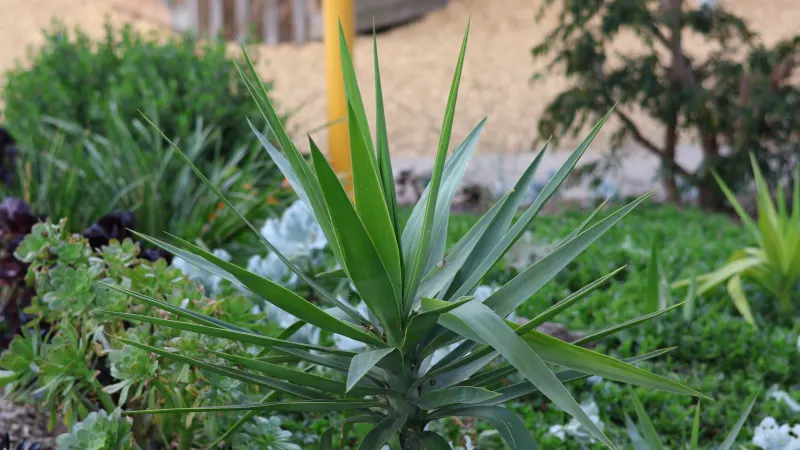
The yucca sold as a houseplant, a cluster of thick woody canes topped with rosettes of long green leaves, is the spineless yucca, Yucca gigantea. You will just as often see it labelled Yucca elephantipes or Yucca guatemalensis. NC State Extension gives both as former names of Yucca gigantea, and the RHS lists all three names on its pages for the plant. It belongs to the asparagus family, Asparagaceae.
Its home is Mexico and Central America. NC State Extension lists Belize, Costa Rica, Guatemala, Honduras, Nicaragua, Panama and several regions of Mexico. There it is no pot plant. The RHS describes a large, upright shrub or small tree with several trunks rising from near the ground, 8–12 m tall and 4–8 m across, taking 20–50 years to reach that size. Its leaves are stiff, leathery and narrow, up to about 1 m long on a mature plant, and it carries spikes of creamy-white, hanging flowers. UF/IFAS Extension notes that a plant usually reaches about 2.5–3 m before it flowers.
Indoors it stays far smaller. NC State Extension notes that houseplants remain much more compact and rarely flower. What you are buying is the trunk and the leaves, on a plant that copes well with being forgotten: the RHS rates it drought resistant, and NC State Extension names the overwatered pot, not the dry one, as the main concern.
The common name is the selling point. Most yuccas end each leaf in a sharp point. This one does not: NC State Extension describes the leaves as spineless, with soft tips, and UF/IFAS Extension notes that, lacking the sharp edges of Spanish bayonet, it suits places where people and pets walk past.
Why a yucca needs so much light
Everything about a yucca makes sense once you picture where it grows. NC State Extension gives its preferred outdoor temperatures as about 21–32°C, and the RHS gives it full sun, a south- or west-facing aspect and a sheltered spot, in loam or sand that drains well. It is a plant of warm, bright, well-drained ground.
A living room is darker than that, even beside a window, and the RHS is direct about what a yucca needs indoors: a sunny position all year, well-drained compost and careful watering. Its growing guide suggests a south-facing window in winter, when the sun is low and weak, and an east- or west-facing window in summer. Shade it from harsh summer sun, and keep the room ventilated so the plant does not overheat. Turn the pot regularly as well, or the canes lean towards the window.
In too little light the leaves lose their stiffness. The RHS lists low light as a cause of drooping leaves, though it advises checking the watering first, since a waterlogged plant droops too.
If you use Botanical Legacy, the place you put a Specimen in carries the light you described for it, as a level or as the window's direction. When a plant's light needs and its place don't match, the app flags it and names a better place you already have. It cannot measure the light in the room, so finding the sunniest window is still your job.
How to water a yucca
Watering is where yuccas are lost, and almost always in one direction. NC State Extension calls the plant drought tolerant and names overwatering as the main concern, leading to root rot. UF/IFAS Extension lists root rot from soil that stays too moist as its main disease.
The rhythm follows the seasons. In the growing season, roughly spring to autumn, the RHS says to water freely. In winter, it says to water sparingly, letting the top 5 cm of compost dry out between waterings. That winter rule matters most. The RHS describes winter as the time the plant is not growing, and a pot watered on its summer schedule then sits wet.
Never leave the pot standing in water in a saucer or a decorative outer pot, and do not water by the calendar: by the RHS rhythm above, the same pot needs far less in December than in June. The longer method is in when to water your houseplants.
The leaves tell you which way you have gone wrong. The RHS says sudden yellowing and limpness of the lower leaves points to too much water: water less and let the plant almost dry out. Crisp brown lower leaves usually mean too little, though the RHS adds that the lowest leaves also die off naturally as the plant grows. For the difference between the two in more detail, see overwatering versus underwatering.
A model of the individual plant helps here. Botanical Legacy keeps a Digital Shadow of each Specimen in your Sanctuary, a running estimate of when that particular pot will be dry. On every plan, including the free one, you can log a quick soil check from the Specimen's page, from bone dry to wet. After three checks between waterings, the model starts correcting its drying rate for that plant from what you found. For a yucca, which is far more often killed by a wet pot than a dry one, that means a timing fitted to this pot in this window, rather than to a label.
Compost, pots and feeding
The compost has one job: to drain. The RHS growing guide suggests John Innes No 2 with an extra 20–30% grit for yuccas in containers, and its plant profile a peat-free, loam-based compost with added grit. NC State Extension goes further for houseplants, suggesting one part potting mix to three parts perlite or sand. The common ground is a heavy, gritty mix that never stays soggy, in a pot with a drainage hole.
Feed only while it grows. The RHS growing guide recommends a balanced liquid feed every two weeks from April to September, and its plant profile suggests feeding monthly in active growth. Either way, stop feeding in winter.
When a yucca has been overwatered and the roots have started to rot, the RHS advises repotting into a pot just large enough for the remaining root ball, in fresh compost, and watering sparingly afterwards.
Temperature, and a summer outdoors
A spineless yucca is tender. The RHS rates it H2: it tolerates low temperatures of about 1–5°C, but not being frozen. Its growing guide gives a minimum of 10°C for the plant as a houseplant, while noting that in winter, when it is not growing, it can take nights down to about 7°C, with days a few degrees warmer, which is why it also suits a cool conservatory. NC State Extension advises bringing it indoors when temperatures drop below about 10°C, and keeping it away from cold draughts and sudden changes of temperature. UF/IFAS Extension warns that cold and freezing temperatures can damage the tissue or cause dieback.
Humidity is not a worry. NC State Extension notes that indoor temperature and humidity are generally adequate for it, so it needs no special treatment for humidity.
It enjoys a summer outside. The RHS says a yucca may go outdoors from the end of May to August, in a sheltered spot, as long as the plant is stable in the wind. Its plant profile also describes it as a plant for the patio that moves to a frost-free place for winter. Bring it back in before the nights turn cold. When you do, check it over for pests at the door, as the guide to debugging plants before bringing them inside describes.
Cutting back a yucca that has grown too tall
Left alone, a yucca keeps getting taller, and in time the rosette meets the ceiling or the canes lean out from the window. The RHS says pruning is usually unnecessary, beyond removing damaged leaves and spent flower spikes in spring. When the plant has simply grown too tall, its growing guide says to cut it back and reduce the height by half. There is a slight risk, the RHS notes, but healthy plants should respond well. Do it in spring, when growth resumes, not in the dark of winter.
The top you remove is not waste. The RHS says the severed upper part can be used for propagation.
Stem cuttings. The RHS suggests taking cuttings 20–25 cm long, measured from the tip, in spring, and inserting them in a coarse, sandy rooting compost. Keep them in semi-shade in a propagator with bottom heat of at least 18°C.
Offsets. Small plantlets sometimes appear at the base. In March or April, the RHS advises exposing the offset, cutting it where it joins the parent, letting it dry for a couple of days and then rooting it like a cutting, or under polythene in a warm, bright spot out of direct sun.
Seed. NC State Extension lists seed, stem cuttings and suckers as ways to propagate it. The RHS suggests sowing seed in spring at 19–24°C, after soaking it for 24 hours, though a houseplant that rarely flowers is unlikely to give you any. For more on rooting cuttings in general, see how to propagate plants.
Common problems
Yellow, limp lower leaves. The RHS links sudden yellowing and limpness of the lower leaves to overwatering. Let the compost almost dry out, and water less from then on, especially in winter. If it does not recover, tip it out and check the roots: for rotting roots, the RHS advises repotting into fresh compost, in a pot just large enough for what remains.
Crisp brown lower leaves. Usually too little water, according to the RHS, though the lowest leaves also die off naturally as the plant grows. A few old leaves browning at the bottom of a growing plant is normal; many, with dry compost, point to thirst.
Drooping leaves. The RHS lists low light as a cause, after you have ruled out watering. Move it to a sunnier window.
Leaf spot. The RHS lists yucca leaf spot, brown fungal spots on the leaves, among the plant's diseases. The RHS suggests removing damaged leaves in spring.
Pests. NC State Extension describes it as generally free of insects and diseases, but lists mealybugs, aphids, scale, black weevil and yucca moth borers to watch for, and UF/IFAS Extension also names scale. Outdoors, the RHS adds aphids on flower spikes and snails. On houseplants, the RHS notes that scale insects sit close to the main veins on the underside of leaves, and that both scale and mealybugs leave sticky honeydew where sooty mould grows. See the guide to common houseplant pests for how to tell them apart.
Root rot. The disease both NC State and UF/IFAS Extension single out, from compost that stays too wet. Prevention is the gritty compost, the drainage hole and the dry winter above.
Frequently asked questions
How often should I water a yucca?
There is no fixed interval. In spring and summer, water freely, as the RHS advises, and let the pot drain. In winter, water sparingly and let the top 5 cm of compost dry out between waterings. Never leave the pot standing in water. A yucca is drought tolerant, and overwatering, which leads to root rot, is the main thing that kills it.
Why are my yucca's leaves turning yellow?
If the lower leaves have turned yellow and limp quite suddenly, the RHS points to too much water: let the compost almost dry out before watering again. A few lower leaves yellowing and browning one at a time on a growing plant are the oldest leaves dying off naturally. Crisp brown leaves in dry compost usually mean too little water.
Can I cut the top off my yucca?
Yes, if it has grown too tall. The RHS says to cut it back and reduce the height by about half, in spring when growth resumes. There is a slight risk, but healthy plants should respond well, and the severed top can be used for propagation as a cutting.
Can a yucca go outside in summer?
Yes. The RHS says it may go outdoors from the end of May to August, in a sheltered spot where it will not blow over. It is tender, rated H2 by the RHS, so it has to come back in before frost. NC State Extension advises bringing it in when temperatures fall below about 10°C.
Is a yucca toxic to cats and dogs?
Yes. The ASPCA lists yucca as toxic to dogs, cats and horses. The toxic compounds are saponins, and the sign it lists in dogs and cats is vomiting; in horses, liver disease and dermatitis. NC State Extension rates the toxicity as low and notes that the saponins are concentrated in the leaves and roots, and that the sap can cause minor rashes. The RHS lists the plant as a skin allergen and advises wearing gloves when handling it. Keep it out of reach of pets that chew plants, and call your vet if one has eaten it.
Can Botanical Legacy help me stop overwatering my yucca?
That is where it helps most. A yucca is drought tolerant and is lost to a wet pot far more often than a dry one, and how fast its compost dries depends on the window and the season. Each Specimen gets its own Digital Shadow, an estimate of when its pot will be dry, and soil checks you log on any plan teach the model that plant's real drying rate. Progress photos build growth curves of height and leaf count, so a yucca recovering after a cut-back shows up as a trend instead of a guess. If the leaves change and you can't tell why, a photo to the Doctor, powered by Botanical Vision v5, gives you a second opinion.
Start your sanctuary
Botanical Legacy's free Observer plan covers up to five Specimens, each with its own continuously running Digital Shadow and soil checks that teach it each pot's drying rate. A yucca, which shrugs off drought and rots in a pot kept wet, is exactly the kind of plant a steady per-pot model is for. Every new account also includes a 14-day trial of Cultivator, the paid plan, which adds the local weather feed and soil sensor support.
START YOUR SANCTUARY - FIVE FREE SPECIMENS, NO PAYMENT REQUIRED →
Give a yucca the sunniest window you have and a dry winter, and it grows like the tree it is.
Sources
7 references
The plant-care facts on this page were checked against these references.
- NC State Extension: plants.ces.ncsu.edu/plants/yucca-gigantea
- RHS: rhs.org.uk/plants/522674/yucca-gigantea/details
- RHS: rhs.org.uk/plants/68706/yucca-elephantipes/details
- RHS: rhs.org.uk/plants/yucca/growing-guide
- UF/IFAS Extension: gardeningsolutions.ifas.ufl.edu/plants/ornamentals/spineless-yu…
- RHS: rhs.org.uk/biodiversity/indoor-plants-sap-feeding-insects
- ASPCA: aspca.org/pet-care/aspca-poison-control/toxic-and-non-toxic-pla…