Species care guide
Corn plant
Dracaena fragrans
How to care for a corn plant (Dracaena fragrans 'Massangeana') indoors: the light it needs and the low light it tolerates, how to water it without rotting the roots, why fluoride and dry air brown the leaf tips, and how to cut back and root a tall cane.

- Light
- Bright, filtered light out of direct sun; it tolerates low light, but grows slowly, with narrower leaves
- Water
- Water thoroughly when the surface of the compost is dry, and less in winter; avoid cold water, and never let the pot stay wet
- Humidity
- Moderate; dry leaf tips are the sign of dry air, and misting helps when indoor humidity drops below 30–40%
- Temperature
- About 16–27°C; keep it above 10°C, away from draughts and sudden changes in temperature
- Pets & toxicity
- Toxic to cats, dogs and horses (saponins); vomiting, drooling and loss of appetite, and dilated pupils in cats
- Difficulty
- Easy; tolerant of low light and an office's steady conditions, though fluoride in tap water and a wet pot mark it over time
A corn plant puts up with a dim office. What marks it is not the shade but the water: too much in the pot, or the wrong thing in the tap.
What a corn plant is
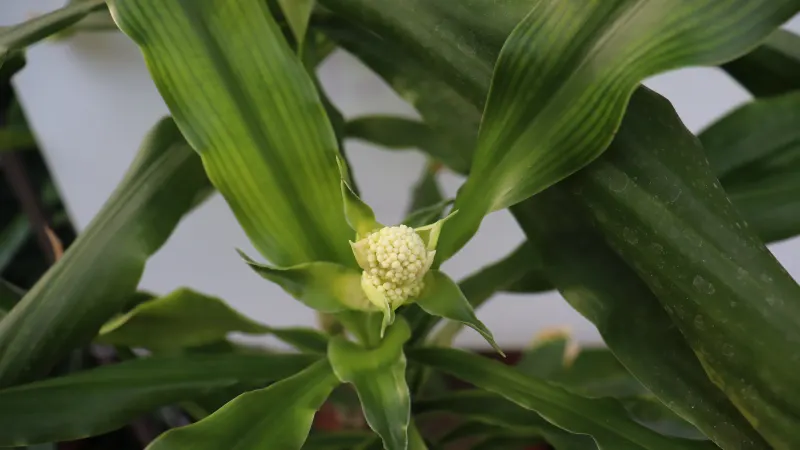
The corn plant is Dracaena fragrans, a slow-growing evergreen shrub from tropical Africa, grown in temperate countries as a houseplant. Its name comes from the look of it: NC State Extension notes that its unbranched stem resembles a corn stalk, and Clemson HGIC that the leaves resemble those of sweet corn. The stems are woody and tan, and the RHS describes glossy, strap-shaped leaves to 40 cm long on cane-like stems. NC State adds that the leaves are arranged in a spiral and droop as they lengthen.
The plant on sale is usually the cultivar 'Massangeana'. Clemson HGIC calls it the most commonly grown corn plant, with glossy green, arching leaves and a wide central yellow stripe, and the RHS gives it an Award of Garden Merit. Other cultivars sold under the same species include 'Janet Craig' ('Compacta'), with solid green leaves, and 'Warneckii', with greyish-green leaves striped in white or green, both of which NC State Extension lists. NC State also notes that the corn plant was previously known as Dracaena deremensis and Dracaena massangeana, so older labels may say either.
Indoors it grows slowly upwards. Clemson HGIC gives 'Massangeana' a height of 1.2–1.5 m with a 60 cm spread; the RHS gives the species 1.5–2.5 m, and 'Massangeana' up to 4 m with time. In flower it is strongly scented: NC State Extension describes white flowers, opening from pink, that are highly fragrant at night. They rarely appear indoors, and the RHS notes that 'Massangeana' seldom flowers at all.
It has close relatives on most windowsills. NC State Extension notes that the corn plant is often confused with the dragon tree, Dracaena reflexa var. angustifolia, and with lucky bamboo, Dracaena sanderiana, and it lists the snake plant, Dracaena trifasciata, as a plant for the same places. Clemson HGIC's warning about fluoride, below, is written for dracaenas as a group.
Light: tolerant of shade, better in brightness
A corn plant copes with shade. UF/IFAS Extension in Nassau County calls it well suited to office life, a plant adapted to low light, and notes that overhead lights running eight or more hours a day are usually enough for it. The RHS notes that 'Massangeana' tolerates low indoor light.
Tolerating is not the same as growing well. Clemson HGIC says most dracaenas grow best in bright, indirect light, and that a plant moved from dim light into a brighter spot makes thicker, stronger new leaves and grows faster. NC State Extension recommends bright to moderate, filtered light and notes that low light gives narrower leaves. UF/IFAS gives the warning sign: a plant growing tall and spindly is not getting enough light and should move closer to a window.
The other limit is direct sun. NC State Extension warns that it can burn the foliage, and Clemson HGIC suggests that round, dry patches or streaks on the leaves may be a sign of too much sun. The RHS puts it simply: full light, with shade from hot sun.
If you use Botanical Legacy, the place you put a Specimen in carries the light you described for it, as a level or as the window's direction. When a plant's light needs and its place don't match, the app flags it and names a better place you already have. It cannot measure the light in the room, so watching the new leaves, and how far they reach, is still your job.
How to water a corn plant
The sources differ in tone but agree on the shape. Clemson HGIC says to let a dracaena dry slightly between waterings, then water thoroughly once the surface of the compost is dry to the touch, and to avoid cold water. NC State Extension says to keep the soil moist through the growing season and reduce watering in winter. The RHS asks for moderate watering while it grows and sparing watering in winter. Between them, the compost is never left soggy, and never left dry for long.
What kills a corn plant is the wet end of that range. Clemson HGIC names root rot, caused by poorly draining soil or watering too often, among the common problems, and lists too much water and poor drainage among the causes of sudden leaf loss. NC State Extension calls for a pot with drainage holes. Water until it runs through, let it drain, and empty the saucer.
How often that is depends on the room. A pot in a bright, warm spot dries faster than the same pot in a dim, cool one, so water by the compost, not by a fixed day. The longer method is in when to water your houseplants.
A model of the individual plant helps here. Botanical Legacy keeps a Digital Shadow of each Specimen in your Sanctuary, a running estimate of when that particular pot will be dry. On every plan, including the free one, you can log a quick soil check from the Specimen's page, from bone dry to wet. After three checks between waterings, the model starts correcting its drying rate for that plant from what you found. For a corn plant, which rots when it is watered too often, that means a timing fitted to this pot in this room, rather than to a label.
Fluoride, salts and brown tips
Brown leaf tips are the corn plant's best-known complaint, and they often have nothing to do with how much you water. Clemson HGIC notes that dracaenas are very sensitive to fluoride, which shows as yellowing leaf tips or margins, or dead, scorched areas. NC State Extension says the corn plant is sensitive to fluorides and to built-up salts, and that if the leaves brown, you should use non-fluoridated water and flush the salts from the pot monthly.
Fertiliser can add to it. Clemson HGIC advises avoiding fertilisers containing superphosphate, which are often high in fluorine, and warns that too much fertiliser can burn or yellow the leaf tips and margins. Clemson also suggests avoiding potting mixes with a high percentage of perlite.
Dry air is the other cause. Clemson HGIC says dry tips and edges are usually from too little humidity, and NC State Extension that the tips can brown in low indoor humidity, especially in heated winter months. So a corn plant with brown tips may be telling you about its water, its feed or the air, and the fix depends on which. The same story, told for a close relative, is in the dragon tree guide.
Temperature, humidity and feeding
Ordinary room temperatures suit a corn plant. Clemson HGIC gives 16–21°C (60–70°F) by day as best for dracaenas, with nights about 5–6°C cooler, and NC State Extension says it thrives at 21–27°C (70–80°F) and should be kept above 10°C (50°F) if possible. The RHS rates it H1B, a plant that can go outdoors in summer but needs protection in winter, with a minimum of 10–15°C. Clemson lists temperature changes and draughts among the causes of sudden leaf loss, so a spot by a door that opens to winter air is a poor one.
For humidity, Clemson HGIC suggests occasional misting when indoor humidity falls below 30–40%, which it says is likely in winter, and NC State Extension suggests a humidifier, especially in heated winter months. The RHS asks for moderate humidity for 'Massangeana'. More on why winter air dries plants is in houseplant humidity and central heating.
Feed while it grows. Clemson HGIC recommends a liquid foliage plant fertiliser once a month in spring and summer, and the RHS a balanced liquid feed monthly through the growing season. Feed only in that season, and no more than that: excess fertiliser is one of the causes of burnt tips.
Soil and repotting
A standard commercial houseplant potting mix suits it, Clemson HGIC says, with a pH of 6.0–6.5; the RHS recommends a peat-free, loam-based compost. NC State Extension says to repot into a larger pot when the plant starts to lift out of its pot or sends roots out of the drainage hole, and the RHS suggests top-dressing or repotting in spring.
Pruning, height and propagation
A corn plant left alone keeps growing up its cane, and in time its stems can grow long and bare. Cutting it back is how you control it. Clemson HGIC says that when stems become long and bare, you can cut them at the height you want and new leaves will soon appear, and UF/IFAS Extension notes that pruning to the desired height forces the plant to branch. The RHS suggests cutting weak stems back to 15 cm in spring and using the cutting for propagation.
The piece you cut off is not waste. Clemson HGIC lists air layering, tip or stem cuttings, and rooting basal shoots, in spring or late summer, as ways to propagate dracaenas. Iowa State Extension describes the cane method for the corn plant in detail: cut the bare cane into segments 5–8 cm long, each with at least two nodes, and lay them on their side on perlite, coarse sand or vermiculite, with their tops just above or just below the surface. Keep the air at about 18–24°C (a heat mat under the pot can take the medium to 24–27°C), keep the humidity high with a loose plastic cover, and give four to six hours of bright, indirect light a day. Roots and shoots form in eight to ten weeks, and Iowa State suggests potting each one up once they are about 2.5 cm long. The general methods are in how to propagate plants.
Common problems
Brown or yellow leaf tips and margins. The classic dracaena problem. Clemson HGIC links yellowing or scorched tips and margins to fluoride, and dry tips to low humidity; excess fertiliser burns them too, and NC State Extension adds built-up salts. Switch to non-fluoridated water, flush the pot monthly, ease off the feed and raise the humidity in winter. More on reading the colour of a leaf is in why plant leaves turn yellow.
Sudden leaf loss. Clemson HGIC lists temperature changes, draughts, too much water, poor drainage and heavy insect infestation. Check the spot, the compost and the undersides of the leaves, in that order.
Root rot. Clemson HGIC ties it to poorly draining soil and watering too often, and lists too much water and poor drainage among the causes of sudden leaf loss. Let the compost dry, check the drainage hole, and water less often from now on.
Narrow leaves and a tall, spindly plant. Too little light. NC State Extension notes that low light gives narrower leaves, and UF/IFAS Extension that a spindly plant should move closer to a window.
Round, dry patches or streaks. Clemson HGIC suggests these may come from too much sun. Move it back from the glass or filter the light.
Pests. Clemson HGIC names scale insects and mites as the most common pests of dracaenas. The RHS lists scale insects, glasshouse red spider mite, thrips and mealybugs for the corn plant, and NC State Extension thrips, mealybugs and scale. See the guide to common houseplant pests for how to tell them apart. A photo to the Doctor, powered by Botanical Vision v5, returns a health verdict, the likely cause of what it sees, and what to do.
Frequently asked questions
How often should I water a corn plant?
There is no fixed interval. Clemson HGIC suggests letting the compost dry slightly, then watering thoroughly once the surface is dry to the touch, with water that is not cold. Water less in winter, as NC State Extension and the RHS both advise, and never leave the pot standing in water: poorly draining soil and watering too often are what cause root rot.
Why does my corn plant have brown tips?
Usually the water or the air. Dracaenas are very sensitive to fluoride, which yellows and then scorches the leaf tips and margins, and NC State Extension adds built-up salts; Clemson HGIC says dry tips and edges are usually from low humidity, and that excess fertiliser burns them too. Use non-fluoridated water, flush the pot monthly, feed only monthly in spring and summer, and raise the humidity in winter.
Can a corn plant live in low light?
Yes. UF/IFAS Extension calls it well suited to office life and adapted to low light, and the RHS notes that 'Massangeana' tolerates low indoor light. It grows best in bright, filtered light, though: in a dim spot it grows slowly with narrower leaves, and a plant turning tall and spindly needs to move closer to a window. Keep it out of direct sun, which can burn the leaves.
How tall does a corn plant get?
Slowly, and taller than you might expect. Clemson HGIC gives 'Massangeana' about 1.2–1.5 m, and the RHS gives the species 1.5–2.5 m and 'Massangeana' up to 4 m. Cutting a cane at the height you want keeps it in check: new leaves appear below the cut, and the plant can branch.
Is a corn plant toxic to cats and dogs?
Yes. The ASPCA lists the corn plant as toxic to dogs, cats and horses. The toxic compounds are saponins, and the signs are vomiting, sometimes with blood, depression, loss of appetite, drooling and, in cats, dilated pupils. The RHS lists it as harmful to dogs, cats, rabbits and rodents if eaten, and NC State Extension lists it as a low-severity poison for people too, whose sap can irritate the skin. Keep it out of reach, and call your vet if a pet has chewed it.
Can Botanical Legacy help with a plant that grows this slowly?
It helps most with the watering. A corn plant rots when it is watered too often, and how fast its pot dries depends on the room. Each Specimen gets its own Digital Shadow, an estimate of when its pot will be dry, and soil checks you log on any plan teach the model that plant's real drying rate. Progress photos build growth curves of height and leaf count, so a slow plant's progress shows up as a trend instead of a guess.
Start your sanctuary
Botanical Legacy's free Observer plan covers up to five Specimens, each with its own continuously running Digital Shadow and soil checks that teach it each pot's drying rate. A corn plant, slow to grow and quick to rot in a pot that stays wet, is exactly the kind of plant a steady per-pot model is for. Every new account also includes a 14-day trial of Cultivator, the paid plan, which adds the local weather feed and soil sensor support.
START YOUR SANCTUARY - FIVE FREE SPECIMENS, NO PAYMENT REQUIRED →
Give a corn plant bright, filtered light, clean water and a pot that drains, and it will grow up its cane for years.
Sources
8 references
The plant-care facts on this page were checked against these references.
- NC State Extension: plants.ces.ncsu.edu/plants/dracaena-fragrans
- RHS: rhs.org.uk/plants/6093/dracaena-fragrans/details
- Clemson HGIC: hgic.clemson.edu/factsheet/dracaena
- RHS: rhs.org.uk/plants/79003/dracaena-fragrans-massangeana-v/details
- UF/IFAS Extension: blogs.ifas.ufl.edu/nassauco/2017/06/20/q-office-staff-just-gave…
- UF/IFAS Extension: blogs.ifas.ufl.edu/nassauco/2017/06/20/q-please-tell-can-dracae…
- Iowa State Extension: yardandgarden.extension.iastate.edu/how-to/how-propagate-housep…
- ASPCA: aspca.org/pet-care/aspca-poison-control/toxic-and-non-toxic-pla…