Plant care · 13 min read
How to debug plants before bringing them inside — clean the leaves, then clear out the pot
A summer outdoors fills a pot with more than roots. How to clean houseplants before the move indoors, flush slugs, ants, earwigs and worms out of the pot, find the vine weevil grubs a rinse never reaches, and keep outdoor pests from reaching the plants that stayed in.
Botanical Legacy · Field notes ·
Rinsing the leaves cleans the half of the plant you can see. Most of what comes indoors is riding in the pot.
The pot is the part everyone forgets
The usual advice for bringing plants in for autumn is to check the leaves and hose them down. It's good advice, and it covers about half the plant. A pot that spent four months on a patio, a balcony or a lawn has been a shelter the whole time: dark, damp, cool underneath, with a drainage hole at the bottom that works as an open door. Things moved in.
Here's what a summered pot typically carries, from the outside in. Under the rim and the base: slugs, snails and their clusters of pearly eggs, earwigs, woodlice. In the mix: ants (a dry pot is a good nest), millipedes, earthworms if the pot stood on soil or grass, fungus gnat larvae in the damp top few centimetres. And down among the roots, the one that does the real harm: vine weevil grubs, cream-coloured, C-shaped, with brown heads, around 1cm long when grown. The adult beetles lay their eggs in pots through spring and summer, and the grubs spend the following months eating roots. On the foliage, the passengers the leaf check is meant for — aphids, spider mites, mealybugs, scale.
The popular myth is that it doesn't matter much, because outdoor bugs die indoors. Some do. A slug in a heated living room dries out, and most earwigs and woodlice wander off the pot and perish somewhere under the sofa. The trouble is the ones that thrive. Outdoors, rain, wind, birds, ladybirds and parasitic wasps held the sap-suckers down all summer. Indoors there's none of that, and warm air shortens their breeding cycle: a spider mite life cycle that takes about 55 days at 10°C is done in about 12 at 21°C. The vine weevil grub has it better still. In a warm pot it keeps eating straight through the winter, and the first sign most people see is a plant collapsing in January with its roots gone.
So cleaning a plant before the move is two jobs. The leaves get washed. The pot gets lifted, looked under, flushed, and sometimes opened.
What to do
Start a week before the move, outdoors, on a dry day. Almost everything here is easier outside, where water can run and soil can fall. It also buys time for a second round of treatment, which a single afternoon doesn't allow. Aim to finish before the nights settle near 10°C — the deadline covered in when to bring plants inside for fall — so the cleaning doesn't push the move later than the plant can afford.
Lift every pot and clean the outside of it. Turn it on its side and look at the base, the drainage holes and the underside of the rim. That's where slugs, snails, earwigs and egg clusters sit through the day. Scrape them off, scrub the pot's outside with a stiff brush and water, and check the ground where it stood: a nest of ants or a colony of woodlice under the pot is a strong hint about what's inside it. Wash the saucers or leave them outside, and don't bring the moss, pebble mulch or fallen leaves in with the plant.
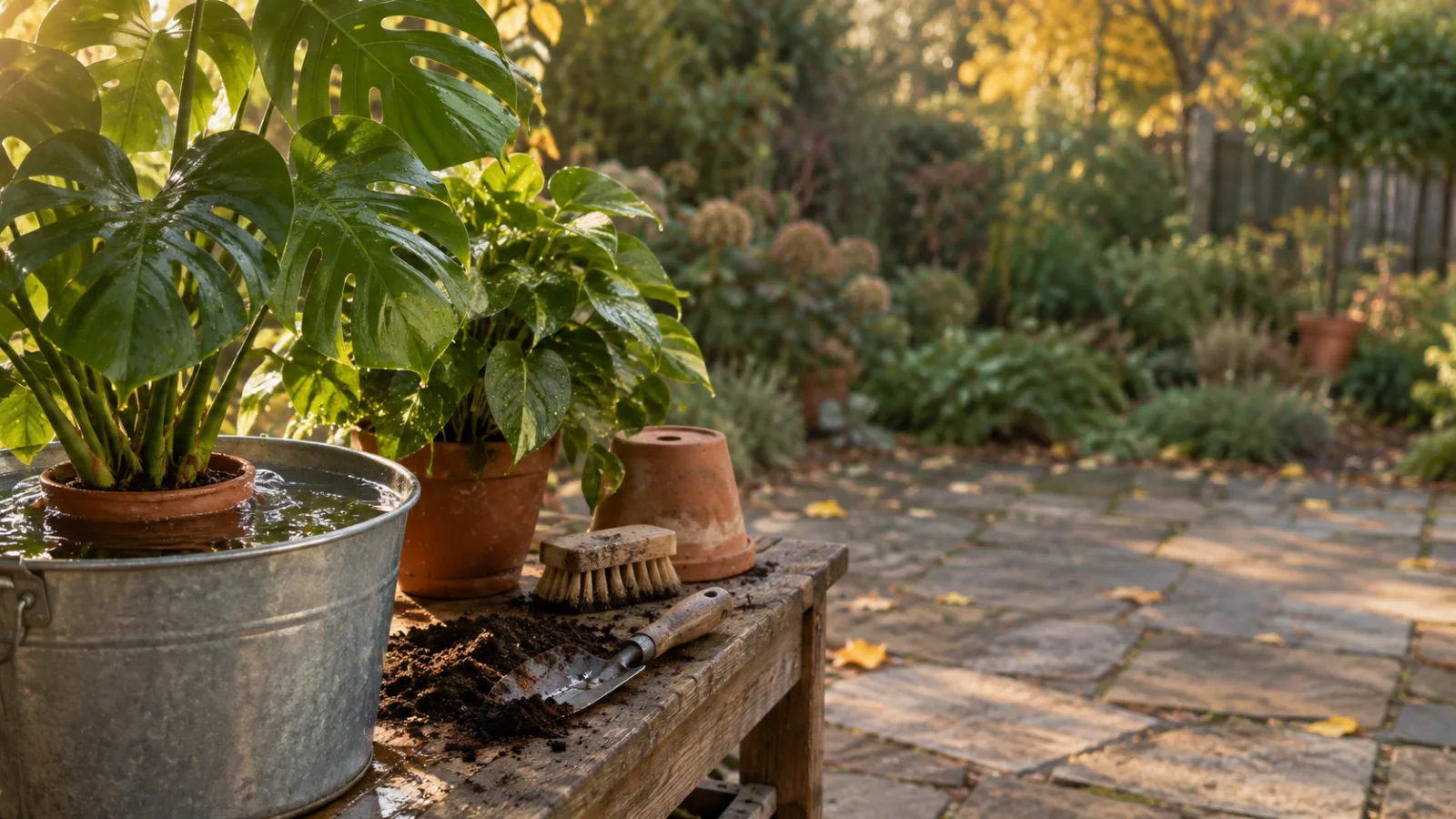
Flush the pot with a soak. Stand the pot in a bucket of room-temperature water so the water covers the surface of the mix by a centimetre or two, and weigh it down if it floats. Leave it for 15–20 minutes. As water fills the air spaces in the mix, most of what's living in there has to leave: slugs, earwigs, woodlice, ants, millipedes and worms come up to the surface or out through the drainage holes, where you can pick them off. Then lift the pot out and let it drain completely — and don't water it again until the top of the mix has dried, because a plant going into lower light uses far less water than it did in August. Use plain water: the soak works by flooding the mix, so nothing needs adding to it.
Skip the soak for succulents and cacti. A jade, an aloe or a cactus sitting in a saturated pot heading into the darkest months is a rot risk, which is a worse problem than a woodlouse. For these, and for any plant whose mix is already wet, slide the root ball out of the pot and inspect it dry instead.
Tip out anything that looks wrong below the soil. A plant that wilts while its mix is damp, or has irregular notches bitten out of its leaf edges (the calling card of the adult vine weevil) should come out of its pot before it comes into the house. Look through the outside of the root ball for C-shaped grubs and ant galleries. If you find grubs, shake off as much of the old mix as the roots allow, pick out every grub you see, and replant in fresh mix in a scrubbed pot. This is the one good reason to repot in autumn: the usual advice to hold the repotting until spring assumes the roots are intact. Where grubs are widespread, a biological control of predatory nematodes, watered into the mix, works well on vine weevil. The cold-tolerant species, Steinernema kraussei, works in a mix above about 5°C, and a heated room is warm enough for any of them.
Replace the top layer of mix. Scrape off the top 2–3cm of the old mix and replace it with fresh. That layer is where fungus gnats lay their eggs and holds many of their larvae, along with weed seedlings, moss, bird droppings and whatever blew in over the summer. It takes two minutes a pot and costs the roots nothing, because it isn't repotting.
Wash the leaves, top and underneath. Tilt the plant with one hand over the surface of the mix and give the foliage a firm spray of lukewarm water, from a hose outside or a shower inside, paying attention to the leaf undersides and the joints where leaf meets stem. Wipe broad leaves with a soft damp cloth; a summer's dust on a monstera or a rubber plant is worth wiping off before the move. Pull off yellowing leaves, spent flowers and dead growth, and pick the debris off the surface of the mix, since fallen leaves are where pests shelter and fungal problems start.
Treat what you find while the plant is still outside, then repeat. Insecticidal soap on the undersides of the leaves handles aphids, spider mites, whitefly and young mealybugs; a cotton bud dipped in rubbing alcohol lifts the mealybugs and scale you can see. Test on one leaf first, since ferns, jade and some succulents mark easily. Spray in the evening or in shade, not in direct sun, and let it dry before the plant goes in. One round usually leaves eggs behind, so repeat after about a week, which is the reason to start a week early. The identifying signs and the treatment order are in the guide to common houseplant pests.
Keep the returners apart for two weeks. Once inside, give the summered plants a room or a shelf of their own, away from the ones that stayed in all year. A yellow sticky card pushed into the pot is a cheap monitor: a few fungus gnats on it in the first week means the top layer needs to dry out between waterings. Most things you missed will show themselves in the fortnight, on one group of plants instead of all of them.
Three ways this plays out
The collapse in January
A pot of polka dot begonias spends the summer on a shaded step and comes in during early October looking better than ever. The leaves were rinsed and nothing turned up. By January one plant wilts although its mix is damp, and it lifts out of the pot with barely a tug: the root system is gone, and eight grubs are curled in what's left of the mix. A vine weevil laid her eggs in that pot in August. Two minutes with the root ball on the doorstep would have shown the grubs when they were a few millimetres long and the roots were still whole.
The ant trail on the windowsill
A money tree in a large pot comes in from the terrace, gets its leaves washed, and settles by the living room window. A week later there's a line of ants from the pot to the skirting board. They'd nested in the dry lower half of the mix over the summer, and they were there for a reason: a colony of mealybugs on the lower stems, which the ants had been tending for their honeydew. A 20-minute soak drove the ants out; the swab and the soap dealt with the mealybugs. Ants in a pot often mean something sap-sucking nearby. Find the ants, then look for what they're farming.
The soak that went too far
Pleased with how well the soak worked on the tropical plants, a Guardian soaks everything, including a jade plant, an aloe and a pot of echeveria. All three go in on the same day, fully saturated, to a north-facing sill. The mix stays wet for three weeks in the cool light, and by November the jade has soft, translucent stems at the base. There were no pests in any of the three. The succulents needed a dry inspection — a look at the root ball, a brush-off of the pot — and nothing else.
What Botanical Legacy does about it
Every Specimen in your Sanctuary keeps a dated photo record, and every photo you add to it is read by the Doctor, powered by Botanical Vision v5. That makes the doorstep a good moment for one: a photo of each plant after the cleaning and before the move is the baseline you compare against during the fortnight of quarantine, and a second at the end of it gives the Doctor another look once anything that came in has had two weeks to show.
When a photo shows signs of trouble, the Doctor checks the plant for pests. It names the common houseplant ones by type — aphids, mealybugs, spider mites, scale, fungus gnats, thrips, whitefly — describes what it saw, grades how far along the problem is, and suggests a treatment. If it's the kind of pest that spreads, the reading on the Specimen's page says so and tells you to keep that plant apart from the others, which is the quarantine step above aimed at the plant that needs it most. The Specimen's tile carries a pests marker too, so it stands out when you look across the collection.
Each photo read uses one image credit from your monthly allowance, the same allowance plant identification draws on: three a month on the free plan, 120 on the paid plan. When the allowance runs out, the photo is still saved to the record, but it isn't read.
The Doctor reads leaves and stems, where the sap-suckers live. It looks for the same signs the guide to reading plant health signs describes, in whatever the photo shows. It doesn't reach into the pot, which is why the soak and the root check stay on the list.
What the model can't see
The Doctor reads what's in the photo, and nothing that happens inside a pot is in the photo. Grubs among the roots, ants in the lower mix, slug eggs under the rim and fungus gnat larvae in the top layer are all out of frame by nature. A phone camera also can't resolve a single spider mite or a just-hatched mealybug crawler, so a clean photo is not a clean plant. The soak, the look under the pot and the root-ball check on anything that seems off are yours to do. What the app adds is the dated photo record: what each plant looked like on the doorstep, so a problem that surfaces in December has something to be compared against.
Frequently asked questions
How do I get bugs out of potted plant soil before bringing it inside?
Soak the pot. Stand it in a bucket of room-temperature water that covers the surface of the mix by a centimetre or two for 15–20 minutes. Slugs, earwigs, woodlice, ants and worms leave as the mix floods and can be picked off. Drain it fully and let the top of the mix dry before the next watering. Skip the soak for succulents and cacti, and inspect their root balls dry instead.
Should I add soap to the water when I soak my plants?
No. Plain water does the job: the soak works by flooding the air out of the mix. Insecticidal soap belongs on leaves and stems, where soft-bodied pests like aphids, mites and mealybugs feed.
Are earthworms in potted plants bad?
In a garden bed, earthworms help. In a pot they have little decaying plant matter to feed on. They don't feed on living roots; a soak will bring them to the surface, and they can go back to the garden.
What are the white grubs in my plant pot?
Cream-coloured, C-shaped grubs with brown heads, up to about 1cm long, are almost always vine weevil larvae. They eat roots and can kill a plant over a winter. Remove the plant from its pot, pick out every grub, replant in fresh mix in a clean pot, and consider a predatory nematode treatment if you find them in more than one pot.
How do I clean houseplant leaves before bringing them indoors?
Give the foliage a firm spray of lukewarm water, paying attention to the undersides and the leaf joints, then wipe broad leaves with a soft damp cloth. Remove yellowing leaves, spent flowers and debris from the surface of the mix. Use leaf-shine products sparingly, only on firm, smooth leaves, and never on hairy ones.
Do I need to repot plants before bringing them inside?
Usually not. Autumn is a poor time to disturb roots, and a larger pot of fresh mix stays wet for longer just as the plant is drinking least. The exceptions are a pot with vine weevil grubs or an ant nest in the roots. For everything else, replacing the top 2–3cm of mix is enough.
Can Botanical Legacy spot pests before I bring plants in?
It can spot common houseplant pests when a photo shows signs of trouble. Every photo you add to a Specimen is read by the Doctor, powered by Botanical Vision v5, and when the photo shows signs of trouble it names common pests such as aphids, mealybugs, spider mites, scale, fungus gnats, thrips and whitefly, grades the severity, suggests a treatment, and tells you to keep the plant apart from the others if the pest spreads. Each read uses one image credit from the monthly allowance, which is three on the free plan. It can't see into the pot, so slugs, ants, worms and vine weevil grubs are still found by soaking the pot and checking the roots.
Start your sanctuary
Botanical Legacy's free plan covers up to five Specimens, indoors or out, with continuous Digital Shadow modelling included and three photo reads a month from the Doctor, shared with plant identification. Every new account also gets a 14-day trial of the paid plan, which raises that to 120 a month and adds local weather, frost and heat wave alerts, and sensor support via Home Assistant — enough to photograph every plant on the doorstep and again at the end of its quarantine.
Start your sanctuary — five free specimens, no payment required →
A plant that comes in clean is one plant to look after. One that comes in carrying something is the whole shelf.
Sources
The plant-care facts on this page were checked against these references.
- Clemson HGIC: hgic.clemson.edu/factsheet/common-houseplant-insects-related-pe…
- RHS woodlice: rhs.org.uk/biodiversity/woodlice
- RHS earwigs: rhs.org.uk/biodiversity/earwigs
- UC IPM Snails and Slugs: ipm.ucanr.edu/PMG/PESTNOTES/pn7427.html
- Illinois Extension: extension.illinois.edu/blogs/good-growing/2022-09-09-tips-movin…
- CSU Extension, Fungus Gnats: extension.colostate.edu/resource/fungus-gnats-as-houseplant-and…
- RHS vine weevil: rhs.org.uk/biodiversity/vine-weevil
- UC IPM Black Vine Weevil: ipm.ucanr.edu/PMG/GARDEN/PLANTS/INVERT/blvinwee.html
- UC IPM Earwigs: ipm.ucanr.edu/PMG/PESTNOTES/pn74102.html
- Woodlice desiccation study (PMC): pmc.ncbi.nlm.nih.gov/articles/PMC6288246
- UC IPM Aphids: ipm.ucanr.edu/PMG/PESTNOTES/pn7404.html
- UC IPM Mealybugs: ipm.ucanr.edu/PMG/PESTNOTES/pn74174.html
- RHS glasshouse red spider mite: rhs.org.uk/biodiversity/glasshouse-red-spider-mite
- Iowa State Extension: yardandgarden.extension.iastate.edu/faq/how-and-when-do-i-bring…
- NC State Extension, Wayne County: wayne.ces.ncsu.edu/news/time-to-bring-houseplants-indoors
- K-State Extension: butler.k-state.edu/horticulture/agent-articles/houseplants/brin…
- Nebraska Extension: lancaster.unl.edu/bringing-houseplants-indoors
- UC IPM less toxic insecticides: ipm.ucanr.edu/home-and-landscape/less-toxic-insecticides
- NC State Extension, jade plant: plants.ces.ncsu.edu/plants/crassula-ovata
- Clemson Land-Grant Press: lgpress.clemson.edu/publication/integrated-pest-management-stra…
- Wisconsin Horticulture, houseplant care: hort.extension.wisc.edu/articles/houseplant-care
- Illinois Extension, houseplant care: extension.illinois.edu/houseplants/care
- UC IPM Houseplant Problems: ipm.ucanr.edu/PMG/PESTNOTES/pn74172.html
- UC IPM Fungus Gnats: ipm.ucanr.edu/PMG/PESTNOTES/pn7448.html
- University of Kentucky Entomology: entomology.mgcafe.uky.edu/ef406
- Wisconsin Horticulture, fungus gnats: hort.extension.wisc.edu/articles/fungus-gnats-on-houseplants
- RHS earthworms: rhs.org.uk/biodiversity/earthworms
- RHS houseplants growing guide: rhs.org.uk/plants/types/houseplants/growing-guide
- RHS overpotting: rhs.org.uk/prevention-protection/overpotting