Species care guide
Money tree
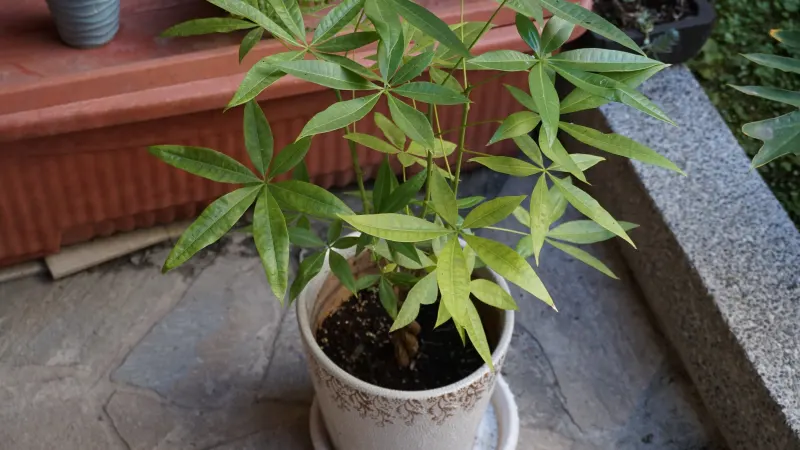
Pachira aquatica
A money tree care guide built on triggers, not timers — how often to water Pachira aquatica, the light it needs, and what dropping or yellowing leaves are really saying.

- Light
- Bright, indirect light; tolerates medium light but gets leggy and sparse in dim corners
- Water
- When the top 5 cm of soil are dry to a finger — roughly every 1–2 weeks in summer, every 2–3 weeks in winter
- Humidity
- Happiest at 50%+ but copes with ordinary household air; dry winters can crisp the leaflet tips
- Temperature
- 16–27°C; keep it above 10°C and away from cold draughts
- Pets & toxicity
- Generally considered non-toxic to cats and dogs — a rare pet-safe choice
- Difficulty
- Easy once the watering is right; nearly every problem traces back to a wet pot
The swollen trunk is a water tank — which is exactly why drowning a money tree feels like kindness.
A plant sold for luck and lost to watering cans
The money tree arrives wrapped in symbolism — the braided trunk, the five-leaflet leaves said to bring fortune, the gift-shop promise of prosperity. What it doesn't arrive with is an honest note about how it dies, which is almost always the same way: drowned by an owner who watered it on a schedule because a plant this auspicious surely couldn't be killed by kindness.
It can. Pachira aquatica has a thick, swollen trunk base that stores water for dry spells, and that single feature explains nearly all of its care. A plant built to ride out drought does not want a constantly damp pot; it wants a real drink followed by a real dry-down, the way it would get one in the wild. Read the trunk as the tank it is, and the money tree is one of the easier statement plants you can keep — long-lived, sculptural, and unusually, genuinely pet-safe. If houseplants in general are new to you, the ten mistakes every beginner makes covers the ground this plant will otherwise teach you the expensive way.
Light
Despite the "aquatica" in its name — it grows in seasonally flooded wetlands in Central and South America — the money tree indoors is a bright-light plant. In the wild it reaches a substantial tree, climbing into strong light as it grows. Indoors it wants bright, indirect light: near a window, out of the harsh midday beam that scorches its leaflets, with an hour or two of soft morning sun very welcome.
It tolerates medium light, but tolerance shows in the shape. In a dim spot the stems stretch toward the window, the gaps between leaves widen, the canopy thins, and the whole plant leans. That leaning is also why rotation matters more here than for most plants — a quarter-turn each week keeps the canopy growing evenly instead of hauling itself sideways toward the glass. Be suspicious of your own eyes when judging brightness: human vision adapts to dimness far better than a leaf does, and a corner that looks fine to you is often where a money tree slowly goes leggy. Direct, unfiltered summer sun through glass is the other extreme to avoid — it bleaches and crisps the leaflets.
How often to water a money tree
There is no number worth trusting. The same plant drinks at one rate on a warm, bright sill and at half that through a cool, dim winter; faster in porous terracotta than glazed ceramic; faster root-bound than freshly potted. Any "water once a week" instruction is an average that's right for a few weeks a year and wrong in both directions for the rest — and with this plant, wrong in the wet direction is fatal.
Use a trigger: water only when the top 5 cm of soil are dry to a finger. Push a finger in deep — this plant wants to dry down further than most before its next drink. Dry — water. Still cool and damp — wait, and check again in several days. When you do water, water thoroughly until it runs from the drainage holes, then drain the pot and empty the saucer. A full drink and a genuine dry-down. In practice that lands most indoor money trees near every 1–2 weeks in summer and every 2–3 weeks in winter — but the soil decides, not the date. The longer method is in when to water your houseplants.
The trigger matters because the money tree's tolerance runs hard one way. That swollen trunk is a reservoir; the plant would rather be left dry than kept wet, every time. A money tree that's gone too dry recovers quickly from a good soak. A money tree kept constantly damp rots at the roots and the trunk base, and by the time the leaves yellow and drop, much of the damage is already done. More owners confuse overwatering with underwatering on this plant than on almost any other, because both extremes end in dropping leaves — and they reach for the watering can when the soil is the last thing the plant needs. This is exactly the gap a per-specimen model closes. Botanical Legacy keeps a Digital Shadow of each Specimen in your Sanctuary — a running estimate of how much moisture is left in that particular pot — so you water when this tree is approaching dry, not when the calendar says so.
Soil and potting
A money tree wants a fast-draining mix that lets the pot dry out properly between waterings. A standard houseplant compost opened up with plenty of perlite, or a cactus-and-succulent mix lightened with a little ordinary potting soil, both work well. The goal is air at the roots and no standing water — a dense, water-retentive compost is how careful owners still drown this plant, because the finger test reads dry on top while the base stays sodden.
The pot does quiet, important work. Porous terracotta breathes through its walls and dries faster, which forgives a heavy hand; glazed ceramic and plastic hold moisture and can double the time between drinks. Either is fine — a pot without a drainage hole is not. Repot every couple of years in spring, when roots fill the pot and water rushes straight through, going up one size only (3–5 cm wider). Keep the swollen trunk base planted at the same depth it sat before — burying it deeper invites rot exactly where the plant can least afford it.
Humidity and temperature
The money tree comes from humid wetlands and is happiest above 50% humidity, but it copes with ordinary household air better than its tropical origin suggests. You don't need a humidifier. If a dry winter with the heating running starts crisping the leaflet tips, grouping plants together or standing the pot on a pebble tray helps more than misting, which evaporates within minutes.
Temperature asks little but has a floor. The comfortable band is 16–27°C, and the plant minds cold more than warmth: sustained exposure below about 10°C does real damage, and a cold draught can trigger a sudden leaf drop. Keep it away from draughty doors, single-glazed winter windows, and the direct stream of air conditioning. Sudden swings of any kind — temperature, light, location — are this plant's particular trigger for dropping leaves, so consistency matters more than precision.
Feeding
A money tree is a light feeder, and the mistake that hurts it is generosity. Fertiliser is salt: more than the plant can use accumulates in the soil, pulls moisture back out of the roots, and burns the leaflet tips brown from the edge inward — damage that mimics dry air, so the cause gets misread and the feeding continues.
The cadence that works is modest. From spring through summer, while the plant is putting out new leaves, feed every 4–6 weeks with a balanced houseplant fertiliser at half the label strength. From autumn, taper to almost nothing; a plant slowing for the season can't use what you give it.
Common problems
Most money tree problems are one symptom with more than one cause — and on this plant, the same symptom often points to opposite watering mistakes, so feel the soil before you act.
Yellow leaves. Overwatering is the leading cause by a wide margin: soil still wet days after watering, a heavy pot, yellowing spread across the plant. But the opposite — left bone-dry too long, with a feather-light pot — yellows too, and a single oldest leaflet retiring while new growth thrives is normal. The pot's weight and the soil's dampness separate the causes; the leaf alone doesn't.
Dropping leaves. The money tree's signature stress response. Sudden change is the usual trigger — a new spot, a draught, a swing in light or temperature — and a flush of dropped leaflets after a move is often just the plant adjusting, not dying. Persistent, heavy drop alongside wet soil, though, is root rot announcing itself. Check the soil before assuming the worst.
Leggy, stretched growth. Long gaps between leaves and stems leaning hard toward the window mean too little light. Move it brighter and rotate it weekly; you can prune leggy stems back in spring to encourage a fuller, bushier shape.
Brown, crispy leaflet tips. Dry winter air, irregular watering, or salt buildup from over-feeding. If you fertilise often, suspect salt and flush the pot; if the heating has run for months, suspect the air.
Root and trunk rot. The one that kills. A money tree in wet, sour-smelling soil with a soft, squishy trunk base is losing its roots, and another drink finishes it. Unpot it, cut every brown, soft root back to clean tissue, repot into fresh, fast-draining mix, and water far less. A trunk that has gone soft and mushy is usually beyond saving — the lesson is for the next plant: let it dry down.
Frequently asked questions
How often should you water a money tree?
There's no fixed interval — the same plant drinks twice as fast in a warm, bright week as a cool, dim one. Water only when the top 5 cm of soil are dry to a finger, then water thoroughly until it drains and empty the saucer. In practice most indoor money trees land near every 1–2 weeks in summer and every 2–3 weeks in winter. When unsure, wait — the swollen trunk stores water, so this plant recovers from drought far better than from a wet pot.
Why is my money tree dropping leaves?
Usually sudden change — a new location, a draught, a swing in light or temperature — which makes the plant shed leaflets as it adjusts; this kind of drop often settles within a few weeks. If the drop comes with soil that stays wet and a heavy pot, the cause is overwatering and root rot instead, which needs the opposite response. Feel the soil before deciding, and resist the urge to "help" a stressed plant by watering it more.
Is a money tree toxic to cats and dogs?
Pachira aquatica is generally considered non-toxic to cats and dogs, which makes it one of the genuinely pet-friendlier statement plants. That said, any plant eaten in quantity can cause mild stomach upset, so it's still sensible to discourage determined chewers — but you don't have the calcium-oxalate worry that comes with pothos, philodendron, or a peace lily.
Why is my money tree's trunk going soft?
A soft, squishy trunk base is the late stage of overwatering — rot working up from the roots into the water-storage tissue. By the time the trunk gives way, the plant is usually past saving. Catch it earlier by always letting the soil dry down well before watering and never leaving the pot in standing water. If the trunk is still firm and only the leaves look unhappy, easing off the water often turns things around.
Will Botanical Legacy catch pests on my money tree from a photo?
Not reliably. The check-in photo analysis reads what a photo can show — yellowing, leaf drop, overall vigour — and folds it into the plant's running model, which is useful for catching slow declines week to week. But spider mites and scale start on the undersides of leaves and in stem joints, exactly where a photo rarely looks. Turning the leaflets over yourself stays part of the job.
Start your sanctuary
Botanical Legacy's free Observer plan covers up to five Specimens, each with its own continuously running Digital Shadow — and a money tree, sculptural and genuinely pet-safe, is a rewarding one to learn the dry-down rhythm on. Every new account also includes a 14-day trial of Cultivator, the paid plan, which adds the local weather feed and soil sensor support.
Treat the swollen trunk as the water tank it is, and the luck takes care of itself.
START YOUR SANCTUARY — FIVE FREE SPECIMENS, NO PAYMENT REQUIRED →
Nearly every money tree problem starts with one drink too many — read the trunk, not the calendar.