Species care guide
Polka dot begonia
Begonia maculata
A polka dot begonia care guide built on the facts that actually keep this cane begonia alive — you prune it, not water it, to stay full, and you give it humid air while keeping its spotted leaves bone-dry.
_Begonia_maculata_-_young_leaf.jpg)
- Light
- Bright, indirect light — plenty of it keeps the silver spots vivid and the canes compact, while low light dulls the markings and stretches the growth and harsh direct sun scorches the leaves.
- Water
- Keep the soil evenly moist but never soggy, letting the top 2–3cm dry before you water again — and water at the soil, keeping the leaves dry to fend off powdery mildew.
- Humidity
- Likes it humid, around 45% or more, but dislikes wet foliage — raise the ambient humidity with a humidifier rather than misting the leaves.
- Temperature
- 18–26°C; keep it warm and away from cold draughts and sudden chills.
- Pets & toxicity
- Toxic to cats and dogs — begonias contain soluble calcium oxalates, most concentrated underground in the tubers.
- Difficulty
- Moderate — the balancing act is giving it humidity while keeping the leaves dry, and pruning it to stay bushy rather than leggy.
Everyone photographs the silver-spotted wings. Far fewer keep the plant behind them — because staying alive comes down to two unglamorous habits: prune it, and keep its leaves dry.
The begonia everyone photographs
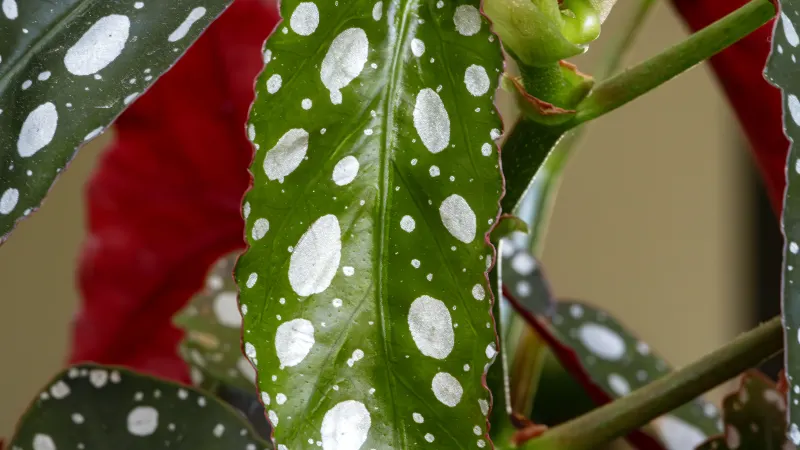
Few houseplants are as photogenic as Begonia maculata. It's a cane begonia — an angel-wing type — so it grows upward on tall, jointed, bamboo-like stems rather than spreading in a low rosette, and from those canes hang large, asymmetric, wing-shaped leaves: olive-green on top, scattered with raised silver polka dots, and a deep maroon-red beneath. It's the begonia that launched a thousand posts, and the first cane begonia in this collection.
What the photos never mention is the two habits that keep it alive, both unrelated to how it looks. First, you prune it to stay full — cane begonias grow tall and leggy by nature, and the cure for legginess is cutting them back, not feeding or watering more. Second, it shares the African violet's hang-up: it wants humid air but hates water on its leaves, because wet foliage on a begonia invites powdery mildew. Master the secateurs and the dry leaf, and the spots take care of themselves.
Light
Bright, indirect light is what this begonia is built for, and it pays you back in the feature you bought it for: in generous indirect light the silver polka dots stay vivid and the canes grow stocky and close-jointed. Somewhere dim, the markings fade to a flat, dull green while the stems stretch and reach, opening long bare gaps between the leaves — and that legginess is one of the plant's most common complaints. Light is the first half of the cure; pruning is the second.
Direct sun is the opposite extreme: a few hours of hot midday sun through glass scorches the leaves and bleaches the spots, and these thin wing leaves burn far more readily than a thick, waxy plant would. Beside a bright east window, or back from a south or west one behind a sheer curtain, gives the brightness without the burn.
Water
Begonias like their soil evenly moist — never drying to a bone-dry crisp, but never sitting wet and soggy either. Let the top two to three centimetres of the mix dry out, then water thoroughly and let all the excess drain away. Begonias are famously prone to root and stem rot, and waterlogged soil is the fastest way to lose one, so when in doubt err slightly too dry rather than too wet. The logic of reading the soil rather than a fixed calendar is in overwatering vs underwatering.
How you water matters as much as how often, and here the polka dot begonia borrows a rule straight from the African violet: water at the soil, and keep the leaves dry. Pour slowly onto the mix with the spout below the foliage — water sitting on a begonia leaf, especially in still, humid air, is the exact film of moisture that powdery mildew and botrytis need. Bottom-watering in a saucer keeps the foliage bone-dry if you'd rather not risk the watering can near the leaves at all.
Humidity without wet leaves
This is the heart of polka dot begonia care, and it's a genuine tension. The plant is tropical and wants warm, humid air — comfortably above 45% relative humidity, and happier higher; too dry, and the delicate wing leaves develop crisp brown edges and tips. And yet the one thing you must not do to raise that humidity is what most people reach for first: misting. Wetting the leaves to humidify them recreates precisely the standing-moisture problem that invites powdery mildew — the pale, dusty patches that are this plant's signature ailment.
The resolution is to separate humidity from the leaf surface: raise the ambient moisture in the air — with a humidifier, by grouping plants, or with a pebble tray beneath the pot — without ever leaving droplets on the foliage. Then pair that humid air with good airflow. Still, stagnant air is a mildew factory, while a gently moving atmosphere keeps the leaves dry even when the humidity is high — one of the most underrated defences against fungal trouble on a begonia.
If you already grow a calathea or a nerve plant, you've met this craving for humid air — but the begonia adds a condition those two don't insist on nearly as firmly: the moisture must stay off its leaves. It's the same lesson the African violet teaches with its fuzzy foliage — moisture in the plant's environment, not on its body — stated more emphatically here, because the penalty is fungal rather than cosmetic.
Pruning cane growth to stay full
Here is the mental shift that separates a lush polka dot begonia from a gangly one: when it looks leggy, you don't feed or water it more — you cut it back. Cane begonias send up tall, jointed stems that, left alone, keep climbing and put out fewer leaves down low, trending toward bare canes with a tuft of foliage at the top. Pruning is the cure, and the most important active skill this plant asks of you.
Pinch or cut a cane back to just above a leaf node and the plant branches, pushing out two or more new shoots where there was one. Do this across the plant over a season and a leggy single-stemmed begonia thickens into a full, bushy one. Prune in the growing season, take off no more than about a third at a time, and always cut a little above a node. Don't be timid — a hard prune is what makes a leggy cane begonia beautiful, and the plant is vigorous enough to take it.
Better still, nothing you cut off need go to waste: polka dot begonia cuttings root about as easily as any houseplant going. Set a cane section with a node or two in a glass of water or moist potting mix, keep it warm and humid, and roots appear within a few weeks — so every prune is also a chance to make a new plant, or to fill out the mother pot by rooting the cuttings back alongside her.
Feeding and potting
Feed lightly through the growing season — spring and summer — with a balanced liquid houseplant fertiliser at about half strength every few weeks while the plant is actively growing. Ease off almost entirely in autumn and winter, when growth slows; feeding a resting plant just builds up unused salts. As with watering, restraint is safer: overfed plants tend toward soft, weak, rot-susceptible growth.
For potting, drainage is the priority, because everything about this plant's vulnerability to rot comes back to how wet its roots stay. Use a light, free-draining mix — a peat-free compost lightened with perlite or bark — in a pot with drainage holes, and never leave it in a full saucer. Begonias have fine, shallow roots and are happy a little snug, so resist over-potting: too large a pot holds more wet soil than the roots can use, which is the overwatering problem in a different hat.
Common problems
Pale, dusty white patches on the leaves. Powdery mildew — the plant's signature affliction, almost always the result of wet foliage, high humidity, and poor airflow together. Improve ventilation immediately, stop any misting or overhead watering, remove the worst-affected leaves, and keep the foliage dry. Catch it early; left alone it spreads. It's a fungal problem worth reading up on alongside the bugs in common houseplant pests.
Long, bare canes with leaves only at the top. Legginess, from too little light, no pruning, or both. Move it into brighter indirect light and cut the leggy canes back to just above a node to force branching lower down — the two halves of the same cure.
Sudden leaf drop. Usually a shock — a cold draught, a sharp temperature drop, or a swing between bone-dry and soggy soil. Move it away from cold windows, draughty doors, and heat sources, and keep the watering rhythm even.
Crispy brown leaf edges and tips. The air is too dry. Raise the ambient humidity with a humidifier or pebble tray — not by misting — and keep it clear of radiators and heat vents.
Soft, mushy, blackening stems or a collapsing base. Stem or root rot from overwatering, and the serious one. Let the soil dry out considerably and check the roots; if the base has gone soft and dark the main plant may be lost, though healthy upper cane sections can often be rooted as cuttings to save it.
Frequently asked questions
Why does my polka dot begonia have white powdery spots?
That pale, dusty white coating is powdery mildew, a fungal problem and the most common ailment this plant faces. It takes hold when the leaves are wet or the air is humid and stagnant — which is why the golden rule is humidity in the air but never on the foliage. Improve airflow straight away, stop misting and overhead watering, remove the most affected leaves, and keep the leaves dry going forward. Caught early it's very manageable; left to spread it can engulf the plant.
Why is my polka dot begonia so leggy, and how do I make it bushier?
Legginess — tall bare canes with foliage only at the top — is simply how cane begonias grow if left alone, made worse by too little light. The fix has nothing to do with watering or feeding: give it brighter indirect light, and prune the canes back to just above a leaf node. Cutting a cane back forces it to branch, so a few well-placed cuts turn one leggy stem into several leafy ones. Do it through the growing season, and root the pieces you remove — they take very easily in water or moist soil.
How do I give it humidity without getting the leaves wet?
Raise the moisture in the air, not on the plant. A humidifier is the cleanest way — set it near the plant and aim for 45% or higher. Grouping plants together and standing the pot on a tray of damp pebbles (the pot above the waterline, not in it) both help. Avoid misting the leaves, the usual reflex: droplets sitting on begonia foliage are precisely what powdery mildew needs. Pair humid air with gentle airflow and the leaves stay dry even in a moist room.
Is polka dot begonia toxic to cats and dogs?
Yes. The ASPCA lists begonias as toxic to cats, dogs, and horses. The culprit is soluble calcium oxalates, most concentrated in the plant's underground tubers, and chewing any part causes intense mouth and oral irritation, drooling, and vomiting. Large quantities can affect the kidneys, though that's mainly a risk for grazing animals rather than a curious nibble. Keep it out of reach — unlike the pet-safe African violet, this isn't one to leave where an animal can get at it.
Can Botanical Legacy help me look after a polka dot begonia?
Yes — and it genuinely earns its place here, because this begonia is grown in soil and its main risk is overwatering. The Digital Shadow models how dry the soil is, so instead of guessing you get a straight answer to the one question that guards a rot-prone begonia: how dry is it, really? It tracks the watering rhythm and the humidity of its environment and schedules the next drink, while you keep the discipline no app can — watering at the soil and keeping the leaves dry. Log it as a Specimen, let the schedule carry the timing, and keep the pests and mildew watch part of your own routine.
Start your sanctuary
Botanical Legacy's free Observer plan covers up to five Specimens, and a soil-grown, rot-prone begonia is exactly the kind of plant a running Digital Shadow helps you not overwater. Every new account also includes a 14-day trial of Cultivator, the paid plan, which adds a local weather feed and soil sensor support for the moisture-sensitive plants in your collection.
Give it humid air and dry leaves, prune it whenever it stretches, and the polka dot begonia rewards you with the most photogenic foliage on the shelf.
START YOUR SANCTUARY — FIVE FREE SPECIMENS, NO PAYMENT REQUIRED →
Two habits carry this whole plant: keep the water off its leaves, and keep your secateurs busy — humid air and a well-timed prune are what turn a leggy stem into that silver-spotted showpiece.