Species care guide
Umbrella plant
Schefflera arboricola
A schefflera care guide focused on the two things owners actually struggle with — leaf drop and leggy, sparse growth — both of which trace back to light and pruning more than watering.

- Light
- Bright, indirect light is the single biggest factor; it gets leggy and sparse in low light and can take a little gentle direct sun
- Water
- Water when the top 2–3cm of soil is dry, then soak and drain fully; keep evenly moist in growth but never soggy
- Humidity
- Average to moderately humid; dry air invites spider mites, so a little extra humidity helps
- Temperature
- 15–24°C; cold draughts and sudden chills are a classic trigger for leaf drop
- Pets & toxicity
- Toxic to cats and dogs — contains insoluble calcium oxalates that irritate the mouth and stomach
- Difficulty
- Easy to moderate; forgiving to keep alive, but staying full and bushy takes light and the occasional prune
A schefflera doesn't die dramatically — it just gets tall, thin, and sad in a dim corner. The cure is light and a pair of scissors.
The fast grower that rewards a firm hand
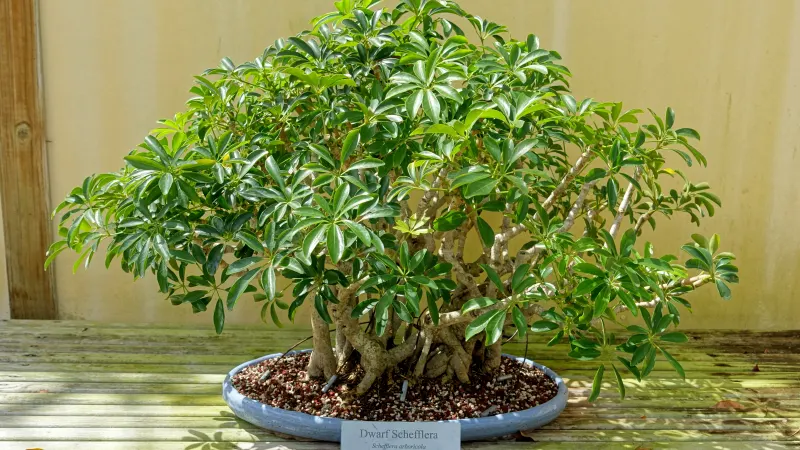
The schefflera, or umbrella plant, is named for the way its glossy leaflets radiate out from a central point like the spokes of an umbrella. The one most people grow indoors is the dwarf umbrella tree, Schefflera arboricola — compact, fast-growing, and genuinely easy to keep alive. Its larger cousin, Schefflera actinophylla, the true umbrella tree, has bigger leaves and can become a substantial indoor tree; the care is essentially the same. Either way, this is a plant that grows quickly and, left to its own devices in the wrong spot, grows badly — which is the whole story of schefflera care.
Because the two complaints you'll hear about this plant, over and over, are "it's dropping leaves" and "it's gone all leggy and sparse." Neither is really about watering, which is what people tend to reach for first. Both trace back to light and pruning. A schefflera in good light, pruned now and then, is a lush, dense, forgiving houseplant. A schefflera in a dim corner, never cut back, stretches into a gangly thing shedding leaves from the bottom. Get the light right and learn to use scissors, and the rest is easy. If you're still building your instincts for reading a plant, how to read plant health signs pairs well with this guide.
Light
Light is the master control for a schefflera, so it's worth getting right. The plant wants bright, indirect light — a spot near a window where it's well-lit for much of the day but not baking in harsh sun. A little gentle direct sun, especially morning light, is fine and even welcome; what it can't take is hours of hot afternoon sun through glass, which can scorch the leaves.
The more common problem, by far, is too little light. Schefflera tolerates moderate light, so it survives in dimmer rooms — but survival and thriving are very different here. Starved of light, the plant does what stretched plants do: it puts out long, weak, bare stems with leaves spaced far apart, reaching toward the nearest window, and it starts shedding older leaves. The result is the "leggy" schefflera everyone complains about. If your plant is sparse, thin-stemmed, or dropping leaves from the bottom, resist the urge to water more and move it somewhere brighter first. Rotating the pot every week or two also helps it grow evenly rather than leaning hard toward the light.
How to water a schefflera
Schefflera watering is straightforward once you know it dislikes both extremes. Check the top few centimetres of soil with a finger; when they feel dry, water thoroughly, letting water run all the way through and out of the drainage holes, then tip away whatever collects in the saucer or cover pot. Through spring and summer, when it's growing fast, it likes to stay evenly moist — watered before it dries out completely, but never left sitting wet. In winter, when growth slows, let it dry out a little more between waterings.
The reason to aim for that middle ground is that a schefflera signals unhappiness at either end by dropping leaves, which makes overwatering and underwatering easy to confuse. Constantly soggy soil suffocates and rots the roots, and the plant responds with yellowing leaves, sometimes with black spots, that fall off. Letting it go bone dry causes wilting and a rain of dropped leaves too. The tell is in the soil and the leaves together: soggy soil with blackening leaves means ease off and improve drainage; dry soil with limp, wilting foliage means you've been too stingy. This kind of "same symptom, opposite cause" ambiguity is exactly what a per-plant Digital Shadow helps resolve, by tracking how much moisture is left in this pot rather than leaving you to guess from the leaves alone. The general principles in the beginner's care guide apply cleanly here — schefflera is a textbook "moist but well-drained" plant.
Pruning: the secret to a full plant
If there's one skill that separates a great-looking schefflera from a disappointing one, it's pruning — and it's easier than people fear. This plant responds to being cut back by branching, so every stem you shorten tends to sprout two or more new shoots below the cut. That's the whole mechanism behind turning a tall, bare, leggy plant into a dense, bushy one.
To keep a plant full, pinch or snip the growing tips of stems that are getting long, cutting just above a leaf node. For a schefflera that's already gone leggy, be braver: you can cut it back hard, even by a third or more, and it will push out vigorous new growth from lower down, filling in the bare stems over the following weeks. Spring and summer are the best times, when the plant is growing strongly and will recover fastest. The cuttings you remove can often be rooted to make new plants — the propagation guide covers the technique. Regular, unafraid pruning is what keeps a schefflera looking like a lush shrub instead of a collection of poles.
Humidity, temperature, and pests
Schefflera is comfortable in average household humidity, but it appreciates a little more, and there's a practical reason to care: dry indoor air makes it a magnet for spider mites. These tiny pests are the most common problem the plant faces, showing up as fine webbing in the leaf joints and a stippled, dusty, faded look to the foliage, worst on the undersides. Wiping the leaves from time to time keeps them clean and gives you an early warning; raising humidity a touch and rinsing the plant off occasionally makes it far less hospitable to mites. Watch for scale insects too, which appear as small brown bumps along the stems and leave a sticky residue.
On temperature, keep it in the comfortable range of roughly 15–24°C and, above all, steady. Sudden chills are one of the classic triggers for a schefflera to shed leaves dramatically — a cold draught from an open door in winter, a spot right against a freezing window, or the blast from a heating or air-conditioning vent can all set off a leaf drop. A stable, draught-free position does a lot to keep the plant calm and holding onto its foliage.
Common problems
Dropping leaves. The signature schefflera complaint, and it has several possible causes: a sudden change in conditions, a cold draught, over- or underwatering, or too little light. Work through them — is it in a stable, draught-free, bright spot, and is the soil moist but not soggy? Correct the odd one out and the shedding usually stops.
Leggy, sparse, stretched growth. Too little light, often combined with never being pruned. Move it somewhere brighter, rotate it for even growth, and cut the leggy stems back to encourage bushy branching. It will fill back in.
Yellowing leaves, sometimes with black spots. Usually overwatering. The soil is staying too wet and the roots are suffering. Let it dry out more between waterings, make sure the pot drains freely, and empty the saucer.
Fine webbing and dull, speckled leaves. Spider mites, thriving in dry air. Rinse the plant, wipe the leaves, raise humidity, and treat with insecticidal soap or neem if needed, repeating to catch successive generations. The houseplant pest guide covers the full approach.
Sticky leaves or small brown bumps on stems. Scale insects. Scrape or wipe them off, treat with insecticidal soap or neem, and check regularly, as they're persistent.
Frequently asked questions
Why is my schefflera dropping leaves?
Leaf drop is the umbrella plant's way of protesting a range of stresses: a sudden change in its environment, a cold draught, over- or underwatering, or too little light. The most common single cause is a chill — a cold draught or a spot against a freezing window. Check that it's in a stable, bright, draught-free position with soil that's kept moist but never soggy, and the shedding usually settles down as it adjusts.
Why is my schefflera leggy and sparse, and how do I fix it?
Legginess means too little light, usually with no pruning to counteract it — the plant stretches toward the window with long bare stems and widely spaced leaves. Fix it in two moves: give it much brighter, indirect light and rotate it for even growth, then prune the leggy stems back to just above a leaf node. Schefflera branches vigorously after cutting, so pruning is what transforms a sparse plant into a full, bushy one.
How do you prune an umbrella plant?
Cut or pinch stems just above a leaf node, and the plant will branch out below the cut. For light shaping, tip-prune the longest stems; for a badly leggy plant, cut back hard — even by a third — in spring or summer, and it will push out vigorous new growth. Regular pruning is the key to keeping a schefflera dense rather than lanky, and the cuttings can often be rooted into new plants.
Is schefflera toxic to cats and dogs?
Yes. Schefflera contains insoluble calcium oxalate crystals, which are toxic to cats and dogs. Chewing the leaves can cause intense mouth and throat irritation, drooling, vomiting, and difficulty swallowing. It's best kept well out of reach of pets that like to nibble houseplants.
Can Botanical Legacy help me keep a schefflera healthy?
Yes, on the two fronts where it matters most. The Digital Shadow models each plant's soil moisture so you can water in that "moist but not soggy" band the plant wants, instead of guessing from leaves that drop for opposite reasons. And logging a periodic photo helps you catch the early signs of spider mites — the umbrella plant's most common pest — while they're still easy to treat. Steady watering and early pest detection are exactly what keep a schefflera full and thriving.
Start your sanctuary
Botanical Legacy's free Observer plan covers up to five Specimens, and a schefflera is a satisfying one to grow with — fast, responsive, and genuinely transformable with a little light and pruning. Every new account also includes a 14-day trial of Cultivator, the paid plan, which adds a local weather feed and soil sensor support for the rest of your collection.
Give it bright light, water it in the middle band, and pick up the scissors when it stretches — and your umbrella plant stays lush instead of leggy.
START YOUR SANCTUARY — FIVE FREE SPECIMENS, NO PAYMENT REQUIRED →
Schefflera doesn't ask for much: enough light to grow well, and a gardener brave enough to cut it back. Give it both and it rewards you with a full, glossy canopy.