Species care guide
Majesty palm
Ravenea rivularis
How to care for a majesty palm indoors: the steady moisture a palm from Madagascar's riverbanks expects, why it needs more light and more humid air than the low-light palms, and what brown tips, yellow fronds and spider mite are telling you.

- Light
- Bright, indirect light; filtered light near a south- or east-facing window; direct sun scorches the fronds
- Water
- Keep the compost evenly moist: water thoroughly when the surface dries, never let it dry out completely, and never leave the pot standing in water
- Humidity
- High humidity; below about 50%, stand the pot on a tray of damp gravel or run a humidifier, especially in winter
- Temperature
- 18–29°C suits it; keep it away from cold draughts and direct heat; most indoor palms show chilling damage below about 7°C
- Pets & toxicity
- Listed by the ASPCA as non-toxic to dogs, cats and horses
- Difficulty
- Moderate to demanding; NC State Extension notes it may be difficult to grow indoors, mainly because it needs bright light, steady moisture and humid air at once
A majesty palm comes from the edges of rivers and streams, and it does best in a pot that remembers the water.
What a majesty palm is
The majesty palm, Ravenea rivularis, is a tropical evergreen palm from Madagascar and a member of the palm family, Arecaceae. Its native range is small, yet it is a houseplant all over the world. The species name explains most of its care: NC State Extension notes that rivularis refers to the palm's preferred habitat, the edges of rivers and streams.
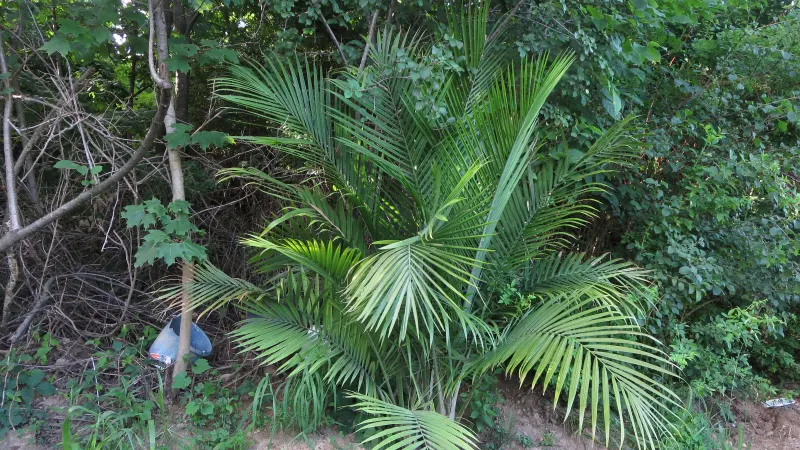
In the wild it is a fast-growing tree that can reach about 30 m. Indoors it is a different plant. It grows much more slowly, usually reaches 1.5–3 m, and most houseplants never form an above-ground trunk at all. What you buy is an upright, full canopy of long, arching, medium to dark green fronds, each up to 1.8–2.4 m long. It is the only species in its genus grown as a houseplant.
What looks like one bushy plant is often several. NC State notes that growers commonly put three or more plants in one pot to make it look full, although each majesty palm is solitary.
In the wild it is in trouble. In 2012 the IUCN moved the majesty palm from Vulnerable to Endangered on its Red List, citing a continued fall in the number of mature palms, the decline of its habitat, and ongoing harvest of its seed despite strict trade regulations.
Why it needs more than the low-light palms
The riverbank shows most in its watering. NC State says the majesty palm needs high humidity, bright indirect light and consistent moisture, and may be difficult to grow indoors. It prefers moist soil and tolerates wet soil.
Compare the palms people usually keep indoors. Penn State Extension describes the kentia palm as tolerant of low light, and Clemson Extension notes that the parlor palm tolerates lower light well and that most lady palms can go somewhat dry between waterings. The majesty palm offers none of that slack.
Homes fall short on all three at once. The RHS describes them as challenging for houseplants, with dry air, limited natural light and often irregular watering, and a majesty palm answers each with brown tips or yellow fronds.
Light: bright and indirect
NC State lists bright, indirect light as a requirement and warns that direct sun can scorch the leaves. For indoor palms in general, Penn State Extension recommends a spot near a south- or east-facing window with filtered sunlight, and Clemson Extension adds that most palms need bright natural light all year.
Filtered is the important word: the RHS notes that strong direct sun, such as through a south-facing window in summer, leaves scorched brown patches. A sheer curtain or a step back from the glass solves it.
Too little light shows up more slowly. The RHS lists weak growth, pale leaves and yellowing lower leaves as signs of it, and NC State lists inadequate light among the causes of yellow leaves on this palm. In winter, the RHS suggests moving houseplants closer to a south- or west-facing window, and wiping dust off the leaves lets more light reach them.
It can spend summer outdoors on a shaded patio, NC State notes. Penn State and Clemson both advise acclimatising it gradually and keeping it out of direct sun.
If you use Botanical Legacy, a place carries the light you described, as a level or the window's direction. When a plant's light needs and its place don't match, the app flags it and names a better place you already have.
How often to water a majesty palm
There is no fixed interval, only a target: compost that stays evenly moist. Clemson Extension's advice for indoor palms is that they should never be allowed to dry out or to stand in water. Water thoroughly when the surface of the compost dries, let the pot drain, and tip away whatever collects in the saucer. Penn State Extension says the same in fewer words: keep palms moist, but not wet.
The RHS suggests pushing a finger a few centimetres into the compost and watering only when it needs it, rather than on a schedule. For a majesty palm, a dry surface is the cue.
The other half matters as much. NC State warns that overwatering causes root rot, and the RHS notes that overwatering is easiest in winter, when growth slows. Where the tap water is hard, the RHS suggests room-temperature rainwater, since hard water can lead to nutrient deficiencies. The wider method is in when to water your houseplants.
This is where a model of the individual plant earns its place. Botanical Legacy keeps a Digital Shadow of each Specimen in your Sanctuary, a running estimate of when that particular pot will be dry. On every plan, including the free one, you can log a quick soil check from the Specimen's page, from bone dry to wet. After three checks between waterings, the model starts correcting its drying rate for that plant from what you found. For a palm that needs its compost kept moist but never waterlogged, that means a reminder fitted to this pot, in this room, in this season.
Humidity and temperature
NC State lists high humidity as one of the majesty palm's needs, and notes that low humidity can bring insect pests. Penn State Extension says palm frond tips turn brown in dry air, especially in winter. Clemson Extension's threshold is 50%: below that, stand the pot on a saucer of gravel to raise the moisture without rotting the roots, or use a humidifier.
The RHS adds the detail: keep the water below the top of the gravel. Grouping plants together raises humidity too, and kitchens and bathrooms are usually more humid than other rooms.
NC State gives 18–29°C as the range it prefers, and says to keep it away from cold draughts and direct heat: Penn State names draughty windows, doors and air-conditioning vents, and the RHS radiators. It is hardy outdoors only in USDA zones 10 and 11, so in a temperate climate it lives indoors. Clemson notes that most indoor palms need more than about 7°C to avoid chilling damage.
Compost, repotting and feeding
NC State notes the majesty palm prefers moist soil with plenty of organic matter. Clemson Extension's guidance for indoor palms is a porous mix rich in organic matter, which holds moisture and still drains, and Penn State stresses a pot with drainage.
Palms do best with their roots confined. Clemson suggests repotting every two to three years, in spring or early summer, when roots fill the pot, and warns that palm roots are fragile. University of Florida research on container palms adds: do not over-pot a slow-growing palm, because the extra compost stays too wet, and use a durable, well-aerated mix, because old compost breaks down and starves the roots of air.
Repotting is also the time to divide a crowded pot. NC State recommends division for this palm: separate the cluster and give each palm its own pot, gently.
Feed lightly. Clemson recommends a slow-release palm fertiliser with micronutrients such as iron, manganese and zinc, two to three times a year in spring and summer, and warns that too much fertiliser harms palms and can brown the tips of the lower leaves.
Yellowing from nutrient deficiencies
NC State lists nutritional deficiency as one cause of yellow leaves on a majesty palm. University of Florida research on container-grown palms in general, not this species, describes the common patterns:
- Nitrogen. The oldest leaves turn a uniform light green first, then the whole canopy pales and growth slows. It is by far the most important limiting nutrient in potted palms.
- Magnesium. Broad yellow bands along the edges of the oldest leaves, the centre staying green. Likeliest in a palm long in the same pot, since the magnesium in fresh potting mix is usually used up after about six months. The RHS adds that overfeeding with potassium can bring it on.
- Potassium. Translucent yellow to orange spotting on the oldest leaves, then dead, frizzled leaflet tips. Relatively uncommon in pots.
- Iron. Shows on the youngest leaves, which come in yellow-green to nearly white. In pots it usually comes from poorly aerated compost or damaged roots, so fixing those, not adding iron, is the cure.
Yellowing on the oldest fronds points to a nutrient; yellowing on the newest points back to the roots. More in why plant leaves turn yellow.
Pruning fronds
A palm cannot be pruned to control its height. Clemson Extension explains that new growth comes from a high central growing point, so pruning a majesty palm only ever means removing old fronds.
University of Florida palm research says to remove only completely dead leaves. A half-yellow frond is often still feeding the palm: potassium moves from old leaves to new ones, and if you cut off a discoloured lower frond, the palm draws potassium from the next frond up, which was green. Repeatedly removing half-dead fronds reduces the number of green ones and, in palms short of potassium, speeds the decline. The RHS gives similar advice for houseplants: cut off completely brown or yellow leaves, keep mostly green ones.
Some loss is normal. Penn State notes that browning of the lower leaves is typically a sign of age; browning throughout the plant points to a problem. Cut dead fronds close to the base, and never tear off one that does not come away easily.
Clean fronds with a damp cloth, not leaf-shine products, which Penn State and Clemson warn damage palm foliage.
Common problems
Brown tips on the fronds. Most often dry air: Penn State links brown frond tips to low humidity, and Clemson adds lack of water. Raise the humidity and keep the compost from drying out. If only the lower leaves' tips brown and you feed often, suspect too much fertiliser.
Yellow fronds. NC State lists five causes: too little light, too little water, overwatering, low humidity and nutritional deficiencies. Check the compost first, then the light, then the pattern of yellowing above.
Spider mite. NC State lists spider mites among the pests to watch for on this palm, and Clemson notes that mites are often a problem indoors because of low humidity and warmth. The RHS describes fine, pale mottling on the upper leaf surface, tiny yellowish-green mites underneath, and fine webbing in heavy attacks; high humidity reduces the risk but will not control them alone. Penn State suggests a damp cloth or a gentle spray of water, and the RHS names the predatory mite Phytoseiulus persimilis as the usual biological control. More in the guide to common houseplant pests.
Reddish-brown dead patches after a cold spell. Chilling damage, which Clemson notes appears a few days after the palm sits below about 7°C.
Wilting and yellowing in wet compost. Suspect root rot, which Clemson says usually comes from slow-draining compost or watering too often. If the roots are brown and soft, water less and repot into fresh compost.
Frequently asked questions
Why is my majesty palm turning brown at the tips?
Usually dry air. Penn State Extension notes that palm frond tips turn brown when humidity is low, especially in winter, and Clemson Extension adds lack of water. Raise the humidity with a gravel tray or humidifier, keep the compost evenly moist, and go easy on fertiliser, which Clemson notes can brown the tips of the lower leaves.
Why are my majesty palm's fronds turning yellow?
NC State lists inadequate light, insufficient water, overwatering, lack of humidity and nutritional deficiencies. Check the compost first: wet points to overwatering, dry to underwatering. Yellowing on the oldest fronds can mean nitrogen, magnesium or potassium; on the newest, look at the roots. Leave a half-yellow frond on until it is completely dead, because it is still feeding the palm.
How much light does a majesty palm need?
Bright, indirect light, more than low-light palms such as the parlor palm. A spot near a south- or east-facing window with the sun filtered suits it. Direct sun scorches the fronds; too little light shows as yellowing and weak growth.
How often should I water a majesty palm?
Whenever the surface of the compost feels dry. Water thoroughly until it drains, then empty the saucer. Indoor palms should never dry out completely or stand in water. Check rather than count days, and expect to water less often in winter, when growth slows.
Is a majesty palm safe for cats and dogs?
The ASPCA lists the majesty palm, Ravenea rivularis, as non-toxic to dogs, cats and horses, and NC State's profile tags it non-toxic for cats and dogs as well. Keeping it out of reach still protects the fronds from chewing.
Can Botanical Legacy help with a palm this particular about water?
That is where it helps most. A majesty palm needs its compost moist but never waterlogged, and the right interval changes with the room and the season. Each Specimen gets its own Digital Shadow, an estimate of when its pot will be dry, and soil checks you log on any plan teach the model that palm's real drying rate. Progress photos build growth curves of height and leaf count, so you can see whether the palm is putting on new fronds faster than it loses old ones.
Start your sanctuary
Botanical Legacy's free Observer plan covers up to five Specimens, each with its own continuously running Digital Shadow and soil checks that teach it each pot's drying rate. A majesty palm, which needs its compost kept steadily moist without tipping into wet, is exactly the kind of plant a per-pot model is for. Every new account also includes a 14-day trial of Cultivator, the paid plan, which adds the local weather feed and soil sensor support.
START YOUR SANCTUARY - FIVE FREE SPECIMENS, NO PAYMENT REQUIRED →
Give a majesty palm bright light, damp compost and humid air at the same time, and it grows like the riverbank palm it is.
Sources
12 references
The plant-care facts on this page were checked against these references.
- NC State Extension: plants.ces.ncsu.edu/plants/ravenea-rivularis
- RHS: rhs.org.uk/plants/43792/ravenea-rivularis/details
- IUCN: iucn.org/content/madagascars-palms-near-extinction
- Penn State Extension: extension.psu.edu/palms-as-houseplants
- Clemson HGIC: hgic.clemson.edu/factsheet/indoor-palms
- RHS: rhs.org.uk/plants/types/houseplants/how-to-help-a-poorly-housep…
- RHS: rhs.org.uk/prevention-protection/leaf-damage-on-houseplants
- UF/IFAS Extension: edis.ifas.ufl.edu/publication/EP262
- UF/IFAS Extension: edis.ifas.ufl.edu/publication/EP269
- UF/IFAS Extension: edis.ifas.ufl.edu/publication/EP443
- RHS: rhs.org.uk/biodiversity/glasshouse-red-spider-mite
- ASPCA: aspca.org/pet-care/aspca-poison-control/toxic-and-non-toxic-pla…